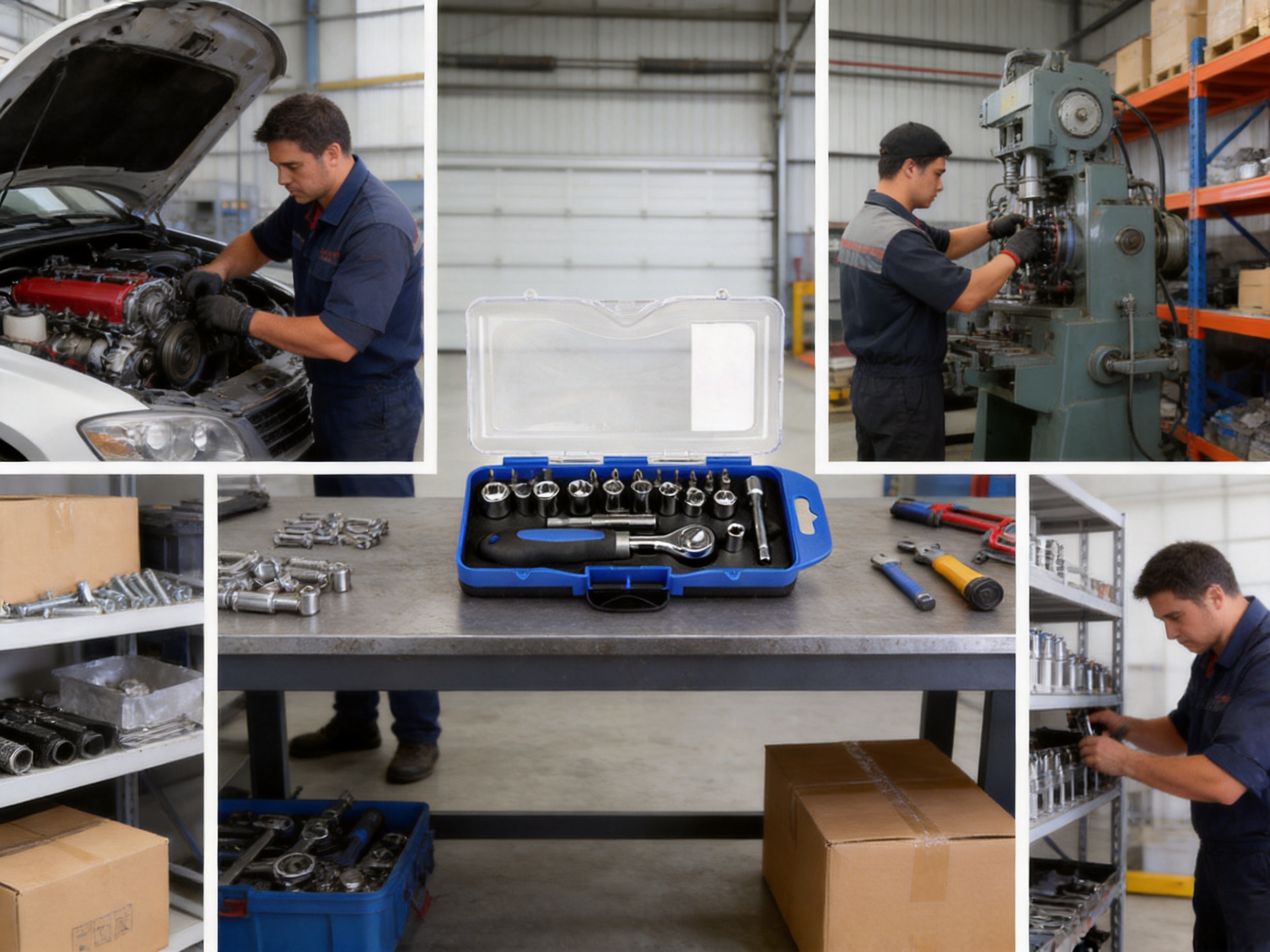
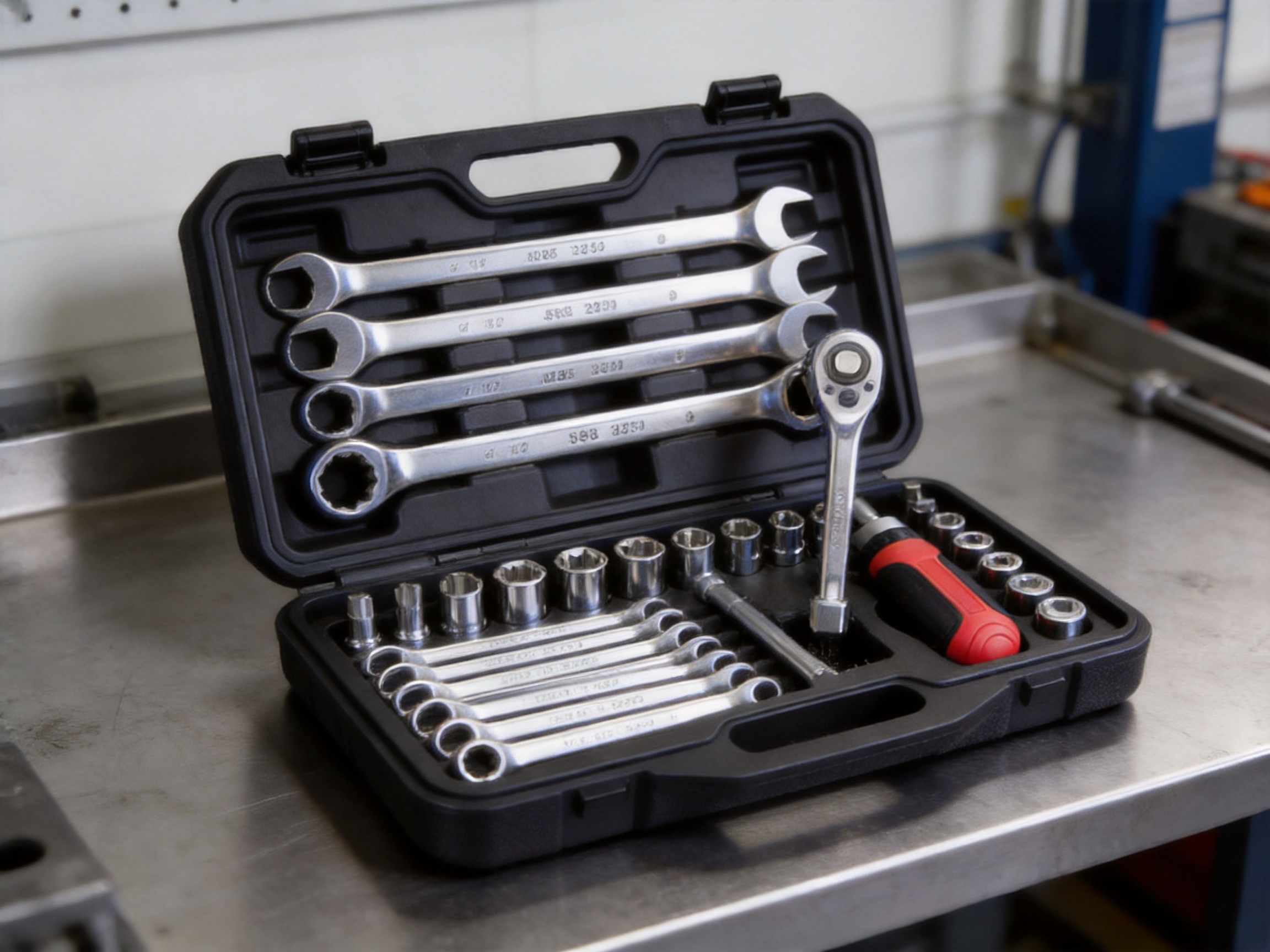
A well-organized wrench set is one of the most useful investments for workshops, maintenance teams, installers, mechanics, and serious home users. The 38-piece ratchet wrench set described in this article is designed to provide a broad working range in a single coordinated package. Instead of purchasing individual tools one at a time, users can obtain a complementary selection of ratchet wrenches arranged for everyday fastening, repair, assembly, and maintenance work.
The value of a wrench set is determined by more than the number of pieces inside the case. Users also consider access, ratcheting efficiency, material quality, surface durability, organization, portability, compatibility with common fasteners, and long-term reliability. A well-made set should reduce tool changes, help users work in restricted areas, and remain dependable through repeated use. It should also be manufactured consistently so that each tool has a predictable fit and feel.
This 38-piece combination ratchet wrench set is positioned as a practical AT Tool product for customers seeking a complete and adaptable fastening solution. It is suitable for distribution through hardware channels, professional tool suppliers, maintenance businesses, automotive service outlets, industrial purchasing departments, and online product catalogs. Its broad piece count allows the set to address many common fastening requirements while maintaining the convenience of a unified package.

A combination of 38 ratchet wrenches
Understanding the 38-Piece Ratchet Wrench Concept
A ratchet wrench combines the function of a wrench with a reversible ratcheting mechanism. The user places the working end over a compatible fastener and turns the handle. When the handle is returned in the opposite direction, the mechanism allows the handle to reset without requiring the user to remove the wrench from the fastener. This feature is particularly helpful when space is limited and the handle cannot complete a full rotation.
The term “combination” generally indicates that the set includes coordinated tools intended to cover different fastening situations. Depending on the final configuration, a 38-piece assortment may include multiple sizes, different drive or working-end arrangements, and tools intended for both standard and more restricted access. Buyers should confirm the exact size range, measurement system, head style, mechanism specification, and packaging configuration before placing a production order.
The main advantage of a 38-piece format is coverage. A small set may be easy to carry but can leave important sizes unavailable. A very large set may offer more options than a user needs while adding cost, weight, and storage requirements. Thirty-eight pieces represent a useful middle ground for many applications because the set can cover routine maintenance without becoming unnecessarily difficult to organize.
For workshops, the set can serve as a general-purpose station kit. For mobile technicians, it can function as a portable maintenance package. For distributors, the product has a clear retail proposition: a large assortment, convenient storage, and a single purchase that answers many everyday fastening needs.
Why Ratcheting Action Matters
Traditional fixed wrenches require the user to lift and reposition the tool after each partial turn. This process can be slow when a fastener is located beside a wall, inside an engine compartment, beneath furniture, behind a machine frame, or between structural components. A ratcheting mechanism allows the user to maintain contact with the fastener while resetting the handle.
Ratcheting action can improve productivity in three important ways. First, it reduces the number of hand movements required for repetitive tightening or loosening. Second, it helps users work in areas where the available swing angle is small. Third, it reduces the need to repeatedly reposition the tool, which may improve convenience and lower frustration during extended work.
These benefits depend on the mechanism being properly manufactured. Excessive play, rough movement, incomplete engagement, or poor alignment can undermine the purpose of a ratchet wrench. A reliable tool therefore requires close control of component dimensions, tooth geometry, assembly, lubrication, and final inspection.
Key Product Advantages Over Basic Wrench Assortments
The 38-piece ratchet wrench set offers several potential advantages over a basic collection of fixed or non-ratcheting wrenches. These advantages are especially relevant to customers comparing complete sets from different suppliers.
Broad Size Coverage
A broad assortment reduces the likelihood that a technician will stop work because the required size is missing. When a set includes a practical range of commonly used sizes, it becomes useful for general mechanical maintenance, equipment installation, furniture assembly, plumbing-related service, workshop repair, and household projects.
Size coverage also benefits businesses that need to equip multiple workstations. Purchasing a coordinated set can simplify procurement, reduce the number of separate product codes, and make inventory management easier. For distributors, a complete set is often easier to market than a series of unrelated individual tools because the product has a clear use case and a recognizable value proposition.
Improved Access in Restricted Areas
A ratcheting wrench can be more convenient than a conventional wrench when the fastener is located in a narrow or obstructed position. The user may only have a limited angle of movement, yet the ratchet can continue advancing the fastener through short strokes.
This characteristic is useful in automotive work, machine maintenance, equipment repair, structural assembly, and installation tasks. Even when a power tool cannot be used because of space limitations, torque-control requirements, or the risk of damaging a component, a hand-operated ratcheting wrench may provide an appropriate alternative.
Reduced Tool Changes
When one organized set covers many sizes, users spend less time searching for separate tools. A properly arranged case or package allows the operator to identify the required tool quickly, return it after use, and confirm whether the complete set is still present.
For professional users, reducing tool changes can improve workflow. For home users, it can make projects less complicated. For retailers, the complete package can provide a stronger product presentation than loose tools placed in a bin.
Consistent Appearance and Handling
A coordinated set provides a consistent appearance across all pieces. Uniform handle profiles, surface finishes, markings, and packaging can improve the perceived quality of the product. Consistency also helps users develop a familiar grip and operating method across the set.
Although appearance does not replace performance, it affects customer confidence and brand recognition. A professionally presented set communicates that the products were designed, manufactured, inspected, and packaged as one system rather than collected from unrelated sources.
Better Storage and Portability
The package format supports storage in a workshop drawer, service vehicle, tool cabinet, warehouse, or home utility area. When each piece has a designated position, users can identify missing tools more easily. A compact package can also help protect the metal surfaces from unnecessary contact, impact, moisture, and contamination during transportation and storage.
Packaging design should be matched to the sales channel. Retail customers may prefer a compact, visually clear package. Professional buyers may prioritize durable packaging suitable for repeated transport. Importers and wholesalers may require carton optimization, pallet stability, barcode labeling, inner-box protection, and documentation for efficient distribution.
Manufacturing Quality Behind a Reliable Ratchet Wrench Set
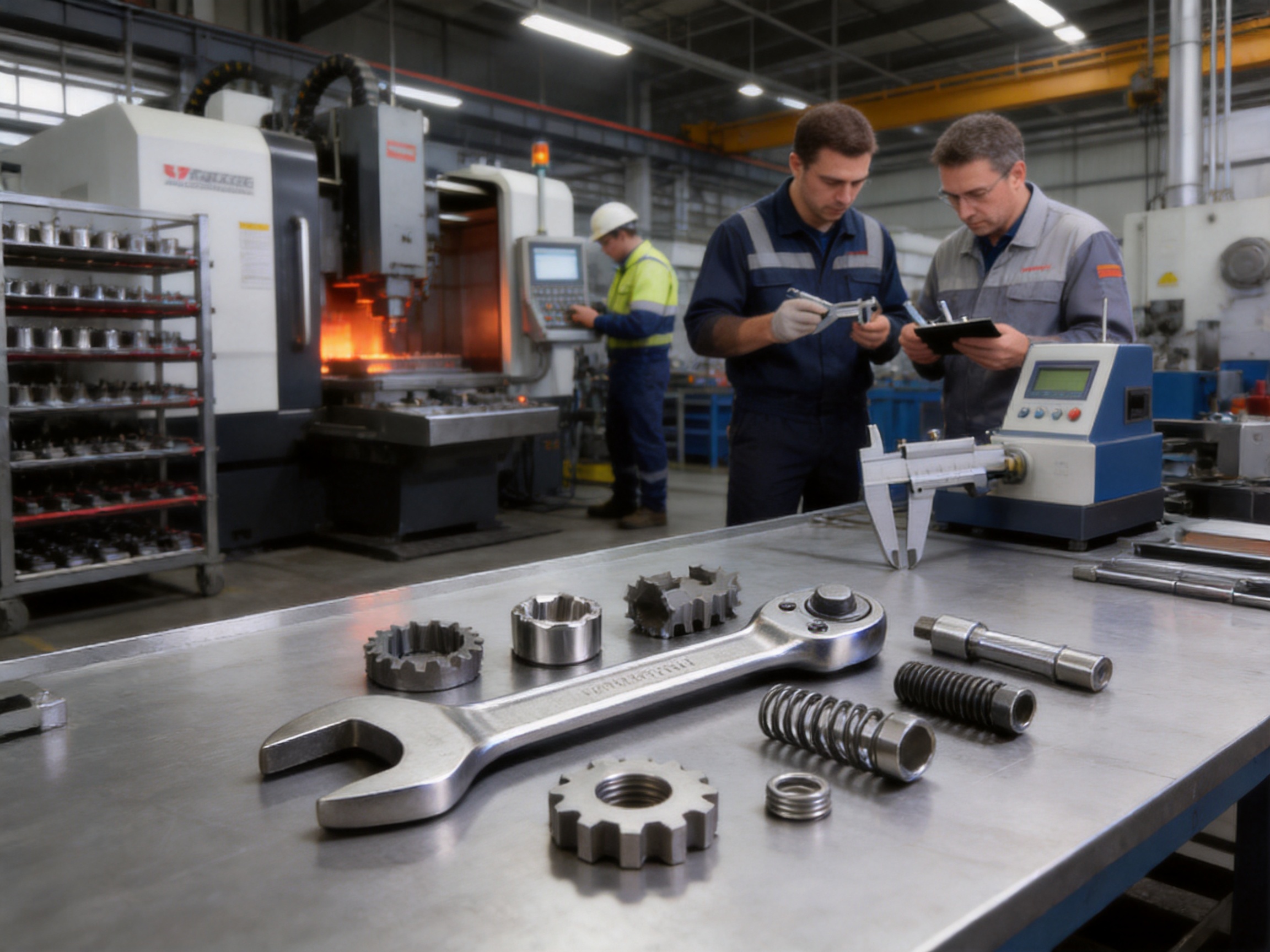
The performance of a ratchet wrench set begins with manufacturing discipline. A tool may appear simple from the outside, but the production process includes material preparation, forming, machining, heat treatment, surface finishing, assembly, inspection, and packaging. Every stage affects the final user experience.
Lizhan Hardware Co., Ltd. is presented as a China-based hardware manufacturer with a factory address in Haiyan, Jiaxing City, Zhejiang, and a warehouse location in Chonburi, Thailand. This combination of manufacturing and regional warehousing can support international supply, production coordination, and distribution planning. The company profile also identifies product categories that include home tools, fasteners, packages, stamping parts, metal hooks, screws, and related hardware products.
The company’s broader hardware background is relevant to the development and supply of tool sets. Experience with metal products, stamping components, fasteners, packaging, and industrial hardware can contribute to practical knowledge of material handling, dimensional control, surface treatment, and bulk order management. The exact production route for each ratchet wrench model should be confirmed with the supplier, but the broader manufacturing scope indicates an established hardware-oriented operating structure.
Material Selection
Ratchet wrenches must balance strength, toughness, wear resistance, corrosion resistance, and manufacturing cost. The selected steel must withstand repeated torque application without excessive deformation under intended use. It must also support the forming, machining, heat treatment, and finishing processes required for accurate tool production.
Material selection should consider the wrench body, ratchet head, internal gear or pawl components, pins, springs, and any additional moving parts. Different components may require different mechanical properties. A body needs structural strength, while a small internal spring needs resilience and reliable recovery. The mating surfaces inside the mechanism need suitable hardness and geometry to resist premature wear.
For export customers, material documentation may be requested as part of a quality program. Depending on the market and purchasing agreement, this may include material certificates, batch identification, hardness records, dimensional inspection records, and sample approval documents. Clear documentation supports traceability and helps buyers compare suppliers objectively.
Forging, Forming, and Stamping Capabilities
Metalworking processes shape the basic wrench body and create the foundation for later machining. Forging or controlled forming can improve the structural continuity of the metal, while stamping may be used for selected components, clips, plates, labels, or packaging-related parts. The choice depends on the design, production volume, required tolerances, and target cost.
A strong manufacturing process should control forming temperature, die condition, material flow, dimensional variation, and surface defects. Inconsistent forming can lead to uneven profiles, weak areas, excessive machining allowance, or alignment problems. Proper process control improves repeatability across large production batches.
The company’s listed experience with stamping parts and hardware products is a useful strength when a project requires related metal components or customized packaging inserts. Customers seeking a complete product program may benefit from working with a supplier that can coordinate tools, hardware accessories, labels, and package components through one manufacturing relationship.
Precision Machining
After the basic body is formed, machining may be required to create accurate openings, working surfaces, drive interfaces, ratchet seats, engagement areas, and marking locations. Precision machining helps ensure that the wrench fits the intended fastener correctly and that the ratchet mechanism operates smoothly.
Important machining considerations include concentricity, parallelism, opening dimensions, surface finish, and alignment between the working end and handle. Even a small dimensional error can affect fit, torque transfer, or user confidence. For ratcheting components, the relationship between gear teeth, pawl geometry, pivot points, and housing surfaces is especially important.
Advanced manufacturing does not necessarily mean that every production step must use the newest equipment. It means that the supplier applies suitable equipment, process controls, inspection methods, and production planning to achieve stable results. A balanced combination of automated and skilled manual operations may be appropriate depending on the design and order quantity.
Heat Treatment and Hardness Control
Heat treatment is one of the most important stages in metal tool production. It can improve the strength, hardness, wear resistance, and toughness of the wrench. The treatment must be carefully controlled because excessive hardness may make a component brittle, while insufficient hardness may lead to deformation or rapid wear.
For a ratchet wrench, different areas may require different performance characteristics. The working surfaces and internal engagement components need resistance to wear, while the handle and body must retain enough toughness to tolerate normal service conditions. The appropriate balance depends on the steel grade, geometry, intended torque range, and product specification.
Quality control may include hardness testing, visual inspection, dimensional checks, and functional testing after heat treatment. Batch records help identify process changes and support corrective action if a problem is discovered. Buyers should discuss the supplier’s available inspection procedures when establishing a long-term supply agreement.
Surface Treatment and Corrosion Protection
Surface finish affects appearance, handling, cleanability, and resistance to environmental exposure. Common tool finishes may include polished, satin, matte, plated, or coated surfaces. The best choice depends on market expectations, target price, corrosion requirements, and the intended use environment.
A good surface treatment should be uniform and properly bonded. It should not create sharp edges, flaking, uneven discoloration, or excessive surface roughness. The finish should also preserve the visibility of size markings so that users can identify tools quickly.
Storage and transportation conditions matter as well. Even a well-finished tool can be affected by moisture, salt air, condensation, or unsuitable packaging. Protective packaging materials, dry storage practices, and appropriate carton design help preserve product condition until the set reaches the customer.
Ratchet Mechanism Assembly
The ratchet mechanism requires careful assembly because several small parts must work together. The internal gear, pawl, selector, spring, pin, cover, and housing must be correctly positioned. Lubrication should be suitable for the operating environment and applied in a controlled quantity.
Assembly quality influences the direction change, operating smoothness, engagement reliability, noise level, and service life of the tool. A mechanism that feels loose or inconsistent can reduce confidence even if the exterior finish looks attractive. For this reason, functional checks should be included in production inspection.
Each assembled head should be checked for basic operation in both directions where applicable. Inspectors may evaluate engagement, release, selector function, head alignment, excessive play, and unusual resistance. The test method should reflect the tool’s design and intended specification.
Quality Control from Incoming Material to Final Packing
A complete quality system begins before production and continues until shipment. Incoming material inspection confirms that steel, springs, pins, packaging materials, and other components meet approved specifications. In-process inspection verifies that forming, machining, heat treatment, finishing, and assembly remain within defined limits.
Final inspection should evaluate both individual tool quality and complete-set accuracy. A set can contain excellent individual tools but still disappoint customers if pieces are missing, incorrectly labeled, poorly arranged, or packed in the wrong configuration. Set-level inspection is therefore as important as tool-level inspection.
| Control Stage | Typical Inspection Focus | Customer Benefit |
|---|---|---|
| Incoming materials | Material identity, dimensions, visible defects, component quantity | Reduces the risk of unsuitable materials entering production |
| Forming and machining | Profile, openings, alignment, edge condition, dimensional consistency | Improves fit, torque transfer, and product uniformity |
| Heat treatment | Hardness, distortion, batch records, visual condition | Supports strength, wear resistance, and repeatable performance |
| Surface finishing | Coverage, adhesion, appearance, corrosion protection, markings | Improves durability and presentation |
| Mechanism assembly | Engagement, selector operation, smoothness, excessive play | Supports reliable ratcheting action |
| Complete-set inspection | Piece count, size sequence, package contents, labels | Prevents incomplete or incorrectly configured shipments |
| Pre-shipment review | Carton condition, quantity, documentation, loading protection | Helps preserve product condition through logistics |
For buyers, the most useful quality conversations are specific. Instead of asking only whether a product is “high quality,” purchasers can ask about approved samples, tolerances, hardness ranges, function-testing methods, packaging checks, inspection frequency, and corrective-action procedures. Clear requirements make it easier for the supplier and buyer to work toward the same result.
Sample Approval and Production Consistency
Before mass production, a buyer may approve a sample covering the tool profile, size range, markings, finish, ratchet action, package design, and documentation. The approved sample should become a reference point for production inspection. If any design or material change is proposed, the supplier should communicate it before implementation.
Consistency is especially important for repeat orders. Customers may sell the same product for several years, and changes in handle shape, finish, markings, or package arrangement can create complaints even when the tool remains functional. A disciplined change-control process protects both the supplier and the customer.
Design Features That Improve User Experience
The practical value of a ratchet wrench depends on how it feels and behaves during real work. A comfortable handle profile can reduce hand fatigue during repetitive tasks. Clear size markings help users select the correct tool quickly. A well-shaped head can improve access around nearby components.
Ergonomic Handle Geometry
The handle should provide a secure grip without creating sharp pressure points. Its length should offer reasonable leverage for the intended application while remaining manageable in restricted spaces. Edges should be smooth and free of burrs. If the product is intended for professional use, buyers may evaluate the handle after extended operation rather than relying only on visual inspection.
Ergonomics also includes the location and readability of markings. Users should be able to identify the size without turning the tool repeatedly or removing dirt from a recessed label. High-contrast, durable markings support fast selection and help maintain organization after frequent use.
Working-End Fit
The working end must fit the fastener with minimal unwanted play while allowing the user to place and remove the tool efficiently. Poor fit can increase the risk of rounding fastener corners, especially when the fastener is already damaged, corroded, or exposed to high resistance.
Accurate openings depend on tooling, machining, heat treatment, and final inspection. Buyers should consider whether the set is produced for metric, inch-based, or dual-system applications. If the target market includes multiple regions, a carefully selected size assortment can improve product relevance and reduce returns caused by incompatible expectations.
Reversing and Direction Control
A reversing system should be easy to operate with one hand where the design permits. The selector should provide a clear indication of direction and should not change unintentionally during normal use. At the same time, it should not require excessive force to operate.
The mechanism should be evaluated under clean and moderately contaminated conditions appropriate to the intended environment. Users may work around oil, dust, metal particles, or moisture, so the design and maintenance instructions should account for normal workshop conditions.
Serviceability and Care
Not every ratchet wrench is designed for field repair, and the service structure depends on the product specification. Nevertheless, products benefit from clear care instructions. Users should avoid using a ratchet wrench as a hammer, striking tool, or substitute for a dedicated breaker bar unless the manufacturer specifically permits that application.
Cleaning, drying, periodic lubrication where appropriate, and correct storage can extend product life. The set should be returned to its package or tool drawer after use. If a mechanism becomes rough, slips, or fails to engage correctly, the tool should be removed from service until it has been inspected or replaced.
Advantages for Distributors, Importers, and Industrial Buyers
The product is not only a tool for end users; it is also a commercial package for businesses that need a clear, manageable item to purchase and resell. A 38-piece set can be positioned in several market segments, including general hardware, automotive accessories, workshop tools, maintenance supplies, home improvement, machinery service, and professional tool distribution.
Clear Product Positioning
A set with a defined piece count is easy to communicate in catalogs, quotations, product listings, and sales conversations. Buyers can quickly understand that the package contains a substantial assortment rather than a single replacement wrench. This clarity supports comparison with competing products while leaving room to highlight finish, packaging, material, mechanism, and service support.
Inventory Efficiency
Instead of maintaining numerous individual stock-keeping units, a distributor can use a complete set as a central product item. This may simplify warehouse organization and reduce the risk of uneven inventory, where some sizes sell quickly while others remain unsold. Individual replacement pieces may still be useful, but the complete set provides a balanced starting product.
Private Label and Packaging Opportunities
Hardware buyers often require customized labels, cartons, inserts, barcodes, instruction sheets, and color schemes. The supplier’s experience with packages and hardware-related products can support discussions about these requirements. Any customization should be confirmed through approved artwork, packaging samples, printing specifications, and carton tests before large-scale production.
Packaging should protect the set without making it unnecessarily bulky. The choice of plastic case, molded insert, paperboard package, fabric pouch, or other format depends on the sales channel and target market. Buyers should balance protection, appearance, shipping volume, environmental considerations, and retail convenience.
International Supply Support
A manufacturing location in Zhejiang and a warehouse presence in Thailand can be valuable for customers serving Asian markets or coordinating regional stock. The appropriate logistics arrangement depends on order size, destination, customs requirements, lead time, and inventory planning.
International buyers should confirm production lead time, minimum order quantity, payment terms, export documents, carton dimensions, gross and net weight, loading capacity, and available shipping options. These details are not secondary to product quality; they determine whether a product can be supplied reliably and profitably.
How the Set Compares with Competing Options
Competition in the hand-tool market is based on a combination of product performance, assortment, price, appearance, reliability, availability, and support. A lower-priced set may appear attractive initially, but it can become costly if the tools have inconsistent sizing, poor ratchet action, weak finishes, missing pieces, or high return rates.
Compared with a basic fixed-wrench set, the ratcheting format can provide faster operation in restricted areas. Compared with a very small ratchet set, the 38-piece configuration can offer broader coverage. Compared with a premium specialist set, it may provide a more accessible balance between assortment and acquisition cost, depending on the final specification and quality level.
The strongest competitive position comes from verified performance rather than exaggerated claims. Buyers should compare samples using the same criteria: fit on representative fasteners, mechanism smoothness, selector reliability, handle comfort, surface quality, marking durability, package completeness, and resistance to normal handling. This process creates a fair basis for supplier evaluation.
| Comparison Factor | Basic Fixed-Wrench Set | Small Ratchet Set | 38-Piece Ratchet Wrench Set |
|---|---|---|---|
| Fastener coverage | Usually limited by the selected sizes | May be concentrated around a narrow range | Designed to provide broader assortment coverage |
| Restricted-space performance | Requires frequent repositioning | Improved, but size options may be limited | Combines ratcheting access with a larger selection |
| Portability | Often simple to carry | Highly portable | Portable when supplied in an organized package |
| Purchasing convenience | May require separate size decisions | Easy to buy but may need supplementary tools | Provides a more complete single-package solution |
| Commercial appeal | Suitable for basic tool sales | Suitable for compact kits | Strong value proposition for general-purpose tool users |
This comparison does not mean that one format is correct for every user. Professional mechanics may require specialized tools for high-torque applications, while occasional users may need only a few sizes. The strength of the 38-piece product is its versatility for customers who want a broad, organized, hand-operated fastening solution.
Applications Across Different Work Environments
Automotive and Equipment Maintenance
Vehicles and machines often contain fasteners positioned in tight spaces. A ratcheting wrench can help technicians work around brackets, housings, frames, and nearby components. The broad set format is useful when the technician does not yet know which size will be required for a repair.
Users should select the tool according to the fastener condition and required torque. Severely seized fasteners may require penetrating lubricant, a breaker bar, or another specialized method. A ratchet wrench should not be forced beyond its intended capacity.
Industrial and Facility Maintenance
Maintenance teams frequently handle mixed equipment from different manufacturers. A comprehensive set helps support routine adjustment, guard removal, fixture maintenance, conveyor service, and general repairs. A dedicated kit assigned to a machine area can also reduce time spent searching for tools.
In industrial environments, tool control is important. The package should be easy to count before and after a job, and users should follow workplace requirements for tool inspection, protective equipment, and lockout procedures.
Furniture and General Assembly
Furniture frames, shelving systems, workbenches, and other assemblies often use multiple fastener sizes. A ratcheting wrench can make repeated tightening more efficient than a fixed wrench, particularly when the user must install many similar fasteners.
For these applications, compactness, comfortable handling, and clear size identification may be more important than maximum torque. A complete set allows the user to respond when the assembly includes different sizes or when a replacement fastener does not match the original specification.
Home Repair and DIY Projects
Home users commonly need tools for bicycles, outdoor equipment, appliances, fixtures, shelving, garden machinery, and small repairs. A 38-piece kit can serve as a central household tool package, reducing the need for repeated purchases.
Clear instructions are valuable for less experienced users. The product literature should explain correct placement, direction control, cleaning, storage, and the limitations of ratcheting tools. Good information helps prevent misuse and supports customer satisfaction.
Purchasing and Specification Checklist
Before ordering the product, commercial buyers should establish a written specification. The following points can help ensure that the delivered set matches the intended market.
Product Configuration
Confirm the exact number of pieces, size range, measurement system, head configuration, ratchet direction, handle design, and whether any accessories are included. The phrase “38-piece set” should be supported by a detailed packing list.
Material and Finish
Request information about the steel grade or approved material standard, heat-treatment expectations, surface finish, corrosion protection, and marking method. If the product will be sold in a humid or coastal market, discuss storage and packaging requirements as well.
Testing and Inspection
Agree on the inspection procedure, sample size, acceptable defect criteria, functional checks, and documentation. Buyers may request pre-shipment photographs, inspection reports, or third-party inspection according to the commercial agreement.
Packaging and Logistics
Confirm the inner package, master carton, carton dimensions, gross weight, net weight, pallet arrangement, barcode requirements, country-of-origin marking, and loading plan. Good logistics preparation reduces damage, delays, and warehouse confusion.
Order and Communication Support
Clarify minimum order quantity, sample policy, production lead time, repeat-order procedure, payment terms, warranty handling, and contact responsibilities. The supplied company information identifies Shawn as a contact and provides sales-office communication channels. Buyers should use the current official contact details to confirm all commercial and technical information before ordering.
Responsible Product Communication
Accurate product communication is important for both the supplier and the customer. Marketing materials should describe the actual contents and verified performance of the set. Claims about torque capacity, certifications, material grades, corrosion resistance, or lifetime durability should be used only when supported by documented specifications or test results.
Product descriptions should explain that the ratchet wrench is intended for normal fastening and maintenance applications, not for every high-load or impact operation. Users should be directed to select a suitable tool for unusually tight, damaged, or safety-critical fasteners. Honest communication builds trust and reduces misuse-related complaints.
For international sales, descriptions may need to be adapted to local terminology. Some markets distinguish between combination wrenches, ratcheting combination wrenches, reversible ratchet wrenches, and socket-based ratchet tools. The exact terminology should match the physical design of the product and the expectations of the target customer.
Care, Storage, and Expected Use
Proper care can help preserve the tool set. After use, users should wipe away oil, dirt, moisture, and metal particles. Tools should be stored in a dry location and returned to the designated package positions. If the set is used in a harsh environment, more frequent cleaning may be appropriate.
The ratchet mechanism should not be exposed unnecessarily to water, corrosive chemicals, or abrasive contamination. Where the design permits lubrication, a suitable light lubricant may be applied according to the supplier’s instructions. Excessive lubricant can attract dust, so the amount should be controlled.
Users should inspect the tools periodically for cracks, distorted openings, damaged teeth, loose components, worn selectors, or unreadable markings. A tool that no longer fits the fastener correctly should not be used simply because it remains visually intact. Removing questionable tools from service is a basic safety practice.
The set should be used with compatible hand force. Ratchet wrenches are not automatically equivalent to heavy-duty breaker bars. Applying an extension pipe or impact force may damage the mechanism or create a safety hazard unless the manufacturer specifically approves the practice.
Q&A: 38-Piece Ratchet Wrench Set
What is included in the 38-piece ratchet wrench set?
The product is presented as a 38-piece combination ratchet wrench set. The exact sizes, measurement system, head designs, and accessories should be confirmed through the supplier’s current packing list and approved sample. Buyers should not rely on the piece count alone when comparing product configurations.
Who can use this type of wrench set?
The set can be suitable for professional maintenance teams, automotive service users, equipment installers, workshops, hardware distributors, and home repair users. The appropriate application depends on the final tool specification and the torque requirements of the work.
What is the main advantage of a ratcheting wrench?
The main advantage is that the user can reset the handle without completely removing the tool from the fastener. This can improve efficiency in areas where the available swing angle is limited.
Is a ratchet wrench suitable for every fastener?
No. The wrench must match the fastener size and profile. Severely seized, damaged, or high-torque fasteners may require a specialized tool. Users should follow the product instructions and avoid exceeding the intended operating capacity.
Why is a complete set useful for distributors?
A complete set offers clear product positioning, broad user coverage, organized packaging, and a single item that can be stored and sold efficiently. It may also reduce the need to manage numerous individual size products.
What manufacturing factors affect ratchet wrench quality?
Important factors include material selection, forming accuracy, machining, heat treatment, surface finishing, mechanism assembly, lubrication, functional inspection, marking, and package control. Weakness at any one stage can affect the user’s experience.
Can the set be customized?
Customization may be possible for packaging, markings, labels, color schemes, documentation, and selected product details, subject to order quantity and technical feasibility. Buyers should request a written quotation and approve samples before mass production.
What should buyers check before placing an order?
They should confirm the piece list, size range, steel and finish requirements, inspection procedure, packaging, carton details, lead time, minimum order quantity, shipping terms, and after-sales process. A signed specification helps avoid misunderstandings.
How should the set be maintained?
Users should keep the tools clean and dry, inspect them for damage, store them in the supplied package, and lubricate the mechanism only as recommended. Ratchet wrenches should not be used as hammers or exposed to force beyond their intended application.
What makes this product competitive?
Its competitive potential comes from the combination of a broad 38-piece assortment, ratcheting convenience, organized packaging, and supply support from a hardware-focused manufacturer. Final competitiveness should be evaluated through samples, specifications, quality records, price, lead time, and service performance.
Conclusion
The 38-piece ratchet wrench set is designed around a practical idea: provide users with a broad, organized, and efficient fastening solution in one package. Its ratcheting action can improve access and reduce repositioning in restricted areas, while the substantial assortment can support a wide variety of maintenance, assembly, automotive, industrial, and household tasks.
The product’s real value depends on manufacturing consistency. Material selection, forming, machining, heat treatment, surface finishing, ratchet assembly, inspection, and packaging must work together. A supplier with experience in hardware, stamping-related products, fasteners, packages, and international distribution can offer useful support when these requirements are clearly specified and verified.
For distributors and industrial buyers, the product combines a clear commercial format with broad end-user appeal. For professional users, it can reduce tool changes and improve convenience during routine work. For home users, it can provide a central tool assortment for repairs and assembly. Before purchase, customers should confirm the exact configuration and evaluate samples against objective criteria.
When supported by accurate specifications, controlled production, careful inspection, and responsive supply coordination, a 38-piece ratchet wrench set can become a dependable addition to a hardware catalog and a useful everyday tool package for a wide range of users.
References
1. General principles of hand-tool design, mechanical fastening, and workshop safety.
2. Industrial guidance on steel material selection, heat treatment, hardness control, and wear resistance for hand tools.
3. Manufacturing quality-control practices for forged, machined, stamped, finished, and assembled metal products.
4. General packaging and logistics principles for hardware products and international distribution.
5. Product information supplied for the 38-piece combination ratchet wrench set and associated hardware manufacturing operations.