Introduction
Modern construction, renewable energy, industrial equipment, and maintenance projects increasingly depend on fastening components that are strong, reliable, adaptable, and easy to install. Although a tube hoop may appear to be a simple component, its design and material have a direct influence on the stability, service life, safety, and maintenance requirements of an assembled system. A poorly selected clamp can cause tube movement, surface damage, vibration, corrosion, or premature loosening. A correctly engineered hoop, by contrast, can provide dependable support while reducing installation time and total project cost.
The aluminum tube hoop described in this article is a lightweight fastening solution intended for tube connection, support, retention, and positioning applications. It is particularly suitable for photovoltaic accessories, piping systems, HVAC equipment, automotive assemblies, marine equipment, structural supports, and general industrial or DIY projects. Its principal value comes from the combination of lightweight aluminum construction, corrosion resistance, broad application compatibility, and a practical form that can be installed efficiently.
The product is also associated with zinc-aluminum-magnesium material options and stamped fastening components. This makes it relevant to buyers looking for durable metal parts manufactured through efficient forming processes rather than relying only on heavy, traditional steel components. The correct material selection, surface condition, dimensional accuracy, and production control can make a substantial difference in the performance of a tube support.
Lizhan Hardware Co., Ltd. is a China-based hardware manufacturer serving customers through a factory in Zhejiang and a warehouse location in Thailand. The company supplies fastening and stamped hardware for industrial, construction, furniture, photovoltaic, and related applications. Its manufacturing strengths include metal forming, fastener production, product customization, quality-oriented production control, and support for bulk orders. This article explains how the aluminum tube hoop works, why aluminum and zinc-aluminum-magnesium material systems are valuable, how the component compares with common alternatives, and what buyers should evaluate before placing an order.
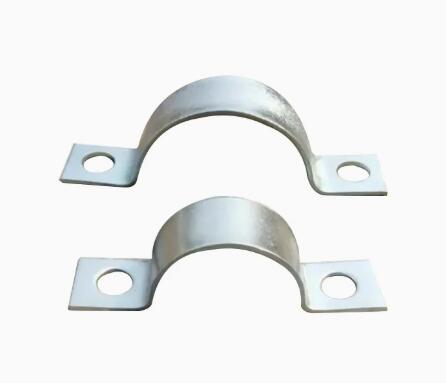
Aluminum tube hoop Photovoltaic Accessories Zinc Aluminum Magnesium Material Fastener Hold Hoop
What Is an Aluminum Tube Hoop?
An aluminum tube hoop is a metal fastening component formed to surround, hold, guide, or support a tube, pipe, conduit, cable assembly, or similar cylindrical part. Depending on the application, it may be used as a single-piece support, a two-part clamp, or part of a larger mounting assembly. The hoop normally includes a curved body that follows the outside diameter of the tube and one or more fastening areas with holes, slots, or connection points.
The curved profile helps distribute holding pressure around the tube instead of concentrating force at a single point. This is important because concentrated pressure can deform thin-wall tubing or damage protective coatings. When properly sized, the hoop holds the tube securely while maintaining a controlled contact area. It can also reduce unwanted movement caused by vibration, wind, thermal expansion, or routine operation.
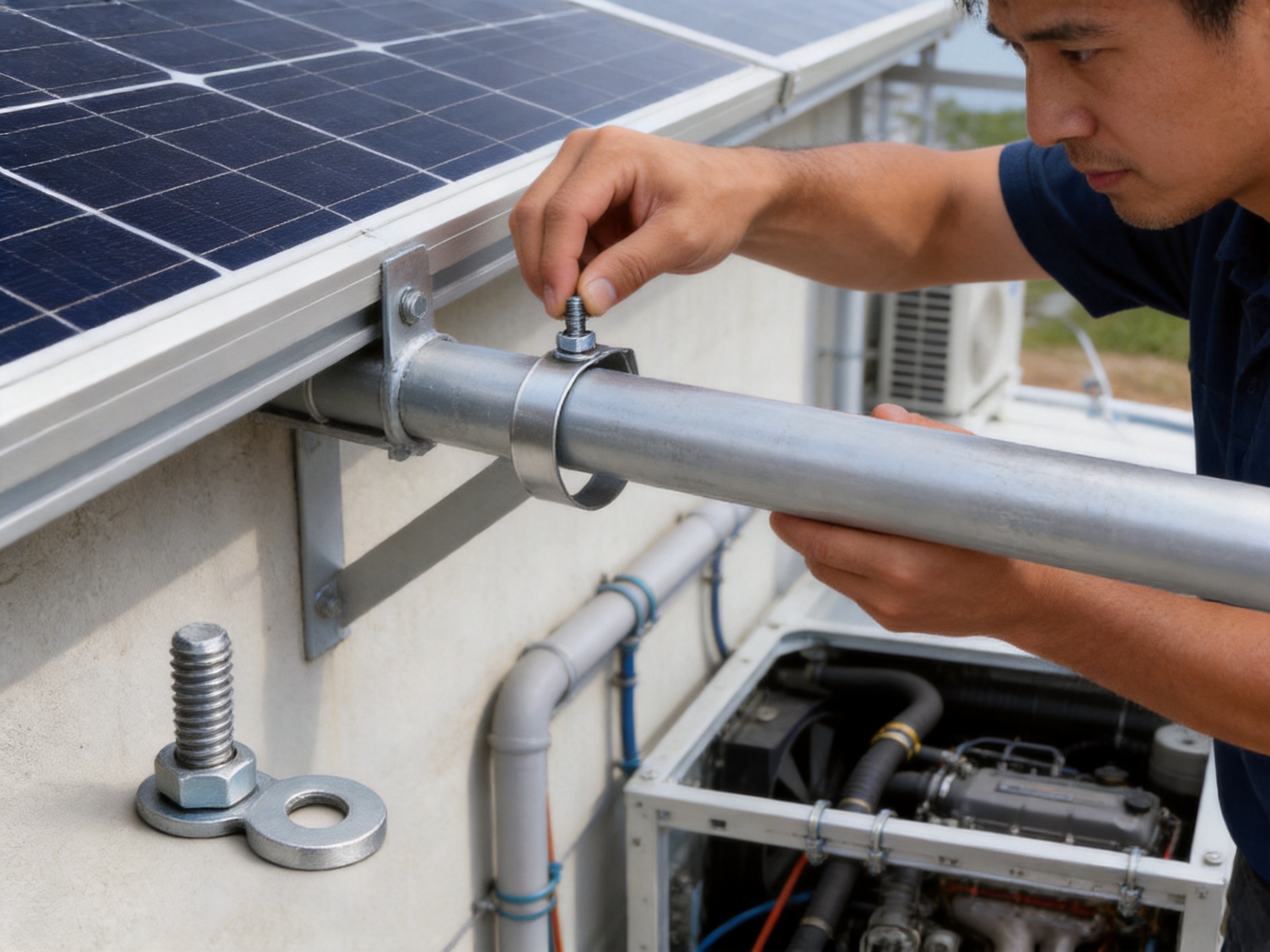
In photovoltaic systems, a tube hoop may be used with support rails, frame structures, conduits, cable protection tubes, equipment supports, or auxiliary mounting arrangements. In HVAC installations, it can support refrigerant lines, drainage tubes, ducts, and other cylindrical components. In automotive or machinery applications, it can retain pipes, hoses, conduits, or lightweight structural tubes.
The term “hoop” does not define one single shape or one universal specification. The exact design depends on tube diameter, loading conditions, mounting surface, fastener type, environmental exposure, installation direction, and the required clearance. A professional supplier can provide standard dimensions or develop a customized stamped part based on drawings, samples, or application requirements.
Basic Product Functions
The first function of the hoop is retention. It prevents the tube from shifting, falling, or separating from its intended position. This is especially important in assemblies exposed to vibration or movement.
The second function is support. A properly positioned hoop transfers the weight of the tube and any connected components to a frame, wall, bracket, rail, or structural member.
The third function is alignment. In systems containing multiple parallel tubes, hoops can maintain spacing and create a cleaner, more organized installation.
The fourth function is protection. By stabilizing the tube and distributing contact pressure, the hoop can help reduce rubbing, bending, and accidental impact.
The fifth function is installation efficiency. A preformed hoop with prepared fastening holes can be installed more quickly than a manually fabricated support. Faster installation is valuable in photovoltaic projects, production lines, commercial buildings, and large-scale maintenance work.
Material Advantages of Aluminum
Aluminum is widely used for fastening and support components because it offers a favorable balance between low weight, corrosion resistance, formability, and practical strength. Compared with many steel parts, an aluminum tube hoop can be easier to transport, handle, position, and install. This is especially useful when technicians work on roofs, elevated platforms, solar structures, or confined equipment areas.
Weight reduction does not mean that the component is unsuitable for demanding applications. The performance of a hoop depends on several factors, including alloy selection, thickness, shape, bend radius, fastening method, and load distribution. A well-designed stamped profile can achieve useful rigidity without requiring the same mass as a conventional steel component.
Lightweight Handling
One of the clearest advantages of aluminum is its low density. A lighter component reduces the effort required during assembly and can lower the cumulative weight of a complete support system. In photovoltaic projects, every component placed on a roof or elevated structure contributes to the overall load. Using lightweight accessories can help designers manage the weight of secondary supports and installation hardware.
For installers, low weight improves handling efficiency. Workers can carry more components to the installation area, position parts with one hand when appropriate, and reduce fatigue during repetitive work. In factory assembly, lighter parts can also simplify material movement and reduce ergonomic strain.
Corrosion Resistance
Aluminum naturally forms a thin oxide layer when exposed to air. This layer helps protect the underlying metal from ordinary atmospheric corrosion. As a result, aluminum is a strong candidate for indoor and outdoor fastening applications, including equipment exposed to humidity, rain, temperature changes, and general environmental conditions.
Corrosion performance still depends on the complete system. Contact with dissimilar metals, saltwater, chemicals, trapped moisture, and damaged surfaces must be considered. In coastal or marine environments, suitable alloy selection, surface treatment, isolation washers, and proper drainage may be necessary. Even with these considerations, aluminum often offers a practical corrosion-resistant alternative to untreated carbon steel.
Formability and Design Flexibility
Aluminum can be shaped through stamping, bending, punching, and related metal-forming methods. This makes it possible to produce curved hoops, mounting tabs, holes, slots, ribs, and other useful features in an efficient production cycle. Formability also supports product customization when customers require a specific diameter, hole position, flange shape, or mounting orientation.
A stamped design can be optimized for strength by adding carefully positioned bends, flanges, or reinforcing features. The result may be more functional than a flat strip simply bent around a tube. Design flexibility allows the manufacturer to balance material thickness, holding force, installation clearance, and production cost.
Zinc-Aluminum-Magnesium Material Options
In addition to conventional aluminum solutions, zinc-aluminum-magnesium material systems are relevant to protective fastening applications. Zinc-aluminum-magnesium coated steels and related material combinations are used in situations where improved corrosion protection is required while retaining the strength and production advantages of steel. The precise performance depends on the substrate, coating composition, thickness, processing method, and environmental conditions.
For photovoltaic accessories and outdoor structural hardware, zinc-aluminum-magnesium materials can be attractive because they are designed to provide a durable protective surface. The magnesium and aluminum content in the coating can contribute to corrosion protection and, in some systems, help protect cut edges or damaged areas through the behavior of corrosion products. Product selection should always be based on the applicable material standard and the real operating environment.
Aluminum and zinc-aluminum-magnesium materials are not automatically interchangeable. Aluminum is usually preferred when low weight, natural corrosion resistance, and lightweight handling are central priorities. Zinc-aluminum-magnesium coated steel may be preferred when higher stiffness, greater mechanical strength, or a particular structural specification is required. A knowledgeable manufacturer can help the buyer compare the options according to load, exposure, tube material, fastening method, and cost target.
Managing Dissimilar Metal Contact
Photovoltaic and industrial assemblies often combine aluminum, galvanized steel, stainless steel, copper, and coated materials. When dissimilar metals contact one another in the presence of moisture, galvanic corrosion may occur. This does not mean mixed-metal assemblies are impossible, but they should be designed carefully.
Possible control measures include insulating washers, protective coatings, compatible fasteners, drainage paths, sealants where appropriate, and avoidance of moisture traps. The tube hoop should also be evaluated together with the screws, nuts, mounting rail, and tube it will contact. A component that performs well by itself may require additional protection when installed in a highly conductive or marine environment.
Product Advantages Compared with Common Alternatives
Compared with Basic Plastic Clamps
Plastic clamps are inexpensive and useful for light-duty indoor installations. However, they may become brittle under ultraviolet exposure, lose strength at elevated temperatures, or deform under sustained loading. An aluminum tube hoop provides a more robust solution when the assembly must tolerate outdoor exposure, mechanical vibration, or higher holding requirements.
Metal hoops also offer more predictable behavior during fastening. Plastic can be crushed if a screw is overtightened, while a properly designed metal component can maintain its shape and clamping function. The choice should still reflect the application; plastic remains suitable for some low-load electrical and household uses, but aluminum is generally more appropriate when long-term mechanical stability is important.
Compared with Heavy Carbon Steel Clamps
Carbon steel clamps can provide high strength, but untreated steel is vulnerable to rust. Painted or coated steel improves corrosion resistance, yet coating damage during stamping, handling, or installation may create exposed areas. Steel components can also add considerable weight to a large installation.
An aluminum hoop reduces handling weight and offers inherent corrosion resistance. It can be particularly advantageous for rooftop photovoltaic systems, portable equipment, marine accessories, and installations where technicians must work quickly. In applications that require very high loads or exceptional stiffness, steel may still be selected, but the designer should compare the complete installed system rather than choosing solely by material name.
Compared with Improvised Metal Straps
Improvised straps may appear economical, but they often produce inconsistent results. A manually cut and bent strap may have sharp edges, uneven curvature, inaccurate holes, and unpredictable holding pressure. It may also require additional drilling, filing, or adjustment at the job site.
A manufactured tube hoop offers repeatable geometry and a more consistent installation process. Pre-punched holes, controlled bend angles, and finished edges reduce the amount of field modification. This improves productivity and makes replacement parts easier to identify and order.
Compared with Generic Universal Clamps
Generic clamps may fit several tube sizes, but broad compatibility can sometimes mean reduced contact area or excessive adjustment. A hoop designed around a defined tube range can provide more stable support and better load distribution. For large-volume projects, the supplier can often adapt the part to the actual tube diameter and mounting arrangement.
Applications in Photovoltaic Systems
Solar energy installations are exposed to demanding conditions. Photovoltaic structures may experience sunlight, rain, wind, dust, temperature cycling, and vibration. Accessories must therefore be selected for outdoor durability and reliable installation. An aluminum tube hoop can support various secondary components without adding unnecessary weight to the main structure.
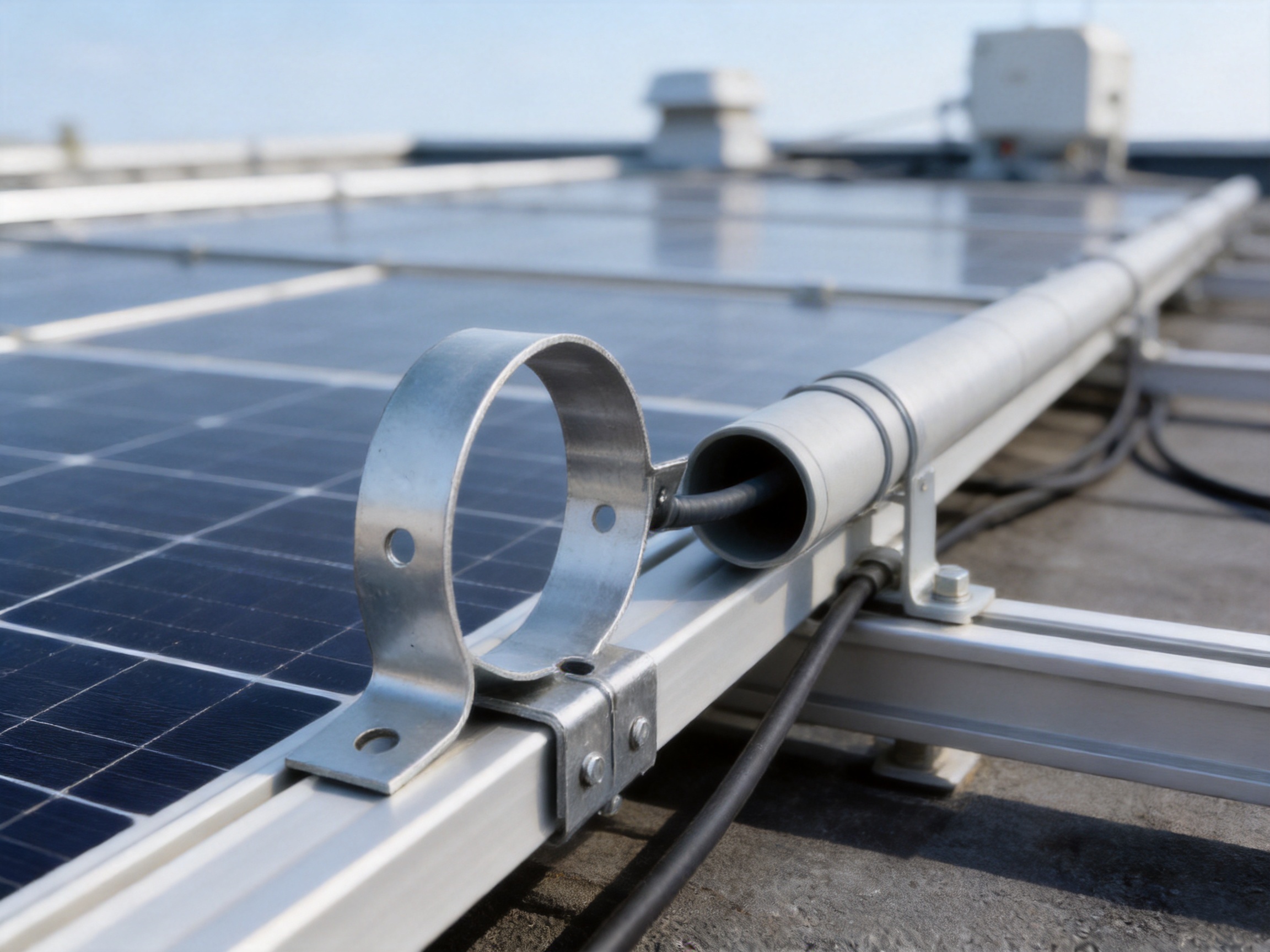
Potential photovoltaic uses include securing conduit, supporting cable protection tubes, holding tubular frame members, organizing auxiliary lines, and retaining components near inverter or equipment locations. The product can also be integrated into custom support assemblies designed for rooftop, ground-mounted, agricultural, commercial, or industrial solar systems.
In a solar installation, the hoop should not interfere with panel drainage, module movement, grounding paths, or thermal expansion. It should be installed at suitable intervals and tightened according to the project specification. The mounting surface must be strong enough to receive the fastener, and the fastening method should be compatible with the rail or structural member.
Because photovoltaic systems are expected to operate for many years, buyers should evaluate more than initial purchase price. Material durability, dimensional consistency, corrosion resistance, packaging quality, replacement availability, and supplier responsiveness can influence the long-term value of the component.
Roof-Mounted Solar Projects
Roof-mounted systems benefit from lightweight accessories because installation teams must move components across elevated surfaces. A lighter hoop can simplify positioning and reduce the accumulated accessory weight. The component should be installed without compromising roof waterproofing, and any penetration or attachment method must follow the roofing system requirements.
Ground-Mounted Solar Projects
Ground-mounted systems often involve long rows of modules, extensive cable routing, and repeated structural connections. Consistent hoops can help standardize installation across a large site. Their corrosion resistance is valuable in locations exposed to rain, irrigation, soil moisture, and agricultural chemicals, although site-specific evaluation remains necessary.
Coastal and Humid Environments
Coastal projects demand careful attention to salt exposure and galvanic compatibility. Aluminum can be suitable, but the full assembly should be reviewed. Protective isolation between metals, appropriate fasteners, and regular inspection may be recommended. Where zinc-aluminum-magnesium coated material is selected, the coating specification should be confirmed before production.
Applications Beyond Photovoltaics
HVAC and Refrigeration
HVAC installations use many tubes and conduits that require organized support. An aluminum hoop can help retain refrigerant lines, drainage pipes, electrical conduits, or auxiliary tubes. The curved shape can reduce point loading, while the prepared holes support fast installation on walls, frames, or equipment brackets.
HVAC applications also require attention to vibration and thermal movement. Pipes may expand and contract as temperatures change, and compressors can generate vibration during operation. The hoop should hold the line securely without restricting necessary movement or damaging insulation. A spacer, liner, or protective interface may be used where the tube surface requires additional protection.
Automotive and Machinery Equipment
Vehicles, production machines, agricultural equipment, and mobile systems contain numerous hoses, pipes, wires, and conduits. Aluminum tube hoops can reduce unnecessary weight and provide a clean method of routing these components. Their corrosion resistance is useful in areas exposed to moisture, road conditions, or industrial environments.
Automotive and machinery applications may require special attention to fatigue, vibration, temperature, and clearance. The hoop design should not create contact with moving parts, hot surfaces, sharp edges, or rotating assemblies. When the component is exposed to continuous vibration, the fastening system should include an appropriate locking method.
Marine Equipment
Marine environments are among the most demanding for metal hardware because saltwater accelerates corrosion and moisture can remain trapped in joints. Aluminum is frequently considered for marine support components because of its low weight and corrosion resistance. However, marine-grade material selection and galvanic isolation are especially important.
The supplier and buyer should review the alloy, surface condition, fastener compatibility, exposure level, and expected service life. A hoop used on a small recreational vessel may have different requirements from one used on commercial marine equipment. Proper drainage and routine inspection should be included in the maintenance plan.
Structural Supports and General Hardware
Tube hoops can be used in storage systems, equipment frames, agricultural structures, display fixtures, workshop projects, and general maintenance. Their flexibility makes them useful wherever a cylindrical component must be held against a stable surface or attached to a frame.
For DIY users, the product can simplify projects that would otherwise require cutting and forming sheet metal. For professional fabricators, a repeatable stamped hoop can improve assembly consistency and reduce labor. The correct size and load rating should always be confirmed before use in a safety-critical structure.
Manufacturing Process and Production Strengths
The quality of a stamped fastening component begins before the stamping press is switched on. It begins with application analysis, material selection, drawing review, tooling design, and process planning. Lizhan Hardware Co., Ltd. can support customers seeking standard or customized hardware by reviewing product dimensions, material requirements, hole locations, surface expectations, packaging needs, and order quantities.
Engineering and Drawing Review
A professional review examines the tube diameter, required clearance, bend radius, fastening hole size, edge distance, mounting orientation, and expected load. This step can identify potential problems such as insufficient material around a hole, an overly sharp bend, interference with the tube, or an unsuitable fastening position.
When a customer provides a sample or drawing, the manufacturer can assess whether the existing design is suitable for stamping. If adjustments are needed, changes may be suggested to improve material utilization, reduce forming stress, simplify tooling, or improve installation. Early engineering communication helps reduce later modification costs.
Material Preparation
Material preparation includes confirming the metal type, thickness, width, surface condition, and supply consistency. Aluminum sheet or strip should be suitable for the intended forming operation. Zinc-aluminum-magnesium coated material must be handled in a way that protects the coating and preserves the specified surface quality.
Material traceability and incoming inspection support production consistency. Important checks may include thickness measurement, visual inspection, coil or sheet identification, and verification against purchasing specifications. The exact inspection plan depends on the customer’s quality requirements and the product’s intended use.
Tooling and Die Design
Stamping dies determine how the raw material is blanked, pierced, bent, formed, and separated. Proper die design is essential for accurate dimensions and stable production. The tooling must account for material thickness, springback, bend direction, hole position, production volume, and the required surface finish.
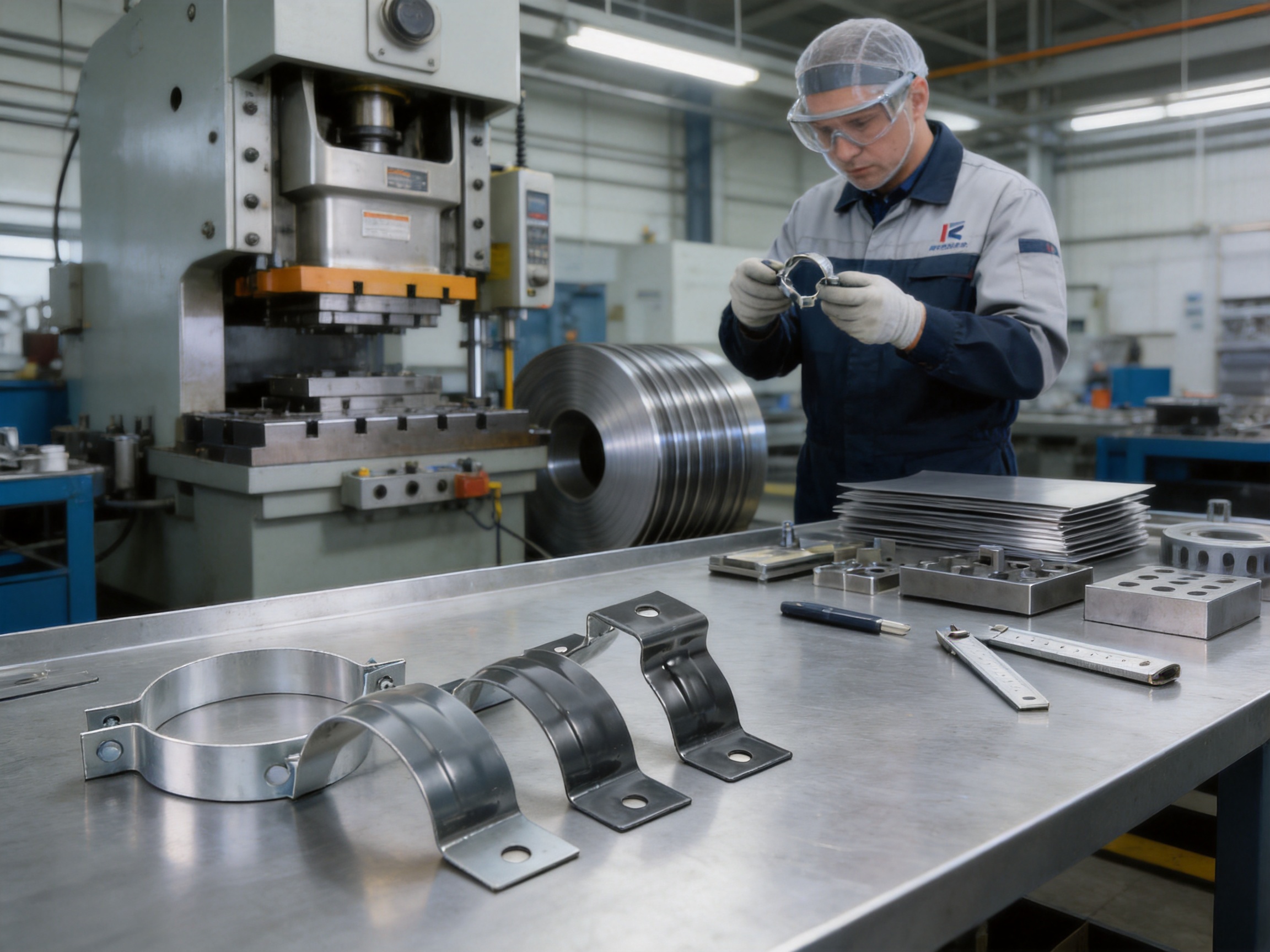
For a tube hoop, the forming stages may include blanking the strip, punching mounting holes, creating bends or flanges, and shaping the curved section. Depending on the geometry and order quantity, the process may use progressive dies, compound dies, or separate forming operations.
Good tooling design also protects the product from unnecessary scratches and deformation. Smooth transitions, correct clearances, and controlled forming pressure help maintain the appearance and function of the finished hoop.
Stamping and Forming
Stamping provides repeatable production for metal parts with defined shapes. Once the tooling has been validated, large quantities can be manufactured efficiently. The process can achieve consistent hole locations, repeatable dimensions, and uniform bends, which are difficult to obtain through manual fabrication.
Forming pressure must be balanced carefully. Too much force can mark the surface, distort the part, or shorten tool life. Too little force can result in incomplete forming or dimensional variation. Production personnel monitor the process and make adjustments when necessary.
Deburring and Edge Control
After stamping, edges may require deburring or other finishing operations. Sharp edges can damage tubes, insulation, cables, protective gloves, or installers’ hands. Edge control is therefore both a product-quality issue and a safety consideration.
The required level of finishing depends on the product design and customer expectation. Some parts may need simple removal of stamping burrs, while others may require additional smoothing or surface treatment. Inspection should confirm that the finished edge does not interfere with installation or intended service.
Surface Treatment and Protection
Aluminum may be supplied with its natural surface condition or with an additional treatment depending on the application. Zinc-aluminum-magnesium materials rely on their protective coating system and must be processed in a way that minimizes unnecessary damage. If a customer requires a specific coating, color, or finish, the supplier should confirm the applicable process before production.
Surface protection is not only an aesthetic issue. It influences corrosion resistance, contact compatibility, friction, appearance, and service life. Buyers should state whether the component will be installed indoors, outdoors, near saltwater, in an industrial plant, or in a high-humidity environment.
Inspection and Quality Control
Quality control may include dimensional inspection, hole-position verification, visual examination, material confirmation, coating inspection, bend evaluation, and sample assembly. For customized parts, first-article approval is valuable because it allows the buyer to confirm the fit before full production.
Inspection frequency can be adapted to order volume and customer requirements. Critical dimensions should be identified in advance. These may include inside diameter, overall width, hole diameter, hole spacing, thickness, bend angle, and flatness of mounting surfaces.
| Evaluation Item | Why It Matters | Typical Verification Approach |
|---|---|---|
| Material type | Determines corrosion behavior, formability, and strength | Purchase specification, supplier documentation, and incoming inspection |
| Thickness | Influences rigidity, load capacity, and fit | Caliper or thickness gauge measurement |
| Inside diameter | Controls tube fit and contact pressure | Gauge, template, or dimensional measurement |
| Hole position | Ensures alignment with the supporting structure | Drawing comparison and sample assembly |
| Edge condition | Reduces risk of damage and handling injury | Visual and tactile inspection |
| Surface condition | Supports appearance and corrosion performance | Visual inspection and coating confirmation |
| Packaging | Prevents deformation and surface damage during transport | Carton, bundle, and loading inspection |
Why Manufacturing Experience Matters
A tube hoop is a relatively small product, but small dimensional errors can create significant installation problems when thousands of units are used. A hole that is slightly out of position may require field modification. A bend that is too tight may interfere with the tube. A burr may damage a cable or coating. A variable inside diameter may lead to inconsistent clamping force.
Manufacturing experience helps address these issues through process standardization and practical engineering judgment. Lizhan Hardware Co., Ltd. operates in the hardware and fastener sector and can combine product development, stamping production, fastener knowledge, packaging coordination, and customer communication. This integrated capability is useful for buyers who need more than a catalog item.
The company’s Zhejiang factory location provides a manufacturing base in an established hardware-producing region. Its Thailand warehouse can support regional distribution and logistics planning for customers who need products closer to Southeast Asian markets. The combination of factory production and warehouse support may help improve order coordination, reduce certain delivery complications, and support repeat purchasing.
For international buyers, communication is also part of manufacturing strength. Clear discussions about drawings, samples, materials, packaging, quantities, delivery requirements, and inspection expectations can prevent misunderstandings. A supplier that responds effectively before production is more likely to provide a product that fits the customer’s assembly process.
Customization Possibilities
Not every project can use a standard hoop. Tube diameters, mounting surfaces, fastening methods, and environmental requirements vary widely. A customized stamped part can be developed to meet specific dimensional or functional needs.
Size and Tube Compatibility
The inside diameter and curved profile can be adapted to suit a particular tube size. The objective is to provide adequate clearance for installation while preventing excessive movement after fastening. The correct fit depends on whether the tube is rigid, insulated, coated, flexible, or expected to expand during service.
Hole and Slot Configuration
Mounting holes can be positioned according to the supporting structure. Round holes may be used for fixed alignment, while slots can provide adjustment during installation. Hole diameter, spacing, edge distance, and orientation should be confirmed against the selected screw, bolt, rivet, or threaded insert.
Thickness and Reinforcement
Material thickness can be selected according to the required rigidity and forming capability. Additional bends, flanges, or ribs may improve stiffness without adding excessive material. The final design should balance performance with tooling cost and production efficiency.
Surface and Packaging Requirements
Customers may specify appearance, surface treatment, protective film, bulk packaging, individual bags, labeled cartons, palletization, or export packaging. Packaging is particularly important for lightweight stamped parts because uncontrolled movement during transport can cause scratches, deformation, or mixed specifications.
Installation Recommendations
Before installation, verify the hoop size, material, hole configuration, and quantity. Inspect the component for visible deformation, sharp burrs, coating damage, or transport-related defects. Confirm that the tube and mounting surface are clean and free from debris that could affect alignment.
Position the hoop so that the curved section supports the tube evenly. Avoid forcing a hoop that is clearly too small or leaving excessive clearance when the application requires stable retention. If a liner, spacer, or insulating layer is specified, install it before tightening the fastener.
Use compatible screws, bolts, washers, or nuts. Washers may help distribute pressure and protect the hoop surface. In outdoor or vibrating applications, an appropriate locking method should be considered. Tighten the fastener sufficiently to hold the tube, but avoid excessive force that could distort a thin-wall tube or deform the hoop.
For photovoltaic projects, installation should follow the system designer’s requirements and applicable structural guidance. The hoop should not obstruct drainage, damage module components, interfere with grounding, or create an unintended electrical connection between incompatible metals.
After installation, check that the tube is stable and that the hoop does not rub against nearby parts. In large projects, a sample installation or first-site inspection can confirm that the selected component works as expected before the complete installation proceeds.
Maintenance and Service Considerations
Aluminum tube hoops generally require limited maintenance, but periodic inspection remains useful in outdoor, marine, industrial, and vibration-prone environments. Check for loosening, deformation, surface damage, unusual corrosion, movement of the supported tube, and contact with adjacent components.
In coastal locations, salt deposits should be managed according to the site maintenance plan. If dissimilar metals are present, inspect contact points for signs of galvanic corrosion. Where the hoop supports equipment subject to vibration, confirm that fasteners remain secure.
Replacement should be considered if the component is cracked, severely bent, deeply scratched, or no longer holds the tube correctly. When ordering replacements, match the original material, dimensions, hole pattern, and surface specification. Mixing visually similar but dimensionally different parts can create inconsistent performance.
Purchasing Considerations for Wholesale Buyers
Wholesale customers should provide as much technical information as possible. Useful information includes tube outside diameter, tube material, wall thickness, installation environment, expected load, mounting surface, fastener type, annual usage, packaging preference, and any required standard or inspection document.
Order volume influences the most economical manufacturing method. Standard products may be suitable for smaller quantities or immediate requirements. Customized stamping dies may be more economical for long-term, high-volume orders because they improve production efficiency and repeatability.
Buyers should also evaluate the supplier’s ability to maintain consistency over repeat orders. Important questions include whether the supplier can retain production records, reproduce approved samples, manage tooling, provide replacement parts, and communicate changes before production.
Price is important, but the lowest unit price is not always the lowest total cost. Installation labor, rejected parts, field modification, transport damage, corrosion-related replacement, and delayed delivery can exceed the original price difference. A reliable supplier should help customers consider total project value.
Recommended Pre-Order Information
Provide a drawing or clear sample whenever possible.
Identify the required aluminum, coated steel, or zinc-aluminum-magnesium material.
Specify dimensions and critical tolerances.
State whether the product will be used indoors, outdoors, near saltwater, or in an industrial environment.
Confirm the required fastener and mounting method.
Describe packaging, labeling, and delivery requirements.
Request a sample or first-article approval for customized designs.
Discuss inspection documents and quality expectations before mass production.
Environmental and Efficiency Benefits
The use of lightweight metal fastening components can contribute to more efficient material handling and installation. Aluminum’s low density may reduce the weight of an accessory package, while stamped production can use material efficiently when tooling and nesting are properly planned.
Durable components can also reduce replacement frequency. A hoop that maintains its shape and corrosion resistance for a long service period may lower maintenance consumption compared with a part that rusts, cracks, or deforms quickly. The environmental value of a product should be considered across its entire life cycle, including manufacturing, transport, installation, use, replacement, and recycling.
Aluminum is widely recyclable, although recycling depends on collection systems and the absence of excessive contamination. Zinc-aluminum-magnesium coated steel can also be recycled through appropriate metal recovery channels. Buyers interested in sustainability should request material information and consider how the parts will be managed at the end of their service life.
Safety and Performance Boundaries
An aluminum tube hoop should not be treated as a universal structural anchor without engineering evaluation. The product is a fastening and support component, and its suitability depends on the design of the complete assembly. Load, wind, vibration, temperature, tube movement, fastener strength, and substrate capacity must all be considered.
For safety-critical applications, the buyer should confirm the required load rating, testing method, material standard, and installation procedure. Where the hoop is used in a solar structure, industrial machine, vehicle, or marine system, the responsible engineer or system integrator should approve the final design.
The component should also be kept away from conditions beyond its specification. Extreme heat, aggressive chemicals, continuous immersion, severe abrasion, and unplanned electrical contact may require special materials or protective measures. Clear application information allows the manufacturer to recommend a more appropriate design.
Q&A
What is the main purpose of an aluminum tube hoop?
Its main purpose is to hold, support, guide, or secure a tube or cylindrical component against a frame, wall, rail, bracket, or other mounting surface. It can also help organize tubes and reduce unwanted movement.
Why is aluminum suitable for photovoltaic accessories?
Aluminum is lightweight, naturally corrosion resistant, easy to handle, and suitable for forming into practical stamped shapes. These qualities are useful in rooftop and ground-mounted solar projects where outdoor exposure and installation efficiency are important.
Can the hoop be used outdoors?
Yes, aluminum tube hoops are suitable for many outdoor applications. The exact suitability depends on alloy, surface condition, fastener compatibility, environmental exposure, and installation design. Coastal and chemical environments require additional evaluation.
What is the difference between aluminum and zinc-aluminum-magnesium material?
Aluminum is a lightweight nonferrous metal with natural oxide protection. Zinc-aluminum-magnesium material commonly refers to a steel substrate with a protective zinc-aluminum-magnesium coating or a related coated material system. The best choice depends on required weight, stiffness, corrosion resistance, strength, and project specifications.
Can the product be customized?
Customization may include inside diameter, overall dimensions, material thickness, hole position, slot design, bend shape, surface condition, labeling, and packaging. Customers should provide drawings, samples, or detailed technical requirements for evaluation.
How does stamping improve the product?
Stamping supports repeatable production of holes, bends, curves, and mounting features. It can reduce manual fabrication, improve dimensional consistency, increase production efficiency, and provide a more uniform installation experience.
Can an aluminum hoop hold heavy tubes?
It can support tubes within the capacity of its design, material, thickness, fastening method, and mounting structure. Heavy or safety-critical applications require load analysis and confirmation from the manufacturer or project engineer.
What fasteners should be used?
The fastener should match the hole design, mounting substrate, load, environment, and metal compatibility requirements. Washers and locking methods may be necessary for some installations. The final choice should follow the project specification.
How should galvanic corrosion be prevented?
Use compatible materials or suitable insulating measures where dissimilar metals meet. Isolation washers, protective coatings, proper drainage, compatible fasteners, and regular inspection can help reduce galvanic corrosion risk.
Is the product suitable for HVAC systems?
Yes, it can be used to support or organize HVAC tubes, refrigerant lines, drainage pipes, and conduits when the size and design are appropriate. Thermal expansion, insulation, vibration, and clearance should be considered during installation.
What should wholesale buyers ask the manufacturer?
Buyers should ask about material, dimensions, tolerances, tooling, sample approval, production capacity, inspection, surface treatment, packaging, delivery, and repeat-order consistency. They should also explain the actual operating environment and intended application.
Where can customers obtain product support?
Customers can contact Lizhan Hardware Co., Ltd. through its sales and business communication channels to discuss drawings, samples, pricing, customization, bulk orders, and delivery arrangements. Early technical communication is recommended for nonstandard products.
Conclusion
The aluminum tube hoop is a practical fastening component that combines lightweight construction, corrosion resistance, installation convenience, and flexible application potential. It can support tubes and conduits in photovoltaic systems, HVAC equipment, automotive assemblies, marine products, structural supports, and general industrial projects.
Its advantages over plastic clamps, untreated steel parts, improvised straps, and unsuitable universal clamps include improved outdoor durability, reduced handling weight, more consistent geometry, and the possibility of customization. Aluminum is particularly valuable where low weight and corrosion resistance are priorities, while zinc-aluminum-magnesium material options may provide an alternative when a coated steel solution is preferred for strength or structural reasons.
The final performance of the product depends on more than the raw material. Engineering review, die design, stamping control, edge finishing, dimensional inspection, surface protection, packaging, and installation practice all contribute to reliability. A capable manufacturer can coordinate these stages and help the buyer select a product that matches the actual application.
Lizhan Hardware Co., Ltd. combines factory-based production in Zhejiang with warehouse and sales support for international customers. Its experience in screws, fasteners, stamped parts, and hardware manufacturing provides a useful foundation for standard and customized tube hoop projects. By communicating technical requirements clearly and evaluating total project cost rather than unit price alone, buyers can obtain a fastening solution that supports efficient installation and dependable long-term service.
References
Aluminum Association. Aluminum Standards and Design Guidance for Fabricated Components.
ASM International. Materials Selection and Corrosion Considerations for Aluminum Alloys.
International Organization for Standardization. General Principles for Geometrical Product Specifications and Dimensional Verification.
ASTM International. Standard Practices for Corrosion Testing and Evaluation of Metallic Materials.
International Electrotechnical Commission. General Requirements for Photovoltaic System Installation and Equipment Compatibility.
Metalforming Industry Guidance. Principles of Sheet Metal Stamping, Bending, Piercing, and Die Design.
Engineering Materials Reference. Galvanic Corrosion Prevention in Dissimilar Metal Assemblies.