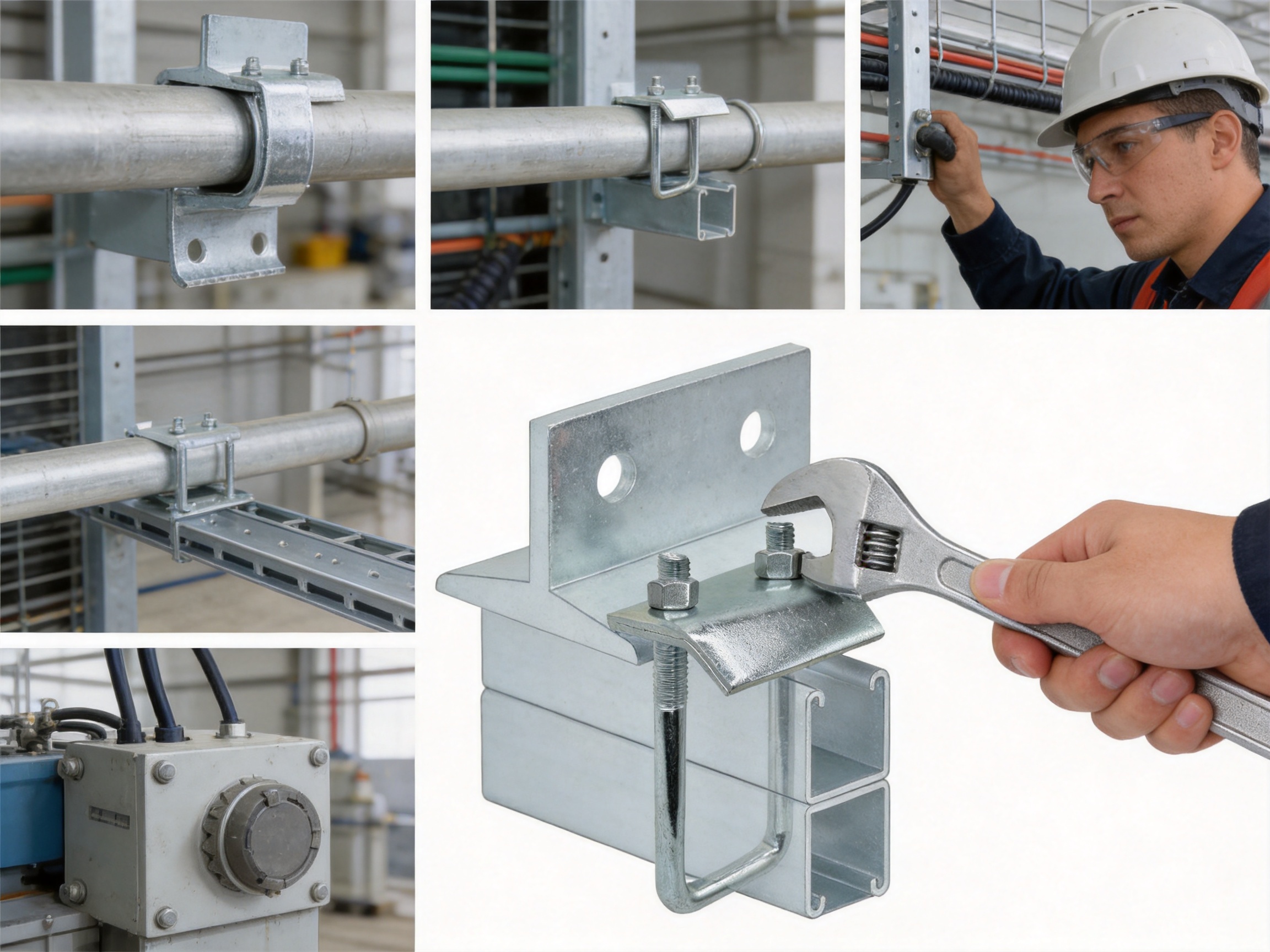
In construction, industrial maintenance, plumbing, HVAC installation, machinery assembly, and infrastructure projects, dependable fastening is essential. A connection may appear simple, but the quality of the fastener often determines whether a supported pipe, cable tray, beam, or tube remains stable throughout its service life. The Beam Clamp with Square U-Bolt and Nuts is designed to provide a practical, durable, and adaptable method for securing structural members and cylindrical or square components.
This product combines a square U-bolt, threaded ends, nuts, and a supporting saddle or clamp plate. Together, these components create a firm mechanical connection around a pipe, beam, cable, tube, or other structural element. The design is straightforward, but its applications are broad. It can be used for pipework stabilization, structural support, cable management, machinery mounting, agricultural equipment, scaffolding, solar mounting systems, and exhaust assemblies.
Unlike fastening methods that require welding, drilling, or complicated brackets, a U-bolt clamp can normally be installed with standard tools. This reduces installation time, simplifies maintenance, and allows the supported component to be removed or adjusted when required. For contractors, distributors, equipment manufacturers, and project engineers, the product offers a balance of mechanical strength, installation efficiency, corrosion resistance, and configuration flexibility.
Product Overview
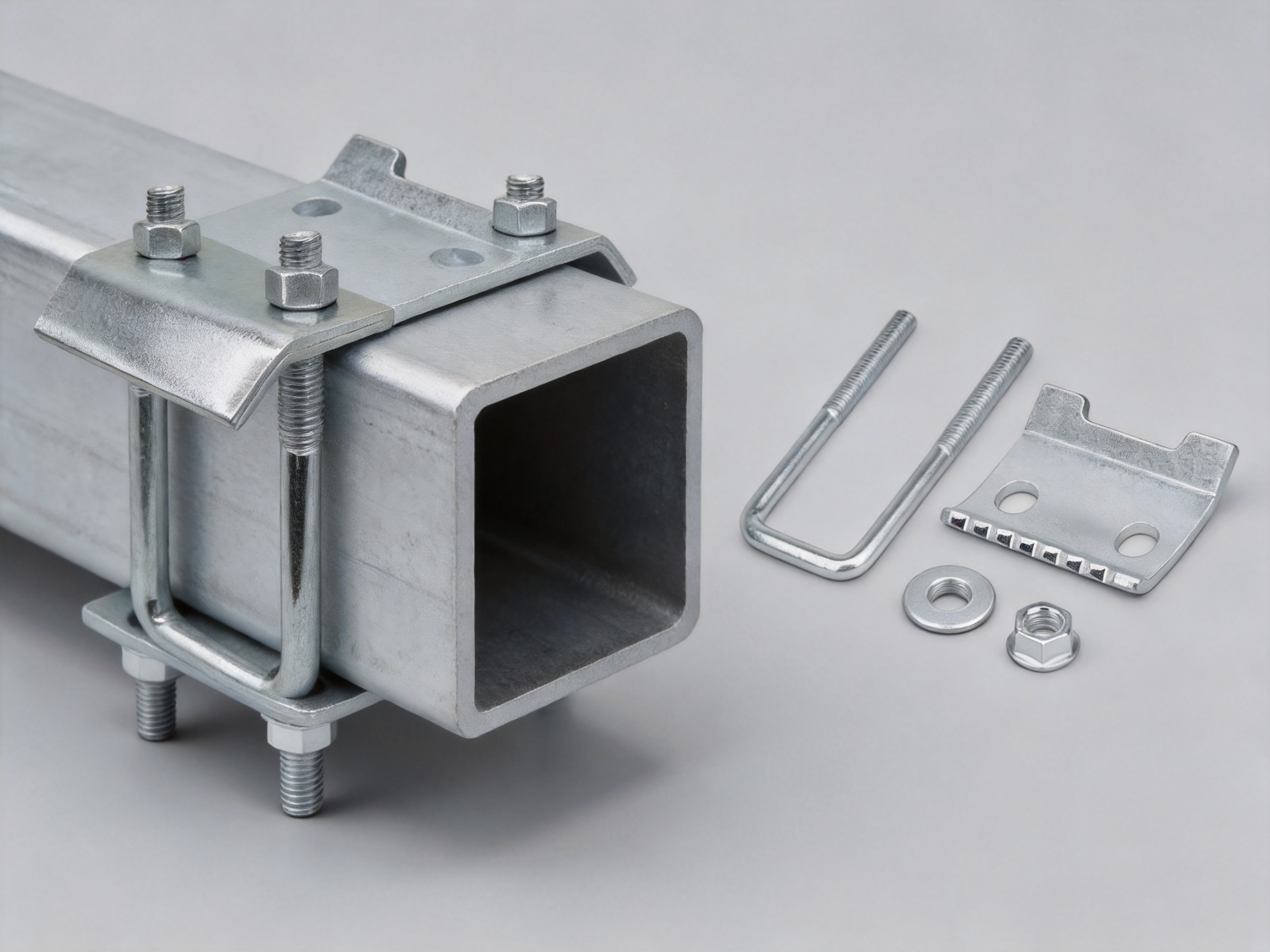
A beam clamp with a square U-bolt is a mechanical fastening assembly that wraps around a supported component and holds it against a saddle plate or mounting surface. The U-shaped bolt has two threaded legs. Once positioned around the component, the threaded ends pass through a plate or bracket and are secured with nuts. Tightening the nuts draws the assembly together and produces a stable clamping force.
The square form of the U-bolt provides a useful alternative to a conventional round U-bolt. Its geometry can offer improved contact with certain structural profiles and can help resist unwanted rotation during installation. It is especially suitable for applications involving square tubing, rectangular sections, structural edges, support channels, and other areas where a more defined bearing shape is preferred.
The product can also be used with round pipes and tubes when the saddle plate and internal dimensions are selected correctly. The clamp should be specified according to the outside diameter, width, height, material, load, operating environment, and required thread size of the supported component.
Standard configurations may include sizes from approximately M6 to M24, while bolt length, width, thread form, plate thickness, nut type, and finish can be adapted for different projects. Exact dimensions should always be confirmed through technical drawings or a product specification sheet before installation.

Beam Clamp with Square U-Bolt and Nuts
Construction and Main Components
Square U-Bolt
The square U-bolt is the primary load-retaining component. It is formed into a U-shaped profile with two parallel threaded legs. The legs extend through a saddle plate or mounting plate, allowing nuts to apply compression to the assembly.
The square bend is valuable when the clamp must follow a more angular or defined profile. It can also improve positioning during assembly by reducing the tendency of the fastener to roll or rotate. This feature is particularly useful where access is limited or where the installer must align the clamp with a beam flange, square tube, support rail, or equipment frame.
U-bolts can be manufactured in different diameters and lengths. A larger diameter may be selected for higher tightening requirements or heavier service conditions, while longer legs may be required when the supported member is thick or when additional plates, washers, or insulation layers are included.
Saddle Plate or Clamp Plate
The saddle plate distributes the tightening force over a wider area. Without an appropriate plate, the nuts could concentrate pressure at small contact points and potentially damage the supported component or create an uneven connection.
A properly designed saddle plate helps maintain alignment and provides a stable surface for the nuts and washers. Plate dimensions, thickness, shape, and hole spacing should correspond to the U-bolt size and intended load. For pipe support, the contact surface may be shaped to follow the pipe. For structural applications, a flatter plate may be more suitable.
Nuts and Washers
Nuts secure the threaded legs of the U-bolt. Standard hex nuts may be used for general applications, while lock nuts, prevailing-torque nuts, or double-nut arrangements may be selected for installations exposed to vibration or repeated movement.
Washers may be installed beneath the nuts to distribute pressure, protect the plate surface, and improve tightening consistency. The washer type should be compatible with the fastener size, finish, and service environment. In applications where loosening is a concern, the correct locking method should be selected based on the load and maintenance requirements rather than relying only on excessive tightening.
Materials and Corrosion Protection
Material selection is one of the most important factors affecting the performance of a beam clamp. The product can be supplied in galvanized steel or stainless steel, depending on the intended application and environmental conditions.
Galvanized Steel
Galvanized steel provides a practical combination of strength, affordability, and corrosion protection. The zinc coating acts as a protective barrier and can also provide sacrificial protection to the steel substrate. This makes galvanized U-bolt clamps suitable for many indoor, outdoor, construction, agricultural, and general industrial applications.
The expected service life of a galvanized fastener depends on coating quality, coating thickness, humidity, salt exposure, chemical contact, temperature, and maintenance. In ordinary environments, galvanized steel can provide long-term service. In highly corrosive marine or chemical environments, stainless steel or another specialized material may be more appropriate.
Stainless Steel
Stainless steel is selected when corrosion resistance, cleanliness, and appearance are especially important. Stainless fasteners are commonly considered for food-processing equipment, outdoor structures, coastal installations, water systems, clean facilities, and applications where regular coating maintenance is difficult.
Different stainless steel grades have different mechanical and corrosion characteristics. The grade should be matched to the environment, particularly where chlorides, acids, high humidity, or dissimilar-metal contact may be present. Stainless steel selection should also consider the risk of thread galling during tightening.
Finish Options
Depending on the required specification, finishes may include hot-dip galvanizing, electro-galvanizing, stainless steel natural finish, or other protective treatments. The appropriate finish is determined by the required appearance, corrosion category, operating environment, project standards, and budget.
Surface treatment is not only a cosmetic feature. It influences service life, thread performance, storage stability, and compatibility with other components. Professional manufacturing and inspection are therefore important to ensure that the coating is consistent and that threaded areas remain functional after treatment.
Key Advantages of the Product
Strong Mechanical Grip
The U-shaped design surrounds the supported member and creates a secure mechanical grip. When correctly sized and tightened, the clamp distributes the holding action around a broad section rather than relying on a single point of contact.
This arrangement is useful for maintaining the position of pipes, tubes, beams, cables, and equipment supports. It can help reduce movement caused by vibration, thermal cycling, operational forces, and minor alignment changes.
Versatile Application Range
A single product family can serve many industries. Contractors may use the same basic fastening principle for plumbing supports, HVAC pipework, cable trays, structural frames, solar mounting systems, agricultural machinery, exhaust systems, and equipment bases.
This versatility simplifies sourcing and inventory management. Distributors can offer multiple sizes and materials while maintaining a familiar product format. End users can also use standard installation methods across different projects.
Efficient Installation
Installation generally requires only positioning, inserting the U-bolt through the plate, and tightening the nuts. This is faster than welding a permanent bracket or drilling through a structural component. The connection can be assembled in locations where hot work is restricted or where welding would damage a coating.
The removable design is also helpful during inspection, replacement, and repair. A pipe or tube can be released without cutting the fastener or dismantling an entire frame.
Adjustable Configuration
U-bolt clamps can be configured for different diameters, widths, thicknesses, and mounting arrangements. Custom bolt lengths can accommodate insulation, protective sleeves, backing plates, and unusual structural profiles.
Customers may also request different thread sizes, nut combinations, saddle shapes, finishes, and packaging formats. This flexibility is valuable for original equipment manufacturers and project contractors that require a fastener adapted to a particular assembly.
Resistance to Vibration
Vibration can gradually reduce joint preload if the connection is not designed and installed correctly. The use of lock nuts, double nuts, suitable washers, and correct tightening procedures can improve resistance to loosening.
The clamp’s surrounding geometry can also help maintain the position of the supported member. However, the clamp should not be treated as a substitute for proper engineering. Dynamic loads, vibration frequency, thermal movement, and support spacing must be evaluated for each application.
Serviceability and Maintenance
Because the connection is mechanical and accessible, it can be inspected and retightened when required. Maintenance teams can check for corrosion, thread damage, plate deformation, or movement of the supported component.
This serviceability is an important advantage compared with inaccessible or permanent fastening methods. It can help reduce downtime when components must be replaced or rerouted.
Advantages Compared with Alternative Fastening Methods
Compared with Welding
Welding can create a strong permanent connection, but it requires trained personnel, suitable equipment, surface preparation, and controlled working conditions. Welding may also introduce heat distortion, damage protective coatings, and increase fire risk in occupied buildings or industrial facilities.
A beam clamp with a square U-bolt can be installed without hot work. It is easier to remove, reposition, and replace. This makes it particularly attractive for maintenance projects, temporary structures, retrofit work, and installations where the supporting member should not be permanently altered.
Compared with Drilled-Bolt Connections
Drilling through a beam or tube can weaken the section, damage protective coatings, and create additional labor. It also requires accurate marking and access for drilling equipment.
A U-bolt clamp wraps around the component and avoids the need to create holes in the supported member. This can preserve the original structural profile and speed up installation. The product is especially convenient when drilling would be difficult because of limited space or an already-installed component.
Compared with Basic Wire or Strap Supports
Wire and thin strap supports may be suitable for light-duty temporary positioning, but they generally do not provide the same controlled clamping action, thread adjustability, or repeatable tightening as a metal U-bolt assembly.
The U-bolt clamp offers a more professional and predictable fastening solution. Its threaded connection allows the installer to apply and maintain a defined tightening condition, provided the correct tools and procedures are used.
Compared with Generic Low-Cost Clamps
Very low-cost clamps may have inconsistent dimensions, uneven bends, weak threads, poor coating coverage, or unsuitable nuts. Such problems can make installation difficult and reduce the reliability of the finished connection.
A professionally manufactured product provides advantages through controlled material selection, forming accuracy, thread quality, coating consistency, and inspection. These details may appear minor, but they have a direct effect on fit, installation time, and long-term performance.
Manufacturing Process and Quality Strengths
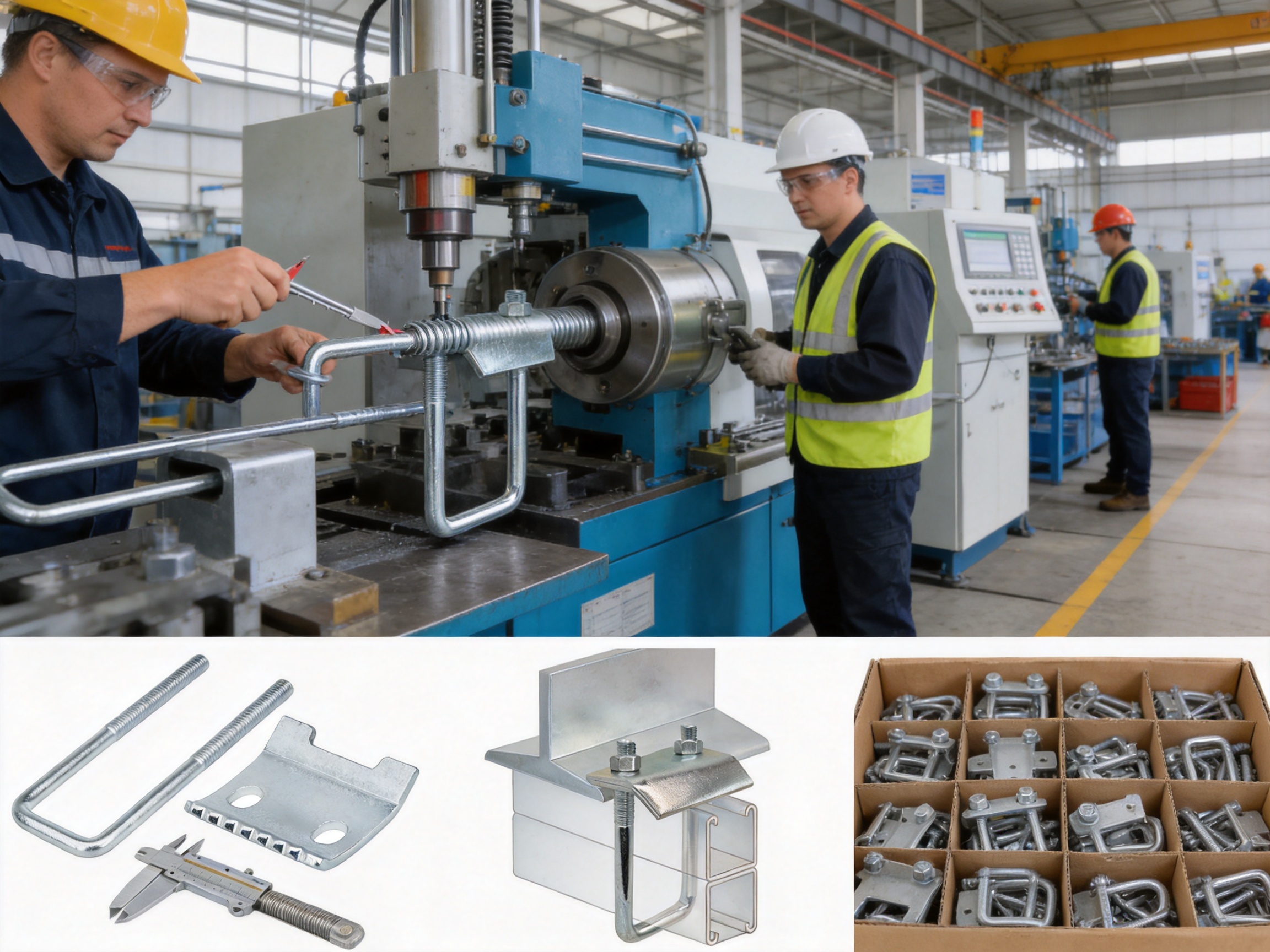
The performance of a beam clamp begins with the manufacturing process. A reliable product requires more than simply bending a steel rod into a U shape. Each stage, from raw material purchasing to final packaging, influences the consistency of the finished fastener.
Material Procurement
Manufacturing begins with the selection of suitable steel or stainless steel wire and sheet material. Material dimensions, chemical composition, mechanical properties, and surface condition should be checked according to the required specification.
Consistent raw material helps ensure stable forming, dependable thread production, and repeatable mechanical behavior. For larger orders, controlled material sourcing also helps maintain consistency between production batches.
Cutting and Blanking
Wire or bar stock is cut to the required length for the U-bolt. Plate components are blanked or cut according to the designed dimensions. Accurate cutting is important because insufficient length can prevent proper nut engagement, while excessive variation can create assembly problems.
For custom products, cutting parameters can be adjusted to accommodate special leg lengths, wider bends, or additional thread engagement.
Forming and Bending
The U-bolt is formed using controlled bending equipment. The bending process must maintain the correct leg spacing, bend radius, overall width, and square profile. Poorly controlled forming may cause twisting, uneven legs, or inaccurate alignment with the saddle plate.
Modern production methods can use dedicated tooling for repeatable geometry. Tooling selection depends on the material grade, wire diameter, bend shape, and required dimensional tolerance.
Threading
Thread quality is critical because the nuts must run smoothly and develop reliable clamping force. Threads may be produced through rolling or cutting processes, depending on the product design and manufacturing requirements.
Thread inspection can include checking pitch, diameter, engagement, visual appearance, and compatibility with the specified nuts. Damaged or incomplete threads should be rejected before the product reaches packaging.
Plate Stamping and Forming
The saddle plate is commonly produced through stamping, punching, forming, or a combination of these processes. Stamping allows manufacturers to produce consistent shapes at efficient production rates while maintaining repeatable hole positions and profiles.
Tool design is important for preventing cracks, burrs, excessive deformation, and dimensional variation. After stamping, edges may be deburred or treated to improve handling safety and assembly quality.
Heat Treatment and Surface Finishing
Depending on the material and required mechanical performance, selected components may undergo heat treatment or stress-relief processes. Surface finishing follows the required corrosion protection specification.
Galvanizing or other coatings should be applied consistently. Threaded areas must remain usable after finishing, and excess coating should not prevent the nuts from engaging correctly. Stainless steel components may receive cleaning, passivation, or other finishing steps appropriate to the selected grade.
Assembly and Inspection
Before shipment, components can be matched into complete sets containing the U-bolt, plate, nuts, and washers where specified. Inspection may include dimensions, thread fit, appearance, coating condition, component quantity, and packaging accuracy.
Factory testing and quality management practices help reduce variation between batches. The supplied product information identifies production under an ISO 9001 quality framework and a stated five-year anti-rust warranty, subject to the applicable terms and environmental conditions.
Manufacturing and Supply Capabilities
Lizhan Hardware Co., Ltd. operates a China manufacturing facility in Zhejiang and maintains a warehouse presence in Thailand. This structure supports both production and regional distribution requirements.
The China factory location provides access to established hardware manufacturing resources, forming equipment, stamping capabilities, surface-treatment suppliers, and export logistics. The Thailand warehouse can support regional stocking and distribution for customers in Southeast Asia, potentially helping shorten replenishment times for qualifying orders.
For contractors and wholesalers, supply continuity is an important consideration. A manufacturer that can provide standard sizes, custom configurations, bulk packaging, and regional logistics offers more value than a source that only supplies isolated small quantities.
Bulk pricing is available for contractors and commercial buyers. Orders can be organized according to size, material, finish, packaging requirements, and project schedule. For custom applications, customers should provide drawings, sample dimensions, quantity forecasts, installation conditions, and required standards at the inquiry stage.
Application Areas
Plumbing and Pipework
U-bolt clamps are frequently used to stabilize water pipes, process lines, drainage systems, and utility piping. The clamp can help maintain alignment and reduce uncontrolled movement between support points.
For piping applications, the installer should consider pipe diameter, operating temperature, insulation, thermal expansion, fluid weight, and support spacing. The clamp should not restrict designed movement where expansion or contraction is expected.
HVAC Systems
Heating, ventilation, and air-conditioning systems often include extensive networks of round ducts, refrigerant lines, condensate pipes, and support frames. A U-bolt assembly can be integrated into ceiling supports, brackets, channels, or equipment frames.
Where vibration isolation is required, the clamp may be used together with rubber liners, isolation pads, springs, or specialized support hardware. The fastening assembly must be selected so that it does not crush insulation or create unwanted noise transmission.
Structural Beams and Tubing
The square U-bolt configuration is well suited to square and rectangular structural tubing. It can connect secondary brackets, braces, frames, signs, rails, and support components without drilling through the primary member.
The clamp should be positioned so that the load is transferred evenly and does not create an unintended eccentric force. For structural applications involving significant loads, the complete connection should be reviewed by a qualified engineer.
Cable Trays and Electrical Supports
Cable trays and conduit systems require stable support to prevent sagging, excessive vibration, and damage to cables. U-bolt clamps can be used as part of a bracket assembly for routing and positioning.
Electrical installations may have additional requirements related to grounding, spacing, fire safety, corrosion, and material compatibility. The clamp should be selected as one part of the complete support system.
Solar Mounting Systems
Solar installations often require corrosion-resistant fasteners capable of outdoor exposure and temperature variation. A galvanized or stainless steel U-bolt can be used for selected mounting and support arrangements when the design is approved for the application.
Wind, snow, thermal movement, and roof or frame conditions must be considered. The product should be installed according to the system designer’s instructions and should not be used beyond its verified load capacity.
Machinery and Equipment
U-bolt clamps can secure pipes, guards, brackets, exhaust components, frames, and auxiliary equipment. Their removable design helps maintenance teams disconnect or reposition components during servicing.
For machinery exposed to strong vibration, the joint should include an appropriate locking arrangement. Periodic inspection is recommended, particularly during the initial operating period after installation.
Agricultural Equipment
Agricultural machines and support structures often operate outdoors and encounter dust, moisture, vibration, and changing temperatures. Galvanized U-bolt clamps can provide a practical solution for attaching rails, handles, tubing, guards, and support components.
Where fertilizers, salt, chemicals, or continuous moisture are present, stainless steel or an enhanced protective finish may be more appropriate.
Selection Guide
Choosing the correct beam clamp requires more than matching the nominal pipe diameter. The following factors should be reviewed before ordering.
Supported Member Dimensions
Measure the outside diameter of a round pipe or the width and height of a square or rectangular tube. Allow enough clearance for installation without creating excessive looseness. The inside dimensions of the U-bolt should suit the supported member and any liner or insulation.
Thread Diameter and Length
Thread size affects nut compatibility and the available tightening capacity. Leg length should provide sufficient thread engagement after the plate, washers, and nuts are installed. The final assembly should leave enough thread beyond the nut without creating unnecessary protrusion.
Load and Operating Conditions
Consider the total supported weight, movement, vibration, impact, temperature, wind, snow, and other forces. The clamp’s capacity depends on the complete assembly, including the U-bolt, plate, nuts, supporting structure, and contact surface.
Material and Finish
Select galvanized steel for many general outdoor and industrial uses, or stainless steel where greater corrosion resistance is required. The choice should account for the surrounding atmosphere and contact with other metals.
Nut and Locking Arrangement
Standard nuts may be appropriate for stable static loads. Lock nuts or double nuts may be preferred where vibration or movement could cause loosening. The locking arrangement should remain accessible for inspection and maintenance.
Packaging and Quantity
For commercial projects, packaging can be organized by size, finish, order number, or installation area. Clear labeling reduces sorting time and helps avoid the use of incorrect fasteners on site.
Technical Comparison Table
| Evaluation Factor | Beam Clamp with Square U-Bolt | Welded Bracket | Drilled-Bolt Connection | Basic Strap Support |
|---|---|---|---|---|
| Installation method | Mechanical tightening with standard tools | Hot work and welding equipment | Drilling and bolt installation | Manual wrapping or fastening |
| Removability | High; can be released and reused when suitable | Low; generally permanent | Moderate; requires access to bolts | High, depending on design |
| Need to alter the supported member | Normally no drilling or welding required | Usually requires welding to the member | Requires drilled holes | Normally no drilling |
| Configuration flexibility | High; multiple sizes, plates, materials, and nut options | Depends on fabrication | Depends on hole position and bolt size | Usually limited |
| Vibration control | Can use lock nuts or double nuts | Strong permanent joint but requires design review | Can use locking hardware | May loosen or shift if not properly designed |
| Corrosion protection | Available in galvanized steel or stainless steel | Depends on weld and coating system | Depends on bolt and structural member finish | Depends on strap material and finish |
| Maintenance access | Generally straightforward | Limited without cutting or rewelding | Usually accessible if correctly positioned | Generally accessible |
Installation Recommendations
Before installation, inspect the U-bolt, plate, nuts, washers, and supporting member. Confirm that the dimensions and material are correct. Do not use components with damaged threads, severe corrosion, cracks, deep scratches, or significant deformation.
Position the clamp so that the load is centered and the plate sits evenly. Avoid placing the U-bolt across sharp edges that could concentrate stress. If a liner is required, ensure that it is compatible with the pipe, temperature, and environment.
Install the washers and nuts in the specified arrangement. Tighten both nuts gradually and alternately so that the plate remains level. Uneven tightening can create an unbalanced load, distort the plate, or cause the supported member to shift.
Use a suitable wrench or torque-controlled tool when a specified tightening value is available. Excessive tightening can damage threads, crush tubing, deform insulation, or reduce the service life of the assembly. Insufficient tightening can allow movement and loosening.
After installation, verify that the supported component is correctly aligned and that the clamp does not interfere with adjacent equipment. In vibration or heavy-duty applications, conduct a follow-up inspection after the system has operated for an appropriate period.
Quality Control Considerations
Professional buyers should evaluate more than price when comparing suppliers. Important questions include whether the manufacturer controls raw materials, maintains forming accuracy, checks thread fit, verifies coating quality, and uses consistent packaging procedures.
Dimensional inspection should cover U-bolt width, leg spacing, leg length, thread length, plate dimensions, hole position, and overall fit. Visual checks should identify burrs, cracks, uneven bends, incomplete threads, coating defects, and packaging damage.
Where required by the project, buyers may request material certificates, inspection reports, sample approval, coating information, or production documentation. These records help establish traceability and simplify quality audits.
ISO 9001-based quality management can support process consistency by establishing documented procedures, corrective actions, supplier controls, and inspection responsibilities. Certification or stated compliance should always be reviewed against the supplier’s current documentation and the specific purchase requirements.
Why Choose This Product for Commercial Projects?
The Beam Clamp with Square U-Bolt and Nuts is suitable for buyers seeking a versatile fastening product that can be adapted across multiple industries. Its main value lies in the combination of a practical design and flexible manufacturing options.
Compared with a one-size-fits-all clamp, the product can be specified with different dimensions, finishes, nut arrangements, and materials. Compared with improvised supports, it offers a more controlled and professional connection. Compared with permanent fastening, it provides easier access for inspection and replacement.
The manufacturer’s product range and factory resources support both standard orders and customized requirements. Customers can discuss project-specific dimensions, bulk quantities, export packaging, and regional delivery arrangements. The China production base and Thailand warehouse presence can be useful for customers managing supply chains across Asia.
For contractors, the product can reduce installation labor. For distributors, it can provide a repeatable product family with multiple size options. For equipment manufacturers, it can be adapted to production assemblies. For maintenance departments, its removable structure can simplify repair and replacement work.
Frequently Asked Questions
What is a beam clamp with a square U-bolt used for?
It is used to secure pipes, beams, square tubing, rectangular tubing, cable supports, machinery components, exhaust systems, agricultural equipment, and other structural or industrial parts. The specific use depends on the clamp size, material, load, and installation arrangement.
Can the clamp be used with round pipes?
Yes. Although the square U-bolt is especially useful for square or angular profiles, it can also be used with round pipes when the internal dimensions, saddle plate, and contact arrangement are correctly selected.
What materials are available?
Common material options include galvanized steel and stainless steel. Galvanized steel is suitable for many general industrial and outdoor applications. Stainless steel is preferred where increased corrosion resistance or a clean appearance is required.
Which size should be selected?
The size should be selected according to the supported member’s outside dimensions, the required thread diameter, the available installation space, the load, and the operating environment. Customers should confirm dimensions using technical drawings or samples before placing a large order.
Can the bolt length be customized?
Yes. Bolt length, leg spacing, thread length, plate size, and other details may be customized according to the application and production feasibility. Custom orders should include complete drawings or dimensional requirements.
How can loosening be reduced in vibrating applications?
Suitable measures include lock nuts, double nuts, compatible washers, correct tightening, proper support spacing, and periodic inspection. The appropriate method depends on the vibration level and the complete joint design.
Does the clamp require welding or drilling?
Normally, no. The U-bolt wraps around the supported member and is tightened through a plate. This allows installation without hot work or drilling through the beam or pipe, although the supporting bracket or surrounding structure may require its own mounting method.
Is the product suitable for heavy loads?
It can be used in load-bearing support applications when the complete assembly is correctly engineered and the selected size is suitable. Load capacity should not be assumed from appearance alone. Engineers should review the U-bolt, plate, nuts, supporting structure, load direction, vibration, and safety factor.
Can the clamp be used outdoors?
Yes, galvanized steel and stainless steel versions can be used outdoors when appropriately selected. Environmental exposure, salt, chemicals, humidity, temperature, and contact with dissimilar metals should be considered.
What quality information can commercial buyers request?
Depending on the order, buyers may request dimensional specifications, material information, surface-finish details, sample approval, inspection records, packaging requirements, and other documentation required by the project or purchasing department.
Does the manufacturer support bulk orders?
Yes. Bulk pricing and commercial supply arrangements are available for contractors, distributors, and project buyers. Quantities, sizes, finishes, packaging, delivery schedules, and customization should be discussed before production.
Where is the product manufactured and supplied from?
The product is manufactured through the company’s China factory operation in Zhejiang, with warehouse support in Thailand for regional distribution. Availability and delivery timing depend on product configuration, order quantity, and destination.
Ordering and Project Support
To receive an accurate quotation, buyers should provide the product name, required quantity, U-bolt dimensions, supported member dimensions, material preference, surface finish, nut type, plate requirements, packaging instructions, destination, and delivery schedule.
For a standard order, a product photograph or nominal size may be sufficient for an initial inquiry. For a custom project, a drawing or sample is strongly recommended. Information about vibration, temperature, corrosive exposure, insulation, and load can help the manufacturer recommend a more appropriate configuration.
Samples may be useful before committing to a large production run. They allow the purchaser to verify fit, thread engagement, plate alignment, finish, installation method, and compatibility with existing components.
Clear packaging and labeling are especially important for mixed-size orders. Each carton or bag can be organized by size, finish, project section, or purchase order. This reduces errors during warehouse handling and onsite installation.
Conclusion
The Beam Clamp with Square U-Bolt and Nuts is a dependable and adaptable fastening solution for pipes, beams, structural tubing, cable supports, machinery, and general industrial assemblies. Its square U-bolt design provides secure positioning, while the threaded connection and saddle plate allow efficient installation, adjustment, inspection, and removal.
Its advantages over welding, drilled connections, improvised straps, and inconsistent generic clamps include easier installation, reduced alteration of the supported member, flexible configuration, corrosion-resistant material options, and practical maintenance access. The product can be manufactured in galvanized steel or stainless steel and can be adapted through different sizes, bolt lengths, plates, nuts, and packaging arrangements.
Manufacturing quality is supported by controlled material selection, forming, stamping, threading, finishing, inspection, and supply management. The China factory and Thailand warehouse structure provides a foundation for both customized production and regional commercial supply.
When the clamp is correctly selected, installed, and maintained, it can provide a reliable connection for a wide range of construction, plumbing, HVAC, structural, agricultural, machinery, and infrastructure applications. For safety-critical or heavily loaded projects, the complete fastening system should always be reviewed by a qualified professional and used within verified design limits.
References
1. General principles of mechanical fastening and bolted-joint design.
2. ISO 9001, Quality management systems—Requirements.
3. Standard engineering practices for U-bolt pipe supports and structural clamps.
4. Technical guidance on galvanized steel fasteners and zinc corrosion protection.
5. Stainless steel selection principles for industrial and outdoor fastening applications.
6. Construction and maintenance practices for pipework, HVAC supports, cable trays, and structural tubing.
7. Manufacturer-provided product information for beam clamps, square U-bolts, nuts, materials, finishes, customization, and commercial supply.