Choosing a drywall screw is a 20-second decision on the jobsite, but the wrong choice announces itself months later as popped heads, rust spots on fresh paint, or a screw that refuses to stop spinning inside a steel stud. Coarse-thread screws are made for wood studs, fine-thread screws are made for steel studs, and the coating determines whether that screw survives a bathroom renovation or a coastal retrofit. This guide covers the most common drywall screw applications, what each screw is engineered to do, and how to make the right call without slowing down the crew.
How Drywall Screws Are Designed for Their Job
Every common drywall screw application builds on the same three design features: a bugle head, a sharp point, and an aggressive thread. The bugle head lets the screw seat itself just below the paper surface without tearing it, which is why crews can drive them at speed without a separate countersinking step.
The point starts the hole instantly and the thread pulls the gypsum board tight against the stud or joist. Drywall screws are heat-treated to keep the shank stiff, so they drive fast without flexing. That hardness makes them more brittle than wood screws under sideways loads, which is why they are board-to-framing fasteners, not structural connectors.
The design of the drywall screw thread has a direct effect on holding power: coarse threads for wood, fine threads for sheet steel, and special thread forms when the board itself needs extra grip.
Coarse-Thread vs. Fine-Thread Drywall Screws: Match the Stud
The first application decision is structural: what is behind the board? Wood studs, steel studs, furring strips and old framing all ask for different thread behavior.
Coarse-thread screws for wood framing
Coarse-thread drywall screws are the default for wood studs, joists and furring strips. The wider thread spacing displaces more wood fiber per turn, which gives a deeper bite and faster seating in soft framing lumber. On a wood stud, coarse threads hold better and strip less easily than fine threads when driven with an impact driver.
Fine-thread screws for steel framing
Fine-thread screws are built for metal studs and light-gauge steel framing, usually 20- to 25-gauge. The tighter thread spacing reduces the force needed to tap into thin steel, so the screw seats cleanly instead of enlarging the hole or spinning free. A coarse-thread screw driven into a steel stud can dimple the flange and strip the opening, a frequent cause of callbacks in commercial drywall work.
| Framing material | Recommended thread | Why it works |
|---|---|---|
| Wood studs and joists | Coarse thread | Deep bite and fast seating in wood fiber |
| Steel studs, 20-25 gauge | Fine thread | Low driving torque and a clean seat in thin steel |
| Wood furring and strapping | Coarse thread | Same bite as wood studs with a shorter screw |
Not sure what is behind the wall? Pull one screw from an existing installation or drill a test hole. The framing material matters more than board thickness, because a screw that does not hold in the stud cannot hold the board.
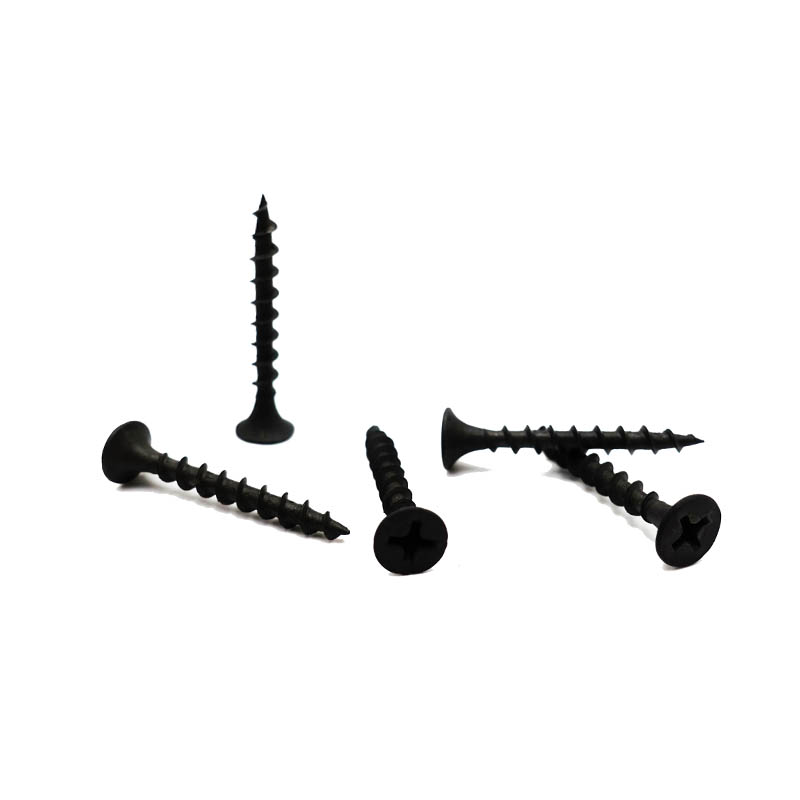 Black Phosphated Coarse-Thread Drywall Screw with Bugle HeadThis screw uses a black phosphate finish and coarse thread for standard drywall-to-wood framing. Its bugle head and Phillips drive suit typical board installation. Check it if your framing is wood and you need a corrosion-resistant option for normal indoor conditions.View Product →
 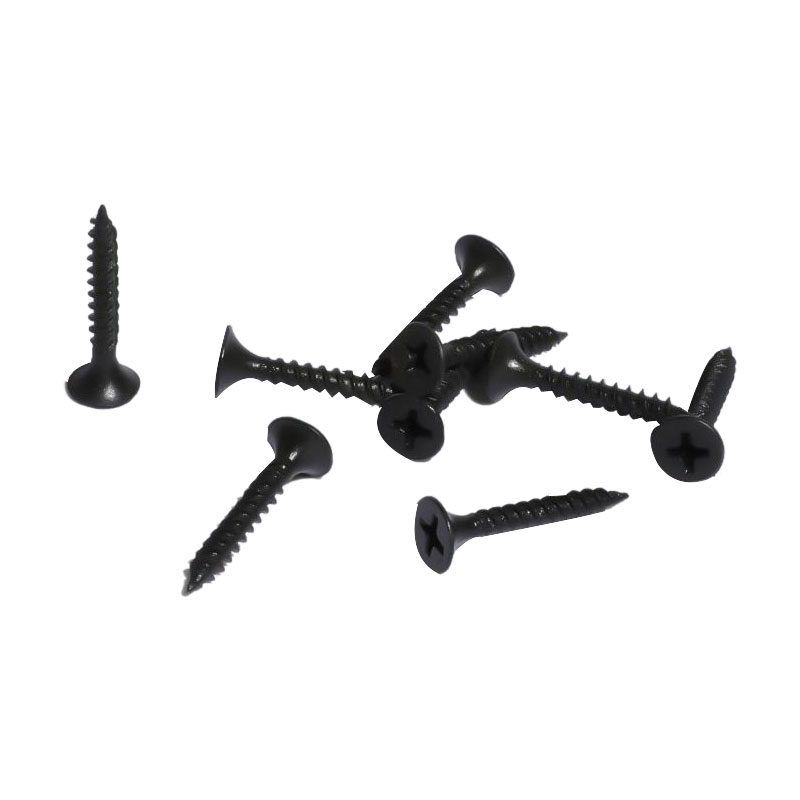 Fine-Thread Black Phosphated Gypsum Board ScrewWith a fine thread, this screw is designed for attaching drywall to light-gauge steel studs. The black phosphate coating works for dry indoor areas. Consider it when your framing material is steel rather than wood.View Product →
The Most Common Drywall Screw Applications
Most drywall screws end up in one of five places:
- Wallboard installation over wood or steel studs. Walls are typically screwed every 16 inches along each stud, with additional screws at board edges.
- Ceiling installation. Ceilings use the same screw type as adjacent walls, but spacing should be tightened to about 12 inches because gravity constantly pulls the board away from the joists.
- Double-layer and sound-rated assemblies. The base layer is fastened first, then the face layer goes on with a longer screw that still reaches the framing.
- Patch and repair work. Re-screwing a popped head, adding screws beside a loose edge, or fastening a patch panel to existing studs uses the same thread logic as new construction.
- Gypsum board over furring strips and strapping in basements and garages. A shorter coarse-thread screw, usually 25 to 32 mm, is enough when the strapping is solidly anchored.
Screw spacing follows the same logic on every site: more screws per board on ceilings, more screws along unsupported edges, and never a screw that misses the framing member. A board is only as strong as its worst-fastened stud line.
Coatings: Match the Finish to the Moisture Level
Coating choice decides whether a drywall screw application is a fire-and-forget job or a maintenance problem. Black phosphate is the standard interior finish: economical, stable in dry rooms, and visually quiet against dark gypsum facing. Grey phosphate performs similarly and shows up on production lines where a neutral appearance is preferred.
Yellow zinc plating adds real corrosion resistance and is the usual choice for bathrooms, kitchens, laundry rooms and any area where the board can get damp before or after painting. Blue-white zinc offers a cleaner look with moderate protection, which makes it common in prefabricated panels and exposed fastening lines.
Rule of thumb: if the room gets wet on a regular basis, skip black phosphate and choose a zinc-based finish. In a shower enclosure or an unventilated crawl space, black phosphate will surface-rust quickly.
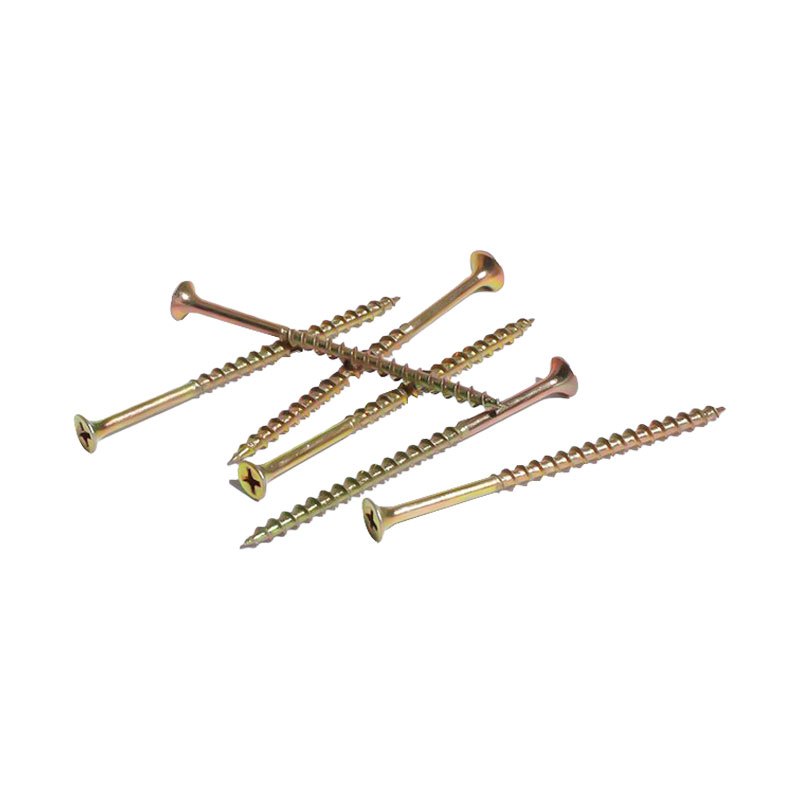 Yellow Zinc Plated Drywall Screw for Wet EnvironmentsThe yellow zinc plating offers better corrosion resistance than black phosphate, making it suitable for showers or damp spaces. Its bugle head works for standard drywall installation where moisture is a concern.View Product →
Specialty Drywall Screws for Less Obvious Jobs
Wafer-head and pan-head self-tapping variants
Not every screw in a drywall fastener family is used to fix gypsum board. Wafer-head and pan-head self-tapping variants attach metal accessories, brackets and light-gauge steel parts to the same studs and tracks. A flat head gives a more stable seating surface than a countersunk bugle head when the screw is clamping a steel part rather than compressing a soft board.
Type-17 points and high-low threads
Type-17 points tap their own pilot hole in engineered wood, which reduces splitting when screws are placed near the edge of a lumber member. High-low thread forms alternate wider and narrower flutes to increase pullout resistance in particle board and softer substrates. These variants are common in manufactured housing, where one wall can mix wood, steel and composite backings.
Length, Gauge and Drive Selection
For standard 12.5 mm board, the proven guidance is simple:
- 12.5 mm (1/2 in.) board on wood studs: 32 mm (1-1/4 in.) screw.
- 12.5 mm board on steel studs: 25 mm (1 in.) screw.
- 15.9 mm (5/8 in.) board on wood studs: 41 mm (1-5/8 in.) screw.
- Second layer over existing board: add the board thickness and keep at least 16 mm of engagement in the framing; 45-50 mm is typical.
Number 6 gauge is enough for standard interior board; number 8 gauge adds shear margin for ceilings and heavier board. Whatever the length, aim for at least 16 mm of thread in the framing member. If the point emerges through the far side of the stud, the screw is probably one size too long.
Phillips #2 is the dominant drive because it keeps the screw on-center at production speed with a magnetic driver bit. Square and Torx drives are used mainly where cam-out is a concern, such as high-torque ceiling work with an angle driver.
Drywall Screw Application FAQs
Q1: Can drywall screws be used for wood-to-wood joints or furniture?
Not recommended. Drywall screws are hardened and brittle, so they snap under sideways movement. Use wood screws or structural screws for furniture and framing joints.
Q2: Are drywall screws the same as self-tapping screws?
They are a subcategory of self-tapping screws, but drywall screws are designed specifically for gypsum board and light-gauge steel studs. General self-tapping screws cover a much wider range of head styles, points and thread forms for metal-to-metal work.
Q3: When should I pick yellow-zinc-plated drywall screws?
Two situations: interior rooms with regular humidity such as bathrooms and kitchens, and any project where the fasteners may sit exposed to dampness before painting. For genuinely wet or exterior conditions, black phosphate and zinc are not enough; use a higher-grade coating or stainless steel.
Q4: Do I need to pre-drill steel studs for fine-thread drywall screws?
No. Fine-thread drywall screws are designed to tap their way into 20- to 25-gauge steel without a pilot hole. If the steel resists, check the gauge: material heavier than 20-gauge may need a self-drilling screw rather than a standard drywall screw.
Common drywall screw applications become simple once the selection logic is clear: match the thread to the framing, the coating to the moisture, and the length to the total board build-up. Getting those three decisions right avoids the visible failures that usually appear just after the painter leaves the site. As a fastener manufacturer with more than 20 years of export experience, LIZHAN supplies drywall screws in coarse, fine and specialty variants with consistent dimensional tolerances and batch-to-batch coating control.
For any large project, the reliable move is the same: test samples from the actual production line against the framing you will use on site, before the purchase order rather than after delivery.