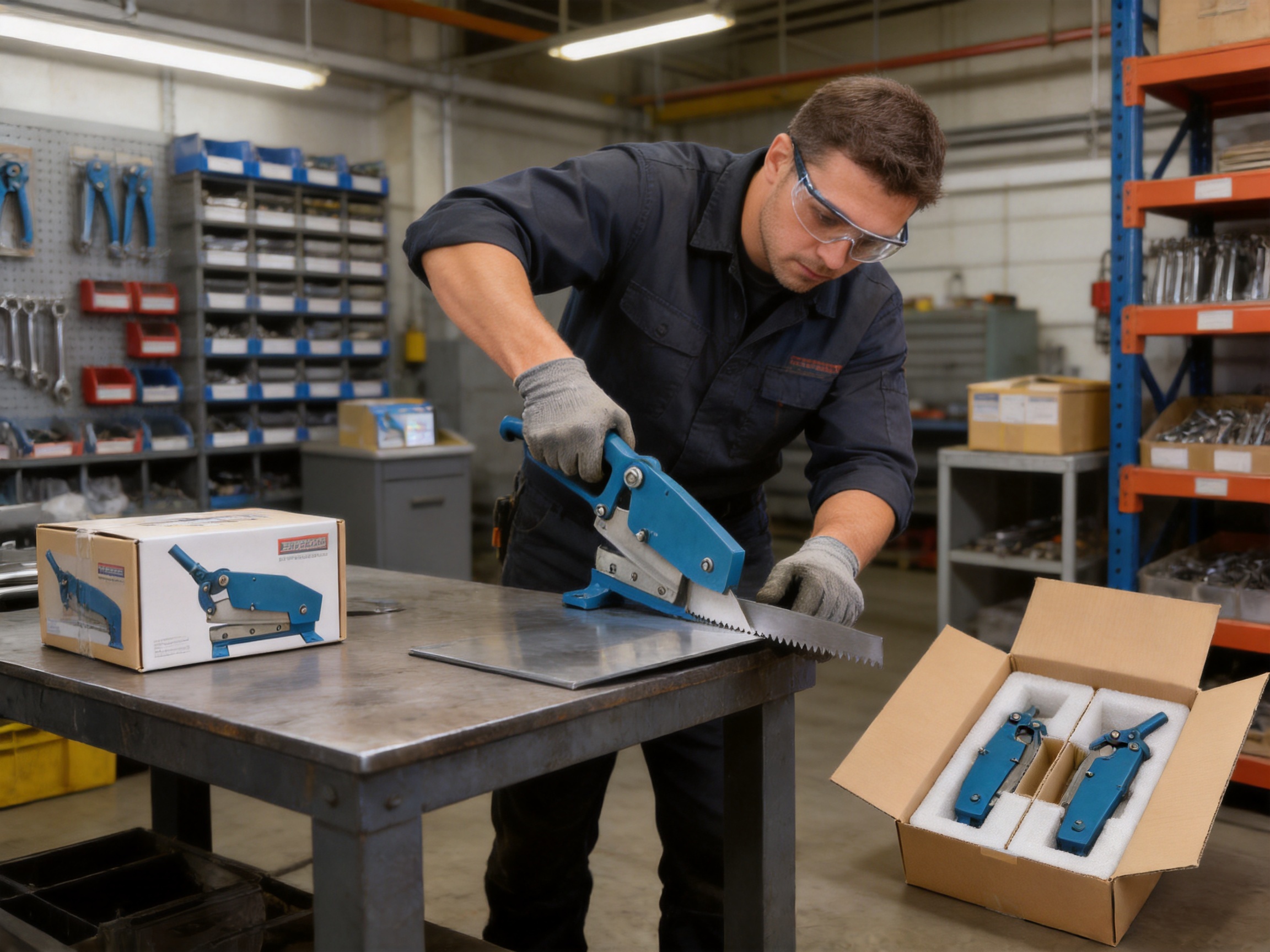
Metalworking depends on tools that can deliver dependable cutting performance without unnecessary complexity. A hand shear is one of the most practical tools for cutting and trimming sheet metal, steel plate, workshop materials, and fabrication components. When the tool is correctly designed and manufactured, it provides direct mechanical control, repeatable results, and a convenient solution for jobs that do not require powered machinery.
The Hand Shear is an AT Tool designed for practical metal-cutting applications. It features a 300 millimeter blade length and is specified for steel plate up to 3 millimeters thick. With a compact packing dimension of 44 by 32 by 20 centimeters and two pieces per case, it is suitable for professional distribution, hardware retail, workshop supply, and industrial tool inventories.
This article examines the product’s design, working advantages, suitable applications, quality considerations, manufacturing process, packaging, maintenance requirements, and purchasing value. It also explains why a purpose-built hand shear can be a more flexible and economical option than relying exclusively on powered cutting equipment.
Product Overview
The Hand Shear is a manually operated cutting tool intended for users who need a practical method of separating or trimming metal materials. Its 300 millimeter blade length provides a useful balance between cutting reach and tool control. The blade is long enough to support efficient cutting along a material edge while remaining compact enough for routine handling in a workshop or construction environment.
The stated steel plate capacity is 3 millimeters. Actual cutting performance can vary according to the material grade, hardness, width, edge condition, operator technique, and maintenance condition of the tool. Nevertheless, the specification indicates that the tool is intended for substantially heavier work than light-duty household scissors or thin-material snips.
Unlike powered shears, the Hand Shear does not require electricity, compressed air, batteries, motors, or complicated control systems. This makes it useful in locations where power is unavailable, where portability is important, or where the quantity of cutting does not justify setting up a larger machine.
The tool can support fabrication, repair, installation, maintenance, hardware processing, and general metalworking tasks. It is especially valuable for cutting operations that require operator judgment, short production runs, adjustment work, and on-site modifications.
| Item | Specification | Practical significance |
|---|---|---|
| Product | Hand Shear | Manual tool for controlled metal cutting |
| Product category | AT Tool | Suitable for hardware and industrial tool distribution |
| Blade length | 300 millimeters | Provides useful cutting reach and handling balance |
| Steel plate capacity | Up to 3 millimeters, depending on material and conditions | Supports medium-duty steel plate and sheet-metal work |
| Quantity per case | 2 pieces | Convenient for wholesale and inventory planning |
| Packing dimension | 44 by 32 by 20 centimeters | Efficient for storage, transport, and distribution |

Hand shear
Why a Hand Shear Remains Valuable in Modern Metalworking
Modern workshops use laser cutters, plasma cutters, hydraulic shears, angle grinders, and other powered systems. However, advanced machinery does not eliminate the need for simple manual tools. A hand shear provides a different type of value: immediate availability, low operating cost, direct control, and easy deployment.
A powered cutting machine often requires electrical connections, setup time, safety controls, material alignment, maintenance, and sufficient workspace. A hand shear can be taken directly to the work area. This is particularly useful for construction teams, maintenance technicians, installers, repair personnel, and small fabrication shops.
Manual cutting also reduces the risk of producing unnecessary waste during small adjustments. When a worker needs to remove a narrow section, trim a fitting, or modify a component during installation, using a large machine may be inefficient. The hand shear enables the worker to make a controlled correction without transporting the material back to a production line.
The tool is also appropriate for emergency and temporary work. A workshop may experience a power interruption, equipment maintenance period, or production bottleneck. A dependable manual shear provides an alternative cutting method that helps keep basic work moving.
Another advantage is reduced operating expense. The tool does not consume electricity or fuel, and it does not require motor replacement, drive-belt service, or electronic control maintenance. Routine care generally consists of cleaning, inspection, lubrication, and protection of the cutting edges.
Blade Length and Cutting Control
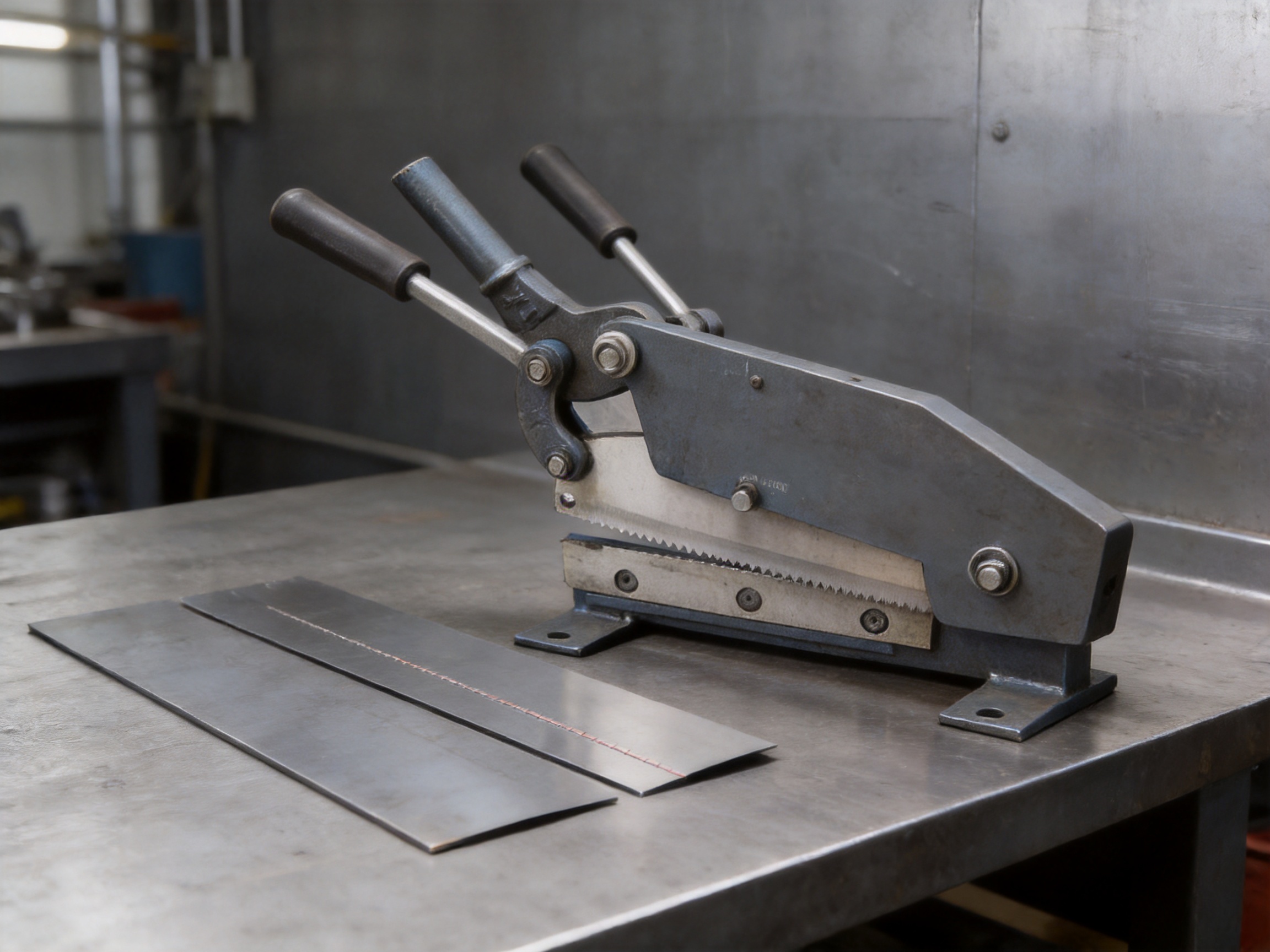
The 300 millimeter blade length is an important part of the tool’s performance profile. A blade that is too short may require excessive repositioning and repeated cuts. A blade that is too long may become difficult to control in confined areas. The 300 millimeter format offers a practical middle ground for many workshop and site applications.
A longer cutting edge can help the operator distribute force over a wider section of material. This may reduce the need to make numerous short cuts and can improve productivity when working along a straight edge. It also helps users process larger pieces without constantly changing their grip or cutting position.
Blade length alone does not determine cutting ability. The blade profile, pivot design, edge alignment, material quality, handle geometry, and overall rigidity are equally important. A properly manufactured hand shear must keep the two cutting edges aligned as the handles move through their operating range.
Correct alignment is essential because poor alignment can cause tearing, deformation, uneven cutting, or unnecessary force requirements. Manufacturing controls should therefore address blade forming, pivot-hole positioning, joint assembly, and final functional inspection.
For users, the best results are achieved when the material is supported correctly and the tool is kept square to the intended cutting line. The operator should avoid twisting the shear during the cut. Twisting can place side loads on the blades and pivot, potentially reducing service life.
Suitability for Three-Millimeter Steel Plate
The product specification identifies steel plate up to 3 millimeters as the intended capacity. This is a substantial specification for a manually operated tool, but users should understand that capacity depends on the material being cut. Mild steel, stainless steel, hardened steel, coated sheet, and nonferrous metals do not behave identically.
Material hardness has a direct effect on required cutting force. A hard or high-strength alloy may require significantly more force than ordinary mild steel of the same thickness. Surface coatings may also influence friction and edge wear. For this reason, the nominal capacity should be treated as a reference for suitable conditions rather than a guarantee for every metal grade.
Material width also matters. A narrow strip may be easier to cut than a broad plate because the operator can maintain better alignment and leverage. For wider material, users may need to plan the cut carefully, support the workpiece, and use a suitable cutting sequence.
The tool should not be forced beyond its intended capacity. Excessive force can damage the cutting edges, deform the blade, loosen the pivot, or create an unsafe operating condition. If the material does not begin cutting with reasonable effort, it should be evaluated for thickness, hardness, position, and suitability before more force is applied.
When used within its intended range, the Hand Shear can provide an efficient solution for trimming steel components, cutting sheet-metal sections, adjusting fabricated parts, and completing installation work.
Advantages Compared with General-Purpose Alternatives
Compared with Ordinary Scissors
Household or office scissors are designed for paper, fabric, thin plastic, and other light materials. Their blades, pivots, and handles are not intended for steel plate. Attempting to cut metal with ordinary scissors can quickly damage the tool and may create sharp, uncontrolled edges.
A dedicated hand shear is designed for substantially heavier work. Its longer blade, stronger construction, and reinforced operating structure provide a more suitable platform for metal cutting. The difference is not simply a matter of size; it is a matter of load capacity, edge geometry, and mechanical durability.
Compared with Lightweight Metal Snips
Light-duty metal snips are convenient for thin sheet metal and small trimming jobs. They are often highly maneuverable, but their capacity may be limited. A 300 millimeter hand shear can offer greater reach and more substantial cutting capability for thicker stock and demanding workshop conditions.
The appropriate choice depends on the job. Snips may be better for intricate curves or very thin sheet, while a heavier hand shear may be preferable for straight cuts, medium-duty material, and situations requiring a stronger cutting platform.
Compared with Powered Shears
Powered shears can deliver higher production speed, especially in repetitive industrial operations. However, they involve greater acquisition cost, energy consumption, maintenance requirements, noise, and setup demands. They may also be inconvenient for isolated repair tasks or field installation work.
The Hand Shear complements rather than completely replaces powered equipment. It is advantageous when portability, affordability, operational simplicity, and direct control are more important than maximum continuous production speed.
Compared with Abrasive Cutting Tools
Angle grinders and abrasive cut-off tools can cut many types of metal, but they create sparks, heat, noise, and abrasive dust. They may also produce a heat-affected edge or require additional finishing work.
A manual shear cuts through mechanical force and generally avoids the sparks and hot particles associated with abrasive cutting. This can be beneficial in environments where fire risk, surface contamination, or noise must be minimized. Operators must still follow appropriate safety procedures because cut metal can have sharp edges and the tool itself contains forceful moving parts.
Manufacturing Strengths Behind Reliable Tool Performance
The performance of a hand shear begins with manufacturing discipline. A strong product is not created by blade shaping alone. It depends on material selection, forming accuracy, heat treatment where applicable, machining, assembly, inspection, corrosion protection, and packaging.
A manufacturer experienced in hardware, fasteners, stamping parts, hooks, screws, and related metal products can bring useful process knowledge to tool production. Familiarity with metal forming and high-volume hardware manufacturing supports consistent production, efficient material utilization, and repeatable quality control.
Lizhan Hardware Co., Ltd. operates from a China factory in Zhejiang and maintains a Thailand warehouse location. This combination can support production coordination, inventory handling, regional distribution, and customer service for buyers in different markets. The company’s broader hardware orientation also provides a foundation for serving distributors that purchase several categories of metal products from one source.
Material Preparation
Manufacturing begins with the selection and preparation of suitable steel. The material must be capable of resisting bending and maintaining a usable cutting edge. Incoming material should be checked for thickness, surface condition, flatness, and consistency.
Material preparation may include cutting blanks to defined dimensions before stamping, forming, or machining. Accurate blank preparation helps reduce variation in later operations. It also contributes to better material utilization and can reduce unnecessary scrap.
Stamping and Forming
Stamping and forming processes are widely used in hardware production because they can produce repeatable shapes efficiently. For a hand shear, forming operations may be used to create structural components, handle sections, reinforcing features, or other shaped parts.
Well-maintained dies and forming equipment are essential. Die wear can gradually change dimensions, create burrs, or affect the fit of mating parts. Process monitoring helps identify these changes before they produce a large quantity of nonconforming components.
Consistent forming also improves the user experience. When the components fit correctly, the assembled shear can operate more smoothly, maintain better alignment, and provide more predictable force transfer.
Blade Processing
The blade is the functional center of the product. Its cutting geometry must be produced with enough accuracy to support clean engagement between the two edges. Blade processing may include blanking, profiling, grinding, edge preparation, and surface finishing.
The cutting edge should be examined for uniformity, chips, excessive burrs, and irregular contact. A carefully finished edge reduces the likelihood of material tearing and helps the operator achieve a more controlled cut.
Depending on the selected steel and production design, heat treatment may be used to improve hardness, strength, and wear resistance. Heat treatment must be carefully controlled because excessive hardness can make an edge brittle, while insufficient hardness may result in rapid dulling or deformation.
Pivot and Joint Assembly
The pivot determines how the blades move relative to one another. A correctly positioned pivot supports smooth opening and closing while helping maintain cutting-edge contact. The pivot area must withstand repeated loads without excessive looseness.
Assembly workers or automated stations should verify that the pivot components are correctly positioned and securely installed. The joint should not be so tight that the tool is difficult to operate, nor so loose that the blades separate or slide during cutting.
Functional testing is particularly important at this stage. A visual inspection may not reveal excessive friction, uneven blade contact, or movement irregularities. Operating the assembled shear through its working range provides a more meaningful assessment.
Surface Finishing and Protection
Metal tools may be exposed to humidity, handling, storage conditions, and transport environments. Surface finishing and protective treatment help reduce the risk of corrosion and preserve the appearance of the product.
Finishing may include cleaning, deburring, protective coating, oil application, or other treatments appropriate to the product design. The purpose is not only visual improvement. Smooth surfaces are easier to handle, less likely to damage packaging, and more resistant to contamination.
Products should be packed in a way that protects cutting edges and prevents metal-to-metal impact during transportation. Proper separation and internal support are especially important for tools with sharp or precisely aligned components.
Quality Control from Raw Material to Finished Product
Quality control is most effective when it is integrated throughout the production process rather than performed only at the end. Incoming material inspection, in-process checks, assembly verification, functional testing, and final packaging inspection each address different risks.
Dimensional checks can confirm blade length, component dimensions, pivot-hole position, and overall assembly fit. Visual checks can identify scratches, burrs, cracks, incomplete forming, coating defects, and other visible problems.
Functional tests should examine opening and closing movement, blade contact, cutting consistency, and pivot stability. Where appropriate, sample tools can be used to cut representative material within the stated working range. This provides practical information that dimensional inspection alone cannot provide.
Quality records can help identify trends over time. If a particular batch shows increasing friction, edge irregularity, or packaging damage, production managers can investigate the relevant process before the issue becomes widespread.
For wholesale customers, consistent quality is especially important because the product may be sold under a distributor’s own catalog, included in a broader hardware program, or supplied repeatedly to professional users. Stable performance supports customer satisfaction and reduces returns.
Ergonomics and Operator Control
A hand shear must transfer substantial force from the operator to the material. Handle shape and balance therefore affect both performance and comfort. A well-balanced tool can be positioned more accurately and may reduce unnecessary wrist movement during repeated work.
Users should hold the tool firmly while keeping fingers away from the cutting path and pivot area. The workpiece should be stabilized on a suitable surface whenever possible. The operator should maintain a clear view of the intended cutting line and avoid placing the free hand near the closing blades.
For thicker material, body positioning is important. The user should apply force in a controlled direction rather than jerking the handles. Sudden movement can cause the blade to slip from the cutting line or cause the material to shift unexpectedly.
Protective gloves, safety glasses, suitable work clothing, and appropriate footwear should be considered according to the application. Gloves must not interfere with secure tool control. Cut metal can have extremely sharp edges, so finished pieces should be handled carefully even when the cutting operation itself is completed.
The tool should be used by trained personnel who understand its capacity and limitations. It should never be used as a clamp, hammer, pry bar, or substitute for a tool designed for bending or gripping.
Applications Across Different Industries
Construction and Installation
Construction and installation teams often need to trim metal components at the work location. A portable hand shear can support modifications to sheet-metal pieces, brackets, protective panels, and other fabricated parts.
Because the tool does not depend on electrical power, it can be useful in unfinished buildings, remote areas, temporary work zones, and maintenance spaces where access to power is limited.
General Fabrication
Small and medium fabrication shops can use the Hand Shear for short runs, edge trimming, preparation work, and adjustments before assembly. It can complement larger machines by handling jobs that are too small or irregular to justify machine setup.
For repeat production, the tool may also be used for secondary operations after a primary machine has completed the main cut. This can help workers make small corrections without interrupting the main production process.
Automotive and Equipment Repair
Repair operations frequently involve customized or replacement metal parts. The Hand Shear can assist with trimming panels, adjusting covers, and preparing pieces for fitting, provided that the material is within the tool’s capacity.
Its mechanical operation can be useful in garages and service locations where sparks from abrasive tools are undesirable or where a quick, localized adjustment is needed.
HVAC and Sheet-Metal Work
Sheet-metal contractors can use manual shears for selected trimming and fitting tasks. The tool may be particularly useful for modifications made during installation, although thinner materials and specialized curved cuts may call for dedicated aviation snips or other sheet-metal tools.
Maintenance Departments
Industrial maintenance teams benefit from tools that are ready for immediate use. A hand shear can be stored in a maintenance cabinet, mobile toolbox, or service vehicle and deployed when a small cutting task arises.
Keeping a manual option available can reduce delays caused by waiting for machine access or arranging an external cutting service.
Packaging, Distribution, and Inventory Benefits
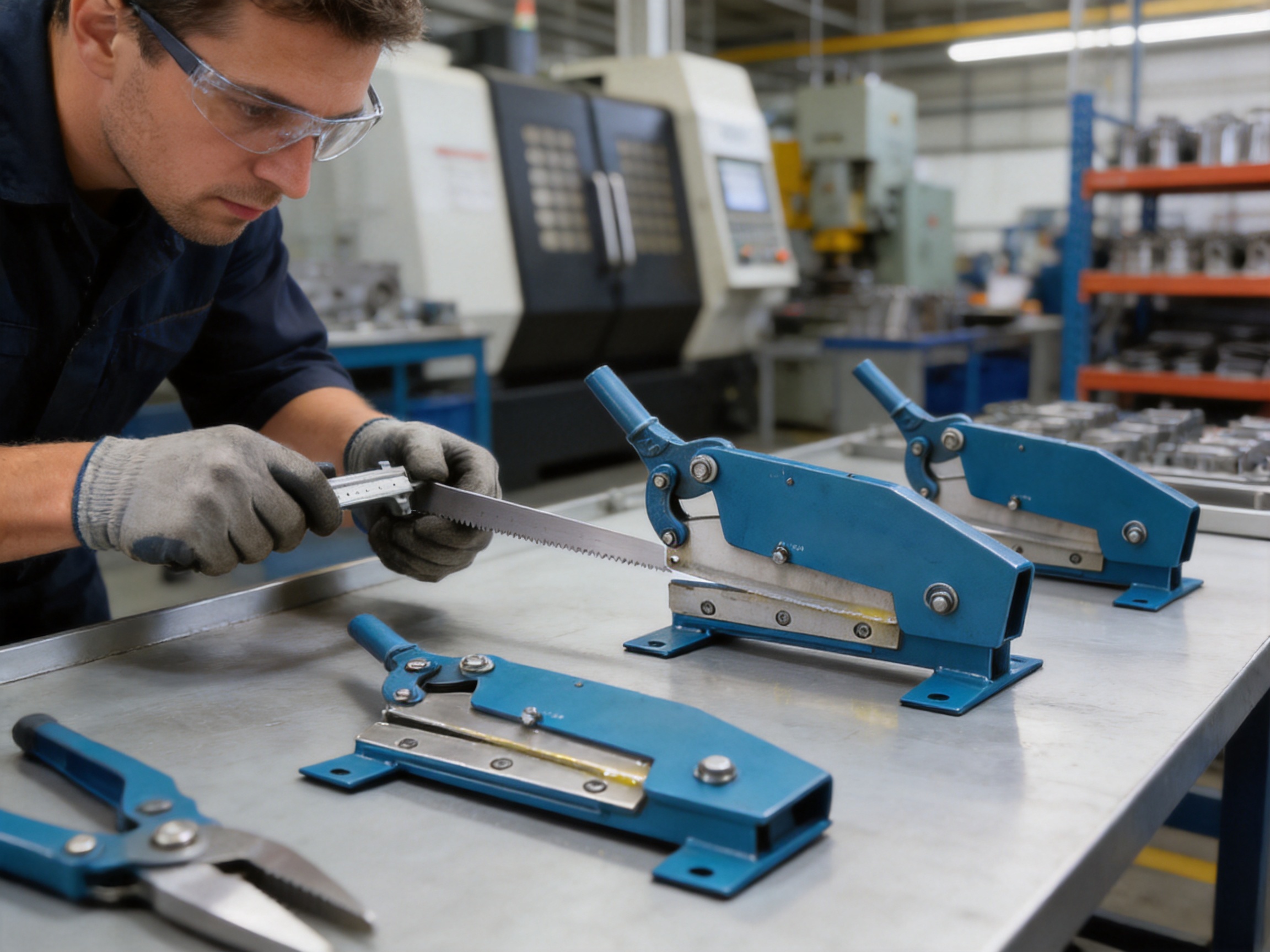
The product is supplied at two pieces per case, with a packing dimension of 44 by 32 by 20 centimeters. These details are important for distributors, importers, wholesalers, and warehouse managers because they affect storage planning, freight calculations, and order quantities.
A two-piece case provides a manageable wholesale unit. It allows buyers to handle inventory in practical increments while protecting the tools during transport. The case quantity may also support mixed hardware orders in which several product categories are consolidated for shipment.
The compact packing dimensions help reduce warehouse space requirements compared with oversized industrial equipment. Efficient packaging can also simplify pallet planning and improve handling during receiving and dispatch operations.
Packaging should protect the cutting edges from impact and prevent movement inside the carton. Internal separators, protective wrapping, or edge guards may be used according to the final packaging design. Clear product identification and consistent case labeling can further improve inventory control.
For international supply, packaging must withstand loading, unloading, container movement, and varying environmental conditions. A well-prepared package reduces the risk of cosmetic damage, blade contact, and component displacement before the tool reaches the end customer.
Purchasing Considerations for Distributors and Professional Users
Buyers should evaluate more than the listed blade length and capacity. Important purchasing factors include production consistency, inspection methods, packaging quality, delivery capability, communication, product documentation, and after-sales responsiveness.
A supplier with experience across hardware categories may provide advantages for customers seeking a consolidated purchasing program. Lizhan Hardware Co., Ltd. identifies product areas including fasteners, screws, stamping parts, metal hooks, and related hardware. This broader product background can help distributors coordinate multiple product lines with one manufacturing partner.
The China factory location in Zhejiang provides access to an established manufacturing region with extensive metalworking and hardware supply-chain capabilities. The Thailand warehouse location can support regional inventory handling and distribution for selected customers and markets.
Communication is also important when purchasing tools for resale or industrial use. Buyers may need to confirm packaging requirements, labeling, case quantities, inspection expectations, material suitability, and shipping arrangements before placing an order.
Professional users should assess the intended material and cutting frequency. A hand shear is a valuable tool, but it should be selected for work that matches its manual operating design. High-volume continuous cutting may require powered equipment, while intermittent cutting and field work may favor the hand shear.
Maintenance and Service Life
Regular maintenance helps preserve cutting performance and extend tool life. After use, the shear should be cleaned to remove metal particles, dust, oil residue, and other contaminants. The cutting edges should be inspected for nicks, flattening, or deformation.
The pivot area should remain properly lubricated according to the product’s maintenance recommendations. Excessive lubricant should be wiped away because it can attract abrasive particles. If the pivot becomes loose, it should be checked and adjusted by a qualified person rather than ignored.
Tools should be stored in a dry environment and protected from unnecessary humidity. If surface corrosion appears, it should be addressed promptly. Corrosion near the cutting edges or pivot can affect both performance and safety.
The shear should not be dropped or stored under heavy objects. Impact can change blade alignment even when damage is not immediately obvious. Protective packaging or a tool case can be helpful when the shear is transported between work locations.
Users should never sharpen the blades aggressively without understanding the original cutting geometry. Removing too much material or changing the blade angle can reduce cutting quality. Sharpening and repair should be performed by a qualified service provider when required.
Safe and Efficient Operating Practices
Before cutting, inspect the tool and the material. Confirm that the blades are clean, the pivot is secure, and there are no visible cracks or severe deformations. Verify that the material is within the expected thickness and hardness range.
Mark the cutting line clearly and support the material. Position the shear so that the blades engage the material squarely. Apply steady pressure and avoid twisting the handles. If the cut becomes unusually difficult, stop and reassess the material and tool condition.
Do not place hands beneath the material near the blade exit point. The cut edge may move suddenly or contain sharp projections. After cutting, deburr or protect the material edge where necessary.
When several workers share the tool, the operating capacity and safety instructions should be communicated clearly. A tool that appears simple still requires correct handling, particularly when cutting thicker stock.
Efficient operation does not mean applying maximum force. Proper support, correct alignment, suitable material positioning, and a clean cutting edge often reduce the effort required more effectively than force alone.
Environmental and Cost Advantages
The Hand Shear has a low operating-energy requirement because it relies on manual force rather than electricity, fuel, or compressed air. This can reduce energy consumption during occasional cutting tasks and make the tool practical in locations without utility access.
Its mechanical construction also limits the number of consumable systems required for operation. There are no motor brushes, batteries, electrical cables, or abrasive discs to replace during ordinary use. The primary service needs are cleaning, lubrication, inspection, and occasional edge maintenance.
Reduced noise and the absence of sparks can be valuable environmental and workplace advantages. Although all metal cutting requires appropriate safety controls, a manual shear may be more suitable for certain indoor or occupied work areas than a noisy powered cutter.
The product’s compact packaging and two-piece case quantity can contribute to efficient storage and shipment. Buyers can manage inventory without allocating space to large machinery or bulky accessories.
How the Product Supports a Broader Hardware Program
Many distributors prefer to work with manufacturers that can supply complementary products rather than a single isolated item. A hand shear may be offered alongside screws, fasteners, stamping parts, hooks, and other metal hardware used by construction, furniture, maintenance, and fabrication customers.
A broader product portfolio can simplify procurement, communication, quality coordination, and shipment planning. It may also allow distributors to develop more complete product catalogs for their target markets.
For a hardware supplier, the Hand Shear represents a practical tool category that complements fastener and metal-component products. It can be marketed to workshops, contractors, maintenance departments, tool retailers, industrial supply companies, and hardware stores.
Customers may evaluate the product as a standalone tool or as part of a larger assortment. Its clear specifications, compact case packaging, and medium-duty positioning make it comparatively straightforward to classify, stock, and present to end users.
Recommended Product Positioning
The Hand Shear should be positioned as a practical, durable, manually operated metal-cutting tool for controlled medium-duty work. Its strongest selling points are its 300 millimeter blade length, stated capability for steel plate up to 3 millimeters, portability, low operating complexity, and suitability for locations without powered machinery.
It should not be presented as a replacement for every industrial shear or as a universal solution for all metals. Clear product positioning builds confidence and helps customers select the tool for suitable applications.
For professional users, the product can be promoted as a dependable field and workshop tool. For distributors, it can be presented as a compact hardware item with manageable case quantities and broad application potential.
For retailers, the product may appeal to customers seeking a stronger alternative to light-duty snips or ordinary cutting tools. Product education should emphasize correct material selection, safe operation, and maintenance.
Q&A
What is the Hand Shear designed to cut?
The Hand Shear is designed for manual cutting and trimming of metal materials. Its stated steel plate specification is up to 3 millimeters, subject to the material grade, hardness, width, tool condition, and operator technique.
What is the blade length?
The blade length is 300 millimeters. This provides useful cutting reach while maintaining a practical size for workshop, maintenance, and field applications.
Does the tool require electricity?
No. The Hand Shear is manually operated and does not require electricity, batteries, compressed air, or fuel.
Can it replace a powered shear?
It can serve as an alternative for intermittent, portable, and localized cutting tasks, but it is not intended to replace high-speed powered equipment in continuous mass production. The best choice depends on cutting volume, material thickness, required speed, and worksite conditions.
Is it suitable for stainless steel?
Suitability depends on the stainless-steel grade, thickness, hardness, and tool condition. Stainless steel can require more cutting force than mild steel. Users should confirm material compatibility before applying the tool to demanding work.
How should the tool be maintained?
Clean the tool after use, inspect the cutting edges and pivot, apply suitable lubrication where needed, protect it from moisture, and store it safely. Avoid using the shear as a hammer, pry bar, or gripping tool.
How many pieces are supplied per case?
The stated case quantity is two pieces per case.
What are the packing dimensions?
The stated packing dimensions are 44 by 32 by 20 centimeters.
Who may benefit from using this tool?
Construction teams, installers, maintenance departments, fabrication shops, repair technicians, hardware retailers, industrial distributors, and professional tradespeople may benefit from its portable manual cutting capability.
What should users do if the tool requires excessive force?
Stop cutting and check the material thickness, material hardness, blade alignment, pivot condition, and cutting position. Do not exceed the tool’s intended capacity or force the handles through resistance that may damage the tool or create a safety risk.
What manufacturing strengths support the product?
Relevant strengths include metal material preparation, stamping and forming experience, blade processing, component assembly, dimensional inspection, functional testing, surface protection, and structured packaging. Experience in broader hardware categories can also support supply-chain coordination and consistent production.
Can distributors purchase this product as part of a larger hardware assortment?
Yes. The product can be considered alongside screws, fasteners, stamping parts, metal hooks, and other hardware categories when building a broader professional tool and hardware program.
Conclusion
The Hand Shear is a practical solution for users who need controlled metal cutting without depending on powered equipment. Its 300 millimeter blade length and stated steel plate capacity of up to 3 millimeters position it for medium-duty applications across workshops, construction sites, maintenance departments, repair operations, and hardware distribution.
Its principal advantages include portability, mechanical simplicity, low operating cost, direct operator control, reduced setup requirements, and suitability for locations where electricity or large machinery is unavailable. Compared with ordinary scissors and lightweight cutting tools, it provides a more appropriate structure for demanding metalwork. Compared with powered shears and abrasive cutters, it offers a quieter, more compact, and lower-complexity option for intermittent tasks.
Product reliability depends on more than the specification sheet. Material quality, blade processing, pivot accuracy, assembly consistency, functional inspection, corrosion protection, and protective packaging all contribute to performance. Manufacturing experience in hardware, fasteners, stamping parts, hooks, and related metal products can support the process discipline required for a dependable hand tool.
With two pieces per case and compact packing dimensions of 44 by 32 by 20 centimeters, the product is also suitable for wholesalers, importers, retailers, and industrial suppliers managing practical inventory levels. When correctly matched to the material and used with proper safety and maintenance practices, the Hand Shear can become a valuable part of a professional metalworking toolkit.
References
1. General principles of manual metal-cutting tool design and operation.
2. Industrial guidance on steel material selection, hardness, and cutting behavior.
3. General workshop safety practices for hand tools and sharp metal edges.
4. Manufacturing principles for stamping, forming, machining, and metal-component assembly.
5. Quality-control methods for dimensional inspection and functional testing of hardware tools.
6. General recommendations for corrosion prevention, tool storage, lubrication, and maintenance.
7. Packaging and distribution practices for metal hardware and industrial tools.
8. Workplace guidance for personal protective equipment during metal fabrication and repair.