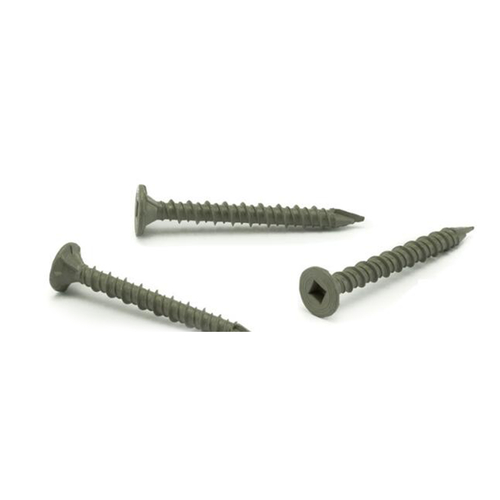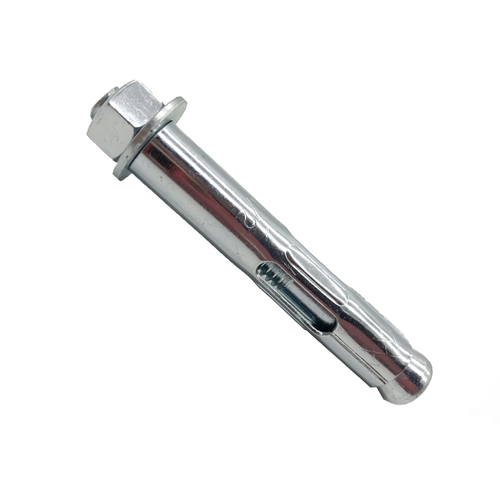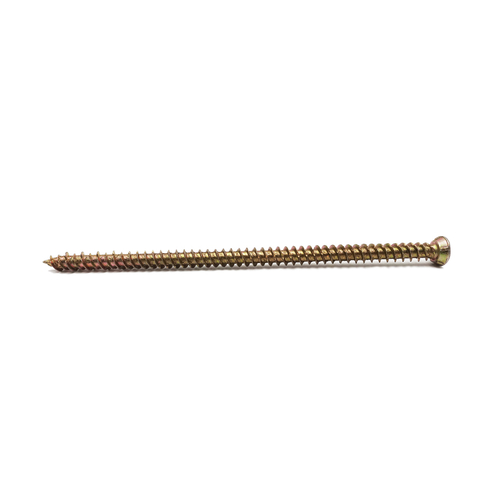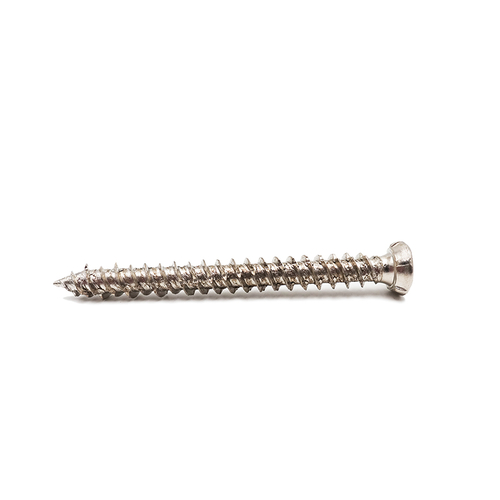
Hex washer head self-drilling screws with EPDM washers are purpose-designed fasteners for applications where speed, sealing performance, corrosion resistance, and secure clamping must work together. The product combines a self-drilling screw body, an integrated hex washer head, a protective surface finish, and an EPDM sealing washer. This configuration enables installers to drill through suitable metal materials, create a firm mechanical connection, and protect the fastening point against water penetration.
For roofing, sheet-metal work, light steel structures, building maintenance, equipment assembly, and many general fastening applications, the screw is intended to reduce the number of installation steps. Instead of preparing a pilot hole with a separate drill bit and then changing tools to install a conventional screw, an appropriate self-drilling screw can perform both operations in one sequence. The hex washer head also allows the use of a socket driver, helping provide controlled torque and efficient installation.
The product is available with painted zinc-plated surfaces and can be supplied within a broader production range that includes black phosphate, zinc plating, yellow zinc plating, Ruspert, and Magni finishes. Diameters listed for the production range include #6-3.5, #8-4.2, #10-4.8, #12-5.5, and #14-6.3. Depending on the application, head styles, recess options, thread types, and standards can be selected to match the required substrate and installation method.
Lizhan Hardware Co., Ltd. produces this type of fastener as part of its drilling screw range. Its manufacturing and supply structure includes a China factory in Haiyan, Jiaxing, Zhejiang, and a Thailand warehouse serving regional distribution needs. This combination supports production flexibility, export coordination, and practical access to inventory for customers requiring recurring supplies of construction and industrial fasteners.
1. Product Overview
A hex washer head self-drilling screw is a threaded fastener with a drill-shaped point. The point is designed to penetrate compatible metal materials without requiring a separately drilled pilot hole. Behind the point, the screw body includes a formed thread that advances into the material and develops holding power. At the opposite end, the hex washer head accepts a socket or nut driver and distributes clamping pressure over a wider area than a simple small-diameter screw head.
The EPDM washer is positioned beneath the metal head. EPDM, or ethylene propylene diene monomer, is a synthetic rubber commonly used for outdoor sealing applications. In this product configuration, the washer helps close the annular space around the screw shank and reduces the possibility of water entering through the fastening hole. The washer also helps protect the surface beneath the head from direct metal-to-metal contact.
The product title specifies a painted zinc-plated surface. This finish can provide a combination of appearance, basic corrosion protection, and color coordination with roofing or building panels. The exact performance of any finish depends on coating thickness, preparation, environmental exposure, installation conditions, and maintenance. For more demanding applications, alternative finishes such as Ruspert or Magni may be considered according to the required corrosion environment and project specification.
The screw is associated with Grade C1022A material. C1022A is a carbon steel designation commonly used for screws requiring a balance of formability, strength, and suitability for cold forming and thread production. The finished fastener must still be selected according to the thickness and hardness of the materials being joined. A self-drilling screw is not automatically suitable for every metal thickness or every structural application.
2. How the Fastener Works
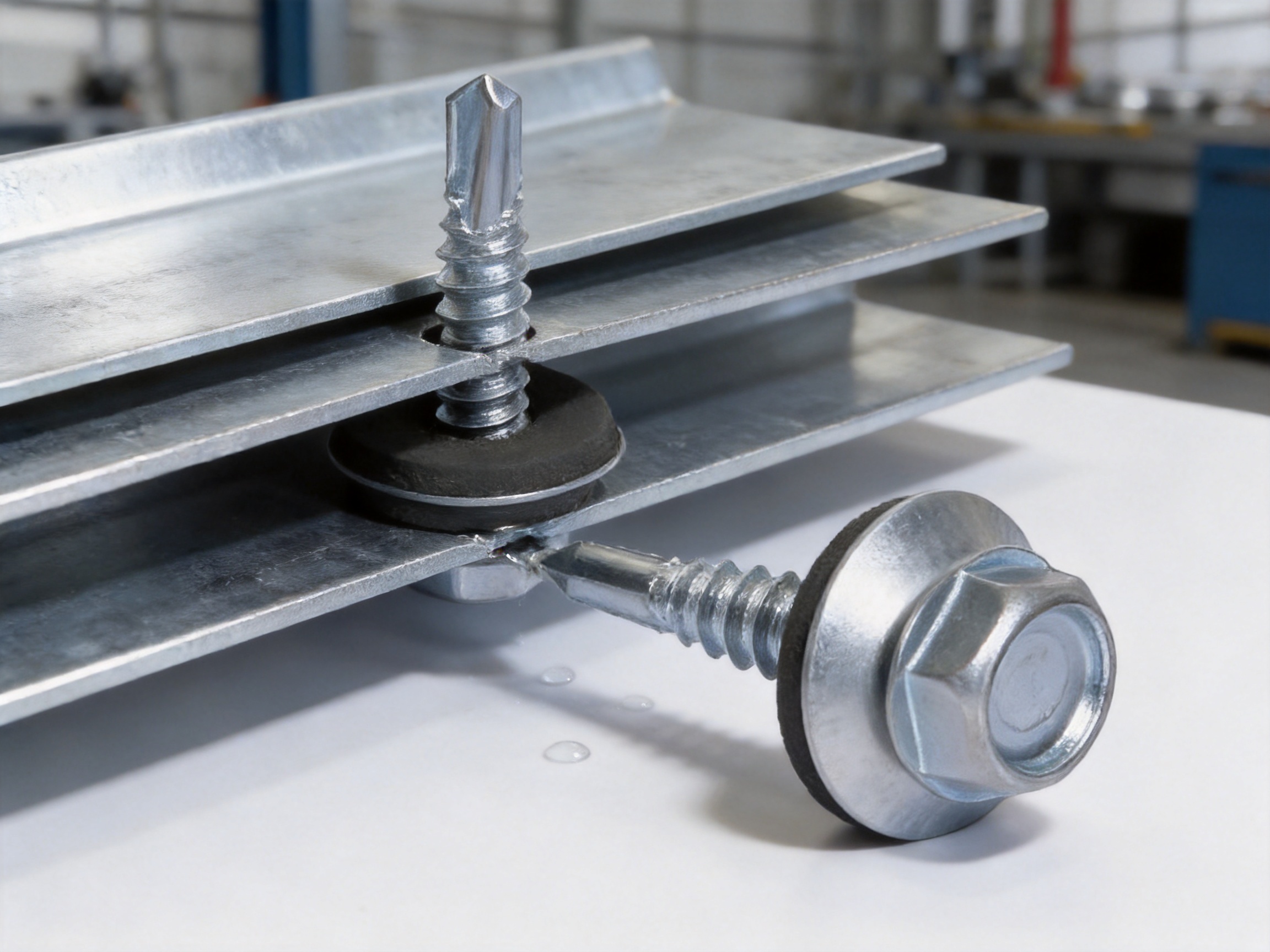
The operation of the fastener can be understood as a sequence of drilling, threading, clamping, and sealing. As rotational force is applied through a socket driver, the drill point begins cutting into the upper material. Once the point passes through the first layer, the screw thread engages with the newly formed hole and pulls the fastener forward. The thread then develops resistance against withdrawal while the head draws the connected components together.
The drill point is especially important because it determines how efficiently the screw enters the substrate. A point that is properly formed and matched to the intended material can reduce installation time and minimize wandering at the start of drilling. Point geometry must be balanced carefully: excessive sharpness may weaken the point, while insufficient cutting ability can increase installation torque and heat.
The hex washer head performs two functions. First, its external hexagonal profile provides positive engagement with a socket. This is particularly useful when the installer needs higher driving torque than a conventional cross recess can reliably transmit. Second, the underside washer area distributes the tightening load over a larger surface. The load distribution helps reduce the risk of the head pulling through a thin panel when the fastener is installed correctly.
The EPDM washer completes the sealing function. When the screw is tightened to the proper level, the washer compresses against the panel or component and forms a weather-resistant interface. Correct compression is essential. Under-tightening may leave a path for water, while excessive tightening can deform the washer, damage the coating, distort a thin panel, or reduce long-term sealing reliability.
These features make the product different from a basic steel screw. A basic screw may provide mechanical fastening but require a separate pilot hole, a separate sealing component, and a different tool. The integrated design of the self-drilling screw reduces those extra steps and provides a more complete fastening solution for exposed connections.
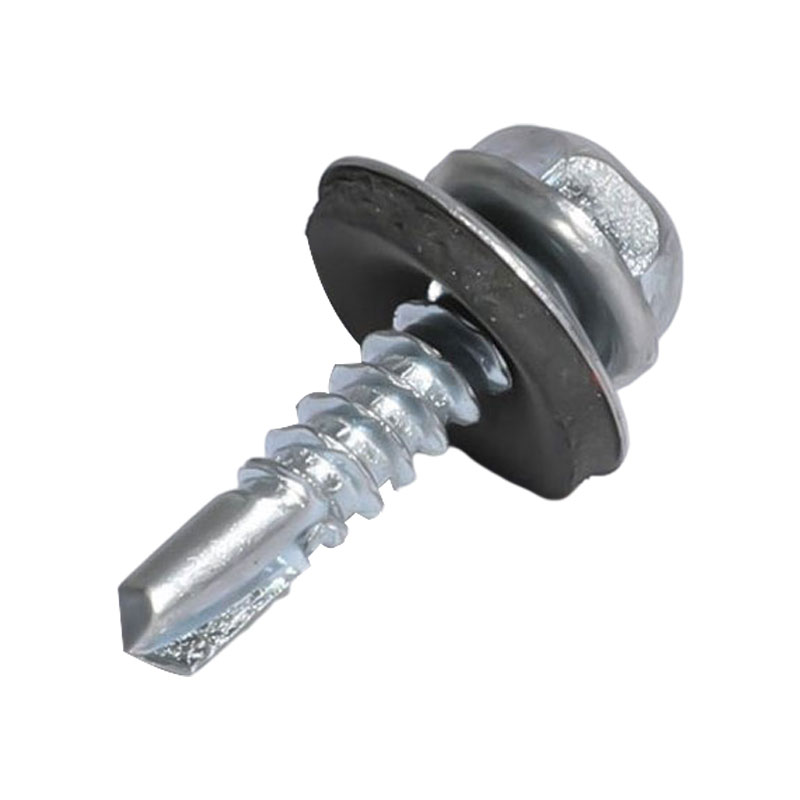
Hex washer head self drilling screw with EPDM washer head painted zinc plated
3. Main Product Advantages
3.1 One-Step Drilling and Fastening
The most visible advantage over ordinary machine screws or non-drilling sheet-metal screws is the ability to create a hole and install the fastener in one operation. This can reduce tool changes, simplify work at elevated locations, and improve productivity across repetitive fastening tasks. The benefit is particularly noticeable in roofing and cladding projects where hundreds or thousands of screws may be installed.
One-step installation does not mean that preparation is unnecessary. The installer should still confirm the material thickness, screw diameter, point style, driver speed, and torque setting. However, the self-drilling design can eliminate the need for a separate pilot-drilling stage when the application falls within the screw’s intended range.
3.2 Improved Weather Sealing
The EPDM washer provides an integrated sealing element that is more convenient than adding a loose washer during installation. A separate washer can be lost, installed incorrectly, or omitted. With an EPDM washer assembled beneath the screw head, the sealing component remains aligned with the fastener during handling and driving.
In roofing and external sheet-metal work, water management is as important as mechanical strength. A fastener hole can become a potential leak path if the head does not seal properly. The EPDM washer helps close this path while accommodating a degree of surface movement and thermal expansion. It should nevertheless be installed on a clean, reasonably flat surface, and the washer should not be reused after removal if its sealing surface has been damaged or permanently compressed.
3.3 Convenient Hex Drive
The hex washer head is suitable for socket-based installation equipment. A socket can provide strong contact with the head and reduce the risk of cam-out compared with some recess-drive systems. This advantage is important when working with harder metal panels, when a higher driving force is needed, or when installers are using powered screw guns with depth-control accessories.
Hex drive installation can also be more practical in outdoor conditions. Gloves, dust, and surface irregularities may make it difficult to position a small bit into a cross recess. A properly sized socket can offer a straightforward engagement point and support faster repetitive installation.
3.4 Choice of Diameters and Finishes
The listed diameter range gives buyers options for different panel thicknesses, clamping requirements, and visual preferences. Smaller diameters may be suitable for lighter sheet materials and lower-load fastening, while larger sizes can provide greater thread engagement and a larger clamping area when the substrate allows it.
Finish selection is also an important advantage. Zinc plating can provide a practical general-purpose surface. Yellow zinc plating may be chosen when a colored appearance or a particular procurement specification is required. Black phosphate is frequently used where appearance, paint compatibility, or indoor service conditions are important. Ruspert and Magni coatings may be considered for applications requiring enhanced surface protection, subject to the project’s corrosion requirements and testing criteria.
3.5 Broad Head and Recess Options
The production range includes hex washer head, bugle head, flat head, pan head, wafer head, and pan framing head configurations. This breadth allows the manufacturer to support different installation and appearance requirements rather than forcing every project to use one head profile.
The listed recess options include Phillips, square, and Torx. Although the featured product uses a hex washer head, the broader production capability indicates that the supplier can support multiple screw designs for different customer programs. A buyer may therefore coordinate several related fastener types through one manufacturing source, simplifying procurement and reducing the need to manage many unrelated suppliers.
4. Application Areas
4.1 Roofing and Building Envelopes
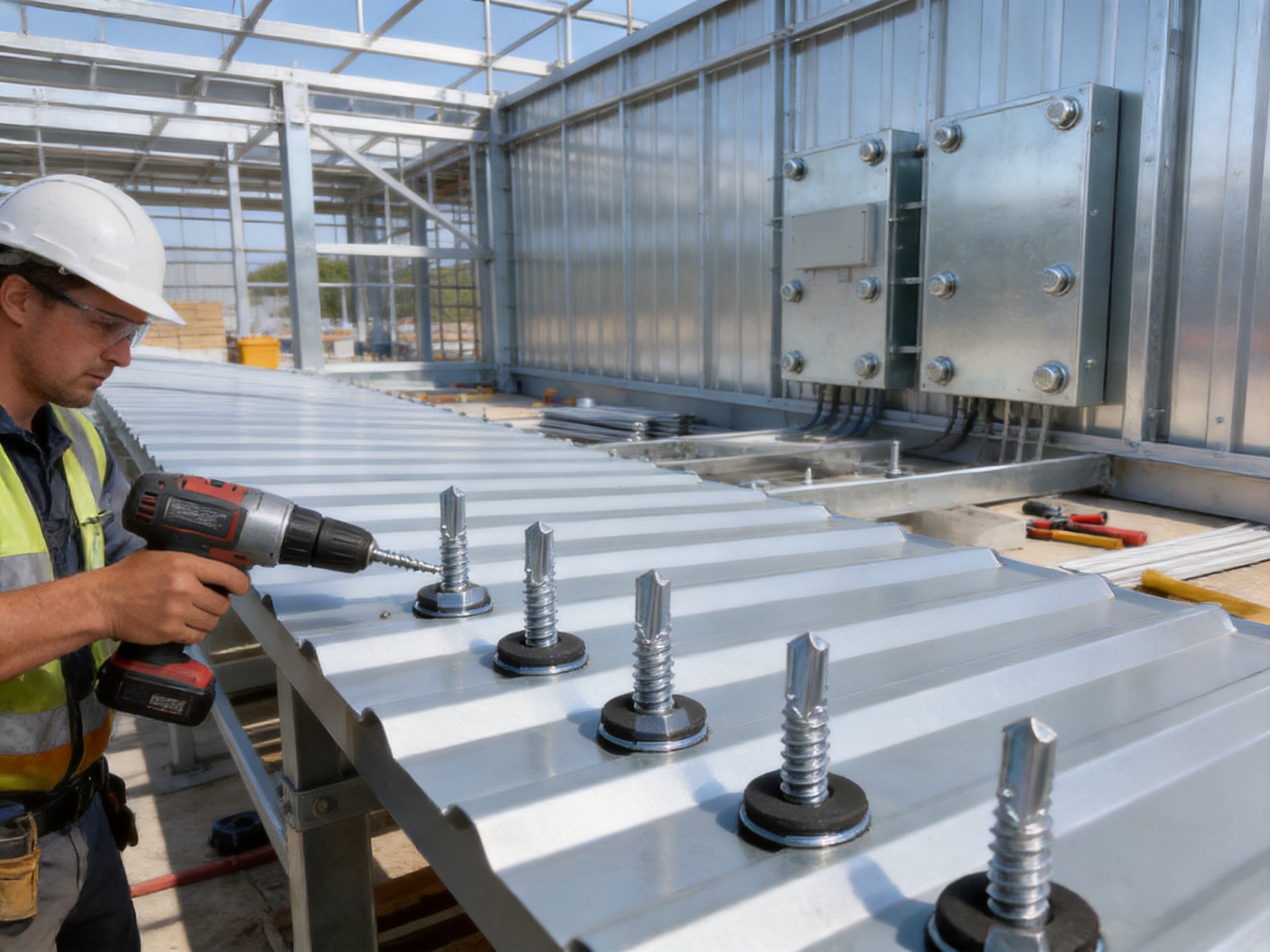
Roofing is one of the most natural applications for a self-drilling screw with an EPDM washer. Metal roofing panels, flashing, trim, and accessory components frequently require fasteners that can penetrate thin metal, provide dependable clamping, and resist water entry around the hole. The washer is especially valuable where the screw head is exposed to rain, condensation, and changing temperatures.
During roofing installation, the fastener should be placed according to the panel manufacturer’s recommended fastening pattern. It should be driven perpendicular to the panel unless the design specifically requires another orientation. The screw should not be positioned so close to an edge that the material splits, tears, or loses sufficient bearing area. Correct spacing and installation torque remain essential even when the fastener has a high-quality coating and washer.
4.2 Metal Cladding and Siding
Metal siding, wall panels, and façade components often require clean, consistent fastening. The hex washer head can provide a visible and practical connection point, while the EPDM washer can help reduce moisture penetration behind the panel. Painted finishes can also help the fastener blend with colored cladding systems.
For architectural applications, color matching may be an important consideration. The supplier should receive the required coating color, gloss level, quantity, and approval sample requirements before production. The painted surface should be examined for coverage, adhesion, uniformity, and damage caused during packaging or transportation.
4.3 Light Steel Framing
Self-drilling screws are widely used in light steel framing and interior metal-stud work. In these applications, the installer may need to join metal sections quickly without pre-drilling each connection. The correct screw point and thread form can help create a stable connection between framing members.
Not every light steel framing connection is equivalent. A nonstructural partition, a service support, and a load-bearing assembly have different design requirements. Where the connection affects structural safety, the screw diameter, length, drilling capacity, pull-out resistance, shear performance, and spacing should be specified by the project engineer or applicable standard.
4.4 HVAC, Ductwork, and Equipment Assembly
The fastener can also be considered for sheet-metal ductwork, equipment panels, enclosures, brackets, and general fabrication. The integrated drilling function can simplify assembly where components are made from compatible thin or medium-gauge metal. The EPDM washer may be useful when the connection must limit air leakage or protect against moisture.
In equipment assembly, the buyer should review temperature exposure and chemical contact. EPDM performs well in many outdoor and weathering environments, but material compatibility should be checked where the washer may contact oils, fuels, solvents, or unusual chemicals.
4.5 General Maintenance and Repair
Maintenance teams often need a fastener that is easy to carry, identify, and install. A self-drilling screw with a built-in sealing washer can reduce the number of separate components required for repairs to panels, guards, covers, and outdoor fixtures. Multiple surface and head options also make it possible to select a replacement that fits the existing installation.
Before using the screw for a repair, the installer should inspect the underlying material for corrosion, cracking, excessive enlargement of the old hole, or hidden structural damage. A new screw cannot compensate for a weak or deteriorated substrate.
5. Manufacturing Process and Technical Control
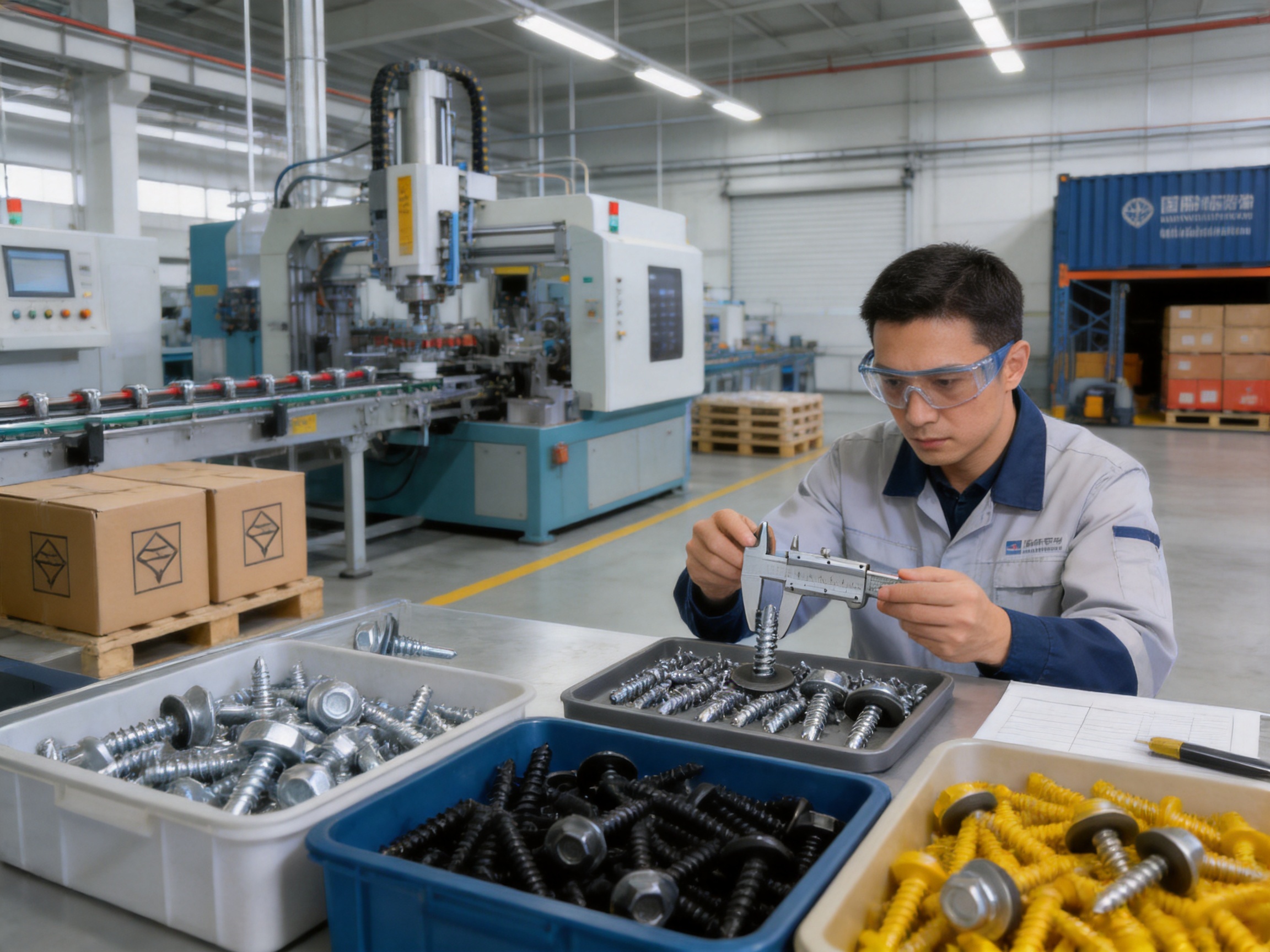
The performance of a self-drilling screw depends on the interaction of several manufactured features. The steel grade, wire preparation, head formation, thread accuracy, point geometry, coating, washer assembly, and packaging must all be controlled. Lizhan Hardware’s stated production range covers drilling screws and related fastener forms, allowing these processes to be coordinated within an established screw manufacturing program.
5.1 Material Preparation
Production begins with suitable carbon steel wire or rod corresponding to the specified grade. Material preparation may include surface cleaning, drawing, and dimensional conditioning so that the wire can be formed consistently. For C1022A fasteners, the material must support the required combination of cold-forming behavior and finished mechanical performance.
Material identification is a basic but important control point. Heat or batch information should be maintained from incoming material through production. This traceability allows the manufacturer to investigate dimensional variation, coating issues, or mechanical-test results when required by a customer.
5.2 Cold Heading and Head Formation
The screw blank is commonly formed through cold-heading operations. The process shapes the head and shank by applying controlled pressure to the prepared wire. For a hex washer head, the tooling must create the external hex profile and the underside bearing area accurately enough to accept a socket and seat the washer consistently.
Good tooling condition is essential. Worn dies can produce variation in head dimensions, burrs, uneven bearing surfaces, or imperfect transitions between the head and shank. Regular die maintenance and in-process dimensional checks help maintain repeatability over long production runs.
5.3 Thread Rolling
Threads are generally formed by rolling rather than cutting. Thread rolling displaces material to create the thread profile and can produce a strong, continuous grain structure around the thread. The process must be adjusted to the selected diameter, thread form, pitch, and intended substrate.
The listed production range includes BSD and CSD thread types. BSD, or bugle screw thread in common industry usage, and CSD, or coarse screw thread, may be selected according to the application and material being fastened. The exact thread specification should be confirmed on the purchase order, technical drawing, or approved sample because terminology can vary between markets.
5.4 Drill-Point Forming
The drilling point requires dedicated forming and inspection. Its length, cutting edges, symmetry, and transition into the thread affect the screw’s ability to penetrate metal. A properly centered point helps the screw begin drilling smoothly and reduces eccentric rotation.
Point performance should be evaluated using representative substrate materials and thicknesses. A point that works effectively in thin galvanized sheet may not be suitable for thicker or harder steel. For this reason, product selection should be based on actual application data rather than diameter alone.
5.5 Heat Treatment and Mechanical Performance
Depending on the required specification and final application, screw production may include heat treatment to achieve the necessary hardness and strength. The process must be controlled so that the screw can withstand installation torque without premature point failure, head stripping, or thread damage.
Heat treatment should be balanced carefully. Excessive hardness can make a screw brittle, while insufficient hardness may reduce drilling ability or thread performance. The appropriate process window is determined by the material, dimensions, point design, and required mechanical properties.
5.6 Surface Finishing
Surface treatment is a major part of the product’s value. The listed options include black phosphate, zinc plated, yellow zinc plated, Ruspert, and Magni. Each finish has different appearance, corrosion-resistance, friction, and application characteristics.
For a painted zinc-plated screw, surface preparation is especially important. Oil, scale, dust, and residues must be controlled before plating or painting. Coating adhesion depends on a clean and properly prepared substrate. The coating should cover the head, shank, threads, and drill point as required, while avoiding excessive buildup that could interfere with installation.
Coating thickness and uniformity should be monitored because uneven coverage can affect both corrosion performance and fit. The point and thread must remain functional after finishing. Excessive coating at the thread crest or in the socket area may increase installation resistance or prevent proper tool engagement.
5.7 EPDM Washer Assembly
The washer must be selected for the intended weathering and temperature conditions and assembled securely beneath the metal head. Its inner diameter should suit the shank, while its outer diameter and thickness should provide an adequate sealing footprint beneath the head.
Assembly control should verify that the washer is not cracked, cut, distorted, contaminated, or incorrectly positioned. The washer should remain attached during handling and installation but must still compress properly when the screw is tightened. Automated or semi-automated assembly can improve consistency for high-volume production, while visual inspection remains useful for detecting surface defects.
5.8 Inspection and Testing
A complete inspection plan can include dimensional inspection, thread-gauge checking, head and socket verification, point symmetry review, coating inspection, washer inspection, and functional installation tests. Mechanical testing may include torque, tensile, shear, and drilling-performance evaluations when required by the customer or applicable standard.
The production range references ASTM and DIN 7504K, DIN 7504P, and DIN 7504N. These designations relate to different self-drilling screw configurations and should be matched carefully to the actual head, point, and application requirements. The applicable standard should be stated clearly in technical documents to avoid confusion between similar-looking products.
6. Why Manufacturing Integration Matters
One advantage of working with a specialist screw manufacturer is the ability to coordinate several stages of production rather than purchasing unrelated components from separate sources. A supplier familiar with cold heading, thread rolling, point forming, coating, and washer assembly can review the whole fastener as a system.
This integrated approach is important because changes in one feature can affect another. For example, a thicker coating may influence thread engagement. A different washer thickness may affect the available head clearance. A harder substrate may require a different point design. A larger screw diameter may require a different forming sequence and driver specification.
Lizhan Hardware’s broad product range includes multiple head styles, recess configurations, diameters, surface finishes, and standards. This range supports product development and purchasing flexibility. A customer can communicate the required application, dimensions, finish, packaging, and quality expectations to a manufacturer with experience across related screw categories.
The company’s China manufacturing location provides access to established fastener production resources and export-oriented supply capability. Its Thailand warehouse adds a regional logistics option for customers operating in Southeast Asia or seeking shorter distribution paths for selected orders. Warehouse availability should be confirmed for each product, finish, size, and quantity before placing an urgent order.
7. Comparison with Alternative Fasteners
7.1 Compared with Standard Machine Screws
Machine screws are designed primarily for use with a pre-tapped hole or a nut. They can provide excellent controlled fastening in assemblies where threads already exist, but they are not generally intended to drill through sheet metal. Using a machine screw for an unprepared metal panel would require additional drilling and usually a nut or threaded insert.
The self-drilling screw is more efficient for direct fastening into compatible metal sheets and light steel members. It can reduce component count and installation time. However, machine screws remain preferable when a reusable threaded joint, precise clamping, or high-grade mechanical connection has been specifically designed into the assembly.
7.2 Compared with Ordinary Sheet-Metal Screws
An ordinary sheet-metal screw may have a sharp pointed tip but not a true drill point. It can be suitable for thin materials that are easy to pierce or for pre-drilled holes, but it may require more force and less predictable starting behavior in thicker metal.
The self-drilling point offers a practical advantage when the screw must penetrate metal without a separate pilot hole. The correct drill-point length still matters. If the point is too short for the combined material thickness, it may not complete the hole before the thread engages. If it is unnecessarily long, it may project farther than desired behind the assembly.
7.3 Compared with Rivets
Rivets can create strong permanent joints and are widely used in sheet-metal fabrication. They generally require access to the rear side of the joint or a specialized blind-rivet system. A self-drilling screw can often be installed from one side and later removed for maintenance.
The screw’s integrated EPDM washer also offers a sealing advantage for exposed panel connections. Rivets may require separate sealant, sealing washers, or additional design measures when water resistance is required.
7.4 Compared with Screws without Sealing Washers
A screw without a washer may be suitable for indoor or protected applications, but its head-to-panel interface may not provide the same level of weather sealing. Adding a loose washer can improve the design but creates an additional part to manage during production and installation.
The integrated EPDM washer offers convenience, repeatability, and a cleaner procurement process. It is especially suitable where the fastening point is exposed and the project requires a consistent sealing component under every screw head.
8. Installation Recommendations
Before installation, confirm the screw size, point capacity, thread type, finish, washer material, and required standard. The fastener should be matched to the total thickness and hardness of the materials being joined. If the application involves structural loads, the design engineer should verify the connection rather than relying solely on nominal screw dimensions.
Use a properly sized socket or driver. An oversized socket can damage the hex head, while an undersized socket may not seat fully and can deform the corners. The driver should be aligned with the screw axis to reduce wobble and uneven loading.
Apply sufficient pressure during the initial drilling stage to keep the point engaged with the material. Excessive pressure can damage the point or distort a thin panel. Insufficient pressure may cause the screw to spin without advancing efficiently. The correct rotational speed depends on screw diameter, substrate thickness, material hardness, and the driver being used.
Stop tightening when the EPDM washer is evenly compressed beneath the head. The washer should contact the surface around the hole without being excessively squeezed, cut, or forced outward. A washer that is visibly crushed or split should be replaced.
Avoid installing the screw at a sharp angle unless the design specifically permits it. Angled installation can reduce thread engagement, create an uneven seal, and place additional stress on the head or washer. The fastening surface should be free of heavy debris, loose rust, and sharp burrs that could damage the sealing element.
After installation, inspect the connection for head damage, washer displacement, incomplete drilling, panel distortion, and coating scratches. In exposed roofing and façade work, periodic inspection can identify loose fasteners, corrosion, damaged washers, or movement caused by thermal cycling before the issue becomes serious.
9. Selecting the Correct Specification
Diameter is only one part of the selection process. The buyer should consider material thickness, joint configuration, required thread engagement, head clearance, visible appearance, corrosion exposure, installation tool, and packaging requirements.
| Selection factor | What to review | Why it matters |
|---|---|---|
| Diameter | #6-3.5, #8-4.2, #10-4.8, #12-5.5, or #14-6.3 | Influences clamping area, thread engagement, and substrate suitability. |
| Length | Required length based on material thickness and engagement | Prevents insufficient holding power or unwanted projection. |
| Head style | Hex washer, bugle, flat, pan, wafer, or pan framing head | Determines tool access, appearance, and load distribution. |
| Recess or drive | Phillips, square, Torx, or external hex | Must match the installation tool and torque requirement. |
| Thread | BSD or CSD thread selection | Should match the substrate and required holding performance. |
| Surface | Painted zinc plated, zinc plated, yellow zinc, black phosphate, Ruspert, or Magni | Influences corrosion protection, appearance, and application suitability. |
| Washer | EPDM diameter, thickness, and assembly condition | Controls sealing contact and outdoor performance. |
| Standard | ASTM or applicable DIN 7504 configuration | Clarifies dimensional and functional expectations. |
Length is not specified in the supplied production range and should therefore be confirmed during quotation. A correct length normally provides enough thread engagement in the supporting material while avoiding unnecessary penetration. For roofing and panel work, the designer should also consider the position of purlins, framing members, insulation layers, and concealed services.
10. Quality, Packaging, and Supply Considerations
Fastener quality is not limited to the appearance of the finished screw. Consistency across the entire lot is essential. Buyers should request confirmation of dimensions, coating, washer type, applicable standard, packaging quantity, and inspection requirements before production begins.
Packaging must protect the drill points, threads, painted surfaces, and EPDM washers from damage. Screws should not be packed in a way that causes the points to rub heavily against coated heads or washers. Moisture exposure during storage and transportation should also be controlled, particularly for products intended for long-term warehouse holding.
Clear labeling supports efficient warehouse management. Labels should identify the screw diameter, length, head type, surface finish, washer material, standard, quantity, and batch or lot information where traceability is required. Consistent packaging is especially useful for distributors that handle several visually similar screw types.
Lizhan Hardware can be contacted for product discussions, quotation, and order coordination. The company’s listed contacts include Shawn and a sales office contact, with communication channels available through email, telephone, and messaging services. Buyers should provide drawings, samples, photographs, target quantities, destination, and required delivery schedule when requesting a customized offer.
11. Customization and OEM Support
Projects often require more than a standard catalog item. Customization may involve diameter, length, head geometry, drive type, point style, coating color, washer dimensions, packaging, or marking. A manufacturing supplier with a wide drilling screw range can evaluate these requirements and determine whether an existing configuration can be adapted.
For painted fasteners, color approval should be completed before mass production. The customer may need to specify a color reference, acceptable variation, gloss, coating location, and packaging protection. The appearance of a painted fastener can change depending on the underlying plating, coating thickness, lighting, and production batch, so an approved sample is useful for reference.
For the EPDM washer, the customer should specify the intended environment and sealing objective. Outdoor roofing, indoor ductwork, equipment enclosures, and chemically exposed assemblies may require different material evaluations. The washer’s dimensions should be coordinated with the head and shank so that sealing is achieved without obstructing tool engagement.
Technical documents should state whether the product is intended for general fastening, weather sealing, nonstructural panel installation, or another specific purpose. Clear application information enables the factory to recommend a suitable thread, point, finish, and inspection method.
12. Environmental and Service-Life Factors
Corrosion exposure varies substantially between indoor, rural, urban, coastal, industrial, and chemically aggressive environments. Zinc-plated or painted zinc-plated screws may be appropriate for many general applications, but the required coating system should be selected according to the expected service conditions.
Coastal locations may expose fasteners to salt-laden moisture. Industrial sites may include corrosive vapors or deposits. Roofing systems can experience repeated wet-dry cycles, temperature changes, condensation, and ultraviolet exposure. The metal coating and EPDM washer must be considered together because a fastener can fail functionally if either the metal or the seal deteriorates.
Color-coated screws should be handled carefully to avoid scratches during transportation and installation. Minor damage can expose the underlying metal and create a starting point for corrosion. Proper socket fit, controlled torque, and careful storage help preserve the protective finish.
The EPDM washer can support long-term outdoor sealing, but its service life depends on temperature, ultraviolet exposure, compression, substrate movement, and chemical contact. The washer should not be treated as a universal seal for every fluid or environment. Application-specific validation is recommended for unusual conditions.
13. Practical Advantages for Distributors and Contractors
Distributors benefit from a product that combines several high-demand features in one item. The self-drilling point, external hex head, painted zinc-plated surface, and EPDM washer make the screw suitable for multiple segments, including roofing, construction, sheet-metal fabrication, and maintenance.
A broad size and finish range can reduce the need to source similar fasteners from several manufacturers. This may simplify inventory planning, purchasing communication, technical support, and private-label or OEM development. It also makes it easier for a distributor to offer customers a coherent family of related screws.
Contractors benefit from installation efficiency and reduced component handling. The integrated washer is less likely to be forgotten than a separate sealing washer, while the external hex head can support secure installation with common socket tools. When the screw is correctly matched to the substrate, these features can contribute to faster and more consistent work.
Project owners benefit from a fastening solution designed around both mechanical attachment and weather protection. A screw that is selected correctly and installed properly can help maintain panel stability, reduce water-entry risk, and support easier future maintenance than a permanently inaccessible fastening method.
14. Common Installation and Purchasing Mistakes
One common mistake is selecting a screw based only on appearance. Two screws may look similar while having different drill-point capacities, thread forms, coating systems, or washer materials. The technical specification should always be reviewed before substitution.
Another mistake is using an unsuitable length. A screw that is too short may not develop sufficient engagement, while one that is too long may interfere with concealed components or create an unwanted projection. Length should be determined from the complete joint stack-up.
Over-tightening is also a frequent problem. Excessive torque may damage the EPDM washer, deform the panel, strip the substrate, or break the screw head. Installation equipment should be set according to product trials and project requirements.
Under-tightening can be equally harmful. If the washer does not seat properly, the connection may leak or loosen under vibration and thermal movement. Installers should inspect the washer after driving and reject any screw with a displaced, cut, or visibly damaged sealing element.
Purchasers should also avoid treating a coating name as a complete corrosion specification. The required coating thickness, test method, substrate preparation, and exposure category should be defined when corrosion performance is critical. The manufacturer can then quote the appropriate finish and quality documentation.
15. Frequently Asked Questions
Q1: What is the main purpose of the EPDM washer?
The EPDM washer helps seal the area beneath the screw head and reduce water penetration around the fastening hole. It also separates the metal head from the panel surface. Correct compression is necessary for the washer to function effectively.
Q2: Can this screw drill through any metal?
No. The screw must be matched to the material type and thickness. Self-drilling screws are designed for specific ranges of metal hardness and thickness. The drill-point capacity should be confirmed before use, especially for thick, hardened, stainless, or structural steel.
Q3: What drive tool is normally used?
The hex washer head is normally installed with a properly sized socket or nut driver. The exact tool size should be confirmed for the selected screw. Using the correct socket reduces head damage and supports controlled torque.
Q4: What diameters are available?
The stated production range includes #6-3.5, #8-4.2, #10-4.8, #12-5.5, and #14-6.3. Availability may depend on the selected length, head style, finish, washer configuration, order quantity, and production schedule.
Q5: What surface finishes can be supplied?
The listed surface options include painted zinc plated, black phosphate, zinc plated, yellow zinc plated, Ruspert, and Magni. The best choice depends on corrosion exposure, appearance, installation requirements, and the customer’s technical specification.
Q6: Is the painted zinc-plated finish suitable for outdoor roofing?
It may be suitable for many general roofing and panel applications when properly specified and installed. The final choice should consider the local environment, coating requirements, panel system, and expected service life. Coastal or industrial exposure may require a more specialized finish.
Q7: What thread types are listed for the production range?
The listed thread options are BSD thread and CSD thread. The customer should confirm the intended thread designation and substrate before ordering because thread terminology and application preferences may vary between markets.
Q8: Does the product comply with ASTM or DIN requirements?
The production information references ASTM and DIN 7504K, DIN 7504P, and DIN 7504N. The applicable standard must be confirmed for the exact screw configuration. A buyer should request the relevant technical details and inspection requirements for the selected product.
Q9: Can the screw be customized?
Potential customization areas include diameter, length, head style, recess or drive, thread, surface finish, washer dimensions, color, and packaging. Custom requirements should be submitted with drawings, samples, application details, and target quantities so the factory can evaluate them accurately.
Q10: Where is the product manufactured and supplied?
The company identifies a China factory in Haiyan, Jiaxing, Zhejiang, and a Thailand warehouse in Chonburi. Customers should confirm whether the required size and finish are produced or stocked at a particular location before arranging shipment.
Q11: Can the screw be reused after removal?
Reuse is generally not recommended for applications where sealing and reliable mechanical performance are important. The drill point, threads, coating, and EPDM washer may be damaged during the first installation or removal. A new fastener and washer assembly is normally the safer choice.
Q12: How should the screw be stored?
Store the screws in a dry, clean location protected from condensation, direct weather exposure, chemicals, and mechanical damage. Keep original packaging intact when possible and rotate stock according to the supplier’s recommended storage practice.
16. Ordering Checklist
When requesting a quotation, provide the product name and application, required diameter, length, head style, drive type, thread type, surface finish, washer material, color, applicable standard, packaging quantity, estimated annual volume, and delivery destination.
For roofing or cladding projects, also provide the panel material, panel thickness, supporting material, environmental exposure, desired color, and installation method. These details allow the manufacturer to recommend a screw that is more likely to perform correctly than a selection based on size alone.
For OEM projects, include drawings or samples showing head dimensions, point geometry, thread specifications, washer profile, coating requirements, and packaging artwork. Confirm the approval process before mass production, including sample approval, first-article inspection, and any required performance testing.
17. Conclusion
The hex washer head self-drilling screw with EPDM washer is a practical fastening solution for applications requiring efficient drilling, secure clamping, weather sealing, and a finished appearance. Its self-drilling point can reduce installation steps, the hex washer head supports positive socket engagement, and the EPDM washer helps protect the fastening point from water entry.
Compared with ordinary screws, the product offers a more complete installation system by combining drilling and fastening functions with an integrated sealing component. Compared with separate screw-and-washer combinations, it can simplify handling and improve assembly consistency. The range of diameters, head styles, threads, finishes, and standards also supports use across roofing, metal cladding, light steel framing, ductwork, equipment assembly, and maintenance.
The value of the product depends on manufacturing control as much as on its visible design. Material preparation, cold heading, thread rolling, drill-point forming, heat treatment, surface finishing, washer assembly, inspection, and packaging must work together. Lizhan Hardware Co., Ltd.’s broad drilling screw production range, China factory, and Thailand warehouse provide a supply structure suitable for standard orders, recurring distribution, and selected customized programs.
For the best result, buyers should specify the complete application rather than ordering by diameter alone. The correct length, point capacity, thread, coating, washer, standard, and installation method should be confirmed before production and field use. When properly selected and installed, this fastener can provide an efficient, clean, and weather-conscious connection for a wide range of metal construction and industrial applications.
References
ASTM International. Standards and Technical Guidance for Steel Fasteners and Mechanical Testing.
DIN 7504K. Self-Drilling Screws with Hexagon Washer Head.
DIN 7504P. Self-Drilling Screws with Countersunk or Related Head Configuration.
DIN 7504N. Self-Drilling Screws with Pan Head Configuration.
International Organization for Standardization. General Principles for Fastener Dimensions, Testing, and Quality Control.
Engineering reference literature on carbon steel fasteners, cold heading, thread rolling, protective coatings, and EPDM sealing materials.