In modern manufacturing and distribution, packaging is no longer a simple container used only to hold a product. It is a functional system that protects goods, communicates quality, improves warehouse efficiency, supports retail display, and helps buyers make faster purchasing decisions. A well-designed color box can make a product easier to identify, safer to transport, more attractive on the shelf, and more reliable in the hands of distributors, retailers, and end users.
The color box is especially important for hardware products, home tools, fasteners, stamping parts, and other industrial or semi-industrial goods. These items may be small, sharp, heavy for their size, or sold in sets with different specifications. Without a strong and well-printed box, products can be scratched, mixed, rusted, lost, or misunderstood by customers. A carefully engineered color box solves these problems by combining structural strength, print clarity, product information, and brand presentation in one compact packaging solution.
Lizhan Hardware Co., Ltd. provides color box packaging designed to support product protection, visual presentation, and efficient delivery. With experience serving hardware-related product categories, the company understands that packaging for screws, fasteners, furniture fittings, machine components, and tool accessories must do more than look attractive. It must be practical, durable, easy to pack, and compatible with the demands of export logistics, warehouse handling, and retail distribution.
This article explores the value of the color box as a packaging product, explains its advantages over ordinary packaging alternatives, and describes the manufacturing strengths and process capabilities that help create consistent, reliable, and market-ready packaging.
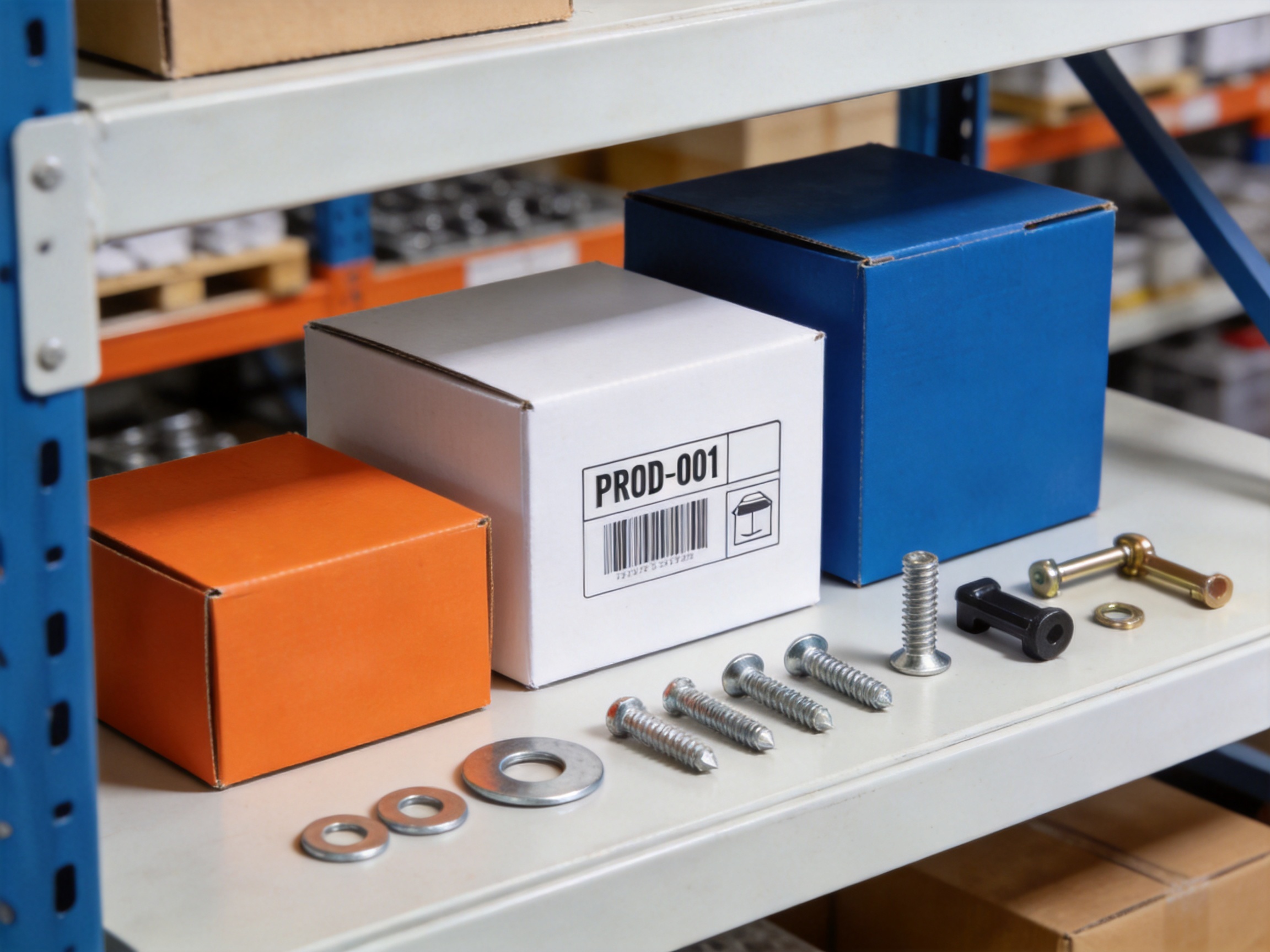
The Role of the Color Box in Product Packaging
A color box is a printed paperboard or corrugated packaging box designed to protect and present a product. It usually includes product names, specifications, images, instructions, barcodes, safety information, brand colors, and other marketing or operational details. Compared with plain cartons or simple plastic bags, a color box provides a higher level of communication and a more professional appearance.
For hardware and tool-related products, the color box plays several important roles. First, it separates products by model, size, material, or application. This is essential for items such as screws, bolts, furniture connectors, stamping parts, and accessories that may look similar but have different dimensions or functions. Clear printed information helps buyers select the correct item and reduces the possibility of order errors.
Second, the color box protects products during storage and transportation. Hardware products may be dense and may create pressure points inside the package. A weak box can collapse, tear, or open during shipping. A properly designed color box uses suitable board thickness, folding structure, adhesive strength, and inner support to improve resistance to compression, vibration, and repeated handling.
Third, the color box improves retail value. Customers often judge product quality before opening the package. Clean printing, accurate colors, smooth surfaces, and strong structure create confidence. For products sold through stores, online platforms, distributors, or wholesale channels, packaging quality can directly influence purchasing decisions and repeat orders.
Finally, the color box supports logistics and inventory management. Printed barcodes, QR codes, product codes, quantity labels, batch information, and multilingual instructions help distributors and warehouses process goods quickly. When packaging is standardized, workers can stack, count, scan, and ship products with less confusion.
Why Color Box Packaging Matters for Hardware and Fastener Products
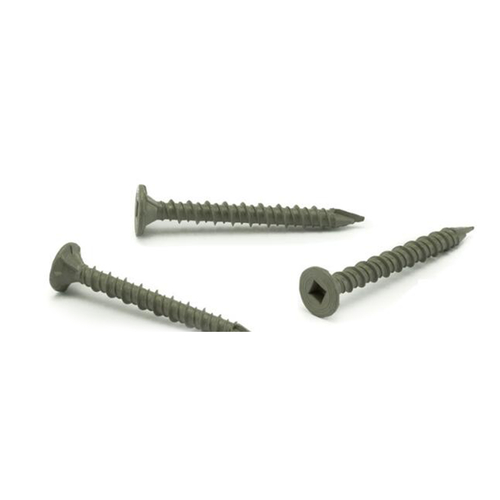
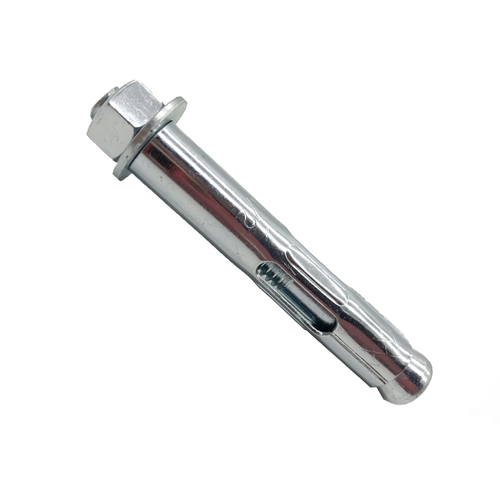
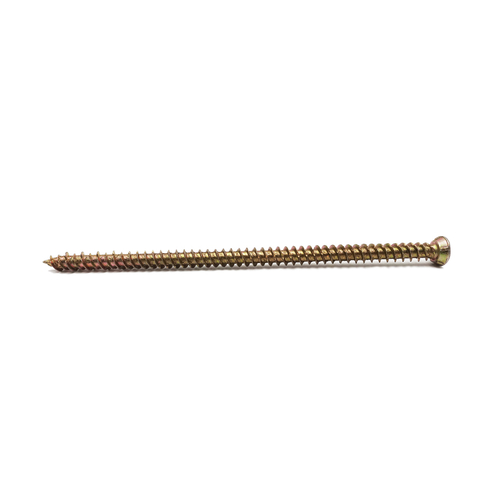
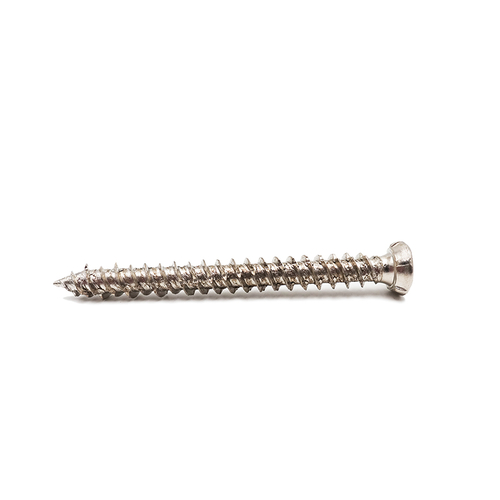
Hardware packaging faces different challenges from packaging for lightweight consumer goods. Screws, machine screws, furniture screws, nuts, washers, anchors, brackets, hinges, stamped components, and small tools can be compact but heavy. Their edges may damage thin packaging. If the package is not designed correctly, the product may move inside the box, break through corners, or create dust and abrasion marks.
A professional color box must therefore balance appearance and engineering. It should look attractive, but it must also be able to carry real weight. For example, a box used for screws may require reinforced locking flaps, a heavier board grade, or a compact internal layout to prevent shifting. A box used for home tools may need a hanging hole, display window, internal tray, or printed operating instructions. A box used for stamping parts may require anti-scratch separation, moisture-resistant coating, or export carton compatibility.
The best color boxes are designed according to the actual product, not copied from a generic template. Factors such as product weight, sharpness, quantity per box, sales channel, shelf space, export distance, climate, and customer handling habits should be considered during the design stage. This product-focused approach is one of the key advantages that separates high-quality color box packaging from low-cost, ordinary packaging.
Core Advantages of a Well-Made Color Box
A premium color box offers a combination of protective, commercial, and operational benefits. The following advantages are particularly valuable for manufacturers, importers, wholesalers, and retailers dealing with hardware and industrial products.
Stronger Product Protection
Protection begins with the correct selection of paperboard. Depending on product weight and shipping requirements, the box may use coated paperboard, white card, kraft board, micro-corrugated board, or laminated structures. For heavier hardware items, stronger board and precise folding design help prevent deformation. The corners, bottom lock, side seams, and flaps must be strong enough to hold the product securely.
Compared with simple paper sleeves or thin bags, a color box reduces the risk of product loss and surface damage. It also helps separate the product from dust, moisture, and friction during transportation. When combined with inner bags, dividers, trays, or protective inserts, the color box becomes part of a complete packaging protection system.
Better Shelf Presentation
A color box gives the product a professional visual identity. Clear graphics, consistent color matching, and attractive layout make the product easier to recognize. In competitive markets, customers may compare several similar products at the same time. Packaging that looks organized and trustworthy can influence the final purchasing decision.
For fasteners and tools, professional packaging also helps reduce the perception that the product is generic or low-value. Even simple products can appear more reliable when packaged in a clean, strong, and informative box. This is especially important for export markets, private-label projects, and retail-ready product lines.
Improved Information Communication
A color box provides space for essential product information. This can include size, material, surface treatment, quantity, application, installation method, warning notices, origin information, batch codes, barcode labels, and customer service details. When this information is printed clearly, customers can quickly understand the product and use it correctly.
For technical products, information accuracy is a competitive advantage. A fastener package that clearly shows diameter, length, head type, drive type, finish, and application can prevent misuse. A tool accessory package that shows compatible equipment or operating instructions helps customers avoid mistakes. Good packaging reduces after-sales questions and increases user satisfaction.
Higher Logistics Efficiency
Color boxes can be designed to fit master cartons, pallets, and shipping containers efficiently. Proper sizing reduces wasted space and improves stacking stability. Standardized dimensions also help warehouses manage inventory more effectively. When boxes are easy to open, close, count, and scan, packing and distribution operations become faster.
For export shipments, efficient packaging design can reduce freight cost per unit. Even small improvements in box dimensions can make a major difference when products are shipped in large quantities. A professional packaging supplier considers not only the single product box but also the entire logistics chain.
Customizable Branding and Private Label Support
Color boxes are ideal for private-label packaging. Importers, wholesalers, and retailers can customize artwork, language, barcode systems, product naming, and market-specific information. This makes it easier to build a consistent product series and serve different sales channels.
Customization may include matte or glossy lamination, spot UV, embossing, foil stamping, window patching, special coating, hanging holes, easy-tear openings, and tamper-evident features. However, customization should always be balanced with function and cost. A successful color box is not only beautiful but also practical for packing, shipping, and selling.
Comparison with Common Packaging Alternatives
Many products can be packed in plain cartons, plastic bags, blister packs, or simple labels. Each solution has its use, but a color box offers advantages when products require stronger presentation, better protection, and clearer information. The following table summarizes the main differences.
| Packaging Type | Main Strength | Common Limitation | Color Box Advantage |
|---|---|---|---|
| Plain Carton | Low cost and simple bulk protection | Limited visual appeal and product information | Provides printed branding, model details, and retail-ready appearance |
| Plastic Bag | Lightweight and economical | Weak structure and limited protection for sharp or heavy parts | Improves rigidity, stacking, and product separation |
| Blister Pack | Displays the product clearly | Can be costly and less flexible for heavy hardware | Offers better print area, easier stacking, and recyclable paper-based options |
| Label-Only Packaging | Fast and basic identification | May look less professional in retail channels | Creates a complete visual and informational packaging system |
| Premium Color Box | Combines protection, presentation, and information | Requires careful design and manufacturing control | Supports market differentiation, logistics efficiency, and customer confidence |
Design Elements That Define a High-Quality Color Box
A high-quality color box depends on much more than colorful printing. It requires coordination between structural design, material selection, printing technology, finishing, and quality inspection. Each element contributes to the final performance of the package.
Structural Design
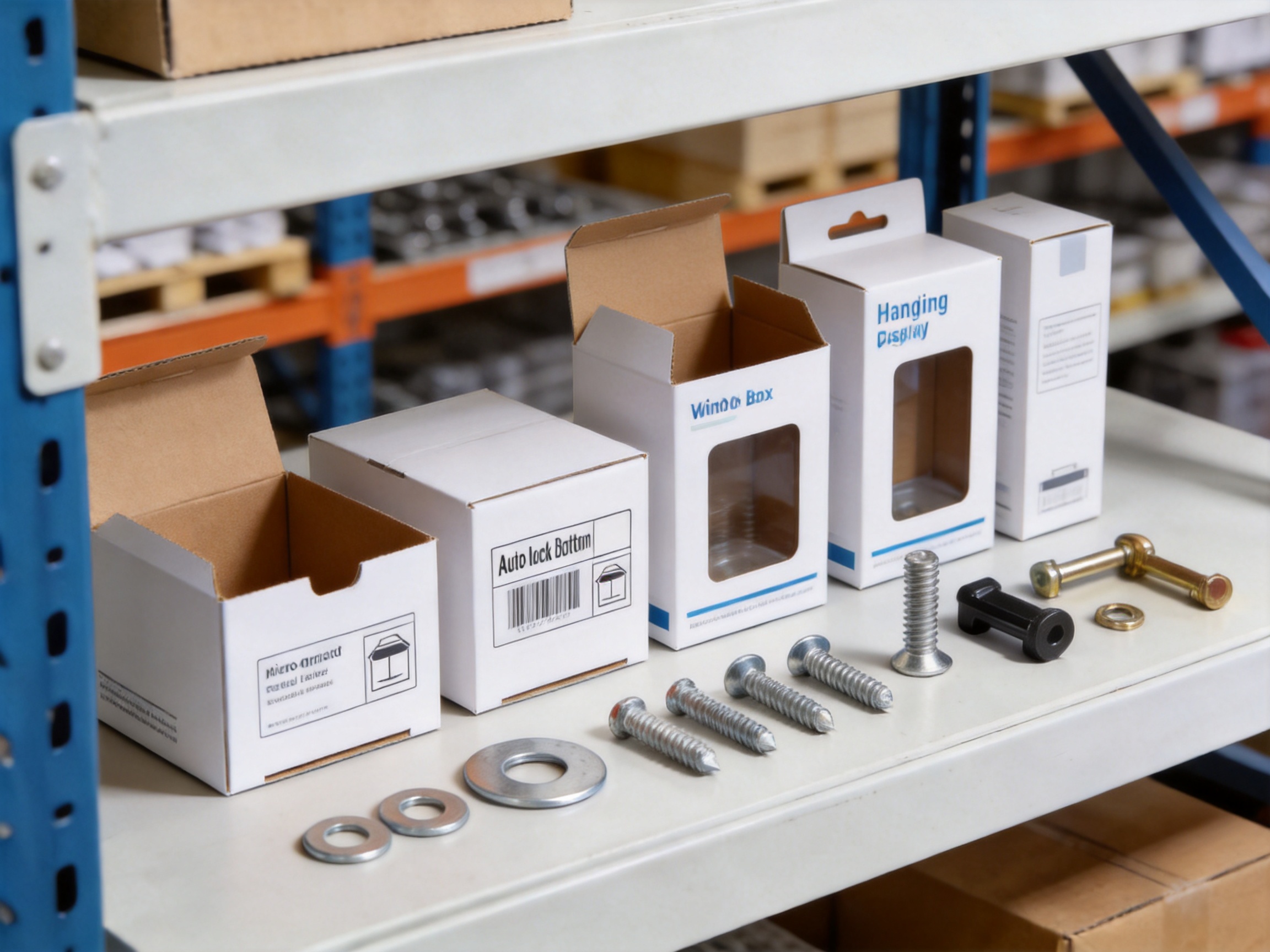
The structure determines how the box opens, closes, carries weight, and protects the product. Common structures include tuck-end boxes, auto-lock bottom boxes, sleeve boxes, window boxes, hanging display boxes, drawer-style boxes, and micro-corrugated retail boxes. The best structure depends on the product’s shape, weight, and sales environment.
For heavy fasteners, an auto-lock bottom may provide better load-bearing capacity than a simple tuck bottom. For small tool accessories, a hanging hole may help retail display. For stamping parts, a stronger rectangular structure may reduce internal movement. Structural design must also consider how workers will pack the product. If a box is difficult to assemble, production efficiency decreases and labor costs increase.
Material Selection
Material choice affects strength, print quality, surface feel, and environmental performance. Coated white card is suitable for clean, high-resolution printing. Kraft paper provides a natural appearance and good strength. Micro-corrugated board improves compression resistance while maintaining a retail-friendly shape. Laminated materials may be used when both strength and premium appearance are required.
For export markets, humidity and handling conditions should be considered. If a package will pass through long-distance sea freight, warehouse storage, or humid environments, the board and surface treatment should be selected accordingly. A low-grade board may save cost at first but can lead to box deformation, customer complaints, or product returns.
Printing Accuracy
Printing quality is one of the most visible signs of packaging professionalism. Clear text, accurate registration, stable color, and clean images help create trust. Poor printing can make even a high-quality product appear unreliable. For technical products, small text such as sizes, instructions, and barcode information must remain readable.
Color management is especially important for customers with private-label requirements. Brand colors should remain consistent from one batch to another. This requires careful control of artwork files, proofing, ink density, printing equipment, and inspection standards.
Surface Finishing
Surface finishing improves appearance and durability. Gloss lamination creates bright colors and a smooth surface. Matte lamination provides a refined, modern look. Varnish can protect printed areas from scuffing. Spot UV can highlight logos or product names. Embossing and foil stamping can add premium visual impact.
For hardware products, finishing should not be selected only for decoration. It should also support handling durability. Boxes may rub against each other during transportation. A suitable coating can reduce scratches and keep the package looking clean when it reaches the customer.
Ease of Assembly and Packing
A good color box must be practical on the packing line. If the box is difficult to fold or lock, workers may slow down, make mistakes, or damage the box. Efficient box design reduces packing time and improves consistency. For high-volume production, small design improvements can create meaningful savings.
Pre-glued side seams, accurate creasing, smooth folding lines, and reliable locking tabs all contribute to easier assembly. The package should also be easy for end users to open without damaging the product or losing small parts.
Advanced Manufacturing Process for Color Boxes
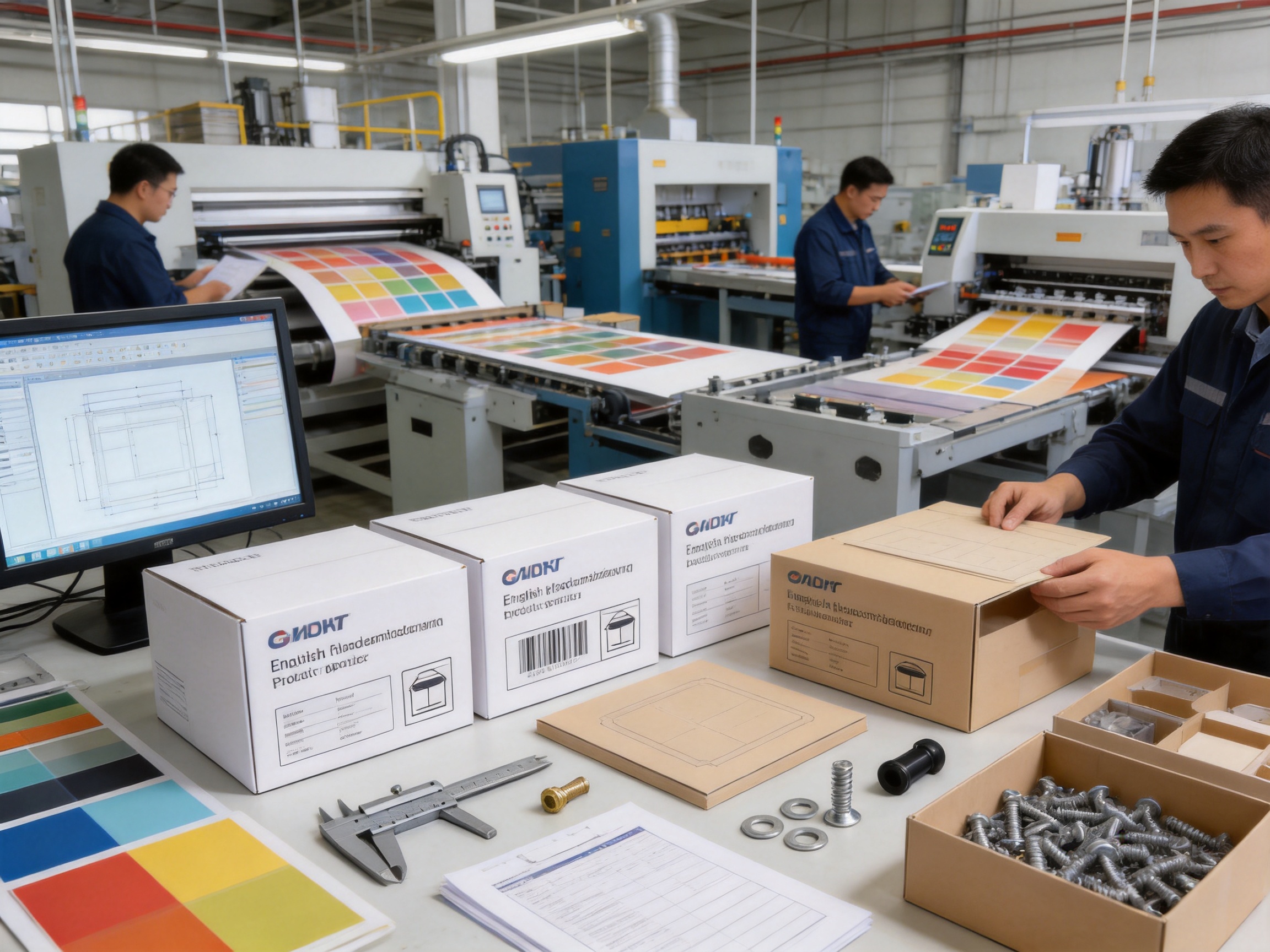
Producing a reliable color box requires a controlled manufacturing process from design to delivery. The process begins with product analysis and continues through artwork preparation, material selection, printing, die-cutting, gluing, inspection, and packing. Lizhan Hardware Co., Ltd. applies a manufacturing mindset shaped by hardware production requirements, where precision, consistency, and practical performance are essential.
Product Requirement Analysis
The first step is to understand the product that will be packed. Important information includes product dimensions, unit weight, quantity per box, surface sensitivity, sales channel, transport method, and expected storage conditions. Packaging for screws may require different strength and labeling than packaging for a tool set or stamped metal part.
By analyzing the product before designing the box, the manufacturer can avoid common problems such as undersized packaging, weak bottoms, unclear labeling, or inefficient carton loading. A box that looks acceptable in a sample room may fail if it is not tested against real product weight and shipping conditions.
Dieline and Structural Development
After product analysis, engineers create a dieline. The dieline defines the cutting lines, folding lines, glue areas, flap positions, locking tabs, and printing boundaries. It is the technical foundation of the box. A precise dieline ensures the box can be cut, folded, glued, and assembled correctly.
Modern packaging development often uses computer-aided design to create accurate structures before physical sampling. Digital design reduces trial-and-error and helps customers visualize the final packaging. For complex products, sample boxes can be made and tested before mass production.
Artwork Preparation and Prepress Control
Artwork preparation includes layout design, color separation, font checking, barcode verification, image resolution control, and printing file preparation. Errors at this stage can cause costly rework, so careful checking is important. Product specifications, quantities, and language requirements must be reviewed before printing plates are made.
For international customers, artwork may need to support different languages, regulatory markings, and retailer standards. Accurate prepress control helps ensure that the printed box matches approved customer files and avoids confusion in the market.
Material Cutting and Printing
Once materials and artwork are approved, printing begins. Depending on the order requirements, printing may use offset, flexographic, or other suitable methods. Offset printing is commonly used for high-quality color graphics and detailed text. Flexographic printing may be suitable for certain corrugated or larger-volume applications.
During printing, ink density, color consistency, registration, drying, and surface cleanliness must be controlled. If colors shift during production, boxes from the same batch may look inconsistent. Quality control during printing helps maintain a uniform appearance across the whole order.
Lamination, Coating, and Finishing
After printing, surface finishing may be applied. Lamination protects the print and improves visual effect. Varnish can add scuff resistance. Spot UV, embossing, and foil stamping may be added for premium packaging. The finishing process must align precisely with printed graphics to avoid misalignment.
For hardware packaging, finishing should be chosen with durability in mind. A box may pass through manual packing, carton loading, long-distance shipping, shelf display, and customer handling. The surface should remain readable and presentable throughout these stages.
Die-Cutting and Creasing
Die-cutting shapes the printed sheet into the final box layout. Creasing forms the folding lines. Accuracy in this stage is essential. If cutting is misaligned, the box may not fold correctly. If creasing is too shallow, the board may crack during folding. If creasing is too deep, the structure may weaken.
High-quality die-cutting creates clean edges, accurate windows or hanging holes, and smooth folding performance. For color boxes containing heavy products, the bottom and side structures must be cut and creased accurately to maintain strength.
Folding and Gluing
After die-cutting, boxes are folded and glued where required. Glue strength must be sufficient to resist opening during packing and transportation. The amount of glue should be controlled to avoid weak bonding or messy overflow. Accurate folding ensures that the box remains square and easy to assemble.
For production efficiency, many color boxes are supplied flat and pre-glued, allowing customers to open and pack them quickly. This reduces shipping space and supports high-speed packing operations.
Inspection and Packing
Final inspection checks printing quality, color consistency, structural accuracy, glue strength, folding performance, surface cleanliness, quantity, and packing condition. Defective boxes may cause problems during customer packing or retail sales, so inspection is a vital part of the process.
Finished color boxes are usually packed flat in outer cartons. Proper packing prevents bending, moisture exposure, edge damage, and surface scratches. For export orders, carton strength and labeling should support long-distance transportation and warehouse management.
Manufacturing Strengths Supporting Reliable Color Box Supply
A packaging supplier’s value is measured not only by the appearance of a sample but also by the ability to deliver consistent quality across repeat orders. Lizhan Hardware Co., Ltd. serves product categories such as fasteners, home tools, stamping parts, and packaging, which gives the company a practical understanding of how packaging must perform for industrial and retail markets.
Experience with Hardware Product Requirements
Packaging for hardware products requires special attention to weight, shape, abrasion, and specification accuracy. A supplier familiar with these products can design boxes that better match real use conditions. For example, screw packaging must account for high density, sharp thread edges, and size identification. Tool packaging may require stronger display features and user instructions. Stamping part packaging may need better separation and scratch protection.
This experience helps avoid packaging that looks attractive but fails during handling. It also supports more practical communication between the customer and packaging team, because the supplier understands the product application and typical buyer expectations.
Integrated Product and Packaging Perspective
Because the company operates within hardware-related manufacturing and supply, packaging can be considered as part of the product value chain rather than a separate afterthought. This integrated perspective helps align packaging size, product count, carton loading, labeling, and export documentation.
For customers sourcing both hardware products and packaging support, integrated coordination can reduce communication time and improve consistency. Packaging decisions can be made with direct reference to the product’s physical characteristics and market positioning.
Customization for Different Markets
Different markets may require different packaging styles. A wholesale customer may prefer simple but strong color boxes with clear product codes. A retail customer may need bright graphics, hanging holes, barcodes, and multilingual instructions. An online seller may require packaging that protects the product during parcel delivery and still looks good when opened by the buyer.
Custom packaging allows the same product to be adapted to different sales channels. This flexibility is an important competitive advantage. Instead of forcing customers to use one standard box, a capable supplier can develop packaging according to project requirements.
Quality Control Mindset
Packaging quality control must be systematic. It should not rely only on visual checking at the end. Good control begins with material selection, continues through printing and finishing, and ends with final inspection. Critical points include board thickness, moisture content, color accuracy, registration, crease depth, glue strength, and dimensional tolerance.
When packaging is used for export, consistency matters even more. A buyer may receive thousands of boxes in one shipment. If only a small percentage have weak glue or incorrect printing, the problem can disrupt packing operations. A disciplined quality control process reduces these risks.
Support for Efficient Communication
Packaging development often requires multiple details: artwork files, measurements, product photos, sample approval, carton packing method, and delivery schedule. Clear communication helps avoid mistakes. Lizhan Hardware Co., Ltd. provides direct contact channels for business communication, allowing customers to discuss specifications, customization, and order requirements efficiently.
Efficient communication is especially important for custom packaging, because small changes in size, printing, or structure can affect cost and production. A responsive supplier can help customers adjust designs before production begins, saving time and reducing risk.
Competitive Advantages Over Ordinary Color Box Suppliers
Many suppliers can print a box, but not every supplier can create packaging that fits the product, supports logistics, and strengthens market positioning. A strong color box supplier offers advantages in design thinking, material application, technical control, and customer-oriented service.
Product-Specific Engineering Instead of Generic Templates
Generic packaging may appear inexpensive, but it often creates hidden costs. If the box is too weak, products may be damaged. If it is too large, shipping space is wasted. If the printed information is unclear, customers may make mistakes. Product-specific engineering addresses these issues from the beginning.
For hardware products, a few millimeters in box size can affect how many units fit into a master carton. A small improvement in bottom structure can prevent failure under product weight. A better label layout can reduce warehouse errors. These practical details create real value.
Balance Between Cost and Performance
The lowest-cost box is not always the most economical solution. A box that fails during shipping can cause replacement costs, customer complaints, lost sales, and brand damage. On the other hand, excessive packaging can increase material and freight costs unnecessarily. A professional supplier helps find the correct balance.
This balance is achieved by selecting suitable materials, optimizing dimensions, choosing practical finishing, and avoiding unnecessary complexity. The goal is to deliver the required protection and presentation at a competitive total cost.
Stable Appearance Across Repeat Orders
For brand owners and private-label customers, repeat consistency is essential. Customers expect the same product line to look the same across batches. Color variation, layout changes, or inconsistent finishing can weaken brand image. A supplier with strong prepress and production control can better maintain consistency over time.
Stable packaging appearance also helps retailers maintain shelf uniformity. When products are displayed together, inconsistent packaging can make the product line look unorganized. Consistency supports professional presentation.
Better Suitability for Export and Distribution
Export packaging must survive complex handling conditions. Products may pass through factories, domestic transport, ports, containers, customs warehouses, distribution centers, retail stockrooms, and final delivery. A color box designed only for local short-distance handling may not be enough.
Export-suitable boxes consider compression, moisture, vibration, stacking, carton packing, and palletization. This is particularly important for heavy small items such as fasteners, where total carton weight can be high. Strong packaging helps maintain product condition throughout the distribution chain.
Enhanced Value for Retail and E-Commerce
Retail and e-commerce both require packaging that performs well visually and physically. In retail, the box must attract attention and communicate information quickly. In e-commerce, the box may be part of the unboxing experience and must also withstand parcel delivery. A color box can be designed to meet both needs by combining clear graphics, strong structure, and practical opening features.
For online sellers, packaging quality can influence customer reviews. A damaged or unattractive package may create a negative impression even if the product itself is acceptable. A strong, well-printed color box helps customers feel that they received a reliable and professional product.
Applications of Color Boxes Across Product Categories
The color box is highly adaptable and can be used for many product types. Its structure, material, and printing can be adjusted according to the application.
Fasteners and Screws
Fasteners such as machine screws, furniture screws, bolts, nuts, washers, and anchors benefit greatly from color box packaging. These products require accurate size identification and strong containment. The box can show specification details such as diameter, length, head type, drive type, material, finish, and quantity. This reduces confusion and improves customer selection.
For bulk fastener packaging, the box should resist tearing and bottom failure. For retail fastener packaging, visual clarity and barcode placement are important. A color box can support both needs by combining strength and printed information.
Home Tools
Home tools and accessories need packaging that communicates function and reliability. A box may include product images, usage instructions, safety warnings, and compatibility information. For retail display, hanging holes or window features may be useful. For tool sets, internal trays or compartments can keep components organized.
Color boxes help home tool products appear more complete and giftable. They also protect tools from scratches and improve shelf appeal.
Stamping Parts
Stamping parts may have specific shapes, edges, or surface finishes that require careful packaging. A color box can be combined with inner partitions, paper wraps, or protective bags to reduce scratching and movement. Printed part numbers and batch information help with industrial inventory control.
For customers ordering multiple stamping part models, clear packaging identification can reduce assembly mistakes and improve production efficiency.
Small Hardware Kits
Kits containing mixed screws, washers, brackets, clips, or installation accessories require organized packaging. A color box can hold inner bags or small compartments, while the outside print can list the contents and application. This is useful for furniture assembly kits, repair kits, and DIY hardware sets.
Good kit packaging prevents missing parts and improves the customer experience. It also helps retailers sell complete solutions rather than loose components.
Promotional and New Product Packaging
When launching a new product, packaging is a key part of market introduction. A color box can highlight product features, instructions, selling points, and brand identity. Compared with plain packaging, it gives the product a stronger first impression and helps distributors present it to buyers.
For promotional hardware or tool products, the box can include campaign graphics, seasonal designs, or special labels. This flexibility makes color boxes useful for product launches and marketing activities.
Sustainability and Responsible Packaging Considerations
Many buyers now pay closer attention to packaging sustainability. Paper-based color boxes can support more responsible packaging strategies when materials are selected carefully and designs are optimized. Reducing unnecessary plastic, choosing recyclable board, and avoiding excessive packaging are practical steps.
Sustainability should be approached with balance. The package must still protect the product. If weak packaging causes product damage, the environmental cost of replacement, reshipping, and waste may be greater than the savings from using less material. A responsible color box design uses the right amount of material to provide adequate protection without unnecessary excess.
Ink and coating choices can also affect environmental performance. Water-based coatings, recyclable paperboard, and simplified finishing can support sustainability goals. Customers may request packaging designs that align with regional regulations or retailer requirements. A flexible supplier can help adjust material and finishing options according to these goals.
How to Develop a Custom Color Box Project
Developing a custom color box is most successful when the customer and supplier exchange complete information early. The following steps can help create a smooth project.
Step One: Define the Product and Sales Channel
The customer should provide product dimensions, weight, photos, quantity per box, and intended market. It is also useful to explain whether the product will be sold in retail stores, online platforms, wholesale cartons, or industrial supply channels. The sales channel affects design priorities.
Step Two: Select the Box Structure
The structure should match product weight and user experience. A small lightweight item may use a tuck-end box. A heavier item may need an auto-lock bottom or micro-corrugated structure. A retail product may need a display hole or window. The structure should also support efficient packing.
Step Three: Confirm Materials and Finish
Material and finishing choices should be based on protection, appearance, budget, and sustainability. Customers may compare several options before approval. Sampling is useful when the product is heavy, sharp, or unusually shaped.
Step Four: Prepare Artwork
Artwork should include all required text, graphics, barcodes, warnings, and specifications. Technical details must be checked carefully. For fasteners and hardware products, incorrect size or quantity information can cause serious customer dissatisfaction.
Step Five: Review Samples
Samples allow the customer to check size, folding, product fit, printing, and appearance. If the box will be used for export or heavy products, basic handling and stacking tests may be performed. Adjustments should be made before mass production.
Step Six: Begin Mass Production and Inspection
After approval, production can begin. During production, quality checks help ensure that the finished boxes match the approved sample. Final packing should protect the boxes during shipment to the customer.
Quality Testing and Performance Evaluation
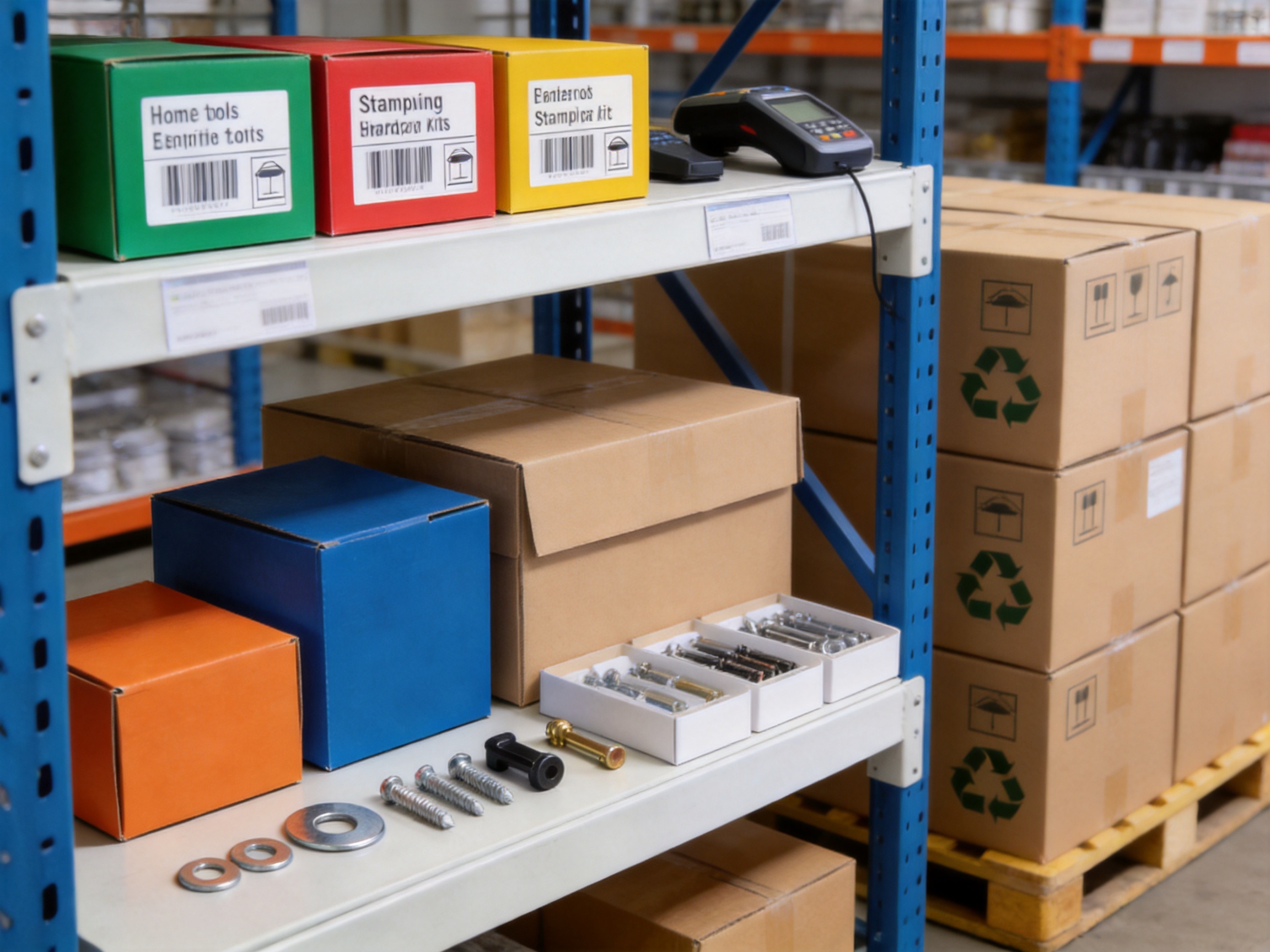
Quality testing helps confirm that the color box can perform in real conditions. The exact tests depend on the product and customer requirements, but several checks are commonly useful.
Dimensional Accuracy
The box should match the approved size and allow the product to fit correctly. If the box is too tight, packing becomes difficult. If it is too loose, the product may move and cause damage. Dimensional accuracy also affects carton loading and palletization.
Folding and Assembly Test
The box should fold smoothly along crease lines without cracking. Locking tabs should hold properly. Workers should be able to assemble the box quickly and consistently. Assembly testing is important for high-volume packaging operations.
Load-Bearing and Bottom Strength
For heavy products such as fasteners, the bottom of the box must hold the product weight. Testing can include filling the box with the intended product quantity and lifting, shaking, or stacking it to observe performance.
Print and Barcode Verification
Text should be clear and free from errors. Barcodes should scan reliably. Color should match approved standards as closely as possible. For export packaging, language and regulatory markings should be reviewed carefully.
Surface Durability
The printed surface may be rubbed during transportation. Surface durability checks help determine whether lamination or varnish is adequate. A package that arrives with scratched or faded printing may reduce customer confidence.
Carton Loading and Transport Simulation
Boxes should fit efficiently into master cartons without excessive empty space. For export or e-commerce products, simple drop, vibration, and compression checks may help identify weaknesses. Transport simulation is especially valuable for new packaging designs.
Best Practices for Buyers Choosing Color Box Packaging
Buyers can improve project results by considering packaging as part of product planning rather than a final step. The following practices are useful.
First, provide accurate product information. Packaging design depends on exact dimensions, weight, and quantity. Guessing can lead to poor fit or structural weakness.
Second, decide the main purpose of the package. Some boxes are designed mainly for retail appeal, while others prioritize export strength or e-commerce protection. A clear priority helps guide material and structure decisions.
Third, avoid overcrowding the artwork. A color box should communicate important information clearly. Too much text or too many graphics can make the box confusing. For hardware products, specifications should be easy to find.
Fourth, test the sample with real products. An empty sample may look good, but the true test is how it performs when filled, packed, stacked, and handled.
Fifth, consider long-term consistency. If the box will be used for repeat orders, keep artwork files, color references, and structure records organized. This helps maintain continuity in future production.
Why a Professional Color Box Enhances Customer Trust
Trust is built through many small signals. Packaging is one of the first signals a customer receives. A strong, clean, and informative color box suggests that the manufacturer pays attention to detail. It also reassures the buyer that the product has been handled professionally.
For industrial customers, trust comes from accuracy and reliability. They need to know that the product inside matches the label and will arrive in usable condition. For retail customers, trust comes from appearance, clarity, and convenience. They want to understand what they are buying and feel confident that it will work as expected.
A color box supports both types of trust. It protects the product, identifies it clearly, and presents it in an organized way. When customers repeatedly receive products in reliable packaging, they are more likely to reorder and recommend the supplier.
Q&A Section
Q1: What is a color box used for?
A color box is used to package, protect, identify, and present products. It is especially useful for retail goods, hardware items, tools, fasteners, stamping parts, and product kits that require clear information and professional appearance.
Q2: Why is a color box better than a plain carton?
A plain carton provides basic protection, but a color box adds printed branding, specifications, instructions, barcodes, and better shelf appeal. It can also be structurally customized for the product, improving both presentation and performance.
Q3: Can color boxes be used for heavy products such as screws?
Yes. Color boxes can be designed with stronger board, reinforced bottoms, compact dimensions, and suitable folding structures. For heavy fasteners, material strength and box structure should be tested before mass production.
Q4: What information should be printed on a hardware color box?
Important information may include product name, size, material, finish, quantity, application, instructions, warnings, barcode, batch code, and customer-specific branding. The exact content depends on the product and market.
Q5: Can the box design be customized for private-label customers?
Yes. Custom color boxes can include customer artwork, brand colors, product images, multilingual text, barcodes, and special finishes. Private-label packaging is one of the strongest advantages of color box production.
Q6: How can customers choose the right material?
Customers should consider product weight, required print quality, shipping distance, storage environment, budget, and sustainability goals. A supplier can recommend coated board, kraft board, micro-corrugated board, or other suitable options.
Q7: Is sample approval necessary?
Sample approval is strongly recommended, especially for custom sizes, heavy products, export packaging, or retail display boxes. A sample allows the customer to check fit, appearance, folding, and strength before mass production.
Q8: How does packaging affect logistics cost?
Packaging size and structure affect how many units fit into a carton, pallet, or container. Optimized color box dimensions can reduce wasted space and improve shipping efficiency, lowering total logistics cost.
Q9: Can color boxes support environmentally responsible packaging?
Yes. Paper-based color boxes can use recyclable materials, optimized structures, and reduced plastic components. Sustainable design should still maintain enough strength to protect the product.
Q10: What makes a color box supplier competitive?
A competitive supplier offers product-specific design, stable printing quality, appropriate materials, reliable manufacturing control, efficient communication, and the ability to support different markets and packaging requirements.
Conclusion
The color box is a powerful packaging solution that combines protection, communication, logistics efficiency, and market presentation. For hardware, fasteners, home tools, stamping parts, and related products, it provides practical value far beyond ordinary packaging. It helps customers identify product specifications, protects goods during handling, improves retail appeal, and supports efficient storage and distribution.
Compared with plain cartons, plastic bags, or simple labels, a well-designed color box delivers stronger brand impact and better product organization. Its advantages come from thoughtful structural design, suitable material selection, accurate printing, durable finishing, and disciplined quality control. When developed correctly, the color box becomes an extension of the product itself.
Lizhan Hardware Co., Ltd. brings practical understanding of hardware-related products to color box packaging. By focusing on product fit, packaging strength, customization, and manufacturing consistency, the company can support customers seeking packaging that is both attractive and reliable. Whether used for fasteners, tool accessories, stamping components, or retail product kits, a professional color box helps products move through the supply chain with confidence and reach customers with a stronger first impression.
In a competitive market, packaging quality can influence sales, customer satisfaction, and repeat business. A color box that protects well, prints clearly, assembles efficiently, and communicates accurately gives manufacturers and buyers a meaningful advantage. It is not merely a box; it is a complete packaging system designed to support product value from factory to final user.
References
1. International Safe Transit Association. Guidelines for packaged-product performance testing and transport simulation.
2. Paperboard Packaging Council. Principles of folding carton design, manufacturing, and quality control.
3. International Organization for Standardization. Packaging and distribution standards related to identification, handling, and quality management.
4. Printing Industries of America. Technical guidance on color management, prepress preparation, and print consistency.
5. Fibre Box Association. Reference materials on corrugated packaging strength, logistics performance, and sustainability.