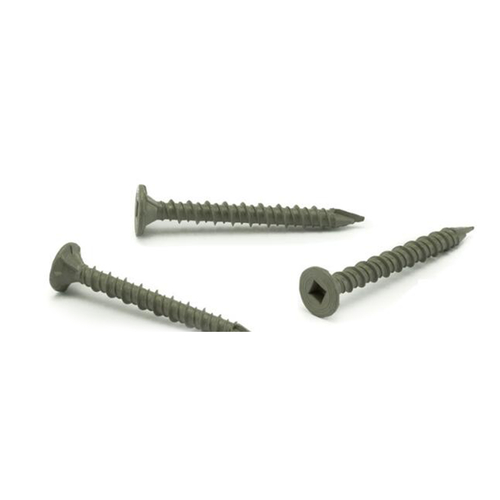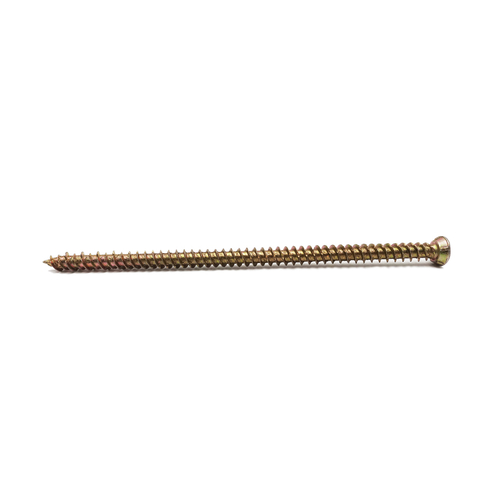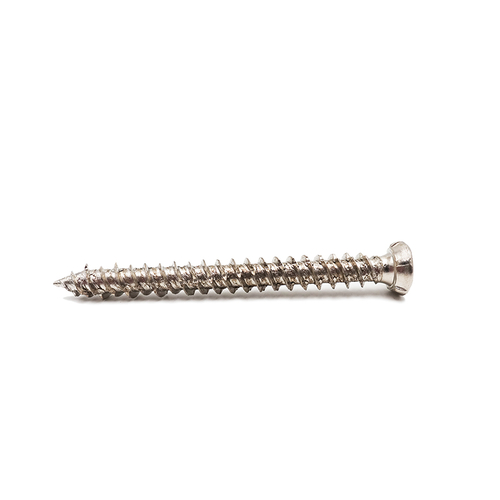
Modern fastening applications demand more than a simple threaded metal component. A screw used in furniture production, interior construction, cabinetry, packaging, wood assembly, and general home tool applications must combine reliable penetration, stable holding power, clean finishing, corrosion resistance, repeatable quality, and efficient installation. The Phillips drive countersunk head chipboard screw with nibs, blue white zinc plating, and Type 17 point is designed to meet these requirements in a balanced and practical way. It brings together a self-cutting point, a clean seating head, optimized thread geometry, and durable surface treatment to support fast assembly and long service life.
This screw is especially suitable for wood-based materials such as chipboard, particle board, medium-density fiberboard, plywood, softwood, and certain engineered wood panels. Although it belongs to a broader fastening family often associated with drywall screws and wood screws, its detailed design makes it particularly valuable in applications where a flush finish and reduced splitting are important. The countersunk head allows the screw to sit neatly into the material surface, while the nibs under the head help remove fibers and create a smooth countersink during installation. The Type 17 point assists in fast starting and reduces the need for pre-drilling in many wood and board materials.
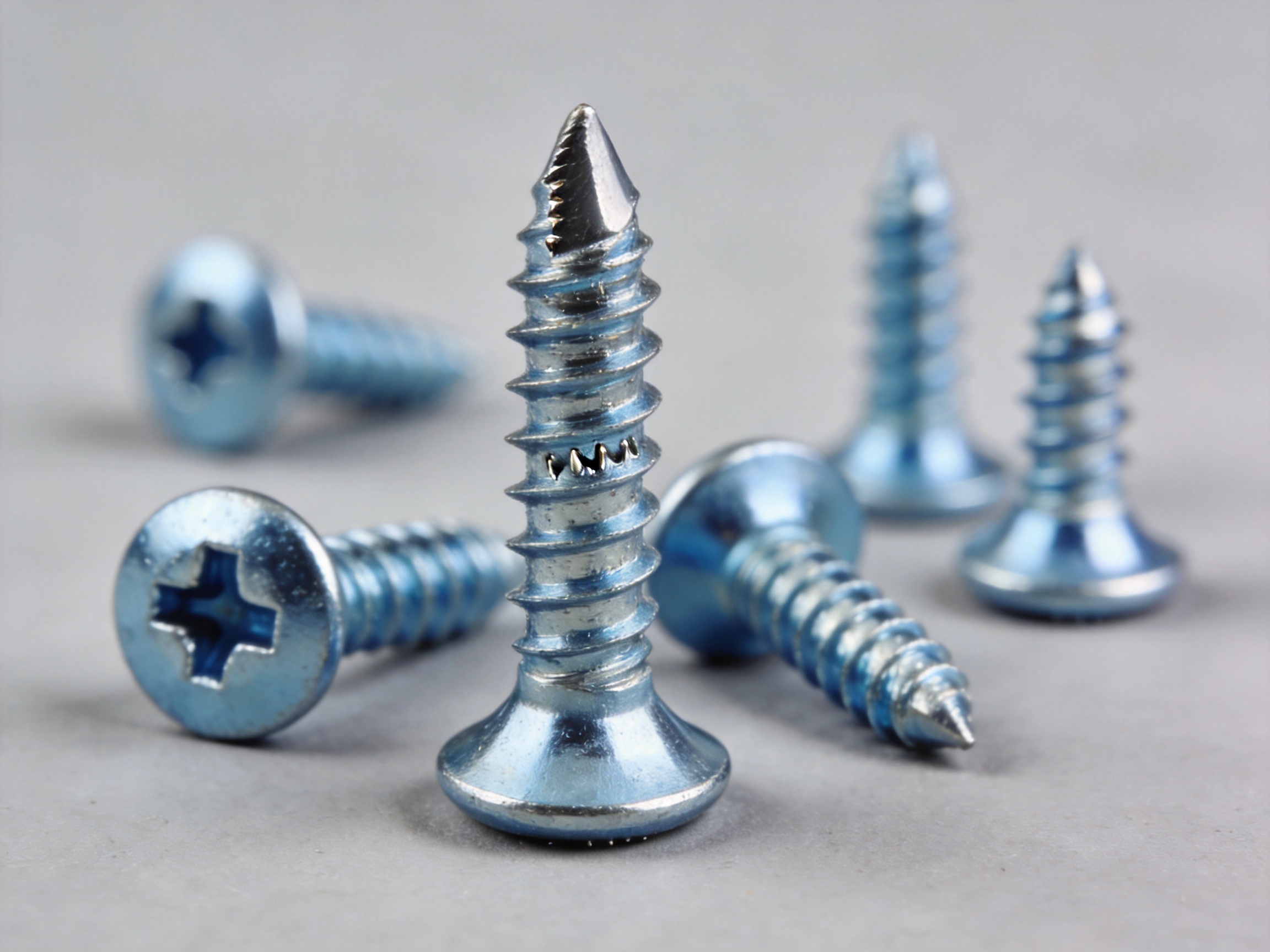
Product Overview
The product is a Phillips drive countersunk head screw with nibs, manufactured from C1022A carbon steel and finished with blue white zinc plating. The available production range includes multiple recess options such as Phillips, square, and Torx; common diameters such as #6-3.5, #8-4.2, #10-4.8, #12-5.5, and #14-6.3; and surface options including black phosphate, zinc plated, yellow zinc plated, Dacromet, Ruspert, and Magni. Thread choices include fine thread and coarse thread, allowing the screw to be adapted to different installation materials and working conditions.
The screw’s most important functional features are concentrated in three areas: the drive, the head, and the point. The Phillips drive provides broad compatibility with common power tools and manual screwdrivers. The countersunk head produces a flush surface and is suitable for furniture, panel assembly, decorative applications, and areas where protruding fastener heads are not acceptable. The nibs under the head act as small cutting ribs that help clear material during seating. The Type 17 point includes a cut-out or flute-like design that improves drilling action in wood-based substrates and reduces installation torque.
For buyers, distributors, and manufacturers, this combination provides a competitive fastening solution that supports productivity and quality control. In high-volume assembly environments, even small improvements in driving speed, torque stability, head seating, and defect reduction can produce significant savings. A screw that starts quickly, drives cleanly, and seats flush with fewer failures can reduce labor time, minimize rework, and improve final product appearance.
Key Specifications
| Item | Specification | Practical Meaning |
|---|---|---|
| Product Type | Countersunk chipboard screw with nibs and Type 17 point | Designed for clean, efficient fastening in wood-based panels and boards |
| Drive Options | Phillips, square, Torx | Allows compatibility with different assembly tools and torque requirements |
| Diameter Range | #6-3.5, #8-4.2, #10-4.8, #12-5.5, #14-6.3 | Supports light, medium, and stronger fastening applications |
| Head Type | Countersunk or bugle-style head options | Provides flush seating and neat surface finish |
| Material Grade | C1022A carbon steel | Offers suitable strength and hardenability for screw manufacturing |
| Surface Treatments | Blue white zinc, black phosphate, yellow zinc, Dacromet, Ruspert, Magni | Provides options for corrosion protection, appearance, and application environment |
| Thread Options | Fine thread and coarse thread | Matches different materials, holding requirements, and installation conditions |
| Point Type | Type 17 | Improves starting, reduces splitting, and supports faster installation in wood |
Why the Countersunk Head Matters
The countersunk head is a core feature of this screw. In wood and panel fastening, the final position of the head affects both function and appearance. A raised head can interfere with hinges, brackets, slides, laminated surfaces, decorative coverings, packaging components, and adjoining boards. A correctly formed countersunk head allows the screw to sit flush or slightly below the surface, reducing interference and giving the assembled product a cleaner look.
Compared with ordinary pan head or round head screws, a countersunk head is better for applications where the surface needs to remain smooth. Furniture panels, cabinet backs, shelf structures, wooden frames, interior fittings, and hardware mounting often require a neat finish. The head geometry distributes load into a tapered seat, helping pull materials together while avoiding excessive surface deformation when the screw is correctly installed.
The addition of nibs under the countersunk head improves performance further. During the final stage of driving, the nibs cut or scrape away small amounts of wood fiber. This helps the head create its own recess and reduces the risk of raised fibers around the screw. The result is a smoother surface and a more professional finish. In production assembly, this feature can reduce the need for separate countersinking operations, which saves time and simplifies processing.
The Advantage of Nibs Under the Head
Nibs are small cutting projections located under the head. Their function may appear simple, but they can significantly improve installation behavior. When the screw approaches the surface, the nibs engage the material and help remove excess fiber. This allows the head to settle more cleanly into the board. In many wood-based panels, especially chipboard and particle board, surface fibers can swell or lift if the screw head presses down without cutting action. Nibs reduce this effect.
Compared with common countersunk screws without nibs, this design offers several advantages. It can improve flush seating, reduce surface cracking, lower the amount of manual finishing, and increase consistency across repeated installations. It is especially valuable in furniture and cabinet production where visible screw heads must look clean and uniform. Even when screws are later covered by caps, plugs, or laminates, a smooth countersunk seat helps ensure better fit and appearance.
Nibs also help control driving torque near the end of installation. Instead of forcing the head into uncut material, the screw forms a cleaner recess. This can reduce sudden torque spikes, which are a common cause of drive cam-out, stripped recesses, or overdriven screws. For power tool users, more predictable final seating means fewer rejected assemblies and less operator fatigue.
The Type 17 Point and Its Practical Benefits
The Type 17 point is one of the most important performance features for wood fastening. It is designed with a cutting slot at the point, allowing the screw to remove material as it enters. This improves starting, reduces splitting pressure, and lowers installation torque. In practical use, the Type 17 point often reduces or eliminates the need for pre-drilling in suitable wood-based materials, depending on board density, screw size, edge distance, and application requirements.
Ordinary sharp-point screws can start well, but they may push material apart rather than cutting it. In chipboard and engineered panels, this can lead to surface swelling, internal cracking, or edge splitting. The Type 17 point helps relieve pressure by cutting a path into the material. This is particularly useful near board edges, in narrow components, and in assembly lines where pre-drilling would slow production.
The advantage over many competitor screws is clear: faster starting, smoother penetration, and reduced damage to the workpiece. When the screw starts quickly, the operator spends less time aligning and forcing the screw. When it drives with lower torque, the tool experiences less load and the drive recess is less likely to strip. When splitting is reduced, fewer boards are wasted. These benefits support both productivity and final product quality.
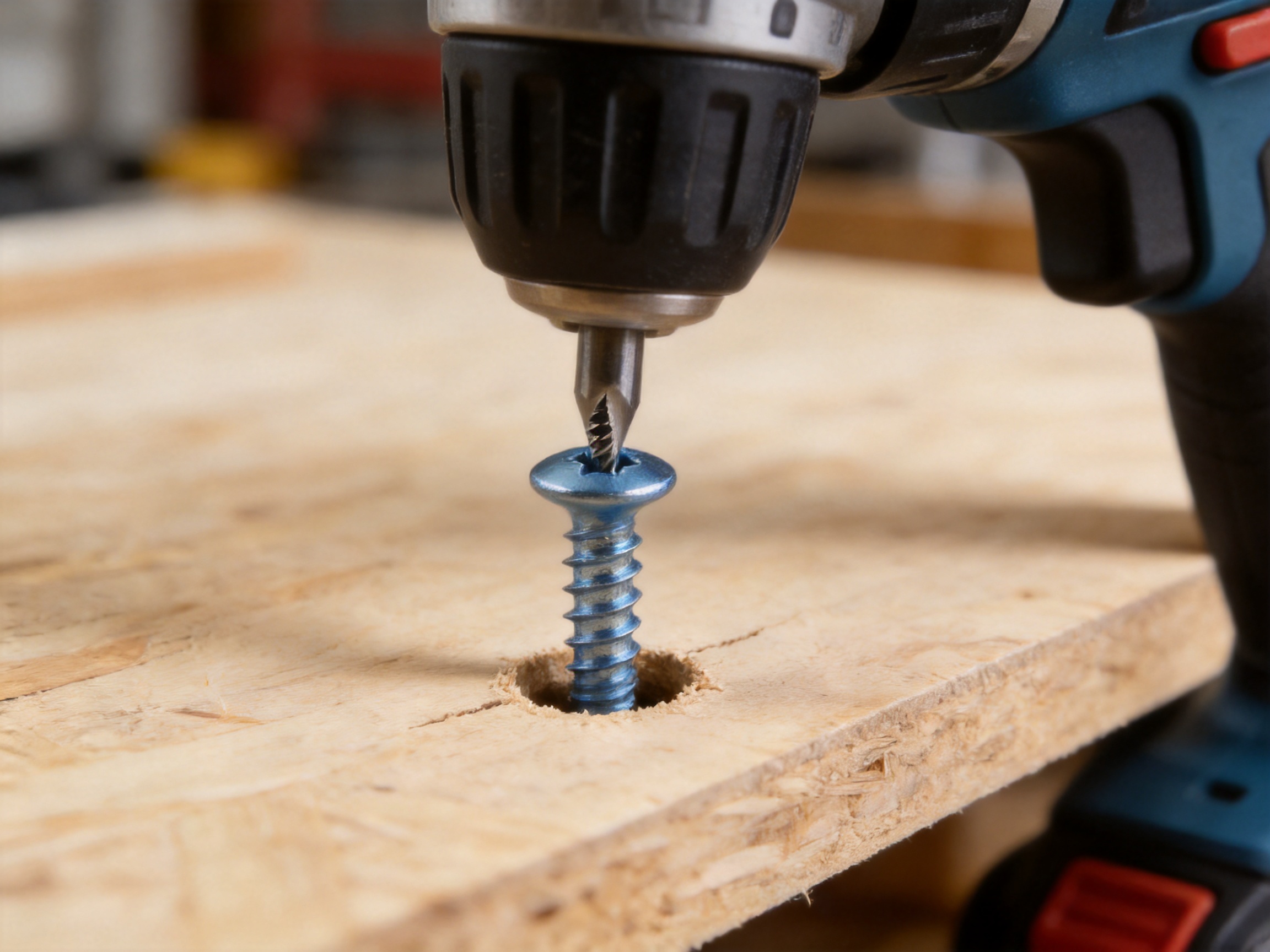
Drive Recess Options: Phillips, Square, and Torx
The standard product title highlights the Phillips drive, which remains one of the most widely used recess types in global markets. Phillips drive screws are compatible with common bits and screwdrivers, making them convenient for distributors, hardware stores, furniture makers, installers, and home users. They are familiar, economical, and suitable for many general fastening tasks.
However, the production range also includes square and Torx recess options. This flexibility is important for customers who need improved torque transfer or reduced cam-out. Square drive recesses provide stable bit engagement and are popular in woodworking and furniture assembly. Torx recesses offer excellent torque transmission and reduce the risk of bit slip, especially in high-speed production settings. By offering multiple recess types, the manufacturer can serve diverse markets and application standards.
Compared with suppliers that offer only one drive style, a flexible production range gives buyers greater purchasing efficiency. A distributor can source several variations from one manufacturing base. A furniture producer can specify Phillips for general models and Torx for premium lines. A packaging or stamping parts customer can match the fastener drive to existing tools and assembly procedures. This adaptability is an important competitive strength.
Material Strength: C1022A Carbon Steel
The screw is produced from C1022A carbon steel, a commonly used material for self-tapping and wood screw manufacturing. This steel grade provides a suitable combination of formability, hardenability, and mechanical strength. During manufacturing, wire is drawn, headed, threaded, heat treated, and surface finished to achieve the desired screw performance. Proper material selection is essential because a screw must be strong enough to penetrate the substrate, resist breakage, maintain thread integrity, and hold components securely.
C1022A is suitable for cold heading processes, allowing the screw head and recess to be formed efficiently with high dimensional consistency. After forming and thread rolling, heat treatment can improve hardness and mechanical performance. The correct balance is important: the screw must be hard enough for reliable driving, but not so brittle that it breaks under normal torque. This balance depends on controlled manufacturing parameters and quality inspection.
Inferior screws may look similar from a distance but fail during installation because of poor steel quality, inconsistent heat treatment, weak recess formation, or uneven threads. A well-made C1022A screw offers more dependable performance and reduces the risk of assembly failures. For professional users, consistency is often more important than a small difference in unit price, because failures can cost far more than the fastener itself.
Blue White Zinc Plating and Surface Protection
Blue white zinc plating gives the screw a bright, clean appearance and provides a practical level of corrosion resistance for many indoor and controlled-environment applications. The zinc layer acts as a protective barrier and sacrificial coating, helping delay corrosion of the underlying steel. The blue white tone is widely accepted in furniture hardware, general assembly, packaging components, and commercial fastener markets because it looks clean and professional.
Surface treatment is not only about appearance. A good plating process supports smoother driving, improved storage stability, and better market acceptance. Screws may be stored in warehouses, transported internationally, handled by distributors, and stocked by retailers before use. Reliable surface protection helps maintain product quality through the supply chain.
The broader available surface range includes black phosphate, zinc plated, yellow zinc plated, Dacromet, Ruspert, and Magni coatings. This allows the same basic screw design to be adapted for different requirements. Black phosphate is often used for drywall and interior applications. Yellow zinc provides a traditional golden appearance and corrosion resistance. Dacromet, Ruspert, and Magni coatings can offer enhanced corrosion protection for more demanding conditions. This variety demonstrates a manufacturing system capable of meeting different market standards and customer specifications.
Thread Design: Fine and Coarse Options
Thread geometry determines how the screw engages the material and how effectively it holds after installation. Coarse threads are commonly used in wood and chipboard because they provide strong grip in softer or less dense materials. They bite deeply and pull components together effectively. Fine threads may be preferred in denser materials or applications requiring more controlled advancement and a different balance of pull-out resistance and insertion torque.
The availability of both fine and coarse thread options provides important application flexibility. A cabinet factory may require coarse threads for particle board panels. A specialized assembly line may prefer fine threads for denser board or composite materials. A distributor may stock both to serve multiple customer groups. Matching thread to material improves performance and reduces installation problems.
Compared with generic screws that offer limited thread choices, this production range supports more precise application engineering. The result is better fastening reliability and fewer complaints from end users. In competitive markets, the ability to provide the right thread type, not just a low-cost screw, is a meaningful advantage.
Application Areas
This screw is suitable for a wide range of applications in home tools, fasteners, packaging, stamping parts, new product development, furniture assembly, and construction-related fastening. Its design is especially useful wherever wood-based panels need to be joined quickly and neatly. Common uses include flat-pack furniture, kitchen cabinets, wardrobes, shelving, drawer systems, wooden packaging, crates, pallets, interior panels, decorative boards, and hardware attachment to wood substrates.
In furniture manufacturing, the flush countersunk head helps create a clean finish and prevents interference with adjacent components. In cabinet production, the Type 17 point supports fast assembly and reduces board splitting. In packaging and crate manufacturing, the screw can provide stronger holding than nails in certain applications and can be removed if disassembly is required. In home tool markets, the Phillips drive version is convenient for general repair and installation tasks.
The screw can also be supplied as part of a broader fastener program alongside machine screws, furniture screws, drywall screws, and other hardware products. For buyers who manage multiple fastener categories, sourcing from a manufacturer with wide production capability can simplify procurement, improve consistency, and reduce communication costs.
Advantages Over Ordinary Competing Screws
Many screws in the market appear similar at first glance, but practical performance often differs greatly. A low-quality screw may have an uneven point, shallow recess, weak plating, inconsistent thread pitch, poor hardness control, or rough burrs. These issues can cause cam-out, head breakage, splitting, rust, poor seating, or unstable holding power. The countersunk chipboard screw with nibs and Type 17 point is designed to reduce these common problems.
First, the Type 17 point improves starting and cutting action. Compared with a simple sharp point, it reduces material displacement and helps prevent splitting. This is valuable for edge fastening and thin board assembly. Second, the nibbed countersunk head improves flush seating. Compared with a plain countersunk head, it reduces raised fibers and creates a cleaner surface. Third, the choice of drive recess allows customers to select the right balance of compatibility and torque control. Fourth, C1022A steel and controlled heat treatment support reliable strength. Fifth, blue white zinc plating improves appearance and storage stability.
Another advantage is production flexibility. The available diameter range from #6-3.5 to #14-6.3 covers many fastening requirements, from light furniture assembly to stronger structural panel joints. Multiple coating options make it possible to serve different climates, storage conditions, and corrosion expectations. Fine and coarse thread options allow better matching to material density. This combination gives the product a broader practical range than many single-specification competitor screws.
Cost efficiency should also be understood in terms of total installed cost, not only purchase price. A screw that reduces pre-drilling, seats cleanly, minimizes defects, and drives consistently may save more money in labor and waste than a cheaper screw saves in procurement. For professional manufacturers, reliable fastening improves output quality and reduces production interruptions. For distributors, reliable products reduce customer complaints and returns.

Manufacturing Strength and Process Control
Advanced screw manufacturing requires more than high-speed machines. It requires controlled raw material selection, accurate tooling, stable cold heading, precise thread rolling, proper heat treatment, consistent surface finishing, and thorough inspection. Each step affects final performance. A defect created at one stage may not be visible immediately but can cause failure during installation.
The production process typically begins with raw wire selection. C1022A steel wire must meet chemical and mechanical requirements before it is accepted for production. Wire drawing controls diameter and surface condition, preparing the material for heading. Cold heading forms the screw head, including the countersunk geometry and drive recess. Accurate heading dies are essential because the drive recess must fit standard bits properly, and the head shape must support flush seating.
Thread rolling forms the screw threads by pressing the blank between hardened dies. Rolled threads are generally stronger than cut threads because the material flow improves surface strength and maintains grain continuity. The Type 17 point is formed with attention to cutting geometry so that it starts efficiently and removes material properly. After forming, heat treatment adjusts hardness and strength. If heat treatment is too soft, the screw may deform or strip. If it is too hard or brittle, it may break. Controlled temperature, time, quenching, and tempering are therefore critical.
Surface finishing follows mechanical forming and heat treatment. Blue white zinc plating requires cleaning, plating, passivation, and drying. Good plating control helps avoid bare spots, excessive buildup, hydrogen-related risks, and inconsistent appearance. For higher corrosion coatings such as Dacromet, Ruspert, or Magni, process control is also essential to meet customer performance expectations.
Final inspection includes dimensional checks, recess fit, thread quality, point sharpness, head shape, surface appearance, coating consistency, hardness, torsional performance, and packaging accuracy. Reliable manufacturers maintain inspection records and use sampling methods to verify that each batch meets requirements. This is especially important for export customers who need consistent quality across repeated shipments.
Precision Tooling and Dimensional Consistency
The performance of a screw is closely tied to dimensional consistency. A small variation in head diameter, recess depth, thread angle, or point shape can affect installation. Precision tooling ensures that every screw in a batch behaves similarly. For assembly lines using automatic feeding systems, dimensional consistency is even more important because irregular screws can jam equipment or cause misdriving.
Head geometry must be controlled so the countersunk head seats properly. If the head angle is inconsistent, the screw may sit too high or sink unevenly. Recess depth must be sufficient to hold the bit but not so deep that head strength is weakened. Thread dimensions must be uniform to ensure predictable insertion torque and holding power. The Type 17 cut must be clean enough to perform its drilling function.
Manufacturing strength is reflected not only in the ability to produce screws but also in the ability to produce them repeatedly at scale. Buyers need confidence that the first shipment and the tenth shipment will match. Consistent tooling management, machine maintenance, and operator training help deliver this reliability.
Quality Control for Professional Markets
Professional fastener customers often evaluate screws through practical tests. They check whether the screw starts quickly, whether the drive recess strips, whether the head breaks, whether the board splits, whether the head seats flush, and whether the coating resists corrosion during storage and use. A strong quality control system anticipates these concerns.
Hardness testing verifies that heat treatment has achieved the required mechanical properties. Torque testing evaluates resistance to twisting failure. Drive tests confirm bit engagement and cam-out behavior. Pull-out testing may be used to compare holding power in specified materials. Salt spray or corrosion testing can evaluate surface treatment performance. Visual inspection identifies plating defects, burrs, damaged threads, mixed parts, and contamination.
For export markets, packaging inspection is also important. Screws must be counted or weighed accurately, packed securely, labeled clearly, and protected from moisture during transport. Poor packaging can damage even a well-made screw. Strong manufacturing companies treat packaging as part of product quality, not as an afterthought.
Packaging and Supply Advantages
Fasteners are small parts, but their packaging has a large impact on logistics and customer satisfaction. Screws may be supplied in bulk cartons, small boxes, plastic bags, retail packs, or customized packaging depending on customer needs. Clear labeling can include size, drive type, coating, quantity, batch information, and customer part numbers. Proper packaging helps distributors manage inventory and helps end users select the correct screw quickly.
For international buyers, stable supply capability is a major advantage. A manufacturer with organized production, quality inspection, and warehouse support can respond more effectively to repeat orders and mixed specifications. The presence of factory and warehouse resources supports better coordination between manufacturing and delivery. Customers who need machine screws, furniture screws, drywall screws, chipboard screws, stamping parts, and other hardware products can benefit from consolidated sourcing.
Supply flexibility is also useful for new product development. When a customer is designing a furniture line or hardware kit, screw dimensions, coating, drive style, and packaging may need adjustment. A capable manufacturer can support samples, specification discussion, trial production, and mass production. This service ability creates value beyond the physical screw.
Installation Guidance
Although the Type 17 point reduces the need for pre-drilling in many cases, correct installation practice remains important. Users should choose the correct screw diameter and length for the board thickness and load requirement. The screw should penetrate deeply enough into the receiving material to provide secure holding without protruding through the opposite side unless through-fastening is intended. Edge distance should be considered to reduce splitting risk, especially in narrow or brittle boards.
The drive bit must match the recess accurately. For Phillips screws, a worn or incorrect bit increases the risk of cam-out and recess damage. Power tools should be set to an appropriate torque level. Excessive torque can overdrive the screw, damage the board, or strip the recess. Insufficient torque may leave the head proud of the surface. For visible applications, users should test on scrap material to confirm seating depth and finish.
When fastening dense hardwood or very hard engineered panels, pilot holes may still be recommended, especially near edges. The Type 17 point improves cutting, but no screw design can eliminate all material-specific installation considerations. For best results, users should match screw size, thread type, and installation speed to the substrate.
How to Select the Right Size
Choosing the correct screw size depends on material thickness, joint design, load requirement, and appearance needs. Smaller diameters such as #6-3.5 may be suitable for lighter panel fastening, thin boards, or hardware attachment where high load is not required. Medium sizes such as #8-4.2 and #10-4.8 are common for furniture and general wood assembly. Larger sizes such as #12-5.5 and #14-6.3 may be used where greater holding strength is required, provided the material can accept the screw without damage.
Length should be selected so that the screw provides enough thread engagement in the main holding member. If the screw is too short, holding power will be weak. If it is too long, it may protrude, split the material, or interfere with other components. In many panel-to-panel applications, the screw length is chosen to pass through the first piece and embed securely into the second piece without breaking through the surface.
Thread type should match the material. Coarse thread is commonly preferred for chipboard and softer wood-based panels because it provides aggressive grip. Fine thread can be considered for denser boards or applications requiring a different torque profile. Coating should match the environment. Blue white zinc is suitable for many indoor applications, while enhanced coatings may be selected for higher corrosion demands.

Company Manufacturing Strengths
Lizhan Hardware Co., Ltd. operates as a professional fastener supplier with production and supply resources serving customers who require machine screws, furniture screws, drywall screws, chipboard screws, and related hardware. The company’s manufacturing approach emphasizes product range, specification flexibility, surface treatment options, and export-oriented service. Its contact and sales support channels make communication accessible for international buyers seeking customized fastener solutions.
The company’s strength lies in combining product variety with practical manufacturing knowledge. A buyer may require standard screws for routine distribution, customized screws for furniture assembly, special coatings for corrosion requirements, or packaging matched to retail and industrial channels. By supporting different recesses, diameters, threads, heads, and coatings, the company can respond to different market expectations rather than offering only a narrow catalog.
Advanced manufacturing capability is reflected in process integration. From raw material preparation to cold heading, thread rolling, heat treatment, plating, inspection, and packaging, each stage must be controlled to produce reliable fasteners. The ability to offer black phosphate, zinc plated, yellow zinc plated, Dacromet, Ruspert, and Magni surfaces indicates familiarity with different finishing technologies and market requirements. This supports customers in choosing the right coating for cost, appearance, and corrosion performance.
The company also benefits from experience with home tool, fastener, package, stamping parts, and new product categories. This broader hardware background helps in understanding how screws interact with other components. A screw is often part of a larger assembly system, and its performance affects brackets, hinges, panels, stamped parts, and packaging structures. Manufacturing partners who understand these connections can provide more useful support during product selection.
Why This Screw Supports Better Productivity
Productivity in fastening comes from speed, consistency, and low defect rates. The Phillips drive countersunk chipboard screw with nibs and Type 17 point supports all three. The point starts quickly, the thread pulls efficiently, the nibs help the head seat cleanly, and the coating supports smooth handling and appearance. These features reduce the time required for each fastening operation and improve the chance that the screw will install correctly on the first attempt.
In a factory setting, a few seconds saved per screw can become a major productivity gain when thousands or millions of screws are installed. Reduced pre-drilling can eliminate an entire operation in suitable materials. Cleaner countersinking can reduce rework. Lower cam-out reduces bit changes and damaged parts. More consistent screws support smoother automatic or semi-automatic assembly.
For contractors and home users, productivity appears as convenience and reliability. A screw that starts easily and seats cleanly makes repair and installation tasks faster. Users do not need advanced equipment to achieve a neat result. This broad usability helps the product serve both professional and retail markets.
Durability and Long-Term Performance
Long-term performance depends on holding power, corrosion resistance, and mechanical stability. The thread must remain engaged under normal service loads. The head must not fracture or loosen easily. The coating must resist corrosion under expected conditions. The screw must maintain its role in the assembly throughout the product’s service life.
In furniture and cabinetry, screws may experience repeated vibration, movement, loading, and unloading. A secure thread helps maintain joint tightness. In packaging and crate applications, screws may be exposed to handling shock and transport vibration. Strong penetration and holding power reduce the chance of loosening. In general home tool applications, the screw may be used in varied materials, making reliable design especially important.
Blue white zinc plating provides suitable protection for many indoor environments. For more demanding use, customers can select alternative coatings. This coating flexibility helps prevent over-specification and under-specification. A customer can choose an economical finish for indoor furniture or a more protective coating for challenging storage and handling conditions.
Environmental and Practical Considerations
Fastener selection also affects resource efficiency. A screw that reduces splitting and rework helps lower material waste. A reliable coating reduces premature corrosion and replacement. Accurate packaging reduces loss and confusion. Consistent manufacturing reduces rejected parts. These practical benefits contribute to more efficient use of materials and labor.
In modern procurement, buyers increasingly value suppliers who can provide stable quality and appropriate product recommendations. Selecting the right screw avoids unnecessary overdesign while still achieving the required performance. For example, a standard blue white zinc plated screw may be ideal for indoor furniture, while a higher corrosion coating can be reserved for more demanding applications. This balanced approach supports cost control and responsible material use.
Q&A Section
Q1: What is the main purpose of this countersunk chipboard screw?
It is designed for fastening wood-based materials such as chipboard, particle board, MDF, plywood, and softwood. Its countersunk head provides a flush finish, while the Type 17 point helps the screw start quickly and reduces splitting.
Q2: Why are nibs under the head useful?
The nibs cut or clear material as the head seats into the surface. This helps create a cleaner countersink, reduces raised fibers, and improves the final appearance of the fastening point.
Q3: What is the advantage of the Type 17 point?
The Type 17 point includes a cutting feature that helps the screw penetrate wood and board materials more easily. It can reduce installation torque, improve starting, and lower the risk of splitting in suitable applications.
Q4: Is pre-drilling required?
Pre-drilling is often reduced or unnecessary in many chipboard and softwood applications, but it may still be recommended for dense hardwood, very hard engineered panels, large screw sizes, or fastening close to board edges.
Q5: What materials are used to produce the screw?
The screw is manufactured from C1022A carbon steel, a material commonly used for self-tapping and wood screws because it provides good formability and suitable strength after proper heat treatment.
Q6: What surface finishes are available?
Blue white zinc plating is a key finish for this product. Other available options include black phosphate, zinc plated, yellow zinc plated, Dacromet, Ruspert, and Magni, depending on customer requirements.
Q7: What drive types can be supplied?
The product range includes Phillips, square, and Torx recess options. Phillips is widely compatible, square offers stable engagement, and Torx provides excellent torque transfer for demanding assembly work.
Q8: How does this screw compare with ordinary wood screws?
Compared with many ordinary screws, it offers better starting through the Type 17 point, cleaner seating through the nibbed countersunk head, flexible drive options, reliable C1022A steel construction, and multiple coating choices.
Q9: What industries commonly use this screw?
It is used in furniture manufacturing, cabinet production, interior fittings, wooden packaging, home tool applications, hardware assembly, and general fastening of wood-based panels.
Q10: How should buyers select the correct specification?
Buyers should consider board thickness, required holding strength, material density, corrosion environment, drive tool compatibility, and surface appearance requirements. Diameter, length, thread type, drive style, and coating should be matched to the application.
Conclusion
The Phillips drive countersunk head chipboard screw with nibs, blue white zinc plating, and Type 17 point is a practical high-performance fastener for wood-based materials and panel assembly. Its design addresses common installation problems by improving starting, reducing splitting, supporting flush seating, and providing a clean final appearance. The C1022A steel base, controlled manufacturing process, and surface treatment options further strengthen its reliability.
For professional manufacturers, distributors, contractors, and home tool users, the screw offers advantages that go beyond its simple appearance. It can reduce installation time, improve assembly quality, lower rework, and provide dependable fastening across a wide range of wood and board applications. The availability of multiple diameters, drive types, thread options, and coatings makes it adaptable to many markets and customer needs.
Backed by organized manufacturing capability and broad hardware experience, this screw represents a strong choice for customers seeking reliable fastening performance, flexible specification support, and stable supply. In competitive fastener markets, the most valuable products are those that combine practical design with consistent production quality. This countersunk chipboard screw achieves that balance and provides a dependable solution for modern wood fastening.
References
1. Bickford, J. H. Introduction to the Design and Behavior of Bolted Joints. CRC Press.
2. Blake, A. What Every Engineer Should Know About Threaded Fasteners. CRC Press.
3. International Organization for Standardization. ISO standards for fastener dimensions, mechanical properties, and surface coatings.
4. Industrial Fasteners Institute. Fastener Technology Handbook.
5. Budynas, R. G., and Nisbett, J. K. Shigley’s Mechanical Engineering Design. McGraw-Hill Education.
6. American Wood Council. Technical guidance on mechanical fasteners in wood construction.