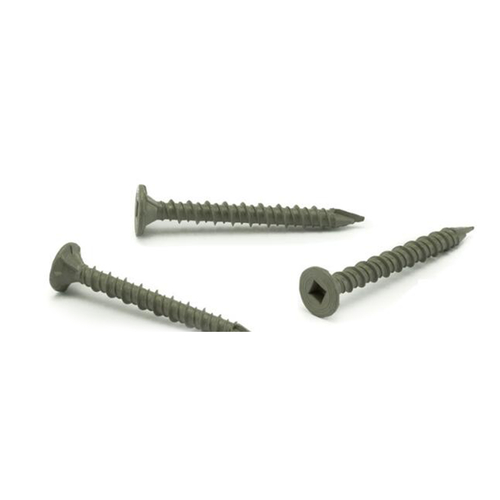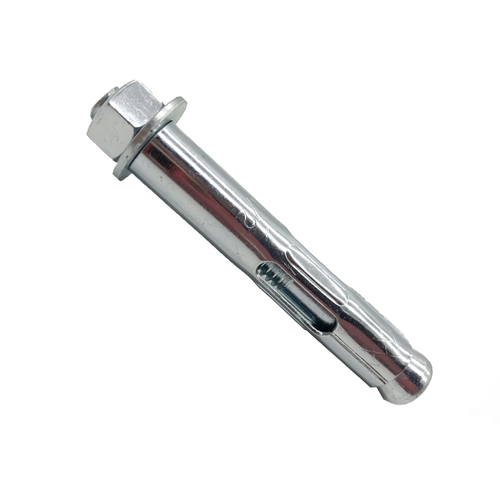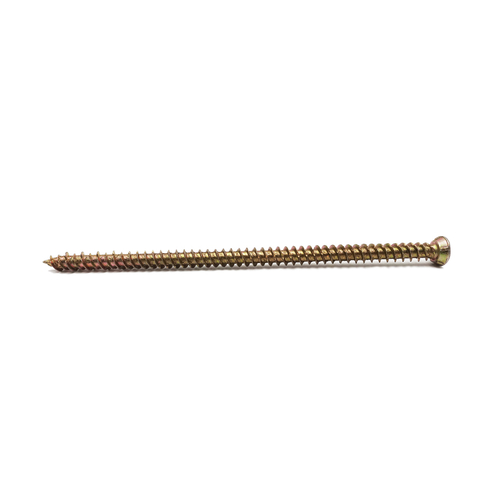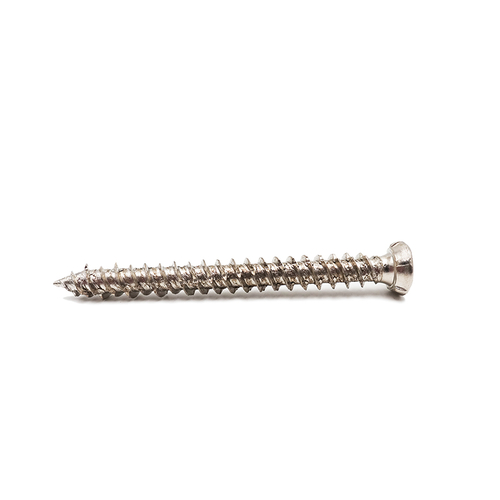
In modern metalworking, a welding post base fitting is more than a simple supporting component. It is the point where structural stability, dimensional accuracy, operator safety, corrosion resistance, and installation efficiency come together. The high quality metal steel welding post base fitting with galvanized finish is engineered for fabrication shops, maintenance teams, construction hardware suppliers, automotive repair stations, equipment builders, and industrial users that need a durable base component for welded posts, frames, brackets, supports, and workstation assemblies.
This product belongs to the stamping parts category, but its value extends beyond conventional stamped hardware. It combines steel material strength, formed geometry, welding compatibility, surface protection, and practical mounting design. In many applications, a weak or poorly finished base fitting can become the source of vibration, misalignment, premature rust, difficult assembly, and structural failure. A carefully manufactured galvanized steel welding post base fitting helps reduce these problems by offering a stable foundation and reliable connection point.
The product is designed for demanding environments where parts must remain secure under repeated stress, thermal exposure, installation load, and long-term use. Whether used in a welding workstation, a post support assembly, a fabricated metal frame, a machinery fixture, or a customized industrial structure, the base fitting provides a strong interface between the post and the mounting surface. Its galvanized surface helps resist rust during storage, shipping, installation, and service, making it suitable for both domestic use and global export markets.
High Quality Metal Steel Welding Post Base Fitting with Galvanized Finished
Product Overview
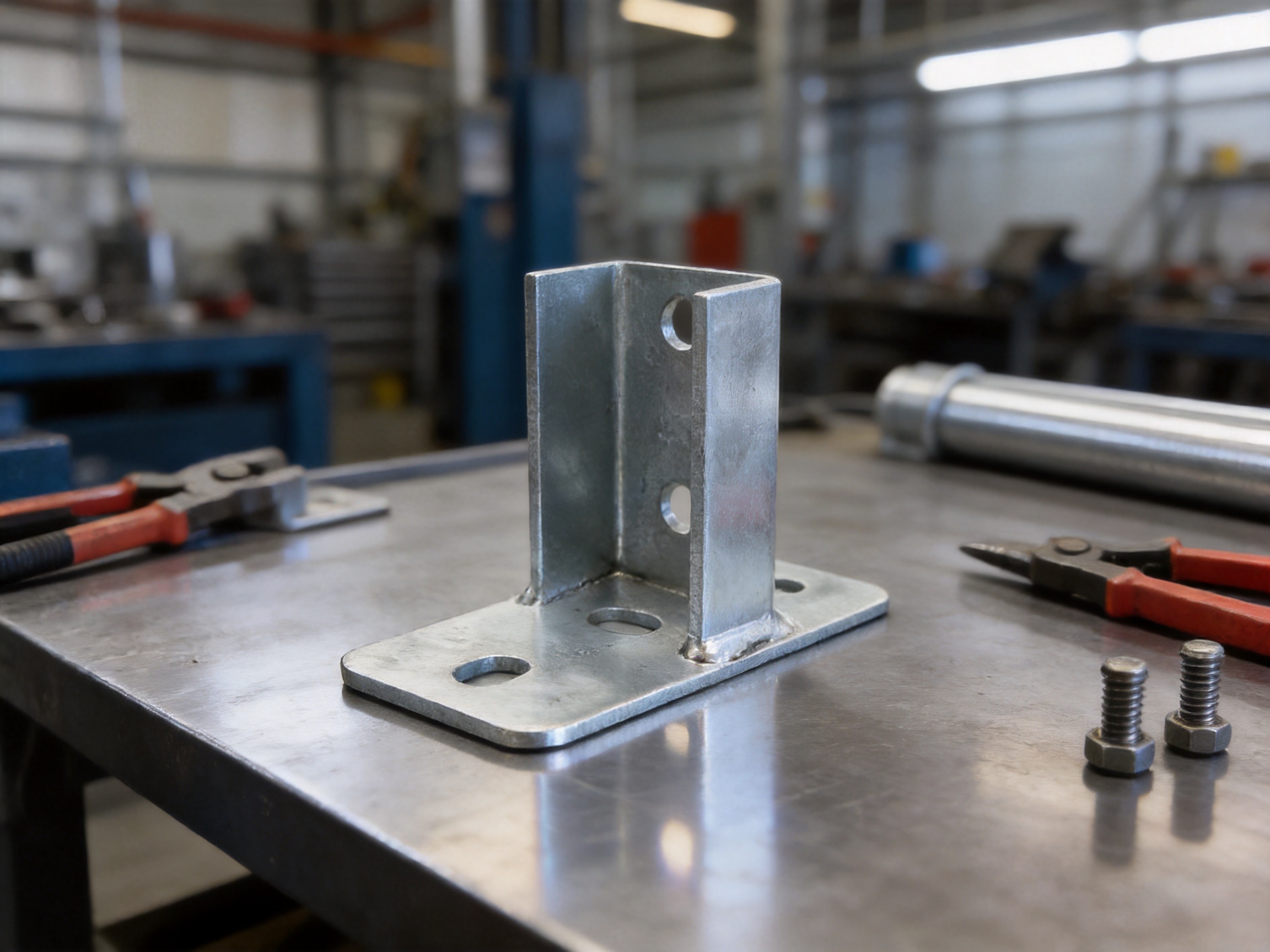
The galvanized steel welding post base fitting is manufactured from quality metal steel and finished with a protective zinc-based coating. It is intended to act as a stable base plate or post support fitting for welding and fastening applications. The component can be integrated into metal structures where a vertical or angled post requires a strong foundation. It can also be used as part of a modular fabrication system where standardized holes, consistent dimensions, and reliable surface treatment are essential.
Unlike light-duty brackets or thin sheet fittings, this type of welding base is designed with structural use in mind. The reinforced steel body provides resistance to deformation, while the galvanized finish improves durability in humid, dusty, and transportation-exposed environments. The base can be used in operations involving MIG welding, TIG welding, arc welding, cutting, grinding, fitting, and assembly, depending on the final application and customer design requirements.
The product is particularly valuable for users who want a balance of strength, cost efficiency, manufacturability, and practical installation. Cast bases can be heavy and expensive. Machined bases can be precise but costly for large batches. Simple sheet plates may be affordable but often lack shaped reinforcement or repeatable consistency. A stamped and formed steel base fitting offers an effective middle ground: strong enough for many structural applications, economical for production, and adaptable to custom hole patterns, thicknesses, shapes, and finishes.
Core Functions in Metal Fabrication
The primary function of the welding post base fitting is to create a stable and dependable connection between a post, tube, rod, support column, or fabricated upright and the surface to which it is mounted. In metal fabrication, this connection must handle several forces at once, including vertical load, lateral force, vibration, torsion, and localized heat during welding. If the base fitting is not strong, flat, and consistent, the entire assembly can suffer from misalignment or reduced service life.
For welding shops, a stable base improves efficiency. Operators can position parts more confidently, maintain better alignment, and reduce the need for rework. When a base plate has properly located mounting holes and a reliable surface, the fixture or post can be mounted quickly. The result is faster production flow and improved repeatability. In maintenance environments, the fitting helps repair teams create secure supports for machinery, guards, platforms, racks, and frames.
The base also plays an important role in safety. Poorly supported posts may shift during fabrication or service. Vibration can loosen fasteners. Rust can reduce material thickness over time. Uneven bases can cause rocking and instability. A well-produced galvanized steel base fitting helps address these risks through robust construction, corrosion protection, and accurate forming. When combined with correct installation and suitable fasteners, it contributes to a safer and more reliable final structure.
Key Product Advantages
One of the major advantages of this product is its robust steel construction. Steel remains one of the most widely used materials in industrial hardware because of its strength, toughness, weldability, and availability. A properly selected steel grade can provide excellent resistance to bending and impact while maintaining good processability during stamping, forming, and welding. For base fittings, these properties are especially important because the component must transfer loads between the post and the supporting surface.
Another important advantage is the galvanized finish. Galvanizing adds a protective zinc layer to the steel surface, helping reduce corrosion caused by moisture, oxygen, and environmental exposure. For parts shipped internationally, stored in warehouses, or used in semi-outdoor environments, corrosion resistance can be a decisive factor. A base fitting that arrives with rust or begins to corrode shortly after installation creates additional costs for the buyer. Galvanized finishing improves product presentation and long-term durability.
The product also provides practical design flexibility. Stamping and forming processes allow holes, ribs, flanges, recesses, bends, and mounting features to be incorporated efficiently. Compared with fully machined components, stamped steel fittings can often be produced faster and at lower unit cost in medium and high-volume production. Compared with welded assemblies made from multiple separate pieces, a stamped base can reduce part count and improve consistency.
Dimensional consistency is another advantage. In fabrication and equipment manufacturing, small dimensional differences can create major assembly problems. When mounting holes are inconsistent, installers spend extra time drilling, enlarging, or forcing parts into place. With controlled stamping dies, inspection routines, and process discipline, the base fitting can be produced to stable dimensions batch after batch. This repeatability supports better assembly efficiency and fewer quality complaints.
Advantages Over Common Competitor Products
Many competing base fittings on the market fall into one of three categories: light-gauge low-cost plates, rough welded bases, or expensive machined components. Each option has disadvantages. Light-gauge plates may deform under load or heat. Rough welded bases may vary in shape and require extra finishing. Machined bases may offer precision but are often too costly for general hardware and fabrication use. The galvanized steel welding post base fitting offers a practical balance between these extremes.
Compared with thin low-cost competitors, this product emphasizes structural stability. Reinforced steel construction helps resist thermal deformation during welding and reduces the risk of bending during installation. In applications where vibration is present, a more stable base helps protect weld seams, fasteners, and connected structures. Low-cost alternatives may appear economical at first, but if they require replacement, repair, or rework, the total cost becomes higher.
Compared with rough welded bases, a stamped and formed fitting can achieve better visual consistency and more predictable dimensions. Welded bases made manually may depend heavily on operator skill. Distortion can occur during welding, and the final surface may require grinding or correction. Stamped parts produced with controlled tooling can achieve repeatable shape and hole placement, making them more suitable for customers who require regular supply, batch consistency, and clean assembly.
Compared with fully machined steel bases, the stamped component offers a more efficient cost structure. Machining removes material, consumes tool time, and can become expensive for large quantities. Stamping uses material more efficiently and enables faster production once tooling is prepared. For many post base and workstation applications, stamping provides adequate accuracy, strong mechanical performance, and better overall value. This makes the product attractive to importers, wholesalers, equipment manufacturers, and project contractors.
Another competitive advantage is export readiness. Proper packing with anti-rust protection and foam support helps reduce transportation damage. Galvanized finishing further protects the part during long-distance shipping and warehouse storage. Many buyers source hardware internationally, so reliable packaging and corrosion resistance are not minor details. They directly affect customer satisfaction, installation schedules, and inventory value.
Manufacturing Strength Behind the Product
Lizhan Hardware Co., Ltd. focuses on hardware manufacturing and supply, with capabilities related to screws, fasteners, stamping parts, packaging support, and home tool components. For a welding post base fitting, this manufacturing background is valuable because the product requires knowledge of both formed metal parts and installation hardware. A good base fitting must not only be shaped correctly; it must also work well with screws, bolts, anchors, welded posts, and fabricated assemblies.
The company’s production approach emphasizes material control, tooling accuracy, forming stability, surface finishing, and inspection. In stamping parts manufacturing, each of these factors matters. If the raw material thickness varies too much, forming results become inconsistent. If the die is not well maintained, holes may burr or dimensions may drift. If the galvanizing process is uncontrolled, coating thickness and surface appearance may vary. If inspection is weak, defects reach the customer. Advanced production management helps prevent these problems.
A strong manufacturing process begins with steel selection. The material must provide adequate tensile strength, formability, and weld compatibility. For base fittings, the steel should withstand punching, bending, forming, and subsequent installation stresses. Material surfaces should be suitable for galvanizing and should be free from severe defects that could affect coating adhesion or part appearance. Reliable suppliers and incoming quality checks help maintain stable product quality from the start.
Tooling design is another core strength. Stamping dies must be engineered to create accurate holes, clean edges, and controlled forming geometry. The die structure must consider springback, material flow, burr direction, bending radius, and production speed. For parts that include mounting holes, hole positioning is critical. Even a small deviation can cause assembly problems. Well-designed tooling reduces variation and supports efficient mass production.
During stamping, equipment stability and process monitoring are essential. Press machines must provide sufficient tonnage and repeatable stroke control. Operators must monitor lubrication, feeding accuracy, die condition, and part output. A disciplined production line can produce large quantities while keeping dimensions consistent. This allows customers to receive base fittings that perform predictably across batches and orders.
After forming, surface finishing becomes a major quality factor. Galvanizing protects the steel and improves market acceptance. Before galvanizing, cleaning and surface preparation help remove oil, scale, and contaminants. Proper pretreatment supports coating adhesion and surface uniformity. After galvanizing, parts may be inspected for coating coverage, appearance, burrs, and handling marks. Packaging then protects the finished surface during transportation.
Galvanized Finish and Corrosion Resistance
The galvanized finish is one of the defining features of this welding post base fitting. Steel is strong and economical, but unprotected steel can corrode when exposed to moisture and oxygen. Galvanizing helps solve this challenge by providing a zinc-based barrier and sacrificial protection. The zinc layer corrodes preferentially, helping protect the underlying steel. This makes galvanized fittings widely used in construction hardware, fencing, racks, supports, brackets, equipment bases, and industrial assemblies.
For export products, corrosion resistance is especially important. Parts may spend weeks in containers, pass through humid ports, or remain in storage before installation. Without adequate protection, uncoated steel may develop surface rust that reduces customer confidence. Galvanized fittings provide a cleaner and more durable surface, making them more suitable for overseas buyers and long distribution chains.
The galvanized finish also supports practical installation. In many jobsite conditions, hardware is handled by multiple workers and exposed to dust, fingerprints, moisture, and scratches. A zinc-coated surface helps maintain protection even when minor handling occurs. While no coating is indestructible, galvanizing offers a strong combination of durability, cost efficiency, and maintenance reduction. For many buyers, it is more economical than painting and more practical than using stainless steel for every application.
In applications where welding is performed after galvanizing, proper safety and process procedures should be followed. Zinc-coated parts should be welded only with suitable ventilation and correct methods, because heating galvanized surfaces can produce fumes. In many production scenarios, users may weld associated posts before final finishing, or they may use the base as a bolted support. The correct approach depends on the final design, applicable safety rules, and engineering requirements.
Structural Stability for Welding and Assembly
Stability is central to the performance of a welding post base fitting. When operators weld or assemble structures, movement can cause poor seam quality, misalignment, and unsafe results. A stable base provides a secure reference point. It helps reduce vibration and supports cleaner workmanship. This is especially important in fabrication shops where repeated operations must be performed quickly and accurately.
The product’s heavy-duty steel construction supports vibration damping and heat resistance during fabrication. Although every welding environment is different, a well-designed steel base reduces the likelihood of sudden movement or excessive flexing. When mounted on a suitable surface with proper fasteners, the fitting can help stabilize posts, work supports, frames, and fixture elements. This improves both operator confidence and final assembly quality.
Standardized mounting holes add further value. Mounting holes allow the base to be fixed to worktables, floors, plates, brackets, or machine frames. When hole patterns are consistent, customers can integrate the fitting into modular workstations or repeated product designs. This is useful for CNC worktables, machining centers, welding benches, automotive repair fixtures, and industrial maintenance supports.
Non-slip pads or compatible stabilizing accessories can also improve safety in certain workstation applications. When a base is used as part of a temporary or adjustable welding setup, non-slip support reduces accidental shifting. In permanent installations, correct bolting and anchoring remain essential. The base fitting is a strong foundation, but final performance depends on the complete system, including fasteners, substrate, weld quality, and load conditions.
Applications in Different Industries
The galvanized steel welding post base fitting is suitable for a wide range of metalworking and hardware applications. In fabrication shops, it can be used to support welding posts, jigs, frames, and modular fixtures. Stable fixtures reduce setup time and help operators produce repeatable results. For small and medium fabrication businesses, using standardized base fittings can improve workflow without requiring expensive custom machined parts.
In automotive repair stations, the fitting can support frame repair tools, bodywork fixtures, alignment stands, and temporary support structures. Automotive repair often involves vibration, pulling force, welding heat, and repeated repositioning of equipment. A strong steel base fitting helps create a more secure working foundation. Its galvanized finish also resists shop humidity, cleaning fluids, and general handling exposure.
Industrial maintenance teams can use the fitting during onsite equipment repairs and plant improvement projects. Maintenance work often requires fast fabrication of guards, supports, brackets, racks, platforms, and machine accessories. A ready-to-use steel base fitting saves time compared with cutting and drilling raw plate for every job. The team can install the fitting, weld or bolt the connected post, and complete the support structure more efficiently.
Construction hardware suppliers may offer the fitting as part of post support systems, fence components, railing supports, temporary barriers, or utility structures. Its corrosion-resistant finish is useful when products are stored outdoors or installed in semi-exposed locations. For applications requiring a stronger or more specialized finish, custom coating options may also be considered according to project requirements.
Equipment manufacturers can integrate the base fitting into machinery frames, storage racks, safety guards, display stands, industrial furniture, and material handling products. Because stamped steel parts can be produced consistently in quantity, they are well suited for OEM production. Manufacturers benefit from stable dimensions, predictable lead times, and the possibility of customizing design details such as thickness, hole diameter, bend angle, and surface treatment.
Technical Considerations for Buyers
When selecting a welding post base fitting, buyers should evaluate more than the visual appearance of the part. Important factors include material thickness, steel grade, plate size, hole pattern, coating type, load direction, installation method, and compatibility with the intended post or structure. A base fitting that works well in one application may not be suitable for another if loads, environment, or mounting conditions differ significantly.
Material thickness affects strength and stiffness. Thicker steel generally provides greater resistance to bending, but it also increases weight and cost. The correct thickness should be selected based on load requirements, post size, installation surface, and safety margin. For high-stress applications, engineering calculation or testing may be needed. For general hardware use, standard thickness options can often provide an effective balance of performance and economy.
Hole pattern is another key factor. Mounting holes must match the required anchors, bolts, screws, or machine table slots. Hole diameter should allow proper fastener fit without excessive looseness. Hole spacing should provide stable load distribution and prevent local tearing. If the base will be used with CNC tables or modular fixtures, standardized hole patterns can greatly improve convenience.
Surface finish should be selected according to the working environment. Galvanizing is suitable for many industrial and construction applications. However, if the part will be used in highly corrosive chemical, marine, or food-processing environments, additional evaluation may be required. Options such as thicker zinc coating, powder coating, stainless steel material, or special plating may be considered depending on performance requirements and budget.
Buyers should also consider packaging. Heavy steel parts can damage each other during transport if not packed correctly. Anti-rust protection, foam separation, strong cartons, pallets, and clear labeling reduce risk during international shipping. Good packaging reflects a manufacturer’s understanding of export requirements and helps protect the buyer’s inventory investment.
Specification and Selection Guide
| Selection Factor | Recommended Evaluation | Why It Matters |
|---|---|---|
| Material | Quality carbon steel or specified steel grade | Determines strength, weldability, forming behavior, and durability |
| Surface Finish | Galvanized zinc-based protection | Improves corrosion resistance during storage, shipping, and use |
| Thickness | Matched to load and installation requirements | Controls stiffness, weight, cost, and resistance to deformation |
| Hole Pattern | Standard or custom mounting holes | Ensures fast installation and compatibility with bolts or anchors |
| Forming Accuracy | Controlled stamping and bending tolerances | Supports repeatable assembly and reduces rework |
| Edge Quality | Managed burrs and clean punched features | Improves safety, fit, coating quality, and appearance |
| Packaging | Anti-rust coating, foam protection, cartons, or pallets | Reduces transport damage and supports export readiness |
| Customization | Available for size, shape, holes, thickness, and finish | Allows integration into different industrial and hardware applications |
Quality Control Process
Quality control for a welding post base fitting must cover the entire production cycle. It begins with raw material inspection and continues through stamping, forming, surface treatment, final inspection, and packing. A defect at any stage can affect final performance. For example, poor raw material can crack during forming. Worn tooling can create oversized holes. Inadequate cleaning can reduce galvanizing adhesion. Rough handling can scratch finished parts. A complete quality system reduces these risks.
Incoming material checks may include verification of thickness, surface condition, material certificate, and coil or sheet quality. During stamping, operators and inspectors may check dimensions, hole diameter, burr level, flatness, and forming shape. First-piece inspection is especially important after die setup. Once the first pieces are approved, production can continue with periodic checks to ensure dimensions remain stable.
After surface treatment, inspection focuses on coating coverage, surface appearance, corrosion protection, and handling damage. Galvanized parts should have consistent protection across visible and functional areas. Sharp corners, hole edges, and formed sections must be evaluated because coating defects often occur in these regions if preparation is poor. Packaging inspection confirms that parts are separated and protected properly before shipment.
For customers with specific requirements, additional testing or documentation may be provided according to order agreement. This may include dimensional reports, material information, coating checks, salt spray testing, or export documentation. The ability to support such requirements demonstrates manufacturing maturity and helps international buyers manage their supply chain with greater confidence.
Advanced Production Capabilities
A strong stamping parts supplier must combine equipment, tooling knowledge, workforce skill, and process management. Advanced manufacturing does not depend on machines alone. It requires understanding how material behaves under pressure, how tool wear affects part quality, how finishing processes interact with geometry, and how to organize production for stable delivery. The galvanized steel welding post base fitting benefits from this integrated manufacturing approach.
Press forming capabilities allow steel sheets or coils to be shaped efficiently. For large-volume orders, progressive dies or dedicated fixtures can improve productivity. For customized orders, flexible tooling solutions may be used depending on the design. The ability to support both standard and customized production gives buyers more options. They can choose an existing base design for speed or request modifications for a specific project.
Tool maintenance is another important strength. Even a well-designed die will eventually wear. Punches, cutting edges, guide components, and forming surfaces must be checked and maintained. Preventive maintenance reduces burrs, dimensional drift, and downtime. Manufacturers that invest in tooling maintenance can deliver more consistent parts and reduce the risk of production delays.
Surface treatment coordination is also important. A base fitting may appear simple before finishing, but galvanizing requires process compatibility. Hole size, drainage, surface cleanliness, and stacking method can influence coating quality. Experienced manufacturers design and process parts with finishing in mind. This helps ensure that the galvanized surface is not only protective but also commercially acceptable in appearance.
Customization for OEM and Project Orders
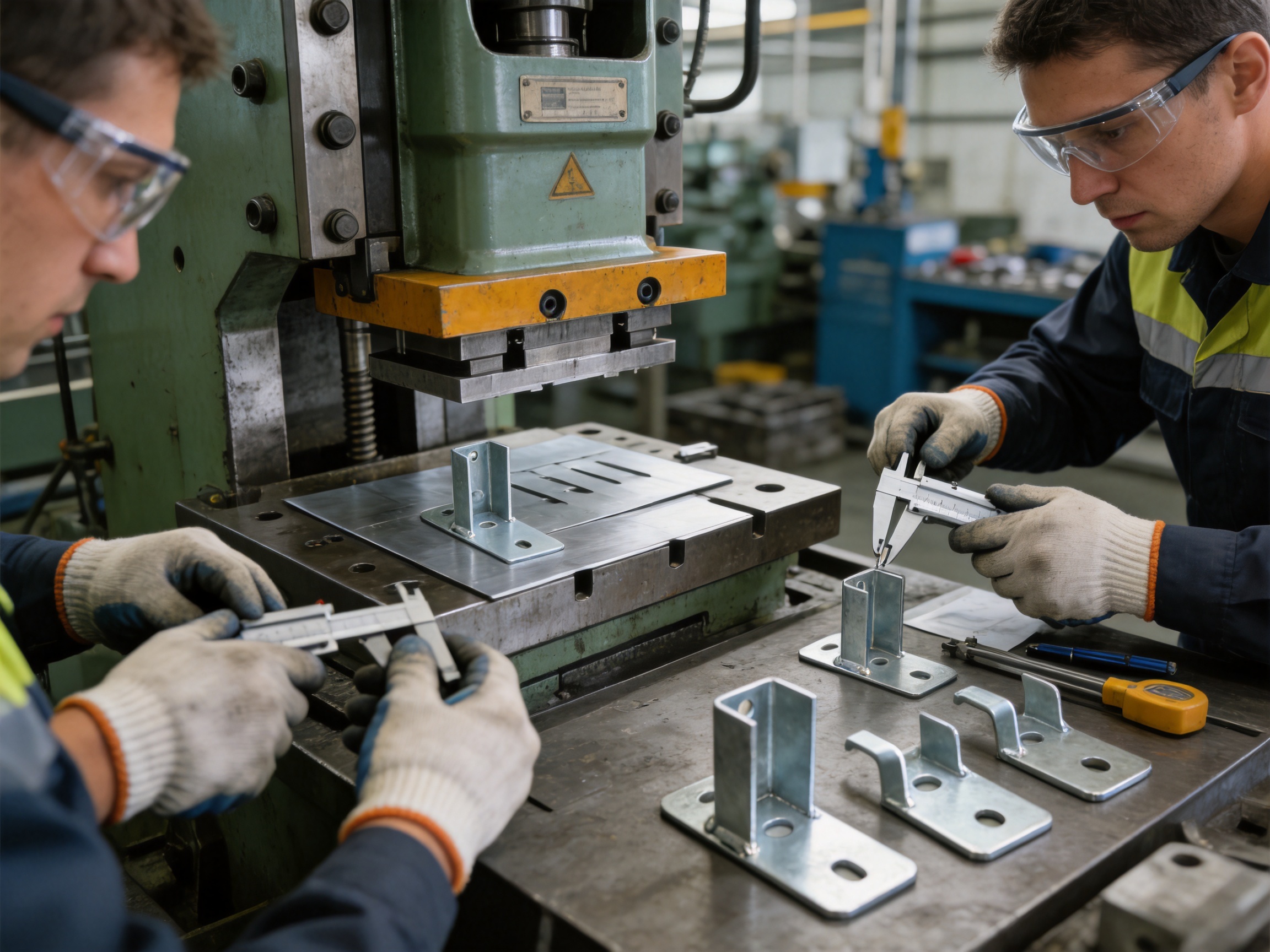
One of the strengths of stamped steel base fittings is customization potential. Customers may require different plate sizes, post diameters, hole patterns, steel thicknesses, bend angles, slot shapes, or coating specifications. A supplier with stamping and hardware experience can adapt the product to fit different industries. This is especially useful for OEM manufacturers, construction projects, distributors, and specialized fabrication workshops.
Customization may begin with drawings, samples, or application descriptions. If the customer provides a technical drawing, the supplier can evaluate material, tooling feasibility, tolerances, and surface treatment. If the customer provides a sample, reverse engineering and measurement can help reproduce or improve the design. If the customer only describes the application, the supplier may recommend a suitable structure based on load, installation method, and cost target.
Hole customization is common. Some customers need round holes for bolts, while others prefer slotted holes for adjustment. Some applications require countersunk holes, square holes, or special spacing. Stamping allows efficient creation of these features when tooling is properly designed. For high-volume production, custom tooling can reduce unit cost and improve consistency.
Surface customization may include standard galvanizing, bright zinc plating, yellow zinc plating, powder coating, painting, oiling, or other finishes. The best option depends on corrosion requirements, visual expectations, installation environment, and budget. Galvanized finishing remains a strong standard choice because of its balance of durability and cost effectiveness.
Installation and Handling Recommendations
Correct installation is essential for achieving the best performance from the welding post base fitting. Before installation, users should inspect the base, confirm dimensions, and check that the mounting surface is flat and strong enough. The supporting surface must be capable of carrying the expected load. Installing a strong steel base on a weak or unstable surface can still result in failure.
Fasteners should be selected according to load and substrate. For concrete floors, suitable anchors may be required. For steel tables or frames, bolts, nuts, washers, or threaded inserts may be used. For wooden structures, appropriate screws or bolts should be chosen with caution because wood strength differs from steel or concrete. Washers may help distribute load and protect the galvanized surface during tightening.
If welding is involved, operators should follow proper welding procedures. Galvanized surfaces require special attention because heating zinc coating can produce fumes. Adequate ventilation, respiratory protection when required, and suitable process planning are necessary. In some cases, welding may be performed before final galvanizing, or the coating may be locally removed and restored after welding. The best method depends on safety rules and product design.
During handling, parts should be protected from severe impact and abrasive contact. Although galvanized coating is durable, rough handling can scratch the surface. If minor scratches occur, zinc-rich repair materials may be used in certain applications. Finished parts should be stored in a dry, ventilated area and protected from prolonged contact with corrosive substances.
Export Packaging and Logistics Advantages
International buyers often evaluate suppliers not only by product price but also by packaging reliability. Heavy steel components can shift during transport, damage cartons, scratch surfaces, or deform if packed poorly. Export-ready packaging for galvanized steel base fittings helps avoid these problems. Anti-rust protection, foam padding, strong boxes, and palletized loading reduce risk from warehouse to destination.
Good packaging also supports efficient inventory handling. Clear labeling, organized cartons, and consistent packing quantities help distributors and OEM buyers manage stock. When goods arrive clean, protected, and easy to count, receiving work becomes faster. This reduces hidden costs and improves supply chain performance. For buyers who distribute hardware to multiple customers, packaging quality can influence their own brand reputation.
The galvanized surface contributes to logistics reliability. Because the coating helps resist corrosion, the product is more tolerant of shipping humidity than uncoated steel. However, packaging still matters. If parts are exposed to condensation for long periods or packed while wet, white rust or surface staining may occur. Professional packing procedures help minimize these risks.
For buyers sourcing from overseas, communication is also part of logistics strength. Clear confirmation of drawings, quantities, lead times, packaging methods, and shipping marks prevents misunderstandings. A manufacturer with export experience can support smoother order execution, especially for repeat customers and project-based procurement.
Why This Product Supports Lower Total Cost
Purchase price is only one part of cost. A cheaper base fitting may lead to higher total expense if it bends, rusts, arrives damaged, requires rework, or delays installation. The galvanized steel welding post base fitting is designed to lower total cost by combining durability, process consistency, corrosion protection, and practical installation features.
Stable dimensions reduce assembly labor. When holes align and the base sits properly, workers spend less time correcting parts. Strong construction reduces replacement risk. A galvanized finish reduces corrosion-related complaints and helps preserve the product during storage. Reliable packaging lowers transport damage. Each of these factors contributes to real cost savings over the life of the product.
For distributors, consistent quality reduces customer returns. For OEM manufacturers, reliable parts reduce production interruptions. For contractors, faster installation helps keep projects on schedule. For maintenance teams, durable fittings reduce repeat repairs. These benefits may not be visible in the first quotation comparison, but they become important in actual use.
The product also supports inventory efficiency. Because it can be used in multiple applications, buyers may stock one reliable base fitting for several project types. Customization can further improve this benefit by matching the fitting to a standard internal design. Over time, standardized quality parts simplify purchasing, training, installation, and maintenance.
Company Strength and Service Capability
Lizhan Hardware Co., Ltd. provides hardware products including fasteners, stamping parts, home tool components, packaging-related items, and new product development support. The company’s manufacturing and supply experience helps it understand how small hardware components influence larger systems. A welding post base fitting may appear simple, but it must interact correctly with fasteners, posts, work surfaces, and finished assemblies.
The company’s location in Zhejiang, China, supports access to established manufacturing resources, material supply chains, surface treatment partners, logistics services, and export channels. In addition, warehouse support in Thailand provides regional convenience for certain customers and supply chain arrangements. This combination can help serve buyers seeking reliable production and flexible delivery support.
Communication is an important part of service capability. Customers often need assistance with product selection, custom drawings, samples, packaging details, and shipping arrangements. Contact support through email, phone, WhatsApp, or WeChat helps buyers discuss requirements efficiently. For international orders, responsive communication can reduce project uncertainty and improve trust.
The company’s broader hardware knowledge also supports cross-product sourcing. Buyers who need welding post base fittings may also require screws, machine screws, furniture screws, fasteners, brackets, stamped parts, or packaging solutions. Working with a supplier that understands multiple product categories can simplify procurement and improve coordination across related hardware needs.
Performance in Welding Workstations
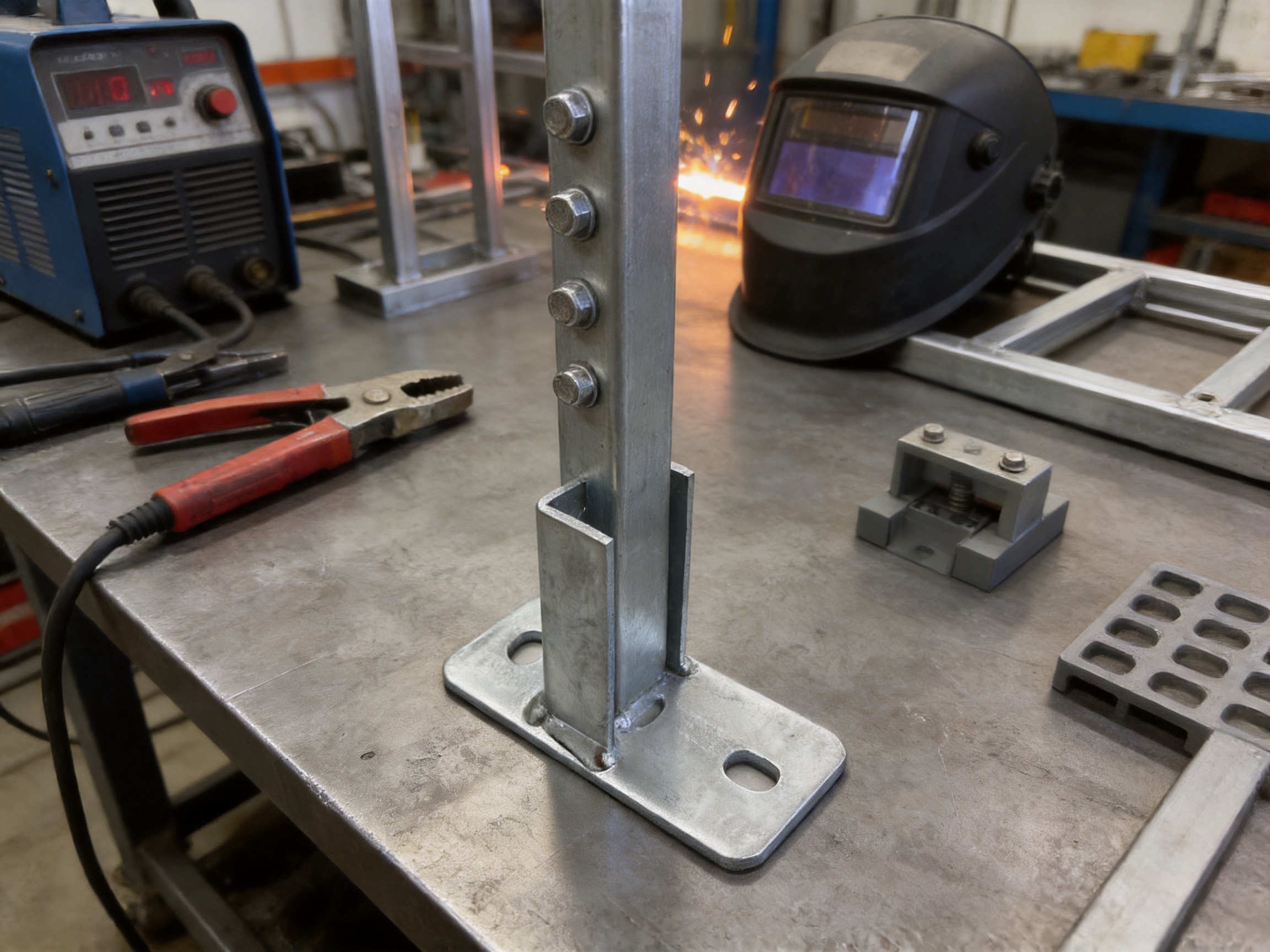
In welding workstation applications, the base fitting provides an important foundation for secure positioning. Welding requires stable support because even small movement can affect seam quality. A base fitting that resists vibration and deformation helps operators focus on weld control rather than constant repositioning. When used with suitable clamps, posts, and table systems, it can become part of a repeatable fixture setup.
Compatibility with MIG, TIG, and arc welding environments depends on the complete workstation design. The base itself provides structural support, while the welding method determines heat input, joint preparation, and operator technique. A strong steel base contributes to stability across these processes. For high-temperature or heavy-duty operations, users should verify that the base dimensions, material thickness, and mounting method match the intended workload.
Workstation safety can be improved through stable mounting, non-slip support features, and clear installation practices. Operators should avoid using unstable temporary supports when a properly mounted base is available. Stable base fittings reduce the chance of movement during grinding, tacking, welding, and inspection. This improves both productivity and workplace safety.
For production environments, modular base fittings can support repeatable fixture layouts. If a shop manufactures similar parts regularly, standardized bases and hole patterns can save setup time. Instead of building a fixture from scratch for every batch, the shop can use a repeatable system. This improves production planning and reduces variation between operators.
Environmental and Maintenance Considerations
Galvanized steel fittings are valued for long service life and reduced maintenance. By protecting the steel from corrosion, galvanizing helps extend the useful life of the part and reduces the need for frequent repainting or replacement. This can have environmental benefits because longer-lasting components reduce material waste and maintenance consumption.
Steel is also recyclable, making it a practical material for industrial hardware. At the end of service life, steel components can often enter recycling streams. While recycling processes depend on local systems, steel remains one of the most recyclable engineering materials. Using durable steel hardware supports resource efficiency when products are properly designed and managed.
Maintenance for galvanized base fittings is generally straightforward. Users should periodically inspect for loosened fasteners, coating damage, deformation, corrosion, or weld defects in the surrounding structure. If the base is installed in a harsh environment, inspection frequency should increase. Cleaning should avoid aggressive chemicals that may damage the zinc coating unless the coating is specifically rated for such exposure.
In applications where scratches or cut edges expose bare steel, localized repair may be appropriate. Zinc-rich repair coating, suitable paint, or other protective methods can help maintain corrosion resistance. For critical structures, maintenance should follow applicable engineering standards and site safety procedures.
Q&A Section
What is the main purpose of a galvanized steel welding post base fitting?
The main purpose is to provide a strong, stable, and corrosion-resistant foundation for posts, supports, frames, fixtures, and fabricated metal assemblies. It helps transfer load from the post to the mounting surface and supports safer, more accurate installation.
Why is galvanized finishing important?
Galvanized finishing protects steel from corrosion by adding a zinc-based surface layer. This is especially useful during storage, shipping, and service in humid or semi-exposed environments. It improves durability and reduces the risk of early rust.
How does this product compare with ordinary thin steel plates?
Ordinary thin steel plates may bend, vibrate, or corrode more easily. This welding post base fitting is designed with stronger steel construction, controlled forming, practical mounting holes, and galvanized protection. It offers better stability, installation reliability, and long-term value.
Can the base fitting be customized?
Yes. Customization may include size, thickness, hole pattern, slot design, shape, bend angle, and surface finish. Customers can provide drawings, samples, or application requirements for evaluation.
Is the product suitable for overseas shipping?
Yes. The product is designed with export readiness in mind. Galvanized finishing, anti-rust protection, foam packaging, strong cartons, and organized pallet loading can help protect the parts during international transportation.
Can it be used with MIG, TIG, or arc welding workstations?
Yes, it can be used as part of workstation and fixture systems associated with MIG, TIG, or arc welding. The base provides support and stability, but the complete setup must be designed according to welding heat, load, safety, and ventilation requirements.
What should users pay attention to when welding galvanized parts?
Users should follow proper safety procedures because heating galvanized surfaces can produce zinc fumes. Adequate ventilation, suitable protective equipment, and correct welding procedures are necessary. In some cases, welding before final galvanizing may be preferred.
What industries commonly use this type of base fitting?
Common industries include metal fabrication, automotive repair, industrial maintenance, construction hardware, machinery manufacturing, workstation assembly, rack production, safety guard fabrication, and equipment support systems.
How can buyers choose the correct specification?
Buyers should consider load requirements, post size, mounting surface, fastener type, hole pattern, thickness, surface finish, and working environment. For demanding applications, engineering evaluation or sample testing is recommended.
Why choose a professionally manufactured stamped steel base fitting instead of making one manually?
A professionally manufactured stamped steel base fitting offers better dimensional consistency, cleaner holes, repeatable forming quality, controlled surface finishing, and more efficient batch production. Manual fabrication may be suitable for one-off repairs, but it often lacks consistency for repeated use or commercial supply.
Conclusion
The high quality metal steel welding post base fitting with galvanized finish is a practical, durable, and cost-effective component for modern fabrication and hardware applications. It combines strong steel construction, corrosion-resistant finishing, stable mounting design, and manufacturable consistency. These qualities make it suitable for welding workstations, post support systems, automotive repair fixtures, industrial maintenance projects, machinery frames, construction hardware, and customized OEM assemblies.
Its advantages over common competitor products come from a balanced design philosophy. It is stronger and more reliable than thin low-cost plates, more consistent than rough manual welded bases, and more economical than many fully machined alternatives. The galvanized finish improves corrosion resistance and export suitability, while controlled stamping and forming support repeatable quality. For buyers who care about total cost, installation efficiency, and long-term reliability, these advantages are significant.
The manufacturing strength behind the product is equally important. Material selection, tooling design, stamping control, surface preparation, galvanizing, inspection, and export packaging all influence final quality. Lizhan Hardware Co., Ltd. supports customers with hardware manufacturing experience, customization capability, international communication, and supply chain awareness. By combining product performance with manufacturing discipline, the company can provide base fittings that meet the practical needs of distributors, OEM manufacturers, contractors, workshops, and industrial users.
For any project requiring a stable, corrosion-resistant, and efficiently produced steel base fitting, this galvanized welding post base fitting offers a dependable solution. When properly selected and installed, it helps improve structural stability, reduce rework, protect against corrosion, and support safer fabrication practices. It is not merely a stamped part; it is a foundation component for stronger, cleaner, and more reliable metalworking assemblies.
References
American Welding Society. Welding Handbook: Welding Science and Technology.
International Organization for Standardization. ISO 9606: Qualification Testing of Welders.
ASTM International. ASTM A123: Standard Specification for Zinc Hot-Dip Galvanized Coatings on Iron and Steel Products.
ASTM International. ASTM A653: Standard Specification for Steel Sheet, Zinc-Coated or Zinc-Iron Alloy-Coated by the Hot-Dip Process.
ASM International. Metals Handbook: Forming and Forging.
Society of Manufacturing Engineers. Tool and Manufacturing Engineers Handbook: Forming.
American Institute of Steel Construction. Steel Construction Manual.
International Organization for Standardization. ISO 9001: Quality Management Systems Requirements.