Understanding Galvanic Corrosion in Fastener Assemblies
Every mechanical assembly that combines two different metals in the presence of moisture carries a hidden risk. When a fastener made from one alloy sits against a base material made from another, an electrochemical reaction can quietly begin. This reaction, known as galvanic corrosion, is one of the leading causes of premature fastener failure in outdoor structures, marine fittings, and even interior assemblies exposed to humidity.
The severity of the reaction depends on how far apart the two metals sit on the galvanic scale, how much moisture is present, and how long the assembly is exposed to that moisture. A fastener that looks identical to another on the shelf can behave completely differently once installed, simply because of what it touches. This is why understanding the difference between 18/8 stainless steel and carbon steel fasteners matters far more than most installers realize.
A fastener does not need to be submerged to corrode galvanically. A thin film of condensation, rain, or even humid air is enough electrolyte to start the process.
What Actually Happens During Galvanic Corrosion
Galvanic corrosion occurs when two dissimilar metals are electrically connected and exposed to an electrolyte, such as moisture containing dissolved salts or minerals. One metal acts as the anode and gradually loses material, while the other acts as the cathode and is protected. The further apart the two metals are on the galvanic series, the faster and more aggressive this exchange becomes.
In fastener terms, this means a carbon steel screws driven into an aluminum panel, or an untreated bolt used against copper flashing, will corrode far faster than the same fastener used on a compatible material. Stainless steel fasteners resist this process because of a passive chromium oxide layer that forms naturally on the surface, which is discussed in more detail below.
What Makes 18/8 Stainless Steel Different
The designation 18/8 refers to an austenitic stainless steel composition containing approximately 18 percent chromium and 8 percent nickel. This composition is closely related to what is commonly labeled as type 304 stainless steel, and in most commercial fastener catalogs the two terms are used interchangeably, since 18/8 is essentially a simplified way of describing the 304 family of alloys.
- Chromium content forms a thin, self-repairing passive oxide layer on the surface
- Nickel content improves ductility and resistance to a wide range of environments
- The alloy resists most household chemicals, moisture, and mild outdoor exposure
- It is non-magnetic or only weakly magnetic depending on cold working during manufacture
Because of this passive layer, an 18 8 stainless steel vs 304 comparison is largely a matter of terminology rather than actual material difference. Both terms typically describe the same austenitic family, and fasteners marked this way are widely used for furniture hardware, appliance assembly, and general construction where moderate corrosion resistance is required.
It is worth noting that 18/8 stainless steel is not immune to every corrosive environment. In chloride-heavy conditions, such as coastal air or de-icing salt exposure, a higher molybdenum-bearing grade may outperform standard 18/8. For most interior and moderate outdoor applications, however, 18/8 provides a strong balance of durability, appearance, and cost.
Carbon Steel Fasteners: Strengths and Limitations
Carbon steel fasteners remain widely used because they offer high mechanical strength at a lower material cost. Unlike stainless steel, carbon steel has no inherent passive layer, which means it relies entirely on surface coatings, such as zinc plating or phosphate treatments, to resist rust and corrosion.
| Property | 18/8 Stainless Steel | Carbon Steel (Coated) |
|---|---|---|
| Base Corrosion Resistance | High | Low without coating |
| Relative Tensile Strength | Moderate to High | High |
| Cost per Unit | Higher | Lower |
| Best Use Environment | Humid, outdoor, washdown | Dry, indoor, structural framing |
| Coating Dependency | Not required | Required for longevity |
Once a protective coating on a carbon steel fastener is scratched, drilled through, or worn down, the exposed steel becomes vulnerable almost immediately, particularly if it is in contact with a more noble metal. This is a common failure mode in decking, fencing, and siding projects where a carbon steel screws head is left exposed to weather after installation.
Galvanic Series Chart: Reading Metal Compatibility
The galvanic series ranks metals from most active, or anodic, to most noble, or cathodic. Metals positioned close together on the chart can generally be used together with minimal risk. Metals positioned far apart should be separated with a non-conductive barrier or avoided in direct contact altogether.
| Position | Metal or Alloy Group | Relative Behavior |
|---|---|---|
| 1 (Most Anodic) | Magnesium and Magnesium Alloys | Corrodes first, sacrificial |
| 2 | Zinc, Galvanized Steel | Highly active, common coating metal |
| 3 | Aluminum Alloys | Active, common in siding and trim |
| 4 | Carbon Steel, Cast Iron | Active, requires coating for protection |
| 5 | Lead, Tin | Mildly active |
| 6 | Brass, Bronze, Copper | Fairly noble |
| 7 | Passive Stainless Steel (18/8 type) | Noble, protected by oxide layer |
| 8 (Most Cathodic) | Titanium, Graphite | Most noble, rarely corrodes |
This is sometimes referred to as a galvanic series chart, and it forms the basis for most fastener selection guidelines in construction and manufacturing specifications. As a general rule, keeping fastener and base material within two or three positions of each other on this scale substantially reduces the risk of accelerated corrosion.
Practical Galvanic Compatibility Chart for Common Fastener Pairings
The following table simplifies the galvanic series into a practical reference for common fastener and substrate combinations. This type of galvanic compatibility chart is useful for quickly assessing risk before a project begins, without needing to memorize the full metal ranking.
| Fastener Material | Aluminum Substrate | Carbon Steel Substrate | Copper or Brass Substrate |
|---|---|---|---|
| 18/8 Stainless Steel | Fair, use barrier if long-term wet | Good | Good |
| Carbon Steel (Coated) | Poor, avoid direct wet contact | Good | Poor |
| Zinc-Plated Steel | Fair | Good | Poor |
| Aluminum Fastener | Good | Poor | Poor |
Where a rating shows poor compatibility, the recommended approach is either switching to a more compatible fastener material or introducing a non-conductive isolation layer, such as a polymer washer or sealant, between the two metals.
Application-Specific Guidance: Machine Screws and Chipboard Screws
machine screws are typically used in pre-tapped holes or with nuts, making them common in enclosures, panels, electrical assemblies, and machinery housings. Because these applications often involve dissimilar metal panels, such as aluminum enclosures or brass terminal blocks, selecting a corrosion-resistant machine screws material is especially important when the assembly will see any humidity or washdown exposure.
chipboard screws, by contrast, are self-tapping fasteners designed primarily for wood-based panels such as particleboard, MDF, and plywood. These are widely used in furniture assembly, cabinetry, and light construction. While wood itself does not typically cause galvanic reactions, chipboard screws frequently come into indirect contact with metal brackets, hinges, or connectors, which reintroduces the same compatibility concerns discussed earlier.

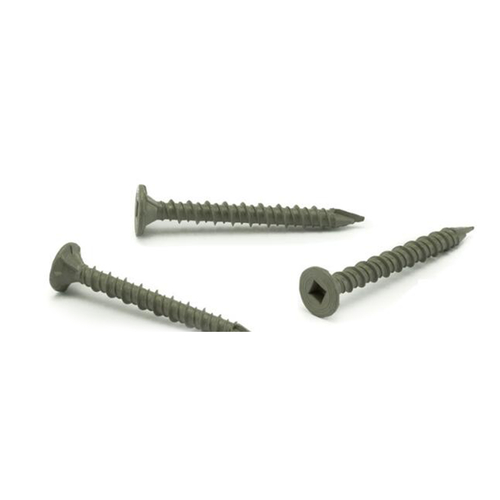
Self-tapping chipboard screws designed for particleboard and MDF assembly
For outdoor furniture, decking hardware, or any chipboard-based assembly exposed to weather, an 18/8 stainless option is generally the safer long-term choice, since it avoids the coating-dependency issue that carbon steel fasteners carry once installed and exposed.
Selecting Non-Corrosive Fasteners for Outdoor Construction
Outdoor construction projects, including decking, fencing, pergolas, and exterior trim, present some of the most demanding conditions for fastener performance. Rainfall, temperature swings, and in some regions salt-laden air all accelerate corrosion, particularly at fastener heads left exposed to the elements.
When specifying non-corrosive fasteners and general outdoor construction screws for these projects, the following factors typically matter more than upfront cost:
- Whether the fastener head will remain exposed after installation, or be countersunk and sealed
- Whether the substrate is treated lumber, which can contain corrosive chemical preservatives
- Local climate conditions, including humidity, salt exposure, and freeze-thaw cycles
- Whether the fastener contacts any dissimilar metal flashing, brackets, or connectors
Treated lumber in particular deserves attention, since many modern wood preservatives contain copper-based compounds. Copper sits relatively high on the galvanic series, which means untreated carbon steel fasteners driven into treated lumber can corrode significantly faster than in untreated wood. This is one of the most common and underappreciated causes of premature fastener failure in outdoor decking.
A Simple Decision Process for Fastener Material Selection
Rather than memorizing the entire galvanic series, most projects can be guided through a short decision process to arrive at an appropriate fastener choice.
This workflow is intentionally simplified, but it reflects how most fastener specifiers approach material selection in practice: start with exposure conditions, then narrow down based on what the fastener will physically contact once installed.
Comparing Long-Term Value, Not Just Unit Price
A common mistake in fastener selection is comparing only the per-unit price of stainless steel versus carbon steel options. In corrosion-prone environments, the total cost comparison should include the labor and material cost of replacing failed fasteners, potential damage to surrounding materials from rust staining, and the risk of structural loosening if a fastener weakens over time.
| Consideration | 18/8 Stainless Steel | Carbon Steel |
|---|---|---|
| Initial Cost | Higher | Lower |
| Expected Service Life in Wet Conditions | Long | Short to Moderate |
| Maintenance Requirement | Minimal | Periodic inspection needed |
| Risk of Staining Surrounding Material | Low | Higher, especially with rust bleed |
For projects where fasteners are difficult to access after installation, such as structural framing behind siding, the higher upfront cost of stainless steel is frequently offset by avoided replacement labor over the life of the structure.
Frequently Asked Questions
Q1: Is an 18 8 stainless steel vs 304 comparison meaningful, or are they the same material?
In practical terms, 18/8 and 304 stainless steel refer to essentially the same austenitic alloy family. The 18/8 label describes the approximate chromium and nickel content, while 304 is the formal grade designation. Most fasteners sold under either name perform similarly in general use.
Q2: Can carbon steel and stainless steel fasteners ever be used together safely?
They can, in dry indoor environments where moisture is not a factor, since galvanic corrosion requires an electrolyte to occur. In any application exposed to rain, humidity, or washdown cleaning, direct contact between the two should be avoided or isolated with a non-conductive barrier.
Q3: Why do some ss screws options cost significantly more than coated carbon steel equivalents?
Stainless steel alloys contain a higher percentage of chromium and nickel, both of which are more expensive raw materials than plain carbon steel. The added cost reflects both material composition and the corrosion resistance that comes without relying on an external coating.
Q4: Do chipboard screws need to be stainless steel for indoor furniture assembly?
Generally no. Indoor furniture assembly in dry conditions does not typically require stainless steel, and standard coated chipboard screws perform adequately. Stainless becomes more important for outdoor furniture, bathroom cabinetry, or any application exposed to consistent moisture.
Q5: How can I tell if a fastener failure was caused by galvanic corrosion specifically?
Galvanic corrosion typically shows concentrated pitting or material loss at the point of contact between two different metals, rather than uniform surface rust across the entire fastener. If corrosion is heaviest exactly where two dissimilar metals touch, galvanic action is a likely contributor.