Choosing the right deck screw for composite decking is a materials decision, not a hardware afterthought. Install composite boards with ordinary wood screws and you should expect rust streaks, raised plastic rings around the screw heads, and pull-out failures near board ends before the second season. Composite boards mix wood fiber with polyethylene or polypropylene, which changes how every part of the fastener—tip, thread, head, and coating—behaves against the board.
This guide explains the fastener engineering behind a clean composite deck installation: coating selection, thread design, sizing rules, and the installation habits that prevent callbacks.
Why Ordinary Wood Screws Fail on Composite Decking
Composite boards move more than lumber. A single warm afternoon can shift a 3.6 m board by several millimetres, and seasonal movement is larger still. A standard wood screw is made for a stable, porous substrate, so its failure modes on composite are easy to predict:
- Displaced material around the head: a sharp wood thread pushes softened composite upward, creating a raised rim that traps dirt and water.
- Weak pull-out resistance: the low-density core of many composite boards does not give a coarse wood thread enough material to bite into, so the board lifts off the joist near the ends.
- Thermal popping: when the board expands against the shank, a conventional thread does not relieve the pressure, and the head raises above the surface.
- Corrosion streaks: simple zinc plating disappears quickly outdoors, and the resulting rust permanently stains the board face.
The differences between deck screws and standard wood screws are not cosmetic. Tip form, thread angle, under-head profile, and finish are each adjusted for man-made boards. If an existing deck shows popped screws or discolored holes, the root cause is almost always the fastener specification.
Essential Features of a Deck Screw for Composite Decking
Evaluate a composite-deck fastener by four characteristics in combination: Type-17 or self-drilling point Under-head nibs Medium thread angle 20–25° Barrier coating
Tip: Type-17 Self-Drilling Point
A Type-17 tip cuts its own pilot hole, so most solid 19–25 mm boards need no pre-drilling. It also displaces less material inside the core, lowering the risk of face cracking at board ends.
Under-Head Nibs Control Seating Depth
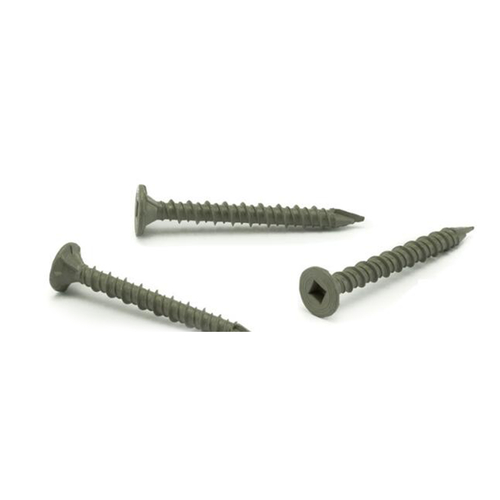
Nibs ream a shallow recess as the screw seats, stopping the head flush instead of letting it bury itself below the surface. This is the most valuable detail on a composite deck screw, and it is the design principle behind LIZHAN’s CSK Phillips deck screw with nibs:
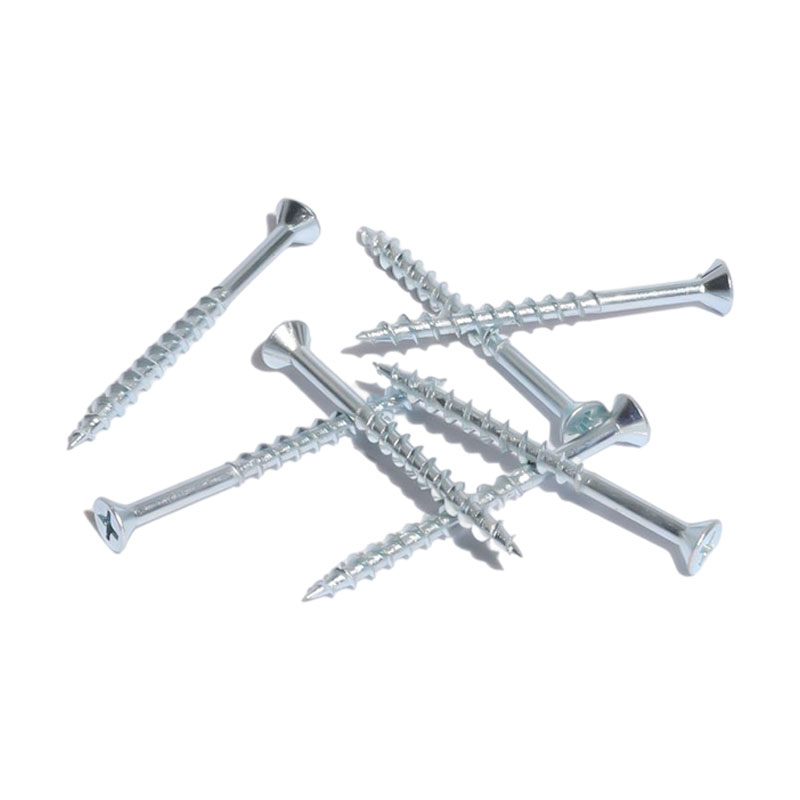 CSK Phillips Composite Deck Screw with Nibs, Zinc PlatedThis deck screw uses nibs to create a flush seat without over-driving, while its fine-to-medium thread and thinner root reduce splitting and improve holding in composite cores.View Product →
Thread Angle and Shank Form
A fine-to-medium thread around 20–25 degrees holds better in a ligno-plastic core than a coarse wood thread, and the thinner root section reduces splitting force during driving. On capped composite boards, an interrupted or reduced thread near the head lets the board move slightly without levering the screw loose.
Head Profile and Drive Type
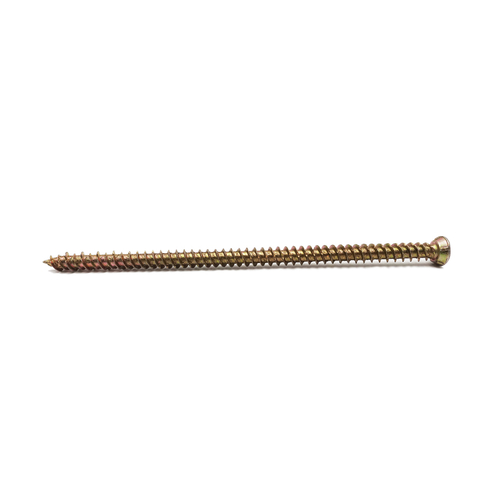
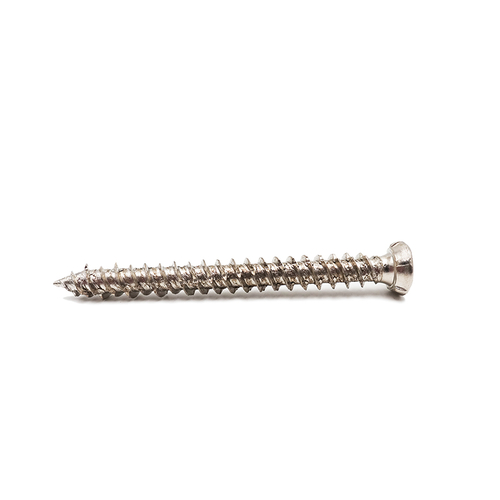
Bugle and countersunk heads seat flush without pre-counterboring. Phillips is the universal drive; crews that prefer the non-slip feel of a Pozi drive can order the same screw family in Pozi configuration:
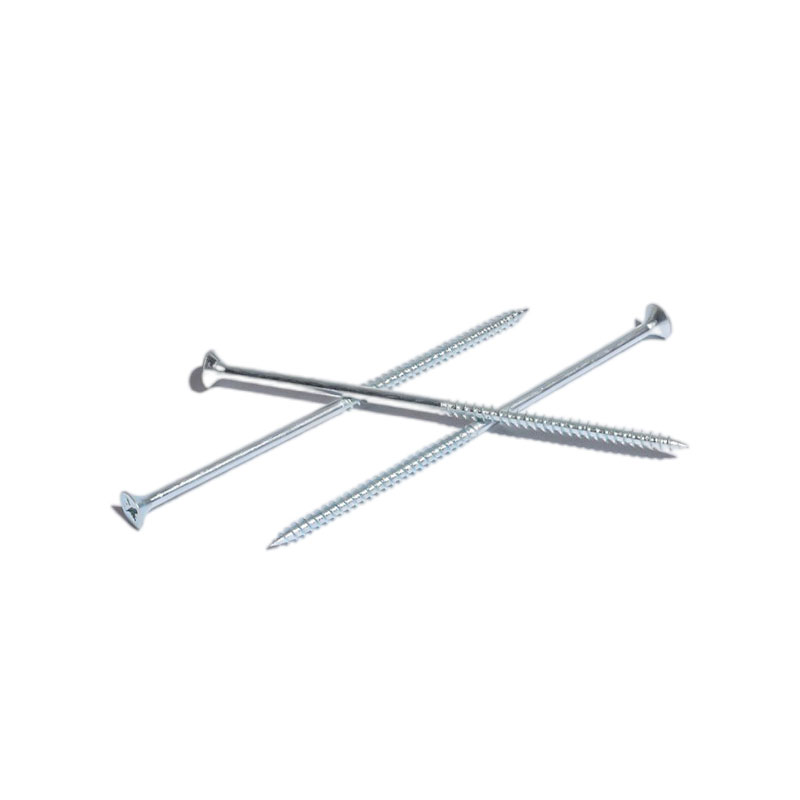 Pozi Countersunk Chipboard Screw, Zinc PlatedThis screw offers a Pozi drive for non-slip driving and a double countersunk head for flush seating; choose length based on board thickness plus 25 mm joist penetration.View Product →
| Parameter | Wood screw | Composite deck screw |
|---|---|---|
| Tip | Sharp gimlet point | Type-17 self-drilling |
| Thread angle | Coarse, 30–35° | Medium, 20–25° |
| Under-head area | Flat, no cutting edge | Nibs or reamer |
| Head profile | Flat or oval | CSK / bugle, flush seating |
| Typical coating | Bright zinc | Zinc, RUSPERT, stainless |
Length and Gauge: Sizing Deck Screws for Composite Boards
Length is board thickness plus embedment. Most composite board manufacturers require at least 25 mm of penetration into the framing; below that, holding value drops sharply when the board contracts in cold weather. The formula is simple: board thickness + 25 mm minimum joist penetration = screw length.
| Board thickness | Framing type | Screw length | Gauge |
|---|---|---|---|
| 19 mm (3/4″) | Wood joist | 50 mm (2″) | #8 |
| 25 mm (1″) | Wood joist | 63–64 mm (2–1/2″) | #8 or #9 |
| 32 mm (5/4″) | Wood joist | 75 mm (3″) | #9 or #10 |
| 25–32 mm | Steel joist | Board + 10 mm steel bite, self-drilling | #10 |
Gauge matters because it controls stiffness. #8 covers most residential decks with 25 mm boards and standard joist spacing. Move up to #9 or #10 for 5/4 profiles, joist spacing above 400 mm, or aluminum and steel sub-frames where a stiffer shank prevents deflection and head tear-through.
Corrosion Protection: What the Finish Really Does
Composite boards do not corrode fasteners, but the environment does. Rain, sprinkler spray, cleaning products, and coastal salt are the real test. The coating decides whether screw heads still look clean after two seasons or produce permanent brown streaks on the board.
- Bright zinc plating is the economical baseline for dry, covered areas with limited exposure.
- Yellow or blue-white zinc is the practical middle ground for most residential decks and the most common finish on LIZHAN decking screws.
- RUSPERT-type barrier layers combine a zinc base with a sealed topcoat, suited to humid, coastal, and poolside conditions.
- Stainless steel is right for salt-air exposure, but verify the substructure metal first: mixing stainless screws with carbon-steel framing can create galvanic corrosion that cancels the benefit. Browse the complete LIZHAN fastener catalog to compare coating classes against your site conditions.
Corrosion never shows on installation day. It appears months later as a brown streak, once the screw head has already lost its protective layer.
Installation Practices That Prevent Callbacks
Field technique decides whether a good screw performs like one. Follow this sequence on every deck:
- Confirm the substructure. Wood joists accept a Type-17 tip without pilot holes on most boards. Steel joists require a self-drilling screw with a point capable of penetrating 1.5–2.5 mm steel; pilot holes are usually not needed.
- Pre-drill only hard-capped or hollow-core boards. If the face is hard or the profile is hollow, drill a pilot hole slightly smaller than the screw root, especially within 25 mm of a board end.
- Hit the joist center line and stop flush. Keep screws at least 25 mm from board ends. Drive the head flush, 1–2 mm below the surface at most; nibs give you a clear tactile stop point.
- Leave the board room to move. Most brands specify a 5–8 mm expansion gap per 3–5 m length; never pull boards tight with the screw.
When the framing is steel, use a screw that drills and seals in one step. A hex washer head self-drilling screw with an EPDM washer drills through the joist and compresses a weatherproof ring around the shank, keeping deck drainage out of the steel pocket.
Frequently Asked Questions About Deck Screws for Composite Decking
Q1: Can I use regular wood screws on composite decking?
You can drive them, but the thread and head are not matched to a composite core. Expect lower pull-out values, surface deformation around the head, and earlier corrosion. Use a screw with a Type-17 tip and nibs instead.
Q2: Do I need stainless steel deck screws for composite decking?
In coastal, poolside, or code-required zones, yes. Inland and covered installations are well served by a barrier-coated carbon steel screw, such as yellow zinc or RUSPERT-class finishes, at a lower per-unit price.
Q3: Should I pre-drill the composite board?
With a Type-17 self-drilling point and solid boards, no. Pre-drill only hard-capped or hollow profiles, and always pre-drill within 25 mm of a board end to prevent face cracking.
Q4: What length deck screw works for a 25 mm composite board?
Add board thickness to 25 mm of joist penetration. A 25 mm board over wood framing therefore takes a 63–64 mm (2–1/2 inch) screw; 32 mm or 5/4 boards move up to 75 mm (3 inches) in #10 gauge.
Bottom line: a deck screw for composite decking needs a self-drilling tip, under-head nibs or equivalent relief, a thread tuned to the composite core, and a coating matched to the exposure class of the site. Length is board thickness plus 25 mm of embedment into the framing.
For volume projects and distribution programs, choose a manufacturer that documents batch quality and supports the rest of your fastener range. That combination, not the lowest price per thousand, is what keeps a composite deck looking new.