For 1/2 in. gypsum board over wood framing, the right screw is a #6 × 1-1/4 in. coarse-thread drywall screw. Run the same board over 25-gauge steel studs and the length stays at 1-1/4 in. while the thread changes to fine. Move up to 5/8 in. board and the length becomes 1-5/8 in. Those three answers cover most residential and light commercial work, and they all come from one rule: board thickness sets the screw length, the framing material sets the thread, and the number of layers decides whether you step up one size.
It is one of the cheapest decisions on a drywall job and one of the most visible when it goes wrong. A screw that is 1/8 in. too short leaves too little thread in the stud. A screw that is 1/8 in. too long punctures the back of the board or bottoms out in a shallow steel stud. Both faults show up later as popped heads, cracked joints and callbacks, long after the crew has packed up.
What follows is the arithmetic behind length selection, the stock sizes that match each board thickness, the thread and coating choices that follow from the substrate, and the details worth writing into a purchase order.
The Selection Math: Board Thickness Plus Embedment
A drywall screw does two jobs. It has to pass through the panel without tearing the paper face, and it has to bite deep enough into the framing to hold that panel for the life of the building. Screw length is simply board thickness plus the amount of thread that ends up inside the framing.
For wood framing, the working target is 5/8 in. (about 16 mm) of embedment into solid wood. For steel studs, aim for at least 3/8 in. (about 10 mm) of thread past the far side of the stud, which in practice means the screw fully penetrates the steel and shows two to three threads. Steel behaves differently from wood: the screw has to cut or drill its own hole, so thread engagement matters more than friction, and a short screw in a steel stud can lose most of its capacity.
There is a practical ceiling as well as a floor. Oversized screws cost more per piece, need more torque, are harder to set to the correct depth, and on thin panels can lift the board away from the framing as the head tries to bury itself. Length selection is a tolerance exercise: long enough to develop full holding, short enough to leave the framing and the back of the board intact.
Drywall Screw Length Chart by Board Thickness
The table below converts board thickness into a starting specification. It assumes standard gypsum board, framing at nominal dimensions, and the embedment targets above.
| Board thickness and layers | Framing | Screw length | Typical size | Thread |
|---|---|---|---|---|
| 1/4 in., single layer | Wood or steel | 1 in. | #6 | Coarse (wood) / fine (steel) |
| 3/8 in., single layer | Wood or steel | 1-1/4 in. | #6 | Coarse / fine |
| 1/2 in., single layer | Wood studs | 1-1/4 in. | #6 | Coarse (W type) |
| 1/2 in., single layer | Steel studs, 25-20 gauge | 1-1/4 in. | #6 | Fine (S type) |
| 5/8 in., single layer | Wood studs | 1-5/8 in. | #6 or #8 | Coarse |
| 5/8 in., single layer | Steel studs | 1-5/8 in. | #6 | Fine |
| 1/2 in. + 1/2 in., double layer | Wood studs | 1-5/8 in. (2 in. for margin) | #6 or #8 | Coarse |
| 5/8 in. + 5/8 in., double layer | Wood studs | 2 in. | #8 | Coarse |
| 1/2 in. cement board, single layer | Wood or steel | 1-5/8 in. | #8 to #10 | Coated, corrosion class |
Two notes on the chart. First, single-layer 5/8 in. board and double-layer 1/2 in. board both come out at 1-5/8 in., but they are not the same job: in a double-layer system the second layer is fixed with screws long enough to pass through both panels, so plan the length around the full thickness rather than one board. Second, cement board is not gypsum. It is denser, it holds moisture against the head, and it needs a corrosion-resistant coated screw instead of a standard black phosphate one.
For single-layer work over timber framing, a black phosphated coarse-thread bugle head screw in 1-1/4 in. and 1-5/8 in. covers most of the schedule.
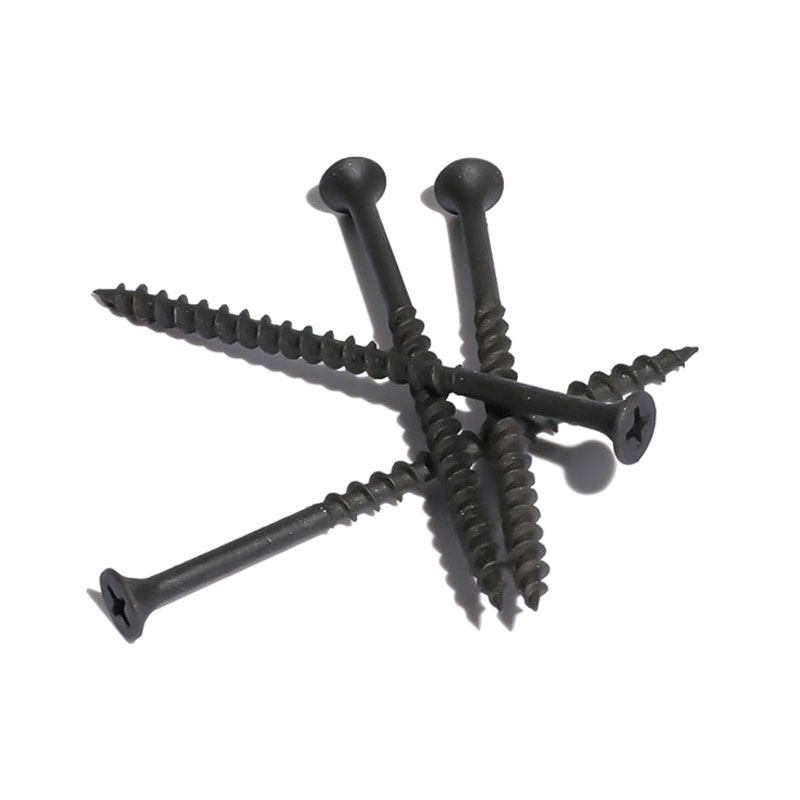 Phillips Bugle Head Black Phosphate Coarse-Thread Drywall ScrewsBlack phosphated coarse-thread bugle head screws for single-layer drywall over timber framing, where board thickness determines length and framing determines thread.View Product →
Thread Type Follows the Framing, Not the Board
Board thickness drives length. It does not drive thread. The framing does that, and the difference is not cosmetic: thread pitch against a thin steel wall behaves nothing like thread pitch in a softwood stud.
Coarse thread (W type) for wood framing
Coarse-thread drywall screws have a wide pitch and a sharp, tapered point. In softwood studs and joists they cut quickly, resist stripping and develop holding with modest torque. This is the default for wood-framed residential work, and it is also the usual choice for the base layer in a two-layer system fixed to timber.
Fine thread (S type) for steel studs
Fine-thread screws use a tighter pitch and a smaller minor diameter, which puts more threads in contact with thin steel. In 25 to 20 gauge studs, roughly 0.018 to 0.033 in. of wall thickness, a fine thread holds better than a coarse one and strips far less often. The screw and the stud gauge have to match: a fine-thread screw is the wrong tool in a thick timber stud, where it takes longer to drive and develops less bite.
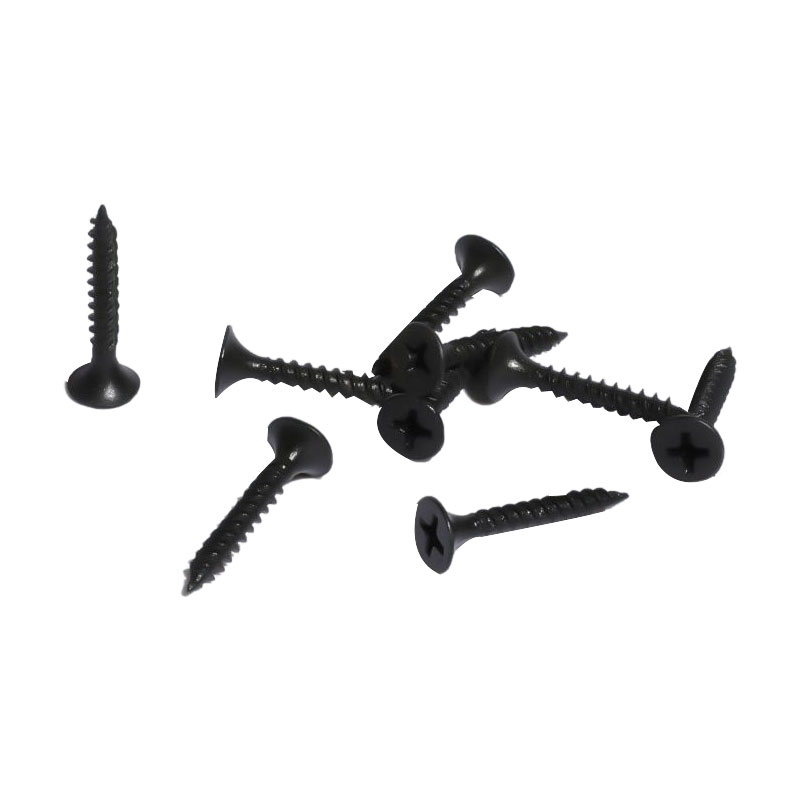 Phillips Bugle Head Fine-Thread Black Phosphate Gypsum Board ScrewsBlack phosphated fine-thread bugle head screws designed for gypsum board over thin steel studs, where tighter pitch improves hold and reduces stripping.View Product →
Self-drilling points for heavier steel and stacked layers
Where the steel is heavier than 20 gauge, or where two steel members have to be joined, the fastener needs a drill point that makes its own hole. Those screws sit at the boundary between drywall screws and self-drilling screws, and the selection question shifts from board thickness to steel thickness. They are also useful when board is fixed through a resilient channel or hat channel, where there is no framing directly behind the panel to compress against.
Type 17 points, with a slot and a drill-like tip, are for wood substrates where the screw should cut in without a pilot hole, which is why they appear on trim and high-low thread variants.
Head Style, Drive and Coating: What Board Thickness Does Not Decide
Length and thread keep a job out of trouble; head, drive and coating keep it out of trouble in the rooms that get wet.
The bugle head is the standard for gypsum board. Its curve compresses the paper into a shallow dimple without breaking the face and spreads load over a wide area. A wafer head is wider and flatter, which helps on fragile board faces or where a larger bearing area is required. Truss and pan heads belong where the screw passes through metal rather than being set into board.
Drive style is largely a tooling decision. A No. 2 Phillips bit is the default worldwide, while square drive and Torx reduce cam-out on high-torque work and last longer in production runs.
Coating is where climate and room type enter the specification. Black phosphate and grey phosphate are dry interior finishes and cover most of a house. Yellow zinc and blue-white zinc platings add corrosion resistance for kitchens, bathrooms, basements and other humid interiors. Epoxy and RUSPERT-type coatings are for cement board, exterior sheathing and any assembly that stays damp.
Where the board itself changes, such as gypsum to cement board to exterior sheathing, this substrate-by-substrate selection guide walks through the differences in more detail.
How to choose the right drywall screws and cement board screws for every substrate
A yellow zinc coarse-thread bugle head screw covers humid interior framing work without moving to a full exterior coating.
 Phillips Bugle Head Yellow Zinc Coarse-Thread Drywall ScrewsYellow zinc coarse-thread bugle head drywall screws suit humid interior framing work, and their listed specification fields help importers and distributors confirm purchase orders.View Product →
Where Drywall Screw Selection Goes Wrong
- One length for the whole project. A single 1-5/8 in. screw used on 1/2 in. walls and 5/8 in. ceilings wastes money on the walls and leaves the ceiling detail to chance.
- Screws that stop short. Once embedment into wood falls below 5/8 in., holding capacity drops sharply. Panels move, joint compound cracks along the seam, and heads pop as the framing dries and shrinks.
- Overdriving past the face paper. A screw set about 1/16 in. too deep breaks the paper and can cut holding by roughly 20 to 30 percent. Depth is set by the driver clutch, not by screw length, so a longer screw never automatically means a stronger joint.
- Mixing coarse and fine thread in one box. The two look similar in a collated strip until a coarse screw meets a steel stud, drives slowly, strips and fails inspection.
- Ignoring stud gauge. The difference between 25 and 20 gauge steel is small on paper and large in performance. Specify the gauge alongside the screw, not months later.
- Forgetting consumption. Ordering is usually done by weight or count, and the two do not track neatly. Rough trade figures put 1-1/4 in. screws at about 300 pieces per pound and 1-5/8 in. screws closer to 200, so a length change quietly changes the piece count in every carton.
What to Put Into a Drywall Screw Purchase Order
For importers and distributors, the screw line on a purchase order is a specification, not a description. These are the fields that prevent disputes at the container:
- Nominal size and length, written as #6 × 1-1/4 in., with the thread named (coarse W, fine S, or self-drilling).
- Head style and drive: bugle head with No. 2 Phillips is the baseline, square or Torx drive where cam-out is a concern.
- Coating and corrosion class, matched to the room or the environment rather than to habit.
- Material and hardness: case-hardened carbon steel with a defined case depth, so screws do not snap at the head or strip in steel.
- Packaging format and count per carton, strip or small box, since retail-ready packing is often part of the deal.
- Batch consistency, ideally one production run per shipment for color and drive performance.
LIZHAN has manufactured fasteners since 2007, operates more than 100 machines, quotes an annual capacity above 10,000 tons, and brings more than 20 years of export experience to buyers in different standard systems. The drywall screw range covers coarse thread, fine thread and self-drilling variants in black phosphate, grey phosphate, yellow zinc and blue-white zinc finishes, which means a single length chart can usually be filled from one supplier instead of three.
Drywall Screw Selection FAQ
Q1: What size drywall screw should I use for 1/2 in. board?
A #6 × 1-1/4 in. screw: coarse thread over wood framing, fine thread over 25 to 20 gauge steel studs. It leaves roughly 3/4 in. of engagement in wood, which sits comfortably above the 5/8 in. minimum.
Q2: Can I use 1-1/4 in. screws on 5/8 in. board?
It is marginal. Over wood framing the screw would leave about 5/8 in. of engagement with no allowance for board compression, uneven framing or overdriving. Step up to 1-5/8 in. and keep the 1/4 in. length as margin.
Q3: Coarse or fine thread for steel studs?
Fine thread (S type) for 25 to 20 gauge studs, because the tighter pitch keeps more threads in contact with thin steel. For steel heavier than 20 gauge, or when joining two steel members, use a screw with a self-drilling point.
Q4: What length do I need for two layers of 1/2 in. board?
The total thickness is 1 in., so 1-5/8 in. gives 5/8 in. of embedment into wood. Move to 2 in. where framing is uneven, where the specification calls for greater penetration, or where the second layer carries a fire or acoustic rating that has to be verified.
Q5: Does screw length change for ceilings?
No. Length follows the board and framing as it does on walls. What changes is spacing: ceilings are commonly specified at 12 in. on center in the field, tighter than the 16 in. typical on walls, with fasteners closer together at board edges.
Measure the board, add the embedment margin, match the thread to the framing, and confirm the coating against the room. A drywall screw specification that takes ten minutes to write saves the far more expensive work of fixing popped heads and cracked joints after the painters have finished. Buyers who want a length chart converted into a quotation, a sample set for a specific substrate, or a coating matched to a humid or exterior application can put the parameters in writing and get a specification back.