A distributor's returns report often exposes the real problem: the same self-drilling screw that sinks cleanly into 1.2 mm steel purlins can burn its point on 6 mm plate, and the contractor blames the fastener instead of the selection. Self-drilling screws are not universal components. They are engineered around five variables — point geometry, head type, thread form, coating, and manufacturing quality — and each one must be matched to the substrate, the driving tool, and the exposure conditions of the specific job. When these variables are chosen correctly, installation moves faster, pull-out failures disappear, and callbacks stop. When they are chosen by habit, even a well-made screw will fail in the wrong application.
What Makes a Self-Drilling Screw Different
A self-drilling screw — often named a drill-tail or TEK screw — has a milled cutting point that drills its own pilot hole in steel, aluminium, and other metals. One fastener and one driving tool replace the drill-bit-plus-screw sequence, with no pre-drilling, punch marking, or hole alignment. A self-tapping screw, by contrast, only cuts the mating threads and still needs an existing pilot hole. For metal-to-metal fastening on steel framing, roofing, cladding, or equipment assembly, the self-drilling point removes one full step per fastener. On a large roof project, that is the difference between hours and days of labour.
The point rating is the first specification a buyer should confirm. It tells you the thickness of steel the point can penetrate before the threads start to engage. If the point is rated below the actual steel thickness, it overworks, overheats, dulls quickly, and the crew ends up pre-drilling anyway.
| Point Rating | Steel Penetration | Typical Application |
|---|---|---|
| #1 | 0.8–1.5 mm | Light sheet metal, aluminium profiles |
| #2 | 1.5–3.5 mm | Steel purlins, metal framing, cladding |
| #3 | 3.5–5.5 mm | Equipment bases, heavier sections |
| #5 | 5.5–7.0 mm | Structural steel connections |
Confirm the point rating against the thickest material in the stack-up, not the average thickness. That single check prevents most field failures in self-drilling screw selection.
Match the Screw to the Substrate
The substrate combination decides which point, thread, and head you need. The stack-up — meaning the top material the screw enters first and the lower material the screw anchors into — matters more than the screw brand.
- Steel-to-steel — hex washer head, fine thread, #2 or #3 point, zinc or anti-corrosion coating.
- Metal-to-wood — a winged screw drills through the steel, then the wings enlarge the hole in the timber so the thread does not bind or split the wood.
- Aluminium-to-steel — use a compatible alloy and anti-galvanic coating; bare carbon steel will corrode quickly when it contacts aluminium outdoors.
- Thin sheet over thick plate — the point must be rated for the thickest layer, while the thread only fully engages in the lower load-bearing member.
Fastener selection starts with the thickest material, not the most common one.
For general steel-to-steel fastening, a hex washer head self-drilling screw with zinc plating is the default because the hex head handles the high torque required to drive through metal without stripping the drive recess.
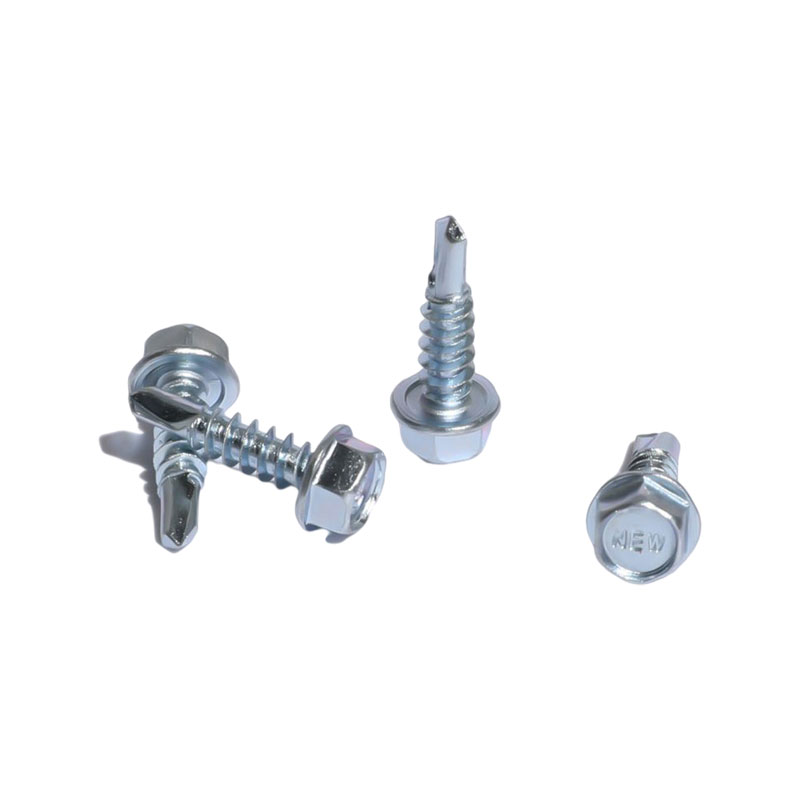 Hex Washer Head Self-Drilling Screw with Zinc PlatingIdeal for steel-to-steel fastening, this hex washer head screw withstands high torque without stripping, making it a reliable default for metal applications.View Product →
Choose the Head Type and Drive
Head type determines how the screw seats, how much torque can be applied, and whether the finished joint is flush or exposed.
Common Head Styles
- Hex washer head — accepts a socket or impact wrench at higher torque; used for steel frames and exposed connections. With a bonded sealing washer, it also works for weather-exposed panels.
- Bugle head — a countersunk profile that seats flush in wood and gypsum board without crushing the surface; common for sheathing and panel-to-steel work.
- Countersunk (CSK) head — gives a clean, flush appearance on trailers, railings, and architectural metal panels.
- Wafer and pan heads — low-profile heads with a flat bearing surface for thin sheet metal and lightweight framing.
For roofing and wall cladding, every fastener is a potential leak point. A hex washer head with a bonded EPDM rubber washer compresses around the pilot hole and keeps water out when the screw is driven perpendicular and tightened until the washer just begins to bulge. Over-torquing distorts the washer and opens a leak path.
Drive Recess Considerations
Phillips drives are the most common and cost-efficient, but under high torque they can cam out. Torx or hex drives preserve torque transfer and reduce stripped heads in harder materials. For long runs of steel roofing, a recess that matches the impact driver bit is not a minor detail; it is an installation-speed factor.
Check the Thread Form and Point Features
Thread form controls holding power and installation effort.
Coarse vs Fine Thread
- Fine threads — better pull-out resistance in thin steel, aluminium, and sheet metal; the standard for metal-to-metal connections.
- Coarse threads — for wood, particleboard, and soft substrates where aggressive thread engagement is needed.
Point and Head Features
Small design details change behaviour significantly. Nibs under the head create a serrated bearing surface that bites into the material, resists vibration loosening, and prevents over-drilling. Wings just behind the drill point ream a clearance hole in wood so the thread can pass without splitting the timber; the wings then shear off when they hit the steel layer.
Wings are the classic metal-to-wood detail: the point goes through steel, the wings open the timber, then the thread engages below.
When an application mixes wood and steel in one stack, a self-drilling screw with wings and a countersunk head is usually the most reliable solution because it controls both layers with a single fastener.
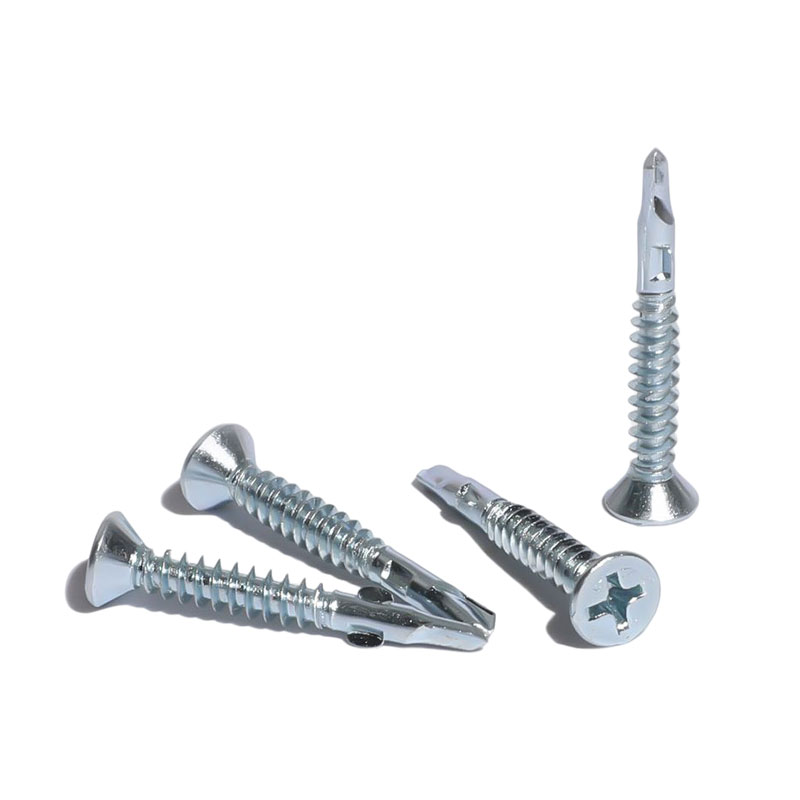 Phillips Countersunk Self-Drilling Screw with Wings, Zinc PlatedDesigned for mixed wood-and-steel stacks, the wings enlarge the wood layer while the countersunk head seats flush, ensuring controlled fastening in one step.View Product →
Select the Right Coating for the Environment
Corrosion resistance depends more on the coating and material than on the base screw alone. Match the coating to the real exposure:
| Coating or Material | Appearance | Best Environment |
|---|---|---|
| Clear or blue-white zinc | Silver-blue | Indoor assembly, dry conditions |
| Yellow zinc | Golden | Covered construction, humid air |
| Black phosphated | Matte black | Indoor, painted or oiled surfaces |
| Stainless steel (304/316) | Silver | Coastal, food, chemical, high humidity |
| Painted + EPDM washer | Colour-matched | Exposed roofing, high UV, coastal wind |
Clear zinc is economical for dry interior work. If the fastener will sit on a truck, in a humid warehouse, or outdoors overnight, move to yellow zinc or stainless steel. For roofing, the combination of a corrosion-resistant coating and an EPDM washer is the accepted standard.
Get the Size and Length Right
Length rules are simple but frequently ignored. Three checks prevent most dimensional mistakes:
- The drill point must be longer than the top material thickness. If the threads engage before the point emerges, the screw jams and the point snaps.
- The thread must reach into the lower load-bearing member for at least three full turns.
- Always test the exact material stack with the actual driving bit and screw before committing to a bulk order.
Quality Checks That Prevent Field Failures
Specification on paper is only half of selection. The other half is manufacturing consistency. A screw with the correct point and coating still fails if the recess is shallow, the point is off-centre, the case-hardening is too thin, or the plating thickness varies between batches.
When you evaluate samples, check the drive fit with the actual bit, inspect the cutting point for cracks and symmetry, verify the coating thickness, and drive a few screws into the target material at full speed. If you need a structured method, this guide on assessing the strength and durability of a self-drilling screw covers the practical steps before you sign a purchase order.
For importers and distributors, batch consistency matters as much as the first sample. Ask how the manufacturer controls heat treatment depth, plating thickness, and dimensional tolerances; then confirm with a second and third batch sample.
Common Selection Mistakes to Avoid
- Using a single point rating for every steel gauge on site.
- Choosing coarse threads for thin metal where fine threads hold better.
- Ignoring the humidity and UV exposure of the final installation site.
- Over-torquing EPDM washers until the seal is destroyed.
- Judging the whole batch from one shiny sample without testing.
Frequently Asked Questions
Q1: Can one self-drilling screw be used for both steel and wood?
Yes, for metal-to-wood stacks the screw needs wings that clear the wood layer after the point drills through the steel. For wood alone, a self-tapping wood screw with coarse thread is simpler and cheaper.
Q2: Do I always need to pre-drill for self-drilling screws?
No. The drill point eliminates pre-drilling. But you need the right point rating for the steel thickness, a bit that fits the recess, and enough driving speed and pressure from the tool.
Q3: What is the difference between a #2 and #3 point?
The number indicates how thick a steel section the point can penetrate before thread engagement. A #2 handles about 1.5–3.5 mm; a #3 handles 3.5–5.5 mm. Using too small a point burns the tip and slows installation.
Q4: What is the best coating for outdoor roofing screws?
For exposed roofing, choose a corrosion-resistant coating such as yellow zinc, painted or rust-protective systems, and a bonded EPDM washer under a hex washer head. Stainless steel is preferred only when the budget and salt exposure justify it.
Selection mistakes are almost always the result of missing information, not missing quality. Write down the substrate stack, the exposure class, the installation tool, and the length rules, then verify with a sample test before buying in volume. The five minutes spent at the specification stage protect you from replacing a thousand failed fasteners on site. That is what choosing self-drilling screws really means.