Modern homes require a surprising number of small tools. A loose cabinet handle, a flat-pack furniture assembly, a leaking pipe connection, a damaged electrical cord, or a picture frame that needs to be secured can all require different equipment. Buying every tool separately may be expensive, inconvenient, and difficult to organize. A compact household tool set solves this problem by combining essential hand tools and repair accessories in one practical package.
The Multitool Home Tool Screwdriver Set, identified as LZ000RD000056, is designed as a general-purpose repair kit for household maintenance, furniture assembly, basic installation, and everyday hardware work. Its selection includes a measuring tape, utility knife, inner hexagon spanner, screwdriver, electrical tape, electrical test pencil, combination pliers, adjustable wrench, claw hammer, hardware fittings, and razor blade. Together, these components cover many of the most common tasks encountered in a home, office, workshop, dormitory, warehouse, or maintenance department.
Rather than focusing on a single specialist application, the set emphasizes versatility, accessibility, and convenient storage. It is suitable for users who need dependable tools close at hand without purchasing a large professional toolbox. It can also serve as a useful promotional, retail, project-support, or household gift package when carefully configured and packed for its target market.
1. Product Overview and Intended Use
The Multitool Home Tool Screwdriver Set belongs to the category of household tool sets and hardware fitting packages. Its core purpose is to provide a balanced collection of basic tools for routine repair and installation. The set is not limited to screwdriver work. It also supports measuring, cutting, gripping, turning, striking, electrical checking, taping, and minor hardware replacement.
The included three-meter measuring tape allows users to measure furniture dimensions, wall positions, shelf spacing, door openings, and installation distances. A utility knife and razor blade support controlled cutting of cardboard, packaging materials, tape, plastic wrapping, and other suitable materials. The inner hexagon spanner is useful for furniture bolts and hexagonal socket fasteners, especially those frequently found in ready-to-assemble products.
The screwdriver component is described as a 6 x 100 screwdriver with slot and cross configurations. This gives users access to two of the most common screw-drive profiles used in household fixtures, furniture, appliances, fittings, and general hardware. The 100-millimeter shaft length provides a useful balance between reach and control for many ordinary applications.
The electrical tape and electrical test pencil extend the set beyond simple mechanical work. Electrical tape may be used for insulation-related maintenance and temporary securing, while the test pencil can help identify the presence of electrical voltage when used correctly and safely. These items are intended for basic checking and maintenance, not for replacing the procedures or equipment required by qualified electricians.
The combination pliers provide gripping, bending, holding, and limited cutting functions depending on their exact construction. The adjustable wrench, sometimes called a monkey wrench, accommodates various nut and bolt sizes. The claw hammer supports light fastening, assembly, and nail removal. Hardware fittings and a replacement razor blade add practical value by providing small consumable or installation-related items in the same package.
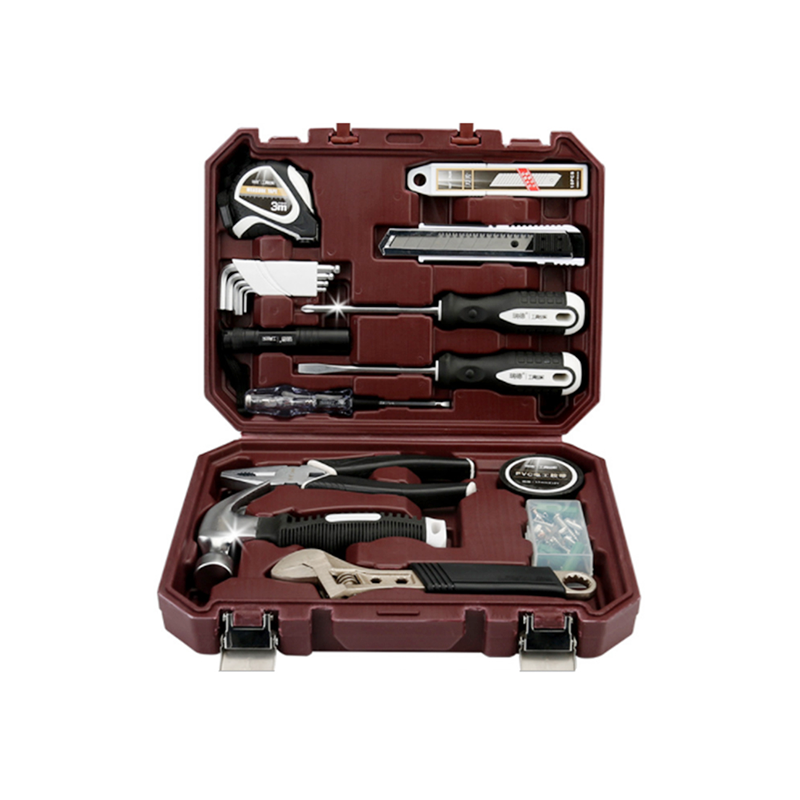
Multitool home tool screwdriver set
2. Why an Integrated Tool Set Is More Convenient Than Individual Tools
One of the strongest advantages of a combined tool set is reduced purchasing complexity. A customer does not need to identify every individual tool required for a small repair project. Instead, the set offers a ready-made selection that addresses a broad range of predictable household needs.
Storage is another important advantage. Individual tools purchased at different times are often placed in different drawers, cabinets, or rooms. This can lead to misplaced items and unnecessary delays. A coordinated set gives users a clear starting point for organization. When the components are returned to the same package after use, the next repair task can begin more quickly.
The set is also appropriate for first-time homeowners, tenants, students, office managers, property maintenance teams, and families establishing a new residence. These users may not need a large professional toolbox, but they still require more than a single screwdriver. A compact assortment offers a practical middle ground between having no tools and investing in a complete industrial tool system.
For retailers, the product presents a straightforward value proposition. It can be marketed as an entry-level household repair kit, a moving-in essential, a new-home gift, a furniture assembly set, or a general maintenance package. The range of included items makes it easier to explain the product’s usefulness to customers who may not already understand specialist tool categories.
For project purchasers and organizations, a standardized kit can simplify distribution. Property managers, construction support teams, schools, offices, hotels, and accommodation providers may require multiple basic tool kits for different rooms or service locations. Purchasing a consistent package can make inventory planning, replacement, and user training easier.
3. Component-by-Component Functional Analysis
3.1 Three-Meter Measuring Tape
Accurate measurement is the foundation of many repair and installation tasks. The three-meter measuring tape is suitable for common indoor work, including measuring furniture, shelves, cabinets, door hardware, curtain positions, wall decorations, and small room dimensions.
A tape measure is particularly useful when installing brackets, positioning handles, aligning frames, or checking whether a replacement component will fit. Its inclusion means the user does not have to estimate distances or search for a separate measuring instrument before beginning a project.
For manufacturers and buyers, a measuring tape also provides an opportunity to evaluate product quality through blade readability, return action, locking performance, case durability, and printed scale clarity. These details affect the user’s perception of the entire set, even though the tape is only one component.
3.2 Utility Knife and Razor Blade
Cutting tools are frequently required during unpacking, moving, furniture installation, and household maintenance. The utility knife can assist with opening cartons, trimming packaging, cutting tape, and preparing light materials. The separate razor blade provides an additional cutting option where a finer or more controlled edge is required.
Because blades are sharp, safe handling and storage are essential. The package should protect the cutting edges during transportation and keep them separated from users when not in use. Product instructions should encourage users to keep blades away from children, avoid cutting toward the body, and replace damaged or dull blades rather than forcing them through material.
Including both a utility knife and a razor blade increases the practical range of the kit. However, it also places greater responsibility on packaging design. A well-engineered package should prevent movement, accidental exposure, and contact between blades and other components.
3.3 Inner Hexagon Spanner
Inner hexagon spanners are widely used for furniture assembly, bicycle adjustments, equipment fittings, handles, and various machine or household fasteners. They are especially valuable for flat-pack furniture, where hexagonal socket bolts are common.
The presence of an inner hexagon spanner makes the set more competitive than a basic screwdriver-only package. Many inexpensive household kits overlook this requirement, forcing users to purchase an additional tool after opening a furniture package. By combining screwdriver and hexagonal fastening functions, the set supports a larger number of common assembly jobs.
3.4 Slot and Cross Screwdriver
Slot and cross-head screws remain common in furniture, electrical accessories, household hardware, appliances, and general fastening applications. A screwdriver with both profiles enables users to address two major categories of fasteners without carrying a large interchangeable-bit system.
The 6 x 100 specification indicates a useful shaft diameter and length for general household applications. The tool should provide a comfortable grip, a secure connection between handle and shaft, and a tip that engages the screw head without excessive slipping. Correct tip geometry is important because poor engagement can damage both the screw and the screwdriver.
For a household set, the screwdriver is often the most frequently used component. Its quality has a disproportionate impact on the customer’s overall evaluation of the package. A durable shaft, suitable heat treatment, corrosion resistance, accurate tip formation, and an ergonomic handle can improve user confidence and extend service life.
3.5 Electrical Tape and Test Pencil
Electrical tape is a versatile accessory for insulating, bundling, labeling, and temporarily securing wires or components. It can be useful during low-risk household maintenance, provided that the user follows appropriate electrical safety procedures and does not treat tape as a substitute for proper repair.
The electrical test pencil adds a basic diagnostic function. It can help a user determine whether voltage may be present before touching a suspected electrical point. However, electrical testing must always be performed according to the tool’s intended rating and instructions. Users should isolate power whenever possible, avoid wet conditions, and consult a qualified professional for uncertain or high-voltage work.
From a product-development perspective, these two components broaden the set’s appeal to homeowners and maintenance personnel. They also demonstrate that the package is designed around real household tasks rather than a narrow collection of metal tools.
3.6 Combination Pliers
Combination pliers are among the most versatile hand tools in a household kit. They can grip small parts, bend wire, hold components during assembly, and assist with turning or positioning work. They are useful for tasks where fingers cannot provide sufficient force or access.
The plier’s performance depends on jaw alignment, pivot construction, handle insulation, surface treatment, and the relationship between opening width and hand force. Smooth movement and accurate jaw contact improve usability. A well-finished tool should open and close consistently without excessive looseness or roughness.
For competitive positioning, combination pliers provide a significant advantage over packages that include only screwdrivers and a hammer. They allow the kit to address mechanical tasks involving wires, small fasteners, clips, and irregularly shaped objects.
3.7 Adjustable Wrench
An adjustable wrench is useful when the user does not know the exact nut or bolt size in advance. It can support minor plumbing work, furniture assembly, appliance adjustment, and general hardware maintenance. Its adjustable jaw makes it more flexible than a single fixed-size wrench.
Quality considerations include jaw parallelism, adjustment screw movement, handle strength, surface protection, and resistance to deformation. The tool should be adjusted firmly against the fastener to reduce slipping. Users should avoid applying excessive force beyond the wrench’s intended capacity.
3.8 Claw Hammer
The claw hammer adds impact and extraction capability to the kit. It can be used for light nailing, joining, assembly, and removing small nails or similar fasteners. Its claw is particularly helpful when disassembling wooden packaging, furniture components, or simple fixtures.
Important manufacturing factors include head-to-handle security, hammerhead balance, striking-face finish, claw formation, and handle comfort. The hammer must be assembled so that the head remains secure during repeated use. A balanced design can improve control and reduce user fatigue during light household work.
3.9 Hardware Fittings
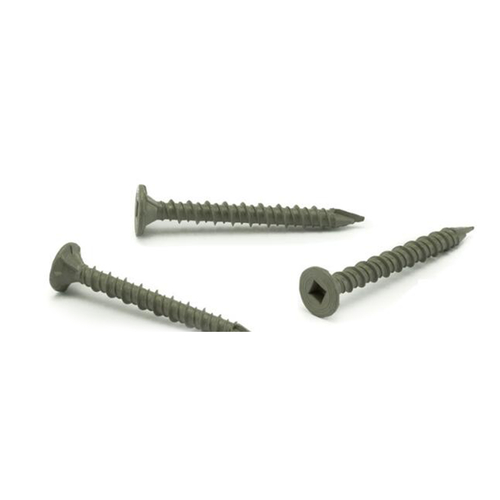
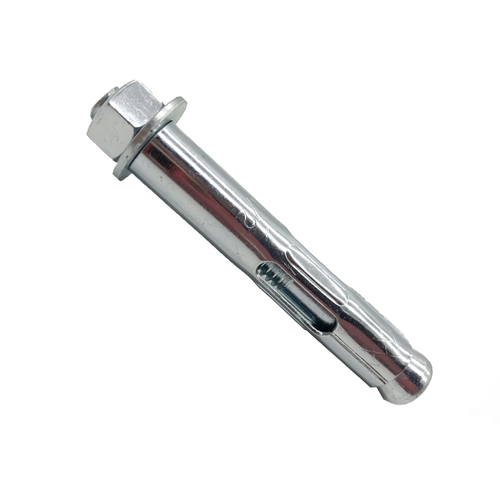
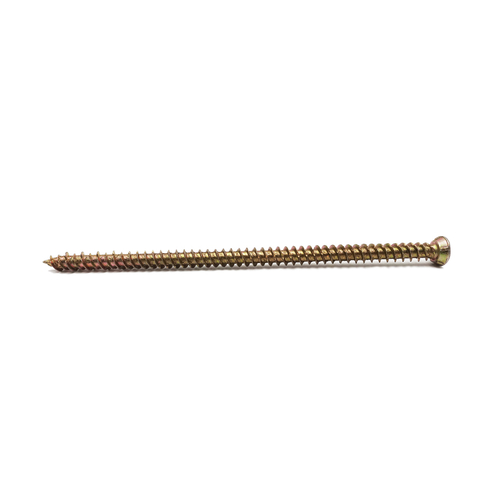
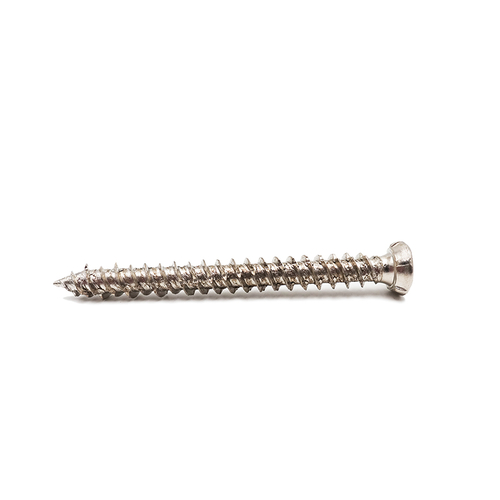
Hardware fittings increase the immediate usefulness of the package. Small screws, anchors, washers, or related items can help users complete minor repairs without making a second trip to a hardware store. The precise selection of fittings may be adapted according to the target market, application, retail channel, or customer specification.
For buyers ordering the set in volume, fittings can be customized by type, size, finish, and quantity. This flexibility is valuable for furniture suppliers, property maintenance programs, promotional campaigns, and private-label retail packages. It also connects the tool set with broader fastener manufacturing capabilities.
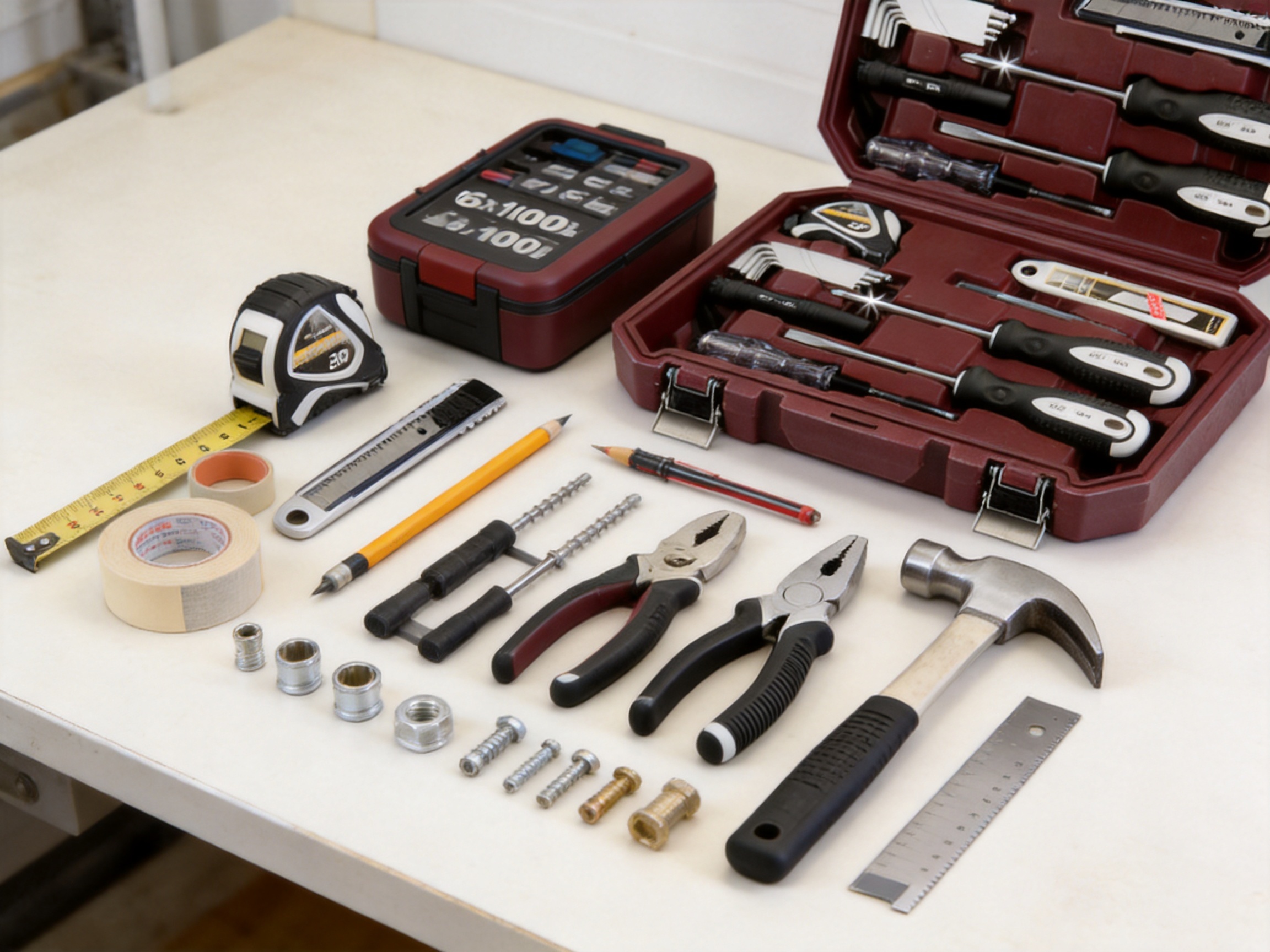
4. Advantages Over Basic Competitor Tool Kits
The first competitive advantage is breadth of function. Many entry-level tool packages contain only a screwdriver, a small hammer, and a few bits. This set covers measurement, cutting, gripping, turning, striking, electrical checking, insulation, and hardware support in one package.
The second advantage is suitability for real household scenarios. The components are not selected solely for visual variety. Each item corresponds to a practical task: measuring before drilling, cutting packaging, tightening furniture fasteners, checking electrical points, gripping wires, adjusting nuts, striking nails, and using replacement hardware.
The third advantage is convenience for non-specialist users. A highly technical tool kit may provide greater performance for professional tradespeople, but it can be unnecessarily complicated for a homeowner. The present configuration is easier to understand and more approachable for basic maintenance.
The fourth advantage is package efficiency. When tools are sourced separately, the total cost may include multiple retail packages, separate shipping, repeated handling, and fragmented inventory. A combined package can reduce these inefficiencies for both consumers and distributors.
The fifth advantage is customization potential. Buyers can discuss component selection, hardware fittings, packaging format, labeling, and order quantities with the manufacturer. This is particularly useful when the product must meet the requirements of a specific market or sales channel.
The sixth advantage is support from an established hardware manufacturing background. A supplier experienced in fasteners, stamping parts, hardware fittings, and related products can evaluate not only the visible tools but also the small metal components that influence the package’s usefulness and reliability.
5. Manufacturing Strengths and Production Capability
The product is supplied by a hardware manufacturer with a China factory and an additional warehouse location in Thailand. This structure can provide advantages in production coordination, export handling, regional distribution, and customer service. A production base in China supports manufacturing scale and component sourcing, while a regional warehouse can help shorten delivery pathways for certain Southeast Asian customers.
The company’s product categories include new products, home tools, fasteners, packages, and stamping parts. This combination indicates a broad hardware orientation rather than a narrow focus on one finished tool. Such breadth is valuable when developing a multi-component kit because the supplier can coordinate tool components, fittings, metal parts, and packaging requirements under one commercial program.
Manufacturing a household tool set is not simply a matter of placing unrelated items into a box. The supplier must manage component specifications, incoming materials, forming operations, surface treatments, assembly, inspection, packaging, and shipment. Each stage affects the final customer experience.
5.1 Material Selection and Component Engineering
Hand tools must be manufactured from materials appropriate to their intended loads and applications. Screwdriver shafts require a balance of hardness, toughness, and corrosion resistance. Pliers and wrench bodies need sufficient strength to withstand gripping and turning forces. Hammerheads must resist deformation under normal light-use conditions.
Material selection also affects weight, balance, appearance, and price. A capable manufacturer evaluates the complete product rather than selecting the cheapest material for each component independently. The objective is to create a practical relationship between durability, manufacturing cost, safety, and market positioning.
For hardware fittings and stamped parts, dimensional accuracy and repeatability are especially important. Small differences in hole location, edge formation, thickness, or surface treatment may influence assembly and fit. Production control helps ensure that the components supplied in repeated batches remain consistent.
5.2 Stamping and Forming Expertise
Stamping is widely used for producing metal brackets, clips, washers, plates, and other hardware parts. The process can provide high repeatability and efficient production when dies, feeding systems, press settings, and inspection procedures are properly managed.
Stamping quality depends on die design, material thickness, forming sequence, cutting accuracy, burr control, and post-processing. Excessive burrs can create safety risks, while inconsistent dimensions may cause assembly problems. A competent hardware manufacturer treats tooling maintenance and process monitoring as important parts of production control.
Where a tool set includes hardware fittings or customized metal accessories, stamping capability can help the supplier respond to specific customer needs. It may be possible to adjust shapes, hole patterns, thicknesses, finishes, or packaging quantities according to project requirements, subject to engineering review and order volume.
5.3 Tool Assembly and Functional Inspection
Several products in the set require assembly. Pliers need accurate pivot alignment. Hammers require secure head and handle construction. Adjustable wrenches require smooth jaw movement and correct adjustment screw engagement. Utility knives need secure blade retention and safe operation.
Functional inspection should therefore be applied at more than one stage. Incoming materials can be checked before production. Semi-finished components can be inspected after forming, machining, or surface treatment. Finished tools can then be checked for appearance, dimensions, movement, assembly security, and basic function.
A structured inspection approach reduces the likelihood that a cosmetic issue, loose connection, sharp burr, incorrect component, or damaged package reaches the customer. It also allows production teams to identify recurring problems and improve the process rather than correcting only individual units.
5.4 Surface Treatment and Corrosion Protection
Household tools are often exposed to humidity, fingerprints, dust, oils, and changing storage conditions. Surface treatment helps protect metal components, improve appearance, and support longer shelf life. Depending on the component, suitable treatments may include polishing, plating, coating, painting, or protective oiling.
The correct treatment must be selected according to the material, use environment, appearance requirements, and cost target. Surface consistency is important for retail presentation. Uneven finishes, exposed corrosion, peeling coatings, or sharp untreated edges can reduce customer confidence.
Packaging also plays a role in corrosion protection. Components should be stored and packed in a way that limits unnecessary moisture exposure during transportation and warehousing. Regional distribution, including movement through humid climates, makes practical packaging and storage controls especially important.
5.5 Packaging Engineering
Because the product is a multi-component package, packaging engineering is central to its success. Tools of different shapes and weights must be arranged so that they do not strike one another during transport. Sharp items must be protected, and smaller fittings must be prevented from scattering inside the package.
A well-designed package should make the contents easy to identify and remove. It should also support efficient retail display, warehouse stacking, barcode placement, labeling, and carton consolidation. Depending on the sales channel, the package may be designed for hardware stores, supermarkets, online retail, project distribution, or promotional use.
Packaging can be adjusted according to customer requirements. Options may include printed cartons, blister packaging, color boxes, transparent windows, internal trays, instruction sheets, multilingual labels, private labeling, and master cartons for export shipment. The appropriate format depends on product quantity, target market, protection requirements, and brand strategy.
6. Quality Control Priorities for This Product
Quality control for the Multitool Home Tool Screwdriver Set should cover both individual components and the completed package. A set may contain several acceptable tools but still fail as a product if one component is missing, incorrectly packed, damaged, or incompatible with the intended application.
Dimensional checks are important for screwdrivers, wrenches, pliers, fittings, and measuring tapes. Visual inspection should identify scratches, burrs, corrosion, poor coating, incomplete markings, damaged handles, or irregular assembly. Functional checks should verify movement, engagement, locking, gripping, striking, and cutting performance as appropriate.
Packaging inspection should confirm that the correct quantity and configuration are present. The three-meter tape, utility knife, inner hexagon spanner, screwdriver, electrical tape, electrical test pencil, combination pliers, adjustable wrench, claw hammer, hardware fittings, and razor blade should be checked against the approved packing list.
Sampling plans may be used for volume orders, while critical safety-related features may require more direct control. Buyers can also specify inspection standards, acceptance criteria, sample approval procedures, packaging tests, and documentation requirements before mass production begins.
Consistency between batches is particularly important for distributors and retailers. A product that changes appearance, component quantity, or performance from one shipment to the next can create customer complaints and inventory complications. Clear specifications and retained samples help maintain continuity.
7. Applications in Different Environments
7.1 Household Maintenance
Homeowners can use the set for tightening screws, assembling furniture, measuring spaces, adjusting nuts, hanging items, opening packages, and handling small repairs. Its broad selection makes it suitable for a kitchen drawer, utility cabinet, garage shelf, or home office.
7.2 Furniture Assembly
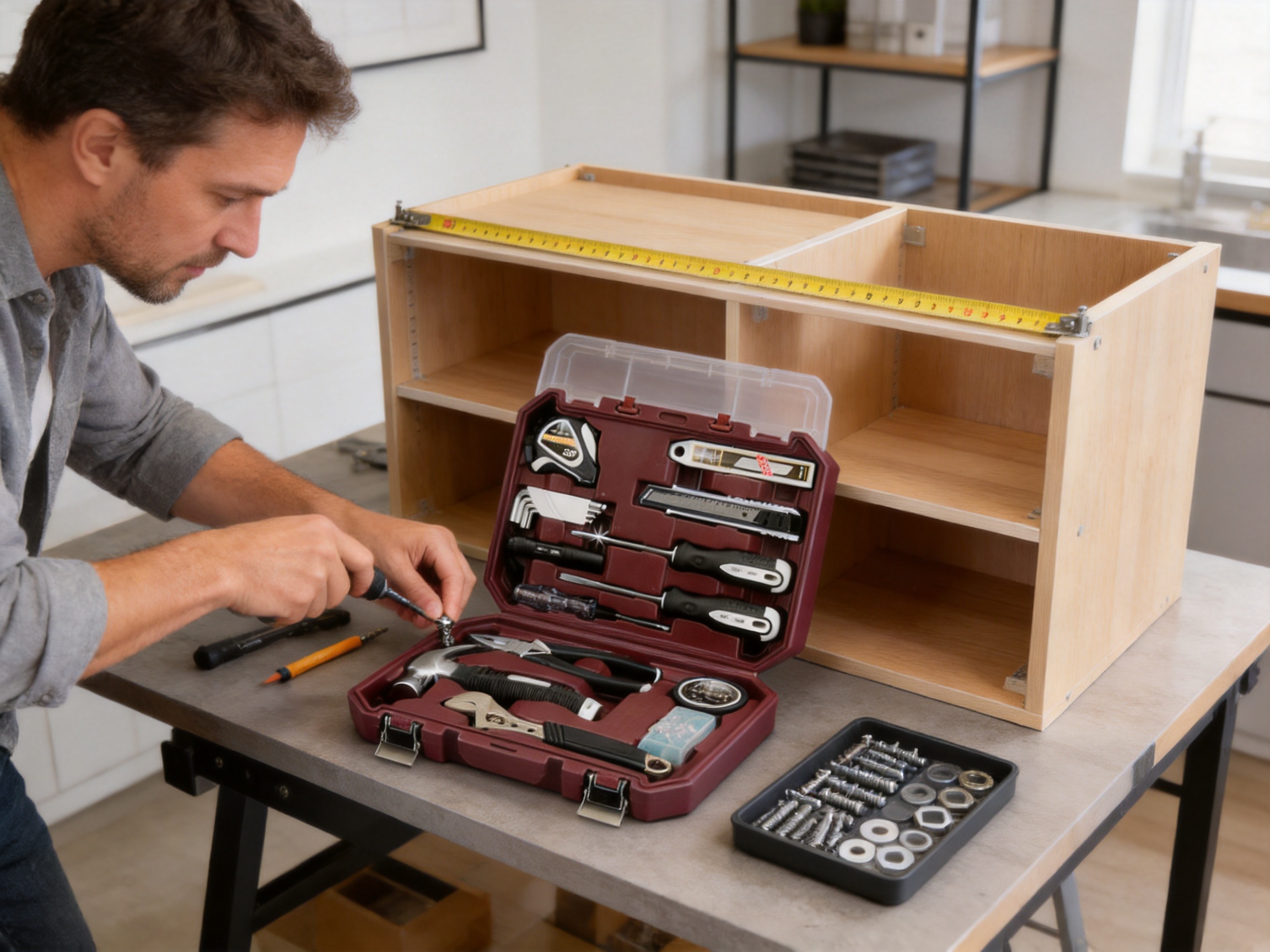
Furniture assembly often requires a measuring tool, screwdriver, hexagonal spanner, adjustable wrench, and pliers. The set can help users assemble tables, chairs, shelves, cabinets, beds, and storage units. The hammer may assist with light fitting work, while the utility knife can open the packaging.
7.3 Office and Facility Maintenance
Offices, schools, hotels, and small facilities regularly encounter loose handles, damaged packaging, displaced labels, minor fixture adjustments, and basic maintenance needs. A standardized tool kit in a maintenance room can reduce response time for low-risk tasks.
7.4 Moving and New-Home Packages
People moving into a new residence commonly need tools immediately. They may need to unpack boxes, assemble furniture, hang accessories, measure spaces, and tighten fittings before a complete workshop has been established. This makes the set suitable for moving-in kits and household starter packages.
7.5 Retail and Promotional Programs
Retailers can position the set as a value-oriented household essential. Businesses may also use it as a practical promotional item for housing projects, property services, home improvement campaigns, or customer loyalty programs. Packaging and component selection can be adjusted to match the intended audience.
8. Purchasing Considerations for Importers and Distributors
Importers should begin by confirming the exact component list. Product names can vary between markets, and terms such as utility knife, test pencil, adjustable wrench, or inner hexagon spanner may require clear technical definitions. A component approval sheet can prevent misunderstandings before production.
Buyers should also determine whether the set is intended for household retail, professional maintenance, promotional distribution, or institutional use. This decision influences material specifications, packaging quality, labeling, instruction requirements, and price positioning.
Order quantities, lead times, sample approval, carton dimensions, gross weight, and shipping configuration should be agreed upon in advance. For international shipments, the buyer should review product classification, packaging regulations, labeling rules, and any requirements applicable to sharp tools or electrical testing accessories.
Private-label customers should provide artwork, logo files, color references, packaging language, barcode information, and compliance statements early in the development process. The manufacturer can then confirm printing methods, minimum quantities, proofing procedures, and production schedules.
It is also useful to request pre-production samples. A sample allows the buyer to examine tool feel, finish, component balance, package protection, printed information, and overall presentation. Any changes should be recorded in a written specification before mass production.
9. Product Development and Customization Opportunities
The standard configuration provides a useful starting point, but different markets may require different combinations. A buyer may request additional screwdriver profiles, more hexagon sizes, a different tape length, alternative plier styles, extra fittings, or a modified package size.
Customization should be guided by actual customer needs rather than adding components simply to increase the item count. A smaller set with highly useful tools may provide better value than a larger set containing redundant or low-quality accessories.
Fittings can be adapted for furniture, general household repair, shelving, light installation, or specific project applications. Packaging can likewise be designed to emphasize portability, retail appearance, sustainability, protection, or low shipping volume.
The supplier’s experience in fasteners and stamping parts may support the development of customized metal accessories. For example, a project buyer may need a particular bracket, washer, plate, clip, or installation fitting included in the package. Such requirements should be reviewed through drawings, samples, material specifications, and production feasibility analysis.
10. Safety and Responsible Use
Although the set is intended for household work, each tool should be used only for its designed purpose. Screwdrivers should not be used as chisels or pry bars. Adjustable wrenches should be fitted securely to the fastener. Pliers should not be used as a substitute for specialized high-load cutters unless their specifications permit it.
Users should inspect tools before use. Cracked handles, loose hammerheads, damaged insulation, distorted jaws, worn screwdriver tips, or exposed blade defects are reasons to stop using the affected tool. Clean and dry tools after use, and store them away from children and moisture.
Electrical accessories require special care. The electrical test pencil should be used only within its stated operating range. Users should not rely on a single test result when working on a potentially energized circuit. Power should be disconnected whenever possible, and qualified electricians should handle uncertain, damaged, or high-risk electrical systems.
Sharp tools should remain covered or secured when not in use. Razor blades should be disposed of safely, and utility knives should be locked or retracted when stored. Clear instructions and responsible packaging reduce the risk of accidental injury.
11. Why Manufacturing Integration Matters
A multi-tool package benefits from supplier integration because the final product includes many different categories of components. A company that understands tools, fasteners, stamped parts, fittings, and packaging can coordinate the project more effectively than a supplier that only assembles unrelated items after purchasing them from multiple sources.
Integrated production management can improve communication about dimensions, materials, surface treatment, packaging space, and shipment timing. It can also make it easier to trace a problem to a specific process or component source. For buyers, a single point of contact may simplify sampling, quotations, revisions, inspections, and repeat orders.
The China factory provides a manufacturing base for hardware production, while the Thailand warehouse offers a regional logistics option. This combination may be valuable for customers serving different markets and seeking a balance between production efficiency and distribution convenience.
Manufacturing strength should ultimately be judged through samples, documented specifications, process communication, inspection results, and delivery performance. Nevertheless, a supplier with a broad hardware portfolio and established production resources is well positioned to develop practical household tool packages.
12. Maintenance and Expected Service Life
Proper maintenance can significantly extend the useful life of the set. Metal tools should be kept dry and wiped after use, especially in humid environments. A light protective oil may be applied to suitable metal surfaces when the tools will be stored for an extended period.
Screwdriver tips should be kept clean and used with the correct screw profile. Applying excessive force to a damaged screw can deform the tip. Wrench jaws should be kept free from dirt so that they engage fasteners properly. Pliers should be lubricated at the pivot when movement becomes stiff.
Hammerheads and handles should be inspected periodically. If the head becomes loose or the handle develops a crack, the hammer should be removed from service until professionally repaired or replaced. Cutting tools should be stored safely and replaced when the blade no longer cuts cleanly.
The service life of the set depends on frequency of use, working conditions, user technique, storage environment, and the loads applied. It is designed as a practical household and general maintenance package, not as a replacement for specialized professional tools in heavy-duty industrial applications.
13. Value for Retail Customers
Customers usually evaluate a household tool set according to three questions: Does it contain the tools they need? Does it feel reliable? Is it easy to store and use? The Multitool Home Tool Screwdriver Set addresses the first question through its broad component selection.
The second question depends on manufacturing quality. Accurate dimensions, secure assembly, clean finishing, comfortable handles, legible markings, and protected packaging all contribute to perceived value. A well-presented package can make the product more attractive on a retail shelf or online product page.
The third question is addressed through the integrated format. Users can keep the tools together and access them when needed. The package also makes the set suitable for gifting because it communicates usefulness immediately.
Compared with purchasing every item separately, a coordinated kit may offer lower initial complexity and better convenience. Even if a customer later purchases specialized tools, the set can remain a useful first-response kit for everyday problems.
14. Recommended Positioning in the Market
The product can be positioned as a practical household starter kit, a compact home repair set, a furniture assembly package, or a general maintenance tool box. Its strongest market message should focus on versatility and readiness rather than claiming professional performance for every application.
For online retail, product information should clearly list every included component and explain typical uses. Photos should show the full contents, package dimensions, tool sizes, and safety information. For physical retail, the packaging should make the key functions visible and easy to understand.
For project procurement, the product can be promoted as a standardized maintenance package. Buyers may benefit from customized fittings, private labeling, multilingual instructions, and regional warehouse support where available.
The product is particularly well suited to customers who value convenience, compact storage, and broad functionality. It provides a practical solution for everyday tasks without requiring users to build a tool collection one item at a time.

15. Frequently Asked Questions
Q1: What is included in the Multitool Home Tool Screwdriver Set?
The listed configuration includes one three-meter measuring tape, one utility knife, one inner hexagon spanner, one 6 x 100 slot and cross screwdriver, one roll of electrical tape, one electrical test pencil, one combination plier, one adjustable wrench, one claw hammer, hardware fittings, and a razor blade.
Q2: Is the set suitable for professional construction work?
The set is primarily intended for household maintenance, furniture assembly, general installation, and light repair. Professionals may use it for minor tasks or as a supplementary kit, but heavy-duty or specialized work should use tools designed and rated for those applications.
Q3: Why is a measuring tape included in a screwdriver set?
Many repair and installation tasks require measurement before fastening, cutting, drilling, or positioning. Including a three-meter measuring tape makes the package more useful for furniture assembly, shelf installation, room organization, and general household work.
Q4: What types of screws can the screwdriver handle?
The listed screwdriver provides slot and cross configurations. It is suitable for many common household fasteners using these drive profiles. Users should select the correct tip and avoid applying excessive force to damaged or incompatible screws.
Q5: Can the hardware fittings be customized?
Hardware fittings may be adjustable according to project requirements, subject to technical review, minimum order quantities, and production feasibility. Buyers should confirm fitting type, size, finish, quantity, and intended application before ordering.
Q6: Can the packaging be customized?
Packaging may be developed for different sales channels and customer requirements. Possible considerations include box style, printed artwork, labeling, internal arrangement, protective inserts, language, barcode placement, and master-carton configuration.
Q7: Is the electrical test pencil safe for every electrical application?
No. It should be used only within its specified operating range and according to the applicable instructions. Users should disconnect power whenever possible and consult a qualified electrician for uncertain, damaged, or high-voltage systems.
Q8: What makes this set different from a basic low-cost tool kit?
Its advantage is the combination of mechanical tools, measuring equipment, cutting accessories, electrical-related items, and hardware fittings. This broader selection supports more everyday tasks than a package containing only a screwdriver and hammer.
Q9: Where is the product manufactured and distributed?
The supplier operates a China factory and maintains a warehouse location in Thailand. The exact manufacturing, packaging, and delivery arrangement should be confirmed according to the buyer’s order, destination, and logistics requirements.
Q10: How should buyers evaluate samples?
Buyers should check component completeness, tool dimensions, surface finish, handle comfort, movement of pliers and wrench, screwdriver engagement, hammerhead security, blade protection, electrical accessory labeling, and packaging strength. Approved samples should be recorded as production references.
Q11: Can the set be used as a promotional gift?
Yes. Its practical nature makes it suitable for new-home programs, property services, home improvement promotions, customer loyalty campaigns, and project distribution. Branding and packaging can be adapted subject to order requirements.
Q12: What information should be included in a purchase inquiry?
A buyer should provide the desired quantity, target market, component requirements, packaging preference, private-label needs, delivery destination, expected timing, inspection requirements, and any applicable compliance or labeling specifications.
Conclusion
The Multitool Home Tool Screwdriver Set is a practical all-in-one package for routine household repair, furniture assembly, light maintenance, and general hardware work. Its combination of measuring, cutting, fastening, gripping, turning, striking, electrical checking, insulation, and fitting accessories gives it a wider functional range than many basic tool kits.
Its competitive value comes from convenience, component breadth, approachable design, and customization potential. The package can serve individual households as well as retailers, distributors, property managers, offices, project purchasers, and promotional programs.
The supplier’s hardware manufacturing background, China production base, Thailand warehouse presence, and experience with fasteners, stamping parts, hardware fittings, and packaged products provide a useful foundation for developing and supplying this type of multi-component kit. With appropriate material selection, process control, functional inspection, packaging engineering, and customer-specific configuration, the set can be positioned as a dependable and accessible solution for everyday tool needs.
For buyers, the best results will come from confirming the component list, approving samples, defining quality standards, selecting suitable packaging, and matching the final configuration to the intended market. For users, safe operation, correct tool selection, regular inspection, and proper storage will help preserve performance and extend service life.
References
1. General principles of hand-tool design, material selection, and functional inspection.
2. Common household hardware maintenance and furniture assembly practices.
3. Manufacturing principles for metal stamping, forming, deburring, and surface finishing.
4. Packaging engineering guidelines for mixed-component hardware kits.
5. General electrical safety practices for household testing and maintenance.
6. Quality-control principles for fasteners, hand tools, hardware fittings, and assembled product packages.