Drywall installation depends on fasteners that combine reliable holding power, clean installation, consistent dimensions, and a surface finish suitable for interior construction. The Phillips bugle head black coarse thread drywall screw is designed to meet these requirements in one practical fastening solution. Its geometry is optimized for attaching drywall panels to wood or suitable light-gauge framing, while its material, thread design, recess options, and protective finishes support efficient professional and industrial use.
This screw combines a bugle head, a Phillips recess, a sharp penetrating point, and a coarse thread profile. The result is a fastener that can seat flush into gypsum board without unnecessarily damaging the paper facing when correctly installed. Its black phosphate surface is commonly associated with drywall applications, but alternative finishes, including zinc plating, yellow zinc plating, Dacromet, Ruspert, and Magni coatings, provide additional choices for different environments and customer specifications.
The product range is manufactured from C1022A carbon steel, a material widely used for construction screws because it offers a practical balance of strength, formability, machinability, and cost efficiency. Available diameters range from #6 to #14, with metric-equivalent nominal diameters from approximately 3.5 mm to 6.3 mm. This range enables buyers to select a screw according to board thickness, substrate, installation method, and required holding performance.
Although the standard configuration uses a Phillips recess and coarse thread, the production range also supports square and Torx recesses, as well as fine-thread and coarse-thread options. This broader manufacturing capability allows distributors, contractors, and original equipment customers to source related drywall screw variants from one product platform rather than managing multiple unrelated suppliers.
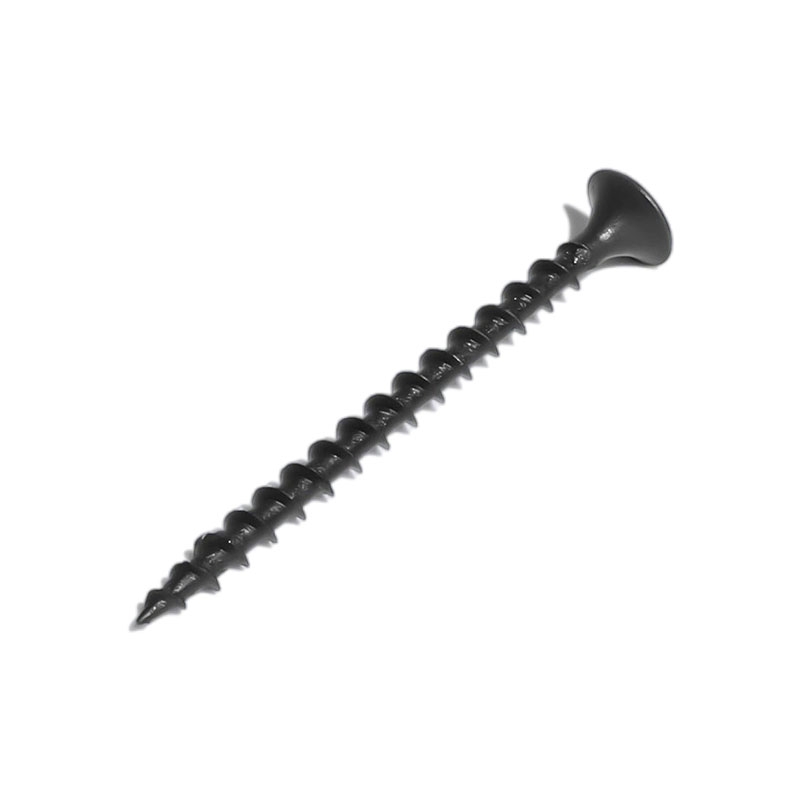
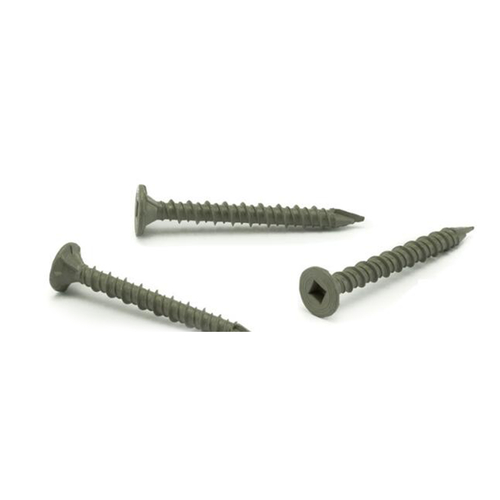
Phillips bugle head black screw coarse thread
1. Product Overview
A drywall screw is more than a simple pointed screw. Every component affects installation quality. The head must distribute pressure across the board surface. The recess must transfer driving torque without excessive cam-out. The thread must create dependable engagement in the substrate. The steel must withstand driving forces without premature fracture. Finally, the surface must provide the level of corrosion resistance and appearance required by the intended application.
The Phillips bugle head black coarse thread screw addresses these requirements through a purpose-built configuration. The bugle head has a gently curved underside that helps spread the clamping load across the drywall surface. Unlike a conventional flat or pan head, the bugle profile is intended to sit slightly below or near the board surface when driven correctly. This makes it easier to cover the fastener with joint compound during finishing.
The coarse thread is particularly suitable for fastening drywall to wood studs, timber framing, and other relatively soft substrates. Its larger thread spacing allows the screw to advance efficiently and remove installation debris from the hole. Coarse threads also provide a substantial thread profile for gripping wood fibers, which supports fast installation in common residential and commercial drywall work.
The black phosphate finish gives the screw its familiar dark appearance and is widely used for interior drywall work where severe atmospheric exposure is not expected. It also provides a degree of surface protection and contributes to a smooth, consistent appearance after installation. Where additional corrosion resistance is required, customers can select from zinc-plated, yellow zinc-plated, Dacromet, Ruspert, or Magni surface treatments, subject to production specifications and application requirements.
Core production specifications
| Specification | Available range or option | Practical significance |
|---|---|---|
| Material | C1022A carbon steel | Suitable balance of strength, formability, and production efficiency |
| Head style | Bugle head | Supports flush seating and helps reduce damage to drywall paper |
| Standard recess | Phillips | Common driving system for drywall installation |
| Additional recesses | Square and Torx | Provides alternatives for torque transfer and customer preference |
| Nominal diameter range | #6-3.5, #8-4.2, #10-4.8, #12-5.5, #14-6.3 | Supports different board, substrate, and load requirements |
| Thread options | Coarse thread and fine thread | Allows selection for wood or metal framing applications |
| Surface options | Black phosphate, zinc, yellow zinc, Dacromet, Ruspert, Magni | Enables application-specific appearance and corrosion protection |
| Typical product category | Drywall screws | Intended primarily for board installation and related interior construction |
The listed length range is organized by diameter group. For #6, #7, and #8 products, the stated head-to-end length range is approximately 7.9 to 8.4 in the applicable specification format. For #10, the stated range is approximately 8.6 to 9.2, while #12 and #14 products are listed at approximately 11.8 to 12.4. Buyers should confirm the final dimensional standard, unit system, tolerance, and packing specification before placing a production order.
2. Why the Bugle Head Matters
The head is one of the most important differences between a drywall screw and a general-purpose wood screw. A bugle head transitions smoothly from the central drive area to the outer head edge. When the screw is installed with an appropriate driver setting, the head can form a controlled countersink in the gypsum board without creating an excessively wide crater.
This controlled seating has several advantages. First, it helps the screw sit below the finished face of the board, allowing joint compound or finishing material to cover the fastener. Second, the curved underside spreads the load over a wider area than a very small flat head. Third, the profile can reduce the likelihood of cutting through the paper facing when the installer uses correct torque and depth control.
In comparison, a conventional pan head may remain visibly proud of the board and can interfere with finishing. A sharply countersunk head may cut too deeply into the board surface, especially when the driver is not properly adjusted. The bugle head is therefore a practical compromise between flush appearance, holding support, and installation tolerance.
Head consistency is essential. If the head diameter, curvature, or recess depth varies significantly from piece to piece, installers may experience irregular seating, inconsistent compound coverage, or driver engagement problems. A controlled manufacturing process helps ensure that screws in the same lot behave similarly during automated or manual installation.
Advantages of the bugle-head profile
The bugle head supports a clean finished surface. Drywall contractors often work rapidly across large wall and ceiling areas, so a screw that seats predictably can reduce rework. Properly seated fasteners are easier to cover, sand, and paint. This contributes to a smoother finishing process and can lower labor costs over the complete installation cycle.
The head also supports a more stable clamping action. As the screw is driven, the underside contacts the board over a controlled area instead of concentrating all pressure at a narrow edge. This is especially useful when fastening gypsum board, fiber-cement board, or similar sheet materials where excessive localized pressure can cause surface damage.
Competitor products may offer similar visual geometry, but performance depends on dimensional consistency, steel quality, point formation, and recess accuracy. A bugle head alone does not guarantee a high-quality drywall screw. The advantage comes from combining the head design with suitable C1022A material, consistent forming, appropriate heat treatment where specified, and reliable final inspection.
3. Coarse Thread Performance
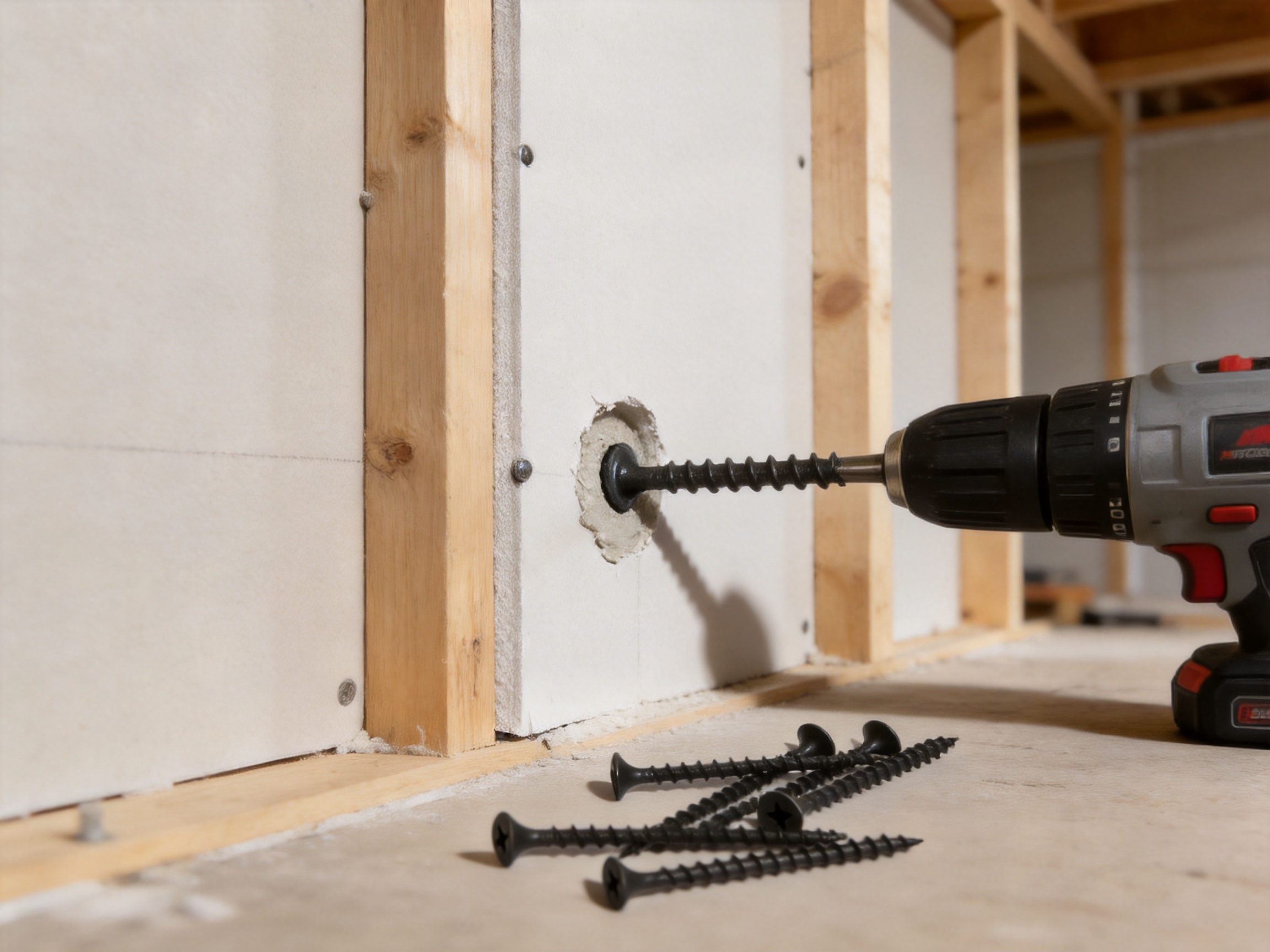
Coarse thread is a defining feature of this product configuration. Coarse-thread drywall screws are normally selected for wood studs and other softer substrates. The thread has a relatively large pitch and a deep engagement profile. As the screw enters the substrate, the thread displaces and grips the material efficiently.
For wood framing, this geometry can provide quick penetration and dependable pull-out resistance. The wider spacing also helps prevent the threads from becoming packed with wood fibers or installation debris. In high-volume construction, efficient driving is important because installers may place hundreds or thousands of screws during a single project.
Coarse thread can also be useful where the board and substrate require rapid advancement. The screw generally requires fewer revolutions to reach the desired depth than a comparable fine-thread screw with a smaller pitch. This can reduce driving time and support higher productivity when used with a suitable power tool.
Fine thread remains valuable for metal framing and selected sheet-metal applications. The production range includes both coarse-thread and fine-thread options, allowing buyers to match the fastener to the substrate rather than using one thread form for every project. Selecting the correct thread is important. A coarse thread in thin metal may not produce the desired engagement, while a fine thread in wood may drive less efficiently or provide a different holding response.
Coarse thread compared with fine thread
| Feature | Coarse thread | Fine thread |
|---|---|---|
| Typical substrate | Wood studs and softer materials | Metal framing and thinner steel sections |
| Thread spacing | Wider pitch | Smaller pitch |
| Driving behavior | Fast penetration and efficient advancement | Controlled engagement in metal |
| Common selection reason | Grip in wood fibers | Engagement with metal framing |
| Primary installation concern | Avoid overdriving into the board | Ensure sufficient penetration through the metal |
Professional buyers should specify the substrate clearly when requesting quotations. The same nominal diameter and length may not perform identically if the thread form is changed. A manufacturer capable of supplying both coarse and fine versions can help simplify product selection and reduce the need for mixed sourcing.
4. Material Selection: C1022A Carbon Steel
C1022A is a carbon steel grade commonly associated with self-tapping and construction screw production. It is valued because it can be formed into precise screw geometry while offering the strength necessary for driving into common building substrates. The material is suitable for cold heading, thread rolling, and related screw-making operations when the manufacturing parameters are properly controlled.
Material selection affects every stage of production. Wire quality influences heading stability. Chemical composition affects formability and heat-treatment response. Cleanliness and internal quality influence the risk of cracks or inclusions. Mechanical properties influence the screw’s ability to withstand driving torque and installation stress.
For drywall screws, the balance between hardness and toughness is particularly important. A screw that is too soft may deform at the recess or fail to penetrate the substrate effectively. A screw that is excessively hard or poorly heat-treated may become brittle. The correct production condition should provide sufficient surface hardness for thread and point performance while retaining enough toughness for practical installation.
Using C1022A also supports cost-effective large-scale production. This is important for drywall screws because they are often purchased in high quantities and distributed through hardware wholesalers, construction supply companies, furniture-related channels, and industrial packaging programs. A material that supports stable production helps maintain competitive pricing without abandoning essential performance requirements.
Material-related quality controls
Reliable screw production begins with incoming raw-material control. Wire rod or wire stock should be checked against the applicable purchase specification. Depending on the order, controls may include dimensional verification, surface inspection, chemical documentation, and mechanical testing. The exact inspection plan can vary by customer requirements and applicable standards.
During processing, manufacturers should monitor wire straightness, lubrication, die condition, and forming behavior. These factors influence the consistency of the head, recess, shank, point, and thread. A stable process reduces variation and helps prevent issues such as head cracks, incomplete recesses, bent screws, damaged threads, or irregular points.
Final inspection can include visual examination, dimensional measurement, thread gauging, recess checking, hardness testing, torque testing, and functional driving trials. The precise tests should be agreed upon according to the product specification, customer drawings, and intended application.
5. Manufacturing Process and Engineering Strengths
The product is supported by a manufacturing approach that combines forming, thread production, heat-treatment control, surface finishing, inspection, sorting, and packaging. Each stage contributes to the final screw. The strength of a supplier is not simply the ability to produce a screw shape; it is the ability to repeat that shape and performance across large production quantities.
Wire preparation and cold heading
After material preparation, the steel wire is cut into controlled blanks. Cold heading equipment then forms the screw head and shank through a sequence of die operations. The forming dies create the bugle head profile and establish the basic dimensions of the screw body.
Cold heading is advantageous for volume production because it offers high productivity and material efficiency. Instead of machining the entire screw from a solid bar, the material is displaced into the required shape. This can support consistent output and lower material waste when tooling and process conditions are well managed.
The heading process must be carefully matched to the C1022A material. Excessive forming force, worn tooling, unsuitable lubrication, or incorrect blank dimensions can produce cracks, folds, off-center heads, or dimensional variation. Experienced production teams monitor these conditions and adjust tooling or process parameters when necessary.
Recess forming
The Phillips recess is formed in the head during the heading operation or a related forming stage. Recess geometry affects driver engagement, torque transfer, installation speed, and the risk of cam-out. A recess that is too shallow may not hold the driver securely. A recess that is too deep or improperly centered may weaken the head or create inconsistent driving behavior.
The production range also includes square and Torx recess options. These systems are often selected where users want increased driver engagement or a different balance of torque transfer and installation control. Offering multiple recesses demonstrates flexibility in tooling, production planning, and customer specification management.
Point forming and thread rolling
The screw point is formed to support penetration into the target substrate. A consistent point helps the screw start cleanly and reduces wandering during installation. Point geometry should be matched to the selected thread and application. A drywall screw intended for wood framing may use a point and coarse thread that differ from those used for metal framing.
Threads are typically formed by rolling rather than cutting. Thread rolling displaces material to create the thread profile and can produce strong, continuous thread surfaces. It also supports efficient high-volume production. The thread rolling operation must maintain correct pitch, major diameter, minor diameter, flank form, and alignment with the screw axis.
Thread quality is critical because a damaged or incomplete thread can reduce holding power and create installation problems. Thread inspection may involve gauges, visual checks, dimensional tools, and functional testing in representative substrates. Consistent rolling also helps ensure that boxes from the same production lot provide a predictable driving experience.
Heat treatment
Construction screws may require controlled heat treatment to achieve the necessary relationship between hardness and toughness. The treatment process must be suitable for the steel grade, screw dimensions, and intended performance. Excessive hardness can increase brittleness, while insufficient hardness may reduce thread durability and driving performance.
Temperature uniformity, furnace atmosphere, transfer time, cooling conditions, and process records all influence heat-treatment results. A disciplined manufacturing system uses controlled parameters and repeatable procedures rather than relying only on visual inspection. Customers requiring specific mechanical properties should identify the relevant standard or test requirements before production begins.
Surface treatment
Surface finishing provides appearance and additional protection. Black phosphate is the standard visual choice for many drywall screws. Zinc plating and yellow zinc plating provide alternative appearances and increased corrosion protection for suitable applications. Dacromet, Ruspert, and Magni are additional coating options used where customers require particular corrosion, friction, or environmental performance characteristics.
Surface preparation is important before coating. Oil, scale, dust, and residues can interfere with adhesion and create uneven coverage. A properly managed finishing line includes cleaning, rinsing, coating or plating, drying, and inspection steps. Coating thickness, color, adhesion, surface continuity, and fastener functionality should be evaluated according to the selected finish and customer requirements.
The surface treatment must also be compatible with the recess and thread. Excessive coating buildup can make the recess tight or affect gauge fit. Inadequate coating can leave exposed areas vulnerable to corrosion. A capable supplier balances protection and dimensional control rather than treating coating as an independent cosmetic step.

6. Advantages Over Generic and Competing Fasteners
Many low-cost screws may appear similar to a drywall screw, but visual similarity does not establish equivalent performance. A purpose-designed bugle head screw offers several advantages over generic wood screws, low-grade drywall screws, and incorrectly specified fasteners.
Application-specific geometry
The bugle head is engineered for board installation and finishing. A generic wood screw may have a pan head, flat head, or other profile that does not seat as cleanly in drywall. The application-specific head can reduce surface damage and improve finishing efficiency when correctly driven.
Thread selection
The availability of coarse and fine threads allows the screw to be selected according to the substrate. Some competitors offer only one thread form, which may force distributors to maintain separate sources or cause users to apply a screw outside its intended purpose. A broader range supports better technical matching and more complete product programs.
Recess flexibility
Phillips is a familiar and widely available driving system. Square and Torx options can support customers who prefer alternative recesses for higher torque control or different tool compatibility. This flexibility is valuable for private-label programs, professional users, and distributors serving multiple markets.
Finish selection
Black phosphate is appropriate for many interior drywall applications, but not every installation environment is the same. Zinc, yellow zinc, Dacromet, Ruspert, and Magni options allow customers to specify a finish based on appearance, corrosion exposure, and project requirements. Competitors with a narrow coating range may be less capable of serving customized orders.
Production range and sourcing efficiency
A supplier that can manufacture multiple diameters, thread types, recesses, and finishes can reduce sourcing complexity. Buyers may consolidate related fasteners into fewer purchase programs, simplify quality management, and coordinate packaging across product families. This is especially important for wholesalers and importers that need a dependable range rather than one isolated item.
Consistency at volume
For construction fasteners, consistency is often more valuable than a single impressive test result. Installers need screws that drive similarly from box to box. Consistent head dimensions, recess depth, point shape, thread form, and coating help reduce stoppages and rejected pieces. Manufacturing experience in fastener production is therefore a meaningful competitive advantage.
7. Installation Guidance
Correct installation is necessary to obtain the full benefit of the product. The installer should select a screw length that provides adequate penetration into the framing while avoiding unnecessary protrusion. The screw should be long enough to pass through the board and achieve secure engagement in the substrate, but the exact selection depends on board thickness, framing material, local construction practice, and applicable building requirements.
A suitable Phillips driver bit should be used for the recess. The bit must be in good condition and should match the specified recess size. A worn or incorrectly sized bit can cause cam-out, damage the recess, and make it difficult to control the final seating depth.
Driving speed and torque should be adjusted to the material. The bugle head should seat flush or slightly below the board surface without breaking the paper facing. Overdriving can create a weak spot and may make finishing more difficult. Underdriving can leave the head proud of the surface and interfere with joint compound application.
For wood framing, the coarse-thread version should be selected unless the project specification requires another design. For metal framing, the fine-thread version may be more appropriate. Users should conduct a small installation trial when changing board thickness, framing type, screw finish, or driver equipment.
Installation checklist
| Step | Recommended practice | Reason |
|---|---|---|
| Confirm substrate | Identify wood, metal, or another supporting material | Determines appropriate thread type and length |
| Select diameter | Choose a diameter suitable for the board and required holding performance | Balances penetration, strength, and installation effort |
| Check driver bit | Use a matching, unworn Phillips, square, or Torx bit | Improves torque transfer and reduces recess damage |
| Set driving depth | Seat the bugle head flush or slightly below the board face | Supports finishing without excessive board damage |
| Inspect installed screws | Check for proud heads, overdriven heads, and incomplete engagement | Reduces rework and improves finished-wall quality |
When screws are installed using automatic feeding equipment, buyers should confirm compatibility between screw dimensions, collated format if applicable, driver settings, and equipment specifications. Bulk loose screws and collated screws may require different packaging and production arrangements.
8. Quality Assurance and Order Management
Professional buyers should evaluate a drywall screw supplier through both product data and manufacturing behavior. A quotation should identify the material, diameter, length, head style, recess, thread, finish, packaging, quantity tolerance, and inspection requirements. If the buyer needs compliance with a particular standard, that requirement should be stated before tooling or mass production begins.
Pre-production samples can verify appearance and basic dimensional conformity. A sample installation can evaluate recess engagement, driving torque, head seating, and substrate performance. For larger programs, an approved sample or golden sample can be retained for comparison during later production lots.
In-process quality control should cover the stages that can create significant variation. Heading checks can verify head diameter and profile. Recess checks can verify drive fit. Thread checks can verify pitch and diameter. Point checks can verify symmetry and penetration behavior. Heat-treatment checks can verify hardness or other agreed mechanical properties. Coating checks can verify appearance and coverage.
Final sorting and packaging are also important. Screws should be protected from contamination, excessive moisture, and mixing of different specifications. Packaging labels should identify the product description, size, finish, quantity, production information, and customer references where required. Clear labeling reduces warehouse errors and supports traceability.
The company’s business structure includes a China factory address in Haiyan, Jiaxing, Zhejiang, and a Thailand warehouse address in Chonburi. This combination can support production coordination and regional distribution planning. The China manufacturing base is positioned within a major fastener-producing region, while the Thailand warehouse can be useful for customers serving Southeast Asian markets or requiring regional stock management.
Questions buyers should ask before ordering
Buyers should ask whether the quoted screw is black phosphate or another finish, whether the quoted dimension is nominal or tolerance-controlled, and whether the coarse thread is intended for wood framing. They should also confirm whether the product is supplied in bulk, boxes, cartons, or customer-specific packaging.
Additional questions may cover minimum order quantity, sample availability, production lead time, inspection reports, coating requirements, pallet configuration, shipping marks, and private-label packaging. Clear communication at the quotation stage helps prevent misunderstandings after production starts.
9. Packaging, Distribution, and Commercial Applications
Drywall screws are distributed through hardware stores, building-material wholesalers, construction supply channels, online industrial catalogs, and project procurement programs. Packaging should reflect the sales channel. Small retail boxes may be suitable for repair and do-it-yourself users, while bulk cartons or larger inner boxes may be more efficient for contractors and distributors.
Packaging design should protect the black phosphate surface from unnecessary abrasion and moisture. Although the product is intended primarily for interior applications, poor storage conditions can affect any steel fastener. Cartons should be kept dry, elevated from floors when practical, and protected from condensation and corrosive chemicals.
For distributors, a complete range can be commercially valuable. The #6, #8, #10, #12, and #14 diameter groups provide opportunities to build a product family around the same general head style. Phillips, square, and Torx recesses allow further segmentation. Coarse and fine thread options support different construction systems, while several finishes provide additional market choices.
The product can also be considered for furniture-related assembly, interior partition systems, cabinet backing, light board fastening, and general panel installation where the screw dimensions and performance are suitable. Users should not assume that a drywall screw is appropriate for structural connections, exterior exposure, or safety-critical assemblies unless the relevant engineering and regulatory requirements have been independently confirmed.
10. Environmental and Corrosion Considerations
Black phosphate drywall screws are generally selected for dry interior environments. They are not automatically equivalent to stainless steel or heavily corrosion-resistant exterior fasteners. Exposure to water, condensation, salt spray, treated timber chemicals, or outdoor weather can require a different surface finish or material.
Zinc plating may be suitable for applications requiring a brighter appearance and additional protection under moderate conditions. Yellow zinc offers a distinctive color and may be selected for identification or appearance. Dacromet, Ruspert, and Magni finishes may provide enhanced performance for specific applications, but their suitability should be evaluated against the actual exposure conditions and the coating supplier’s technical data.
Corrosion resistance depends on more than the coating name. Coating thickness, pretreatment, curing, handling, storage, installation damage, and environmental exposure all contribute to service life. Buyers should specify salt-spray targets or other corrosion requirements when necessary rather than relying only on a general finish description.
Responsible procurement also involves avoiding over-specification. An interior drywall project may not need the highest-cost coating, while a humid or demanding environment may require more protection than black phosphate can provide. Matching the finish to the application can improve technical performance and control total cost.
11. Why Supplier Manufacturing Capability Matters
Fasteners are small components, but their quality can influence installation speed, finishing appearance, and project reliability. A manufacturer with experience in screw production can coordinate material selection, tooling, thread rolling, heat treatment, coating, inspection, and packaging as one integrated process.
The company represented in the supplied product information operates as Lizhan Hardware Co., Ltd. and identifies itself as a manufacturer and supplier of screws, including drywall screws, roofing screws, self-drilling screws, and furniture screws. Its product range indicates experience with multiple screw categories and surface finishes. This breadth can be beneficial to customers seeking a consolidated fastener source.
Manufacturing strength should be evaluated through measurable capabilities rather than general claims. Important indicators include the ability to maintain dimensional tolerances, provide consistent thread and recess geometry, manage different coatings, support sample approval, and communicate production details clearly. A supplier able to explain these processes is more likely to support long-term procurement programs.
The company’s listed contact structure includes sales support through Shawn and Sophia, as well as telephone and messaging contact options. Direct communication can help customers clarify specifications, request samples, coordinate packaging, and resolve technical questions. For international orders, communication regarding warehouse location, shipping terms, customs documentation, and lead time is particularly important.
Customers should nevertheless review samples, commercial terms, technical documentation, and applicable compliance requirements independently. Supplier capability and product suitability should be confirmed against the specific project, market, and legal requirements.

12. Selecting the Correct Size
Diameter and length should be chosen according to the board thickness and supporting structure. The #6 option is commonly associated with lighter fastening requirements, while #8 provides a widely used general-purpose size. Larger #10, #12, and #14 diameters may be selected where a heavier or more robust screw is required, although the appropriate choice depends on the application rather than diameter alone.
A longer screw does not automatically provide better performance. Excessive length can complicate installation, increase the chance of contacting concealed services, or create unnecessary protrusion. Insufficient length may reduce substrate engagement. The buyer should evaluate the complete assembly, including board layers, adhesive or furring systems, framing thickness, and any local installation requirements.
When establishing a product catalog, distributors should list the nominal size together with the actual length, finish, thread, recess, and packaging quantity. This prevents confusion between similar products. The supplied production range uses grouped length specifications, so final orders should confirm the exact dimensional presentation and tolerances.
13. Common Failure Modes and Prevention
Cam-out occurs when the driver slips out of the recess during installation. It may result from a worn bit, incorrect bit size, insufficient axial pressure, excessive torque, poor recess geometry, or an improperly centered recess. Using a suitable bit and maintaining correct driver alignment can reduce the problem.
Overdriving occurs when the screw head penetrates too deeply into the drywall. This can break the paper facing and reduce local holding support. Driver depth control, moderate pressure, and installer training are important preventive measures. A consistent bugle head helps, but it cannot compensate for excessively aggressive tool settings.
Underdriving leaves the head above the board surface. The result may be visible after finishing or may interfere with joint-compound application. Underdriving can be caused by insufficient torque, a hard substrate, an incorrect thread selection, or a screw that is too long for the equipment settings.
Head breakage and shank fracture may be associated with excessive driving torque, unsuitable hardness, material defects, damaged tooling, or installation into a substrate harder than intended. A properly specified C1022A screw manufactured and heat-treated under controlled conditions helps reduce risk, but users should select a fastener designed for the actual substrate.
Corrosion can result from unsuitable finish selection, exposure beyond the product’s intended environment, damaged coating, poor storage, or contact with incompatible materials. Selecting zinc, Dacromet, Ruspert, Magni, or another appropriate finish may improve performance where black phosphate is not sufficient.
14. Q&A
Q1: What is the main application of this screw?
The primary application is fastening drywall and similar board materials to suitable framing, particularly wood framing when the coarse-thread version is selected. The exact application should be confirmed according to board type, substrate, project specification, and local construction requirements.
Q2: Why is the head called a bugle head?
The term describes the gently curved, trumpet-like transition between the recess area and the outer head edge. This profile helps the screw seat into drywall with a controlled countersink and supports finishing over the installed head.
Q3: Is the black phosphate finish suitable for outdoor use?
Black phosphate is commonly used for dry interior applications and should not automatically be treated as an exterior-grade finish. Outdoor, humid, coastal, or chemically aggressive environments may require zinc, Dacromet, Ruspert, Magni, stainless steel, or another specifically qualified solution.
Q4: What is the difference between coarse thread and fine thread?
Coarse thread has wider spacing and is generally selected for wood or softer substrates. Fine thread has closer spacing and is commonly selected for metal framing. The correct choice depends on the substrate and project requirements.
Q5: Can the screw be supplied with a recess other than Phillips?
Yes. The production range identifies Phillips, square, and Torx recess options. Buyers should state the required recess clearly because the drive system affects tooling, packaging identification, driver compatibility, and installation behavior.
Q6: What material is used?
The listed material is C1022A carbon steel. This grade is widely used in screw production because it supports forming and can provide suitable strength and hardness when processed correctly.
Q7: Which diameter sizes are available?
The listed nominal range includes #6-3.5, #8-4.2, #10-4.8, #12-5.5, and #14-6.3. Buyers should confirm the exact diameter, length, tolerance, and unit convention on the final quotation or technical drawing.
Q8: What finishes are available?
The listed finishes include black phosphate, zinc plated, yellow zinc plated, Dacromet, Ruspert, and Magni. Finish selection should be based on the required appearance, corrosion exposure, customer specification, and applicable testing requirements.
Q9: How can installers avoid damaging the drywall?
Installers should use a suitable driver bit, maintain proper alignment, control driving depth, and avoid excessive torque. The bugle head should be seated flush or slightly below the surface without breaking the paper facing.
Q10: Can this product be used for structural connections?
It should not be assumed to be a structural fastener. Drywall screws are intended for board installation and related applications. Structural connections require fasteners specifically rated and approved for the relevant loads, materials, and building regulations.
Q11: What should a distributor confirm before placing a bulk order?
The distributor should confirm diameter, length, head, recess, thread, material, finish, packaging, quantity, inspection requirements, labeling, lead time, shipping terms, and any private-label or compliance requirements. A production sample and installation trial are recommended for important programs.
Q12: What makes a supplier competitive in this product category?
Important strengths include stable raw-material control, accurate cold heading, consistent recess and thread forming, controlled heat treatment, reliable surface finishing, inspection capability, flexible product options, appropriate packaging, and responsive technical communication.
15. Recommended Procurement Specification
A clear procurement description can reduce errors between buyer and supplier. A typical description should identify the product as a Phillips bugle head drywall screw with coarse thread, C1022A carbon steel, black phosphate finish, and the required nominal diameter and length.
For example, a purchase specification may state: “Bugle head drywall screw, Phillips recess, coarse thread, C1022A carbon steel, black phosphate, nominal diameter #8 or 4.2 mm, specified length, with agreed dimensional tolerances and packaging.” If an alternative coating, recess, or thread is required, it should be written directly into the product description rather than left to assumption.
For private-label or distribution orders, buyers should add carton dimensions, inner-box quantity, barcode or label content, production marks, pallet requirements, and destination-market documentation. These commercial details can be just as important as the screw geometry when the product is sold through organized retail or professional distribution channels.
Conclusion
The Phillips bugle head black coarse thread drywall screw is a practical, application-focused fastener for drywall and related interior board installation. Its main advantages come from the combination of a flush-seating bugle head, familiar Phillips recess, efficient coarse thread, C1022A carbon steel construction, and a broad selection of sizes and surface treatments.
Compared with generic fasteners, the product offers geometry designed specifically for drywall finishing, thread options matched to different substrates, and recess alternatives for different user preferences. The availability of black phosphate, zinc, yellow zinc, Dacromet, Ruspert, and Magni finishes gives distributors and project buyers greater flexibility.
Its value also depends on manufacturing discipline. Controlled wire preparation, cold heading, recess forming, point formation, thread rolling, heat treatment, coating, inspection, sorting, and packaging all contribute to reliable performance. A supplier with capability across these processes can provide more than a single screw size; it can support a complete and consistent fastener program.
For the best result, buyers should define the substrate, size, thread, recess, finish, packaging, and inspection requirements before ordering. Installers should use a suitable driver and control the seating depth. When correctly specified and installed, this drywall screw can support efficient construction, clean finishing, and dependable day-to-day fastening performance.
References
1. ASTM International, Standard Specifications and Test Methods for Carbon Steel Mechanical Fasteners.
2. International Organization for Standardization, General Requirements for Fasteners and Dimensional Product Standards.
3. American Society for Testing and Materials, Guidance on Zinc Coatings and Corrosion Testing for Steel Products.
4. Construction fastener engineering manuals covering drywall screw geometry, thread selection, and installation practice.
5. Industrial cold-heading and thread-rolling process references for carbon steel screw production.
6. Manufacturer-provided product specifications for bugle head drywall screws, C1022A material, recess options, thread options, and surface finishes.