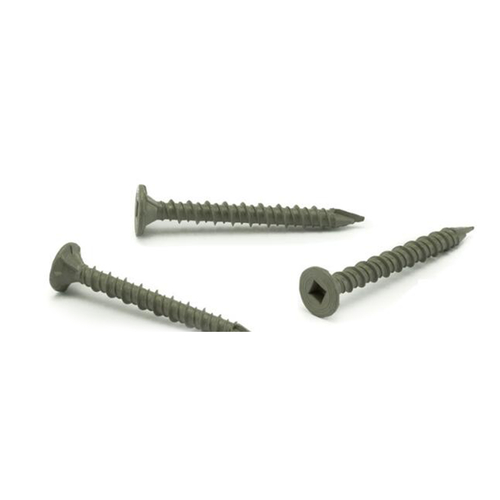
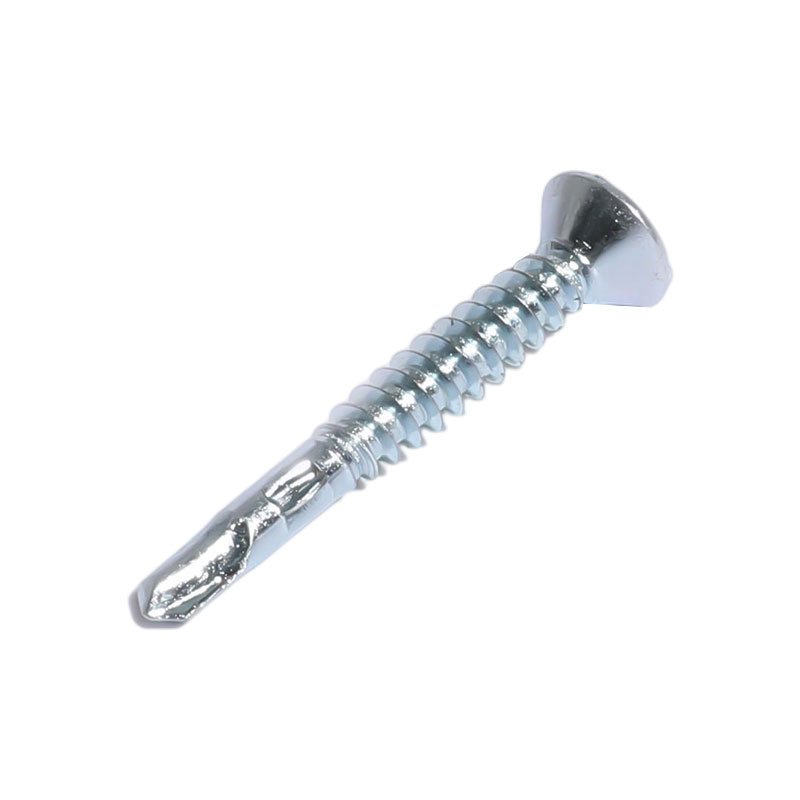
Phillips csk head self drilling screw with wings zinc plated
Product Overview
A Phillips CSK head self-drilling screw with wings zinc plated is a specialized fastening solution designed for efficient installation through timber, boards, panels, or other wood-based materials into metal substrates. The product combines several performance features in one fastener: a countersunk head for a flush finish, a Phillips recess for familiar driving compatibility, a self-drilling point for direct penetration into metal, wing cutters for clean clearance holes in wood, and zinc plating for practical corrosion resistance in general applications.
This type of screw is especially valuable where installers need to fasten wood to steel without separate drilling, countersinking, or pilot-hole preparation. In many construction and industrial assembly environments, every extra operation adds time, labor cost, tooling wear, and alignment risk. A self-drilling screw with wings addresses these issues by cutting its own path and forming a precise fastening result in a single driving operation.
The product belongs to the drilling screw category and is commonly produced from C1022A carbon steel, a widely used material for self-drilling screws because it offers a suitable balance of cold-forming performance, heat-treatment response, drilling hardness, and fastening strength. The zinc plated surface provides a clean metallic appearance and a protective coating that helps reduce corrosion in dry indoor or mildly exposed environments.
The available production range can include multiple recesses, diameters, heads, surface treatments, and thread types. Recess options may include Phillips, square, and Torx. Diameter options may include #6-3.5, #8-4.2, #10-4.8, #12-5.5, and #14-6.3. Head options may include bugle head, hex washer head, flat head, pan head, wafer head, and pan framing head. Applicable standards may include ASTM specifications and DIN7504K, DIN7504P, and DIN7504N types, depending on configuration and customer requirements.
Lizhan Hardware Co., Ltd. manufactures and supplies screws for industrial, construction, furniture, hardware, and packaging-related fastening markets. With production capabilities covering machine screws, furniture screws, drilling screws, self-tapping screws, stamping parts, and related fastener products, the company supports customers who require stable quality, flexible specifications, export-ready packaging, and reliable communication for international procurement.
Why This Screw Matters in Modern Fastening
Traditional wood-to-metal fastening often requires several steps. First, the worker drills a pilot hole through the wood. Next, the worker drills through the metal. If a flat finish is required, a countersink operation may also be needed. Finally, the screw is inserted and tightened. Each step consumes time, requires tool changes, and creates opportunities for error. Misalignment between the wood hole and the metal hole can reduce fastening accuracy and installation strength.
A Phillips CSK head self-drilling screw with wings zinc plated streamlines the process. The drill point penetrates the steel, the wings create a clearance hole in the wood or board, and the countersunk head seats into the surface. When the wings contact the metal, they break away or are worn off, allowing the threads to engage firmly into the steel substrate. This design is one of the main reasons the screw performs better than ordinary self-tapping screws or standard wood screws in wood-to-metal applications.
In competitive fastening markets, product performance is measured not only by the strength of one screw but also by total installed cost. A low-quality screw may appear inexpensive at purchase, but if it causes cam-out, broken points, poor drilling, inconsistent plating, thread stripping, or slow installation, the actual cost becomes higher. A well-manufactured self-drilling screw with wings offers measurable advantages by reducing labor time, minimizing rework, and improving installation consistency.
The countersunk head is particularly useful when a smooth surface is required. In furniture frames, deck boards, interior panels, metal-backed timber assemblies, and general hardware installations, protruding heads may interfere with aesthetics, safety, or additional assembly steps. A CSK head allows the screw to sit flush or near flush with the surface when properly installed.
Core Design Features
Countersunk Head for a Flush Finish
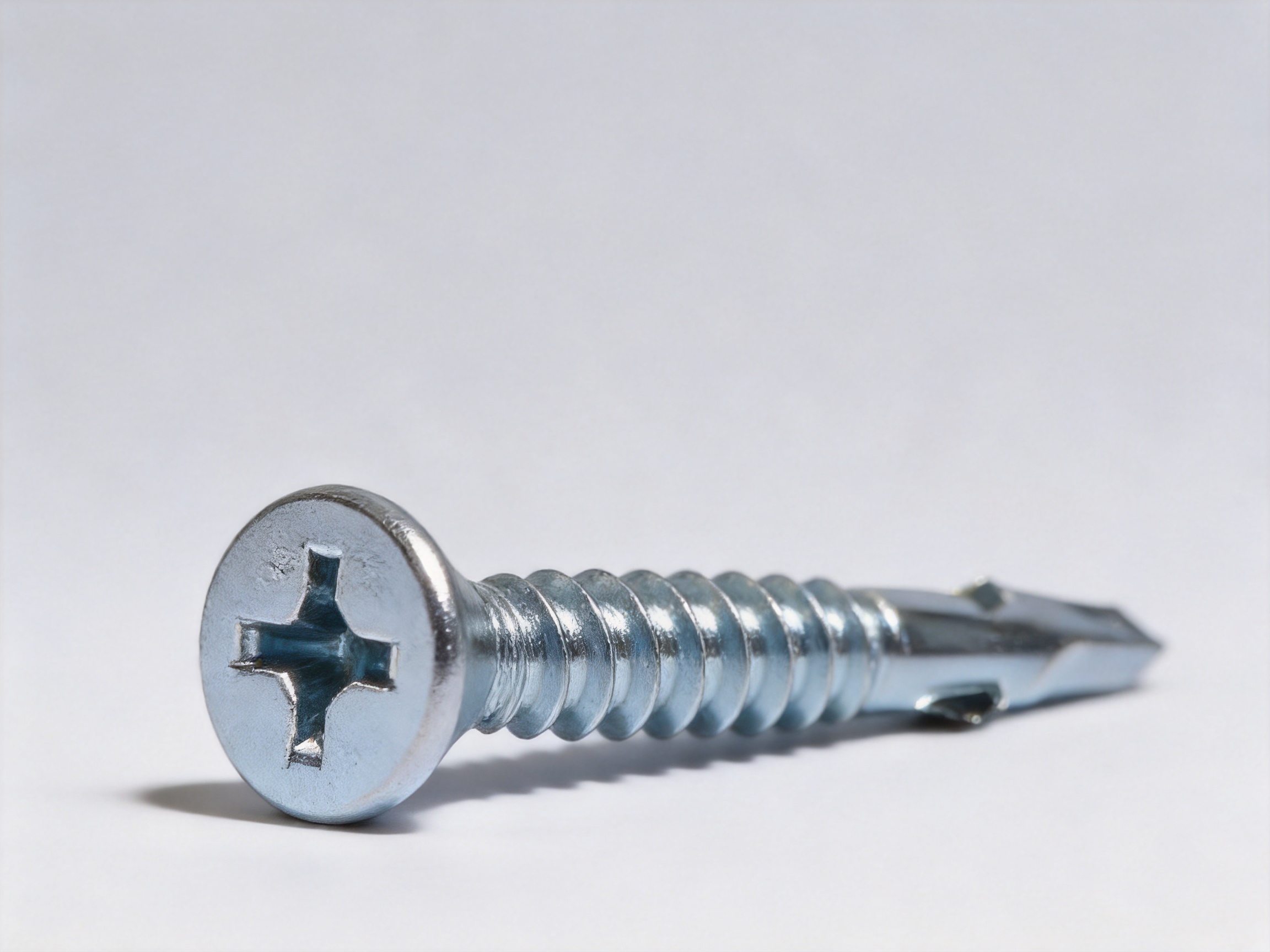
The term CSK refers to countersunk. A countersunk screw head has an angled bearing surface that allows it to sit into a prepared or self-formed recess in the top material. In many wood-to-metal installations, the screw head draws the timber or board down tightly while producing a neat, low-profile finish.
Compared with pan head or hex washer head designs, the countersunk head is preferred when the top surface should remain flat. This is important for panels, boards, furniture components, flooring systems, cladding details, packaging fixtures, and assemblies where appearance and clearance matter. A flush head also reduces the risk of snagging and makes subsequent finishing or covering easier.
Phillips Recess for Common Tool Compatibility
The Phillips drive remains one of the most widely recognized recess systems in global markets. It offers broad compatibility with common drivers and screw-driving equipment. For distributors and installers, this means the screw can be adopted easily without requiring special tooling.
While square and Torx recesses may provide higher torque transfer in some applications, Phillips remains a practical choice for many standard fastening tasks because of its availability, cost-effectiveness, and familiarity. Proper recess forming is essential. A cleanly formed Phillips recess reduces driver wobble, improves installation control, and helps prevent premature cam-out.
Self-Drilling Point for Direct Metal Penetration
The self-drilling point is one of the most important performance elements of this screw. Unlike ordinary self-tapping screws that require a pre-drilled hole in metal, a self-drilling screw has a drill-shaped point that cuts through metal during installation. This reduces preparation work and allows faster installation on site or in production lines.
The drilling point must be carefully formed and heat treated. If the point is too soft, it will wear before penetrating the steel. If it is too brittle, it may break under torque or misalignment. High-quality manufacturing controls ensure the drill point has suitable hardness, shape, cutting edge definition, and penetration consistency.
Wings for Wood Clearance and Thread Protection
The wings are small cutting projections located above the drill point. Their function is to ream a clearance hole through wood or board material before the screw reaches the metal. This prevents the threads from engaging the wood too early and helps avoid jacking, where the top material is pushed away from the metal substrate instead of being clamped tightly.
Once the wings reach the steel, they are designed to break off or be removed by contact with the harder metal. The drill point then penetrates the steel, and the screw threads engage the metal securely. This sequence provides a clean, tight, and efficient wood-to-metal connection.
Zinc Plated Surface for Practical Protection
Zinc plating provides a bright, clean finish and a sacrificial protective layer that helps slow corrosion of the steel screw. It is commonly used for indoor, furniture, hardware, dry construction, light-duty industrial, and general assembly applications. Zinc plated screws are also easier to identify, package, and handle because of their smooth metallic appearance.
For more demanding environments, alternative surface treatments may be considered, including yellow zinc plated, black phosphate, Ruspert, and Magni coatings. The availability of multiple finishes allows customers to select a screw according to application environment, appearance preference, corrosion resistance target, and cost requirement.
Specification Range
The product can be manufactured in a broad specification range to meet different fastening needs. The following table summarizes typical available options based on the product information provided.
| Specification Item | Available Options | Application Value |
|---|---|---|
| Product Type | Phillips CSK head self-drilling screw with wings zinc plated | Designed for efficient wood-to-metal fastening |
| Category | Drilling screws | Suitable for direct drilling into metal substrates |
| Material Grade | C1022A carbon steel | Good forming ability and heat-treatment response |
| Recess | Phillips, square, Torx | Allows different torque transfer and tooling preferences |
| Diameter | #6-3.5, #8-4.2, #10-4.8, #12-5.5, #14-6.3 | Covers light, medium, and heavier fastening requirements |
| Head Type | Bugle head, hex washer head, flat head, pan head, wafer head, pan framing head | Supports different installation surfaces and load distribution needs |
| Reference Norms | ASTM, DIN7504K, DIN7504P, DIN7504N | Helps align production with recognized fastener standards |
| Surface Finish | Black phosphate, zinc plated, yellow zinc plated, Ruspert, Magni | Provides choices for appearance and corrosion resistance |
| Thread Type | BSD thread, CSD thread | Supports different drilling and fastening performance requirements |
Advantages Over Ordinary Screws and Competing Products
Fewer Installation Steps
The most immediate advantage is reduced installation time. An ordinary screw may require pre-drilling. A standard self-tapping screw may still need a hole in metal. A wood screw is not designed to drill steel. By contrast, this self-drilling screw with wings performs drilling, clearance cutting, threading, and fastening in one operation.
In high-volume installation, the time saved per screw can become significant. If a project uses thousands of screws, eliminating even a few seconds per fastener can reduce labor hours substantially. For manufacturers, installers, and contractors, faster installation also means more predictable scheduling and lower assembly cost.
Cleaner Wood-to-Metal Clamping
The wing design helps the screw pass through wood without the threads lifting the top material. This is a major performance difference compared with many ordinary self-drilling screws without wings. Without clearance, the screw may bite into both wood and steel at the same time, preventing the two materials from being pulled tightly together. The result can be gaps, squeaking, poor load transfer, or visible surface defects.
With wings, the screw first clears the wood and then engages the steel. This improves clamping and reduces the need for manual pressure during installation. The assembly becomes tighter and more professional in appearance.
Improved Surface Finish
The countersunk head provides a flat, neat result. Many competing screws with raised heads may be easier to produce but do not offer the same surface finish. For customers in furniture, panels, crates, flooring, interior structures, and finished hardware, appearance is part of product value. A cleanly seated CSK head can improve both function and visual quality.
Reliable Drilling Performance
Drilling screws must perform consistently. If the drilling point is poorly formed, installation slows down and points may burn, slip, or break. Lizhan Hardware Co., Ltd. focuses on controlled forming, heat treatment, thread rolling, plating, and inspection processes to improve drilling reliability. Consistency is often more important than one-time peak performance because customers need every box and every batch to behave predictably.
Material and Heat Treatment Balance
C1022A steel is widely used for drilling screws because it can be cold headed and hardened effectively. The product requires a strong body, sharp drill point, and durable thread. Excessive hardness may cause brittleness, while insufficient hardness may cause drilling failure. A controlled heat-treatment process helps achieve the correct balance between surface hardness, core toughness, and torsional strength.
Flexible Surface Treatment Choices
Zinc plating is a practical and economical option for many general applications. However, customers often operate in different climates and industries. The ability to supply black phosphate, yellow zinc plated, Ruspert, or Magni finishes gives customers more flexibility than suppliers who offer only one standard coating. This flexibility helps distributors serve multiple market segments with fewer sourcing complications.
Broad Customization Capability
Many competitors offer limited stock screws. Lizhan Hardware Co., Ltd. can support different recesses, heads, diameters, threads, and finishes. This matters for buyers who need a specific configuration for local markets, private label packaging, project specifications, or customer-specific assemblies. Flexible production capability reduces the need to coordinate with multiple suppliers.
Manufacturing Process and Quality Control
Raw Material Selection
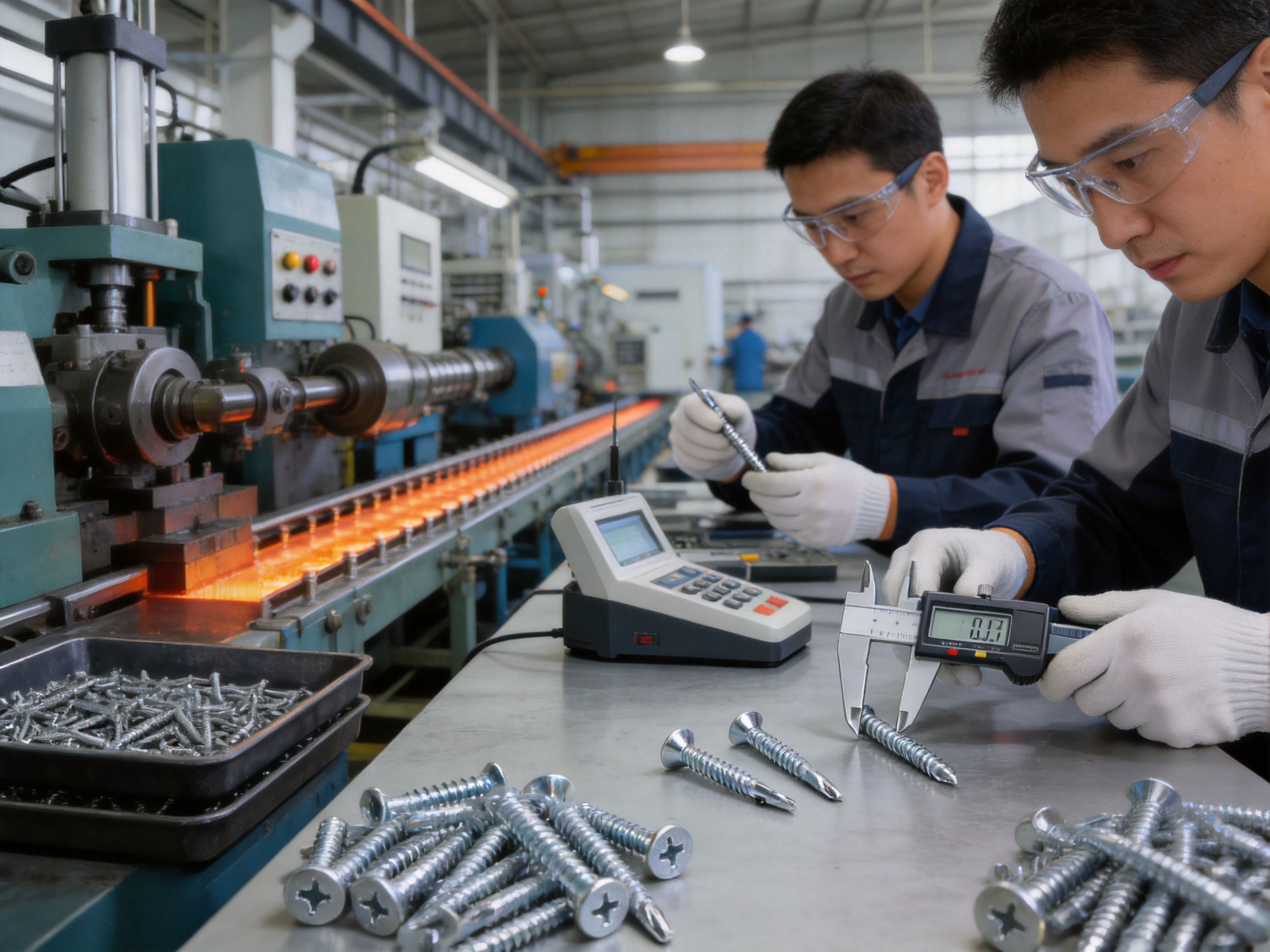
The manufacturing process begins with steel wire rod selection. For self-drilling screws, C1022A carbon steel is a practical choice because it can be processed through wire drawing, cold heading, thread rolling, and heat treatment. Material consistency affects every later step. If the raw material has inconsistent chemistry, surface defects, or poor mechanical properties, the final screw may show unstable drilling behavior or reduced strength.
Reliable manufacturing requires inspection of incoming wire rod, including checking supplier documentation, diameter tolerance, surface quality, and suitability for forming. A stable raw material supply helps maintain consistent screw geometry and mechanical performance.
Wire Drawing and Preparation
Wire drawing reduces the wire to the required diameter and improves dimensional control. Lubrication and drawing speed must be controlled to avoid cracks, surface scratches, or excessive work hardening. The wire must be clean and uniform before heading because surface defects can transfer into the screw body and affect strength.
In advanced production, wire preparation may include annealing, pickling, phosphating, and lubrication depending on the material condition and forming requirements. These processes improve cold-forming performance and reduce tool wear.
Cold Heading
Cold heading forms the screw head and blank shape without cutting away material. The countersunk head and Phillips recess must be accurately formed to meet dimensional and functional requirements. Head angle, head diameter, recess depth, and concentricity all affect installation quality.
A poorly formed head can cause uneven seating, weak drive engagement, or visible surface defects. Precision heading equipment and well-maintained dies help produce consistent head geometry. For export customers, this consistency is especially important because screws may be used with automatic or semi-automatic installation tools.
Drill Point and Wing Forming
The drill point and wings are critical to product performance. The point must cut efficiently through steel, while the wings must ream the wood and then release when contacting metal. Forming these features requires accurate tooling and process control. The wing size, symmetry, and position must be controlled so that the screw drills straight and creates a proper clearance hole.
If the wings are too weak, they may break before clearing the wood. If they are too strong or too large, they may interfere with metal penetration. If they are uneven, the screw may wobble during installation. Precision forming reduces these risks and improves user experience.
Thread Rolling
Thread rolling forms threads by pressing the blank between dies. This process strengthens the thread surface through work hardening and creates accurate thread geometry. For drilling screws, the thread must engage metal securely after the drill point creates the hole. Thread pitch, crest shape, flank angle, and root quality affect holding power and resistance to stripping.
BSD and CSD thread options allow the screw to be matched with different fastening requirements. Thread selection should consider substrate thickness, material type, required pull-out strength, installation speed, and torque control.
Heat Treatment
Heat treatment is one of the most important stages for self-drilling screws. The screw must be hard enough at the surface and drilling point to cut metal, yet tough enough in the core to resist breakage. Typical processes may include carburizing, hardening, and tempering, depending on the specification.
Process control includes furnace temperature, carbon potential, time, quenching conditions, and tempering temperature. Quality checks may include hardness testing, case depth evaluation, torsional testing, and drilling performance checks. Without proper heat treatment, even a well-shaped screw can fail in application.
Surface Treatment
After heat treatment and cleaning, screws receive surface treatment. Zinc plating involves depositing a zinc layer onto the steel surface to provide corrosion protection and a clean appearance. Plating quality depends on surface preparation, bath chemistry, current control, coating thickness, passivation, and post-treatment drying.
Hydrogen embrittlement risk should be considered for hardened fasteners. Proper baking after electroplating may be used when required to reduce hydrogen-related failure risk. Good plating control also prevents problems such as uneven color, poor adhesion, rough deposits, blocked recesses, or thread buildup.
Inspection and Testing
Quality control should be integrated throughout production rather than performed only at the end. Important inspection points include raw material checks, wire diameter checks, heading dimensions, recess quality, point geometry, wing formation, thread dimensions, hardness, plating appearance, coating thickness, and packing accuracy.
Functional tests are especially important for self-drilling screws. A screw may look acceptable but still drill poorly if the point angle, hardness, or wing geometry is incorrect. Drilling tests into representative steel thicknesses help verify real-world performance. Torque testing and pull-out testing may also be used depending on customer requirements.
Packaging and Traceability
Packaging protects screws during shipping, storage, and distribution. It also supports branding, product identification, batch traceability, and efficient warehouse handling. Packaging options may include bulk cartons, small boxes, bags, private labels, and palletized export packing. Accurate labeling helps customers identify diameter, length, finish, head type, recess, material, and batch information.
Traceability is a key strength in international fastener supply. If customers need repeat orders, quality feedback, or documentation, batch records allow the manufacturer to review production conditions and maintain long-term consistency.
Application Areas
Wood-to-Steel Construction
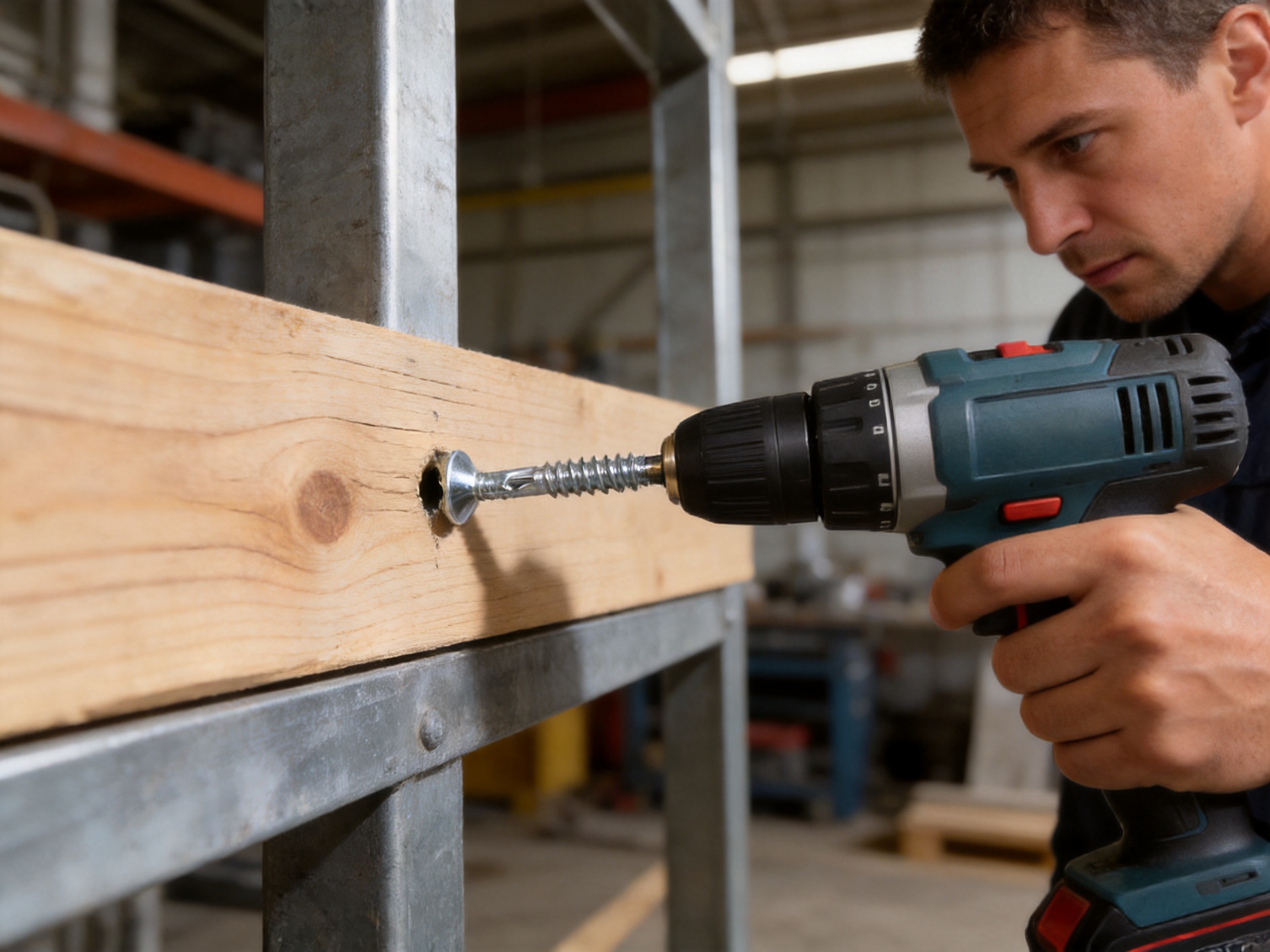
This screw is highly suitable for fastening timber, boards, plywood, oriented strand board, and similar wood-based materials to steel frames or metal support structures. The wings help clear the wood, and the drill point penetrates the steel, making installation faster than separate drilling and fastening.
Furniture and Interior Hardware
In furniture manufacturing and interior hardware assembly, a clean head finish and stable fastening are important. A countersunk zinc plated screw provides a neat appearance and practical corrosion resistance for indoor use. The Phillips recess also supports common assembly tools.
Panel and Board Fixing
Panels fixed to metal frames need consistent seating and reliable clamping. The winged self-drilling structure helps prevent material separation during installation. This improves assembly quality and reduces the risk of loose panels.
Packaging and Industrial Fixtures
For industrial packaging, crates, equipment supports, and temporary or semi-permanent fixtures, fast installation is valuable. A self-drilling screw with wings can reduce production time while providing dependable fastening between wood components and metal reinforcements.
General Hardware and Maintenance
Maintenance teams often face varied substrates and limited time. A screw that can drill directly into metal while passing cleanly through wood can simplify field work. Zinc plating provides a practical finish for many indoor and protected environments.
Installation Guidance
Correct installation improves fastening performance and extends tool life. The driver bit should match the Phillips recess properly. A worn or incorrect bit can cause cam-out, recess damage, poor torque transfer, and slower installation. The screw should be driven perpendicular to the work surface so the drill point cuts cleanly and the countersunk head seats evenly.
Driving speed should be suitable for the screw diameter and metal thickness. Excessive speed may generate heat and damage the drill point, while insufficient speed may reduce cutting efficiency. Controlled pressure helps the drill point engage the metal without wandering. Once the screw head seats, installation should stop to avoid stripping the metal or crushing the wood surface.
The metal thickness should be appropriate for the screw’s drill point capacity. Different diameters and point designs are suitable for different steel thickness ranges. Customers should confirm application conditions before bulk use, especially when fastening into thicker steel, high-strength steel, coated steel, or layered materials.
For best results, trial installation is recommended before full production use. Testing allows the user to verify drilling speed, clamp quality, head seating, coating performance, and torque settings. This is particularly important in automated or high-volume assembly lines.
How the Product Helps Reduce Total Cost
Fastener cost is not limited to the price per piece. The real cost includes labor, tool wear, preparation time, defect rate, rework, inspection, inventory management, and customer satisfaction. A screw that installs quickly and consistently can reduce total cost even if its purchase price is higher than a basic screw.
The Phillips CSK head self-drilling screw with wings zinc plated reduces cost in several ways. It eliminates separate drilling in many applications. It reduces the need for pilot holes. It helps prevent board lift and poor clamping. It provides a flush finish without extra finishing steps. It supports common driver tools. It can be supplied in multiple specifications, allowing customers to consolidate purchasing.
Compared with low-grade competitors, a controlled manufacturing process can reduce broken screws, damaged recesses, poor drilling points, and inconsistent plating. These quality issues are expensive because they occur during installation, when labor and project schedules are already involved. A reliable screw protects productivity.
Company Manufacturing Strengths
Lizhan Hardware Co., Ltd. operates with a product portfolio that covers screws and related hardware components, including machine screws, furniture screws, drilling screws, fasteners, packaging-related hardware, home tool items, and stamping parts. This broad manufacturing background allows the company to understand fastening not as a single product but as part of an assembly system.
The company’s China factory location in Haiyan, Jiaxing City, Zhejiang, supports access to a mature fastener manufacturing region with supply chain resources, skilled production personnel, export logistics, and material availability. The Thailand warehouse location in Chonburi provides additional regional support for customers requiring distribution flexibility in Southeast Asia and nearby markets.
One of the strengths of the company is flexible production. Customers may require different head types, recess types, coatings, diameters, lengths, packaging styles, and standards. The ability to handle these variations is important for importers, wholesalers, construction material suppliers, furniture manufacturers, and OEM buyers.
Another strength is communication accessibility. International fastener purchasing often requires quick confirmation of drawings, samples, surface finish, packing, lead time, payment terms, and shipping arrangements. Direct contact through email, phone, WhatsApp, and WeChat helps shorten communication cycles and reduce misunderstandings.
Manufacturing strength is also reflected in process integration. A quality screw requires coordination across wire preparation, heading, point forming, wing forming, threading, heat treatment, plating, inspection, and packaging. Suppliers who control and understand these processes can respond better when customers request improvements or special requirements.
Comparison with Alternative Fasteners
Compared with Ordinary Wood Screws
Ordinary wood screws are designed mainly for wood-to-wood fastening. They do not have drill points suitable for steel. When used against metal, they usually require pre-drilling and may still fail to form a strong thread in the metal substrate. A self-drilling screw with wings is purpose-built for wood-to-metal applications and performs the drilling operation directly.
Compared with Standard Self-Drilling Screws Without Wings
Standard self-drilling screws can drill metal, but when fastening wood to metal, their threads may engage the wood before the metal is reached. This can cause the wood to lift away from the steel. Winged screws solve this problem by creating clearance through the wood first.
Compared with Bolts and Nuts
Bolts and nuts provide strong mechanical fastening but often require access to both sides of the assembly, drilled holes, washers, and more installation time. A self-drilling screw can be installed from one side and is faster for many light to medium applications.
Compared with Rivets
Rivets are useful for permanent fastening, especially in sheet metal. However, they require pre-drilled holes and specific riveting tools. They are also less convenient when disassembly may be required. A screw offers easier installation and potential removal while maintaining strong fastening performance.
Material and Finish Considerations
C1022A carbon steel provides the foundation for strength and drilling performance. The steel must be compatible with cold forming and heat treatment. The final mechanical properties depend on both material quality and process control. For self-drilling screws, surface hardness and core toughness must be balanced carefully.
Zinc plating is a common finish for general use. It is not the highest corrosion-resistant coating available, but it offers a good balance of cost, appearance, and protection. For indoor furniture, hardware, panel installation, and dry construction, zinc plating is often suitable. For outdoor or high-humidity environments, customers may consider Ruspert, Magni, or other enhanced coatings based on required corrosion resistance.
Surface finish selection should consider the environment, expected service life, appearance, substrate material, and local standards. Customers should avoid using standard zinc plated screws in highly corrosive environments unless the corrosion requirement has been confirmed through testing or specification review.
Dimensional Accuracy and Consistency
Dimensional accuracy is essential for drilling screws. The head must fit the driver. The countersunk angle must seat correctly. The body diameter must match the thread design. The drill point must be concentric. The wings must be symmetrical. The thread must engage without stripping.
Small dimensional differences can create large installation differences. For example, a shallow Phillips recess may cause cam-out. An oversized head may not seat properly. An uneven drill point may wander. A weak wing may fail before cutting the clearance hole. Consistent manufacturing reduces these risks and supports customer confidence.
Lizhan Hardware Co., Ltd. can support customers by maintaining production control and inspection practices suitable for export markets. For buyers who distribute screws under their own labels, consistency helps protect brand reputation and reduces customer complaints.
Procurement Guidance for Buyers
When purchasing Phillips CSK head self-drilling screws with wings zinc plated, buyers should confirm several key details before placing an order. These include diameter, length, head diameter, countersunk angle, recess type, drill point type, wing size, thread type, surface finish, packing method, and applicable standard. If the screw will be used in a specific steel thickness, that thickness should be communicated clearly.
Buyers should also define whether the product is intended for indoor, outdoor, furniture, construction, industrial, or packaging use. This helps determine the most suitable coating and mechanical performance requirements. If salt spray performance or special corrosion testing is required, this should be specified in advance.
Samples are useful before mass production. A sample check can confirm appearance, dimensions, drive fit, drilling speed, head seating, and packaging style. For OEM or private label customers, sample approval helps prevent misunderstandings and ensures the final shipment meets market expectations.
For importers and wholesalers, packaging is a major commercial factor. Small boxes may be better for retail. Bulk cartons may be better for industrial users. Clear labeling and strong export cartons reduce handling damage and simplify inventory management.
Why Work with a Specialized Fastener Manufacturer
A specialized fastener manufacturer brings more than production capacity. It brings technical understanding of materials, forming, heat treatment, coating, standards, packing, and application requirements. This is important because screws are small components with large consequences. A failed fastener can interrupt installation, damage customer products, or create safety concerns.
Working with Lizhan Hardware Co., Ltd. gives customers access to a supplier familiar with different screw families and market applications. The company’s ability to provide machine screws, furniture screws, drilling screws, fasteners, and related hardware makes it suitable for buyers who want to consolidate sourcing and reduce supplier management complexity.
International customers also benefit from export experience. Communication, documentation, packaging, shipment coordination, and after-sales support are all part of successful procurement. The company provides contact channels including email, phone, WhatsApp, WeChat, and social media platforms, helping customers communicate efficiently during quotation, sampling, order confirmation, and shipment follow-up.
Quality Expectations for Professional Markets
Professional markets require screws that perform consistently across batches. The expected quality level includes clean head forming, accurate recess, sharp drilling point, symmetrical wings, smooth threads, uniform plating, correct hardness, and reliable packaging. The screw should install without excessive force, breakage, wobble, or cam-out when used within its intended application range.
Customers may request inspection reports, material information, coating details, or test results depending on order requirements. A capable manufacturer should be able to discuss these requirements and align production accordingly. Quality is a combination of specification clarity and manufacturing discipline.
For self-drilling screws, functional testing is especially meaningful. Dimensional checks alone cannot fully confirm drilling performance. A screw should be tested in representative material to confirm penetration and fastening behavior. This practical approach helps identify issues before shipment.
Environmental and Storage Considerations
Zinc plated screws should be stored in dry, ventilated conditions. Exposure to moisture during storage can lead to white corrosion products on the zinc surface. Although zinc plating provides protection, it is not intended to withstand poor storage conditions indefinitely. Proper packaging, pallet protection, and warehouse management help preserve product quality.
During transport, cartons should be protected from water damage and excessive impact. For ocean shipments, moisture control may be considered, especially in humid routes or long storage periods. Buyers should inspect packaging upon arrival and store products away from direct water exposure.
In application, users should select the correct finish for the service environment. Zinc plated screws are suitable for many dry or mildly exposed conditions, while harsher environments may require enhanced coatings. Correct finish selection improves service life and reduces maintenance concerns.
Q&A Section
What is a Phillips CSK head self-drilling screw with wings zinc plated used for?
It is mainly used for fastening wood, boards, panels, or similar materials to metal substrates. The wings cut a clearance hole in the wood, the drill point penetrates the steel, and the countersunk head provides a flush finish.
Why are wings added to the screw?
The wings prevent the threads from gripping the wood too early. They create a clearance hole through the wood so the screw can pull the wood tightly against the metal. When the wings reach the metal, they break off or wear away, allowing the drill point and threads to work in the steel.
What does CSK mean?
CSK means countersunk. A countersunk head is designed to sit flush or near flush with the surface after installation, creating a clean and low-profile finish.
Why choose zinc plating?
Zinc plating provides a clean metallic appearance and practical corrosion resistance for many indoor and general applications. It is also economical compared with some higher-performance coatings.
Can this screw be used outdoors?
It depends on the outdoor environment and corrosion requirements. Standard zinc plating may not be sufficient for harsh outdoor or high-humidity environments. For demanding conditions, coatings such as Ruspert or Magni may be considered.
What material is commonly used for this screw?
C1022A carbon steel is commonly used because it offers good cold-forming capability and responds well to heat treatment, making it suitable for self-drilling screw production.
What recess options are available?
Common recess options include Phillips, square, and Torx. Phillips is widely used because of common tool compatibility, while square and Torx may be selected for higher torque transfer requirements.
What diameter options are available?
Typical diameter options may include #6-3.5, #8-4.2, #10-4.8, #12-5.5, and #14-6.3, depending on customer requirements and production planning.
What standards can apply to this product?
Depending on configuration, applicable references may include ASTM requirements and DIN7504K, DIN7504P, and DIN7504N types. Buyers should confirm the exact standard needed for their market or project.
How does this product compare with ordinary wood screws?
Ordinary wood screws are not designed to drill metal. This self-drilling screw with wings can pass through wood and drill into metal directly, reducing installation steps and improving clamping efficiency.
How can buyers ensure they order the correct screw?
Buyers should confirm diameter, length, head type, recess type, thread type, coating, drill point capacity, substrate material, steel thickness, packing requirements, and any testing or standard requirements before ordering.
Conclusion
The Phillips CSK head self-drilling screw with wings zinc plated is a practical, efficient, and technically refined fastening solution for wood-to-metal applications. Its value comes from the combination of a countersunk head, common Phillips drive, self-drilling point, wing cutters, C1022A steel construction, and zinc plated protection. Each feature contributes to faster installation, cleaner clamping, better surface finish, and reduced total assembly cost.
Compared with ordinary wood screws, standard self-tapping screws, and non-winged drilling screws, this product offers clear advantages in applications where wood or board material must be fixed to steel. The wings help prevent material separation, the drill point eliminates many pre-drilling operations, and the countersunk head delivers a clean finish.
Lizhan Hardware Co., Ltd. supports this product with manufacturing capabilities covering material preparation, cold heading, wing and point forming, thread rolling, heat treatment, plating, inspection, and packaging. The company’s flexible specification range, export-oriented communication, China manufacturing base, and Thailand warehouse support make it a strong option for international buyers seeking reliable fastener supply.
For distributors, contractors, furniture manufacturers, panel producers, hardware suppliers, and OEM customers, choosing a well-manufactured self-drilling screw with wings is not only a product decision but also a productivity decision. A consistent screw improves installation speed, reduces rework, protects assembly quality, and supports long-term customer satisfaction.
References
ASTM International. Standard specifications and test methods for threaded fasteners and protective coatings.
Deutsches Institut fuer Normung. DIN 7504 series: Self-drilling tapping screws, dimensional and technical references.
Industrial Fasteners Institute. Fastener Standards and Technical Reference Manual.
Bickford, J. H. Introduction to the Design and Behavior of Bolted Joints.
ASM International. Heat Treater’s Guide: Practices and Procedures for Irons and Steels.
ASM International. Surface Engineering for Corrosion and Wear Resistance.
Budynas, R. G., and Nisbett, J. K. Shigley’s Mechanical Engineering Design.