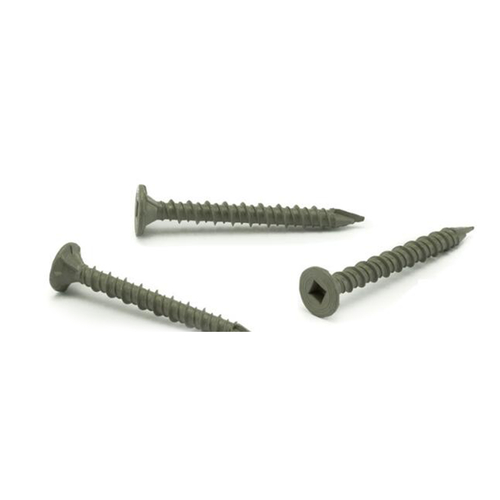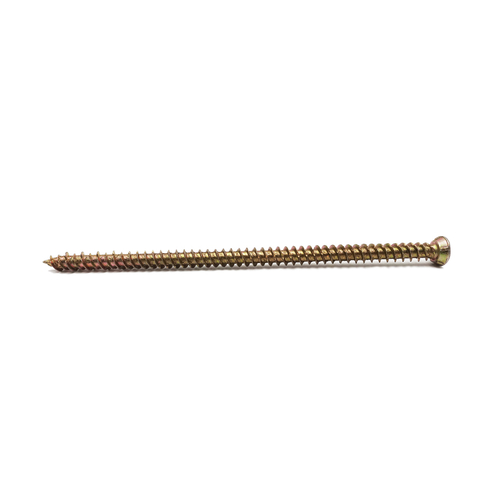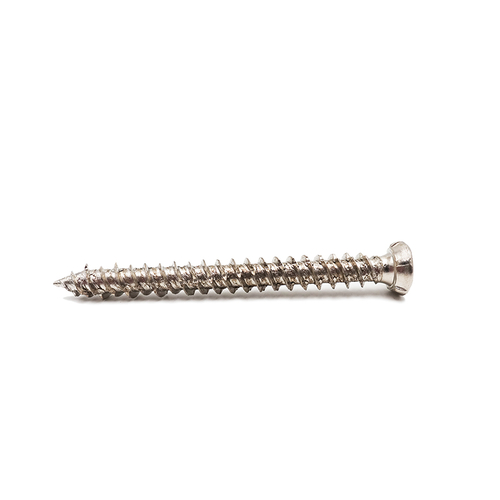
Drywall installation depends on a fastener that can penetrate smoothly, hold securely, sit flush, and resist failure throughout the service life of the wall or ceiling system. The Phillips drive bugle head drywall screw with black phosphated finish and fine thread is designed for this exact purpose. It combines a sharp drywall-suitable geometry, a controlled head profile, reliable carbon steel strength, and a finish suited to interior board fastening. For contractors, distributors, furniture producers, package manufacturers, and hardware buyers, this type of screw offers a practical balance of productivity, consistency, and cost efficiency.
The product discussed here is a bugle head drywall screw manufactured from C1022A carbon steel, available with Phillips, square, or Torx recess options, and supplied in fine thread or coarse thread configurations. Diameter options include common drywall screw sizes such as No. 6, No. 8, No. 10, No. 12, and No. 14 equivalents, while surface treatments include black phosphate, zinc plating, yellow zinc plating, Dacromet, Ruspert, and Magni. Among these options, the black phosphated fine thread version is especially valued for fastening gypsum board to light-gauge steel studs and other interior metal framing applications.
Lizhan Hardware Co., Ltd. supplies this product as part of a broader fastening range that includes new products, home tools, fasteners, packaging-related hardware, and stamping parts. With manufacturing resources in China and warehousing support in Thailand, the company is positioned to serve customers who need stable production, flexible specification support, and reliable export supply. The strength of the product is not only in its form, but also in the process behind it: wire selection, cold heading, thread rolling, heat treatment, surface finishing, inspection, packaging, and logistics control all contribute to performance.
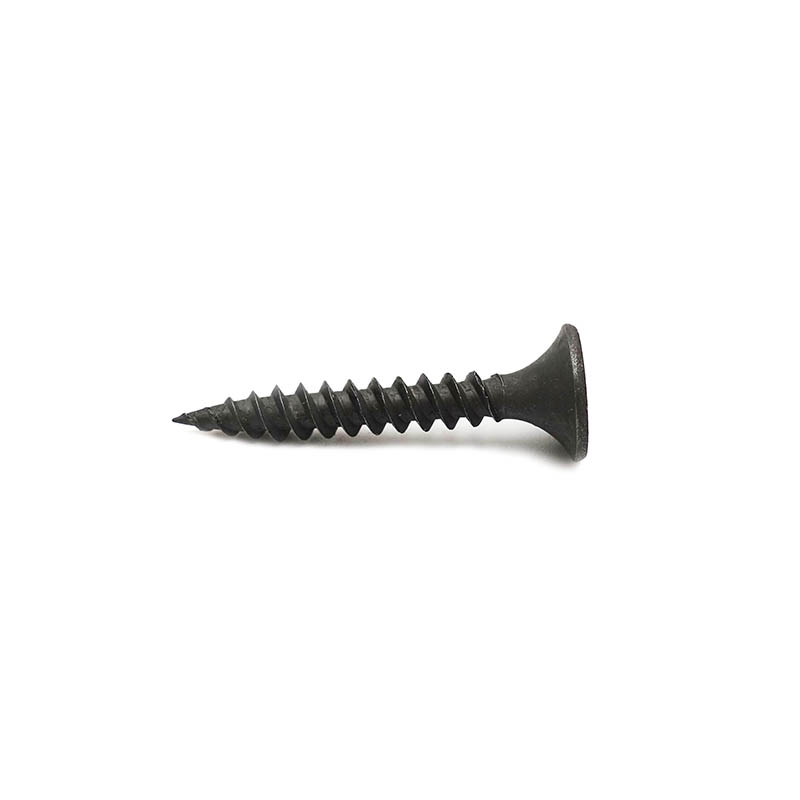
Phillips drive bugle head drywall screw black phosphated fine thread2
Product Overview and Application Value
A drywall screw is not simply a pointed piece of steel. It is a precision fastener developed for one of the most common tasks in modern construction: fixing drywall panels to framing members. The Phillips drive bugle head drywall screw black phosphated fine thread type is particularly suitable where clean seating, controlled penetration, and dependable clamping are required. The bugle head helps distribute force over the paper surface of drywall, reducing the risk of tearing when installed correctly. The fine thread provides strong engagement with thin steel sections, while the black phosphate finish supports smooth driving and short-term corrosion resistance in indoor environments.
The screw’s Phillips recess remains widely used because of tool availability, installer familiarity, and efficient power-driver compatibility. In many markets, Phillips drive drywall screws are a standard choice for interior finishing crews because bits are easy to obtain and replacement is inexpensive. For buyers who prefer increased torque transfer or lower cam-out potential, square and Torx recesses may also be selected. This product range therefore supports both traditional work practices and higher-performance fastening preferences.
The bugle head is a defining feature. Unlike a flat head that may cut aggressively into the drywall face, the curved underside of the bugle head is designed to compress the board surface gradually. This enables the screw to sit slightly below the drywall plane without destroying the paper layer. Since the paper facing contributes significantly to drywall panel strength, preserving it during fastening is essential. A properly shaped bugle head helps installers achieve the correct depth rapidly and consistently.
The fine thread design is another important advantage. Fine thread drywall screws are typically preferred for metal studs because the closer thread spacing creates more points of engagement within thin steel. This can improve holding strength and reduce stripping in appropriate metal thicknesses. Coarse thread versions are commonly chosen for wood framing because the deeper thread profile bites more effectively into softer wood fibers. The availability of both options allows the same product family to serve multiple jobsite conditions.
Key Specifications
The following table summarizes the main product characteristics and available options. Exact dimensions, tolerances, packaging, and finish requirements can be customized according to buyer standards, market expectations, and project needs.
| Item | Specification or Option | Practical Benefit |
|---|---|---|
| Product Type | Bugle head drywall screw | Designed for flush fastening of gypsum board and interior panels |
| Drive Recess | Phillips, square, Torx | Supports different installation habits and torque requirements |
| Head Style | Bugle head | Helps prevent paper tearing and allows clean countersinking |
| Material Grade | C1022A carbon steel | Provides suitable strength after controlled processing and heat treatment |
| Diameter Range | No. 6, No. 8, No. 10, No. 12, No. 14 equivalents | Covers common drywall and panel fastening needs |
| Thread Options | Fine thread and coarse thread | Fine thread for metal framing; coarse thread for wood framing |
| Surface Options | Black phosphate, zinc plated, yellow zinc plated, Dacromet, Ruspert, Magni | Allows corrosion protection and appearance selection by application |
| Main Application | Drywall to light steel or wood framing | Efficient interior construction fastening |
| Packaging Support | Bulk packing, carton packing, customer-specific packing | Suitable for distributors, contractors, and retail programs |
Why the Bugle Head Matters
The head design of a drywall screw has a direct effect on installation quality. A poorly formed head can cause paper breakage, uneven seating, wobbling during driving, and reduced holding capacity. The bugle head solves these problems by creating a smooth transition from the shank to the head surface. When the screw is driven into gypsum board, the head compresses the paper and gypsum gradually instead of cutting sharply into the panel.
This is a major advantage over screws with unsuitable head geometry. If a head is too flat underneath, it may shear the paper. If it is too rounded or inconsistent, it may fail to seat flush. If the head diameter is not controlled, the installer may experience either insufficient bearing area or excessive surface damage. A well-made bugle head offers the right combination of bearing surface and countersinking action.
For professional drywall installers, speed and repeatability are critical. Every wall may require hundreds or thousands of screws. A screw that drives predictably reduces fatigue and rework. When the head seats properly, finishing compounds can be applied more easily, and the risk of visible screw defects after painting is reduced. A small detail in head geometry can therefore affect the final appearance of an entire interior space.
The bugle head also improves productivity because it works effectively with screw guns equipped with depth-sensitive nosepieces. These tools are designed to stop the screw at a controlled depth. A consistent head profile allows the tool to perform correctly, reducing overdriving and underdriving. Competitor products with variable head dimensions may require more manual correction, increasing labor time and cost.
Advantages of the Phillips Drive
The Phillips drive is one of the most widely recognized recess systems in the world. Its popularity is a practical advantage because installers can easily find compatible bits, and distributors can stock accessories with confidence. For drywall screws, Phillips drive remains a dependable choice for high-volume work where speed and tool compatibility are essential.
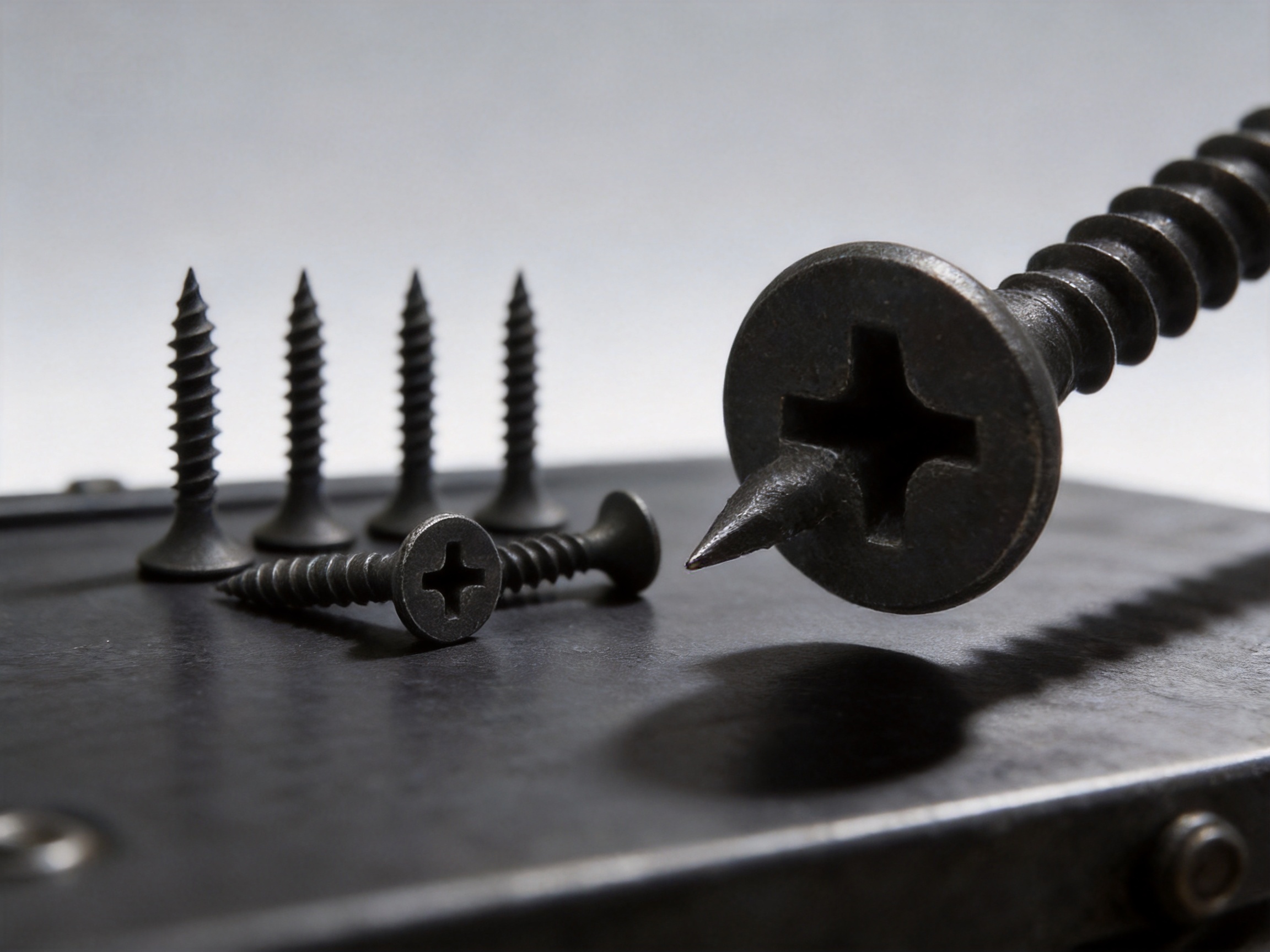
A properly formed Phillips recess allows the driver bit to engage quickly and center itself during installation. This helps operators maintain alignment and reduce wobble. The recess must be deep enough and sharply defined enough to accept the bit securely, but not so deep that the head becomes weakened. Precision forming during cold heading is therefore important.
Compared with low-grade screws that have shallow or distorted recesses, a well-manufactured Phillips drive screw reduces stripping, cam-out, and driver bit wear. Cam-out can occur when torque forces push the bit out of the recess. While Phillips drive naturally has some cam-out characteristics, accurate recess geometry improves performance significantly. For customers who require even stronger torque transfer, the availability of square and Torx versions is a useful product-family advantage.
Because the Phillips drive is familiar to installers in many regions, training requirements are minimal. Contractors can use standard tools and proceed efficiently. Hardware retailers benefit because the product matches common consumer expectations. Industrial users benefit because spare bits and driver systems are already integrated into many production environments.
Fine Thread Performance for Metal Framing
The black phosphated fine thread drywall screw is particularly valued for fastening drywall to light-gauge metal studs. Fine threads have a closer pitch than coarse threads, which increases the number of thread contact points with thin metal. This helps the screw engage the steel more securely and reduces the chance of thread stripping under normal installation conditions.
Metal framing has become increasingly common in commercial construction, partition systems, office interiors, and some residential applications. Compared with wood framing, metal studs are dimensionally stable, non-combustible, and resistant to many forms of biological degradation. However, metal studs require screws designed to penetrate and hold in relatively thin steel. Fine thread drywall screws meet this requirement better than ordinary wood screws or coarse-thread fasteners.
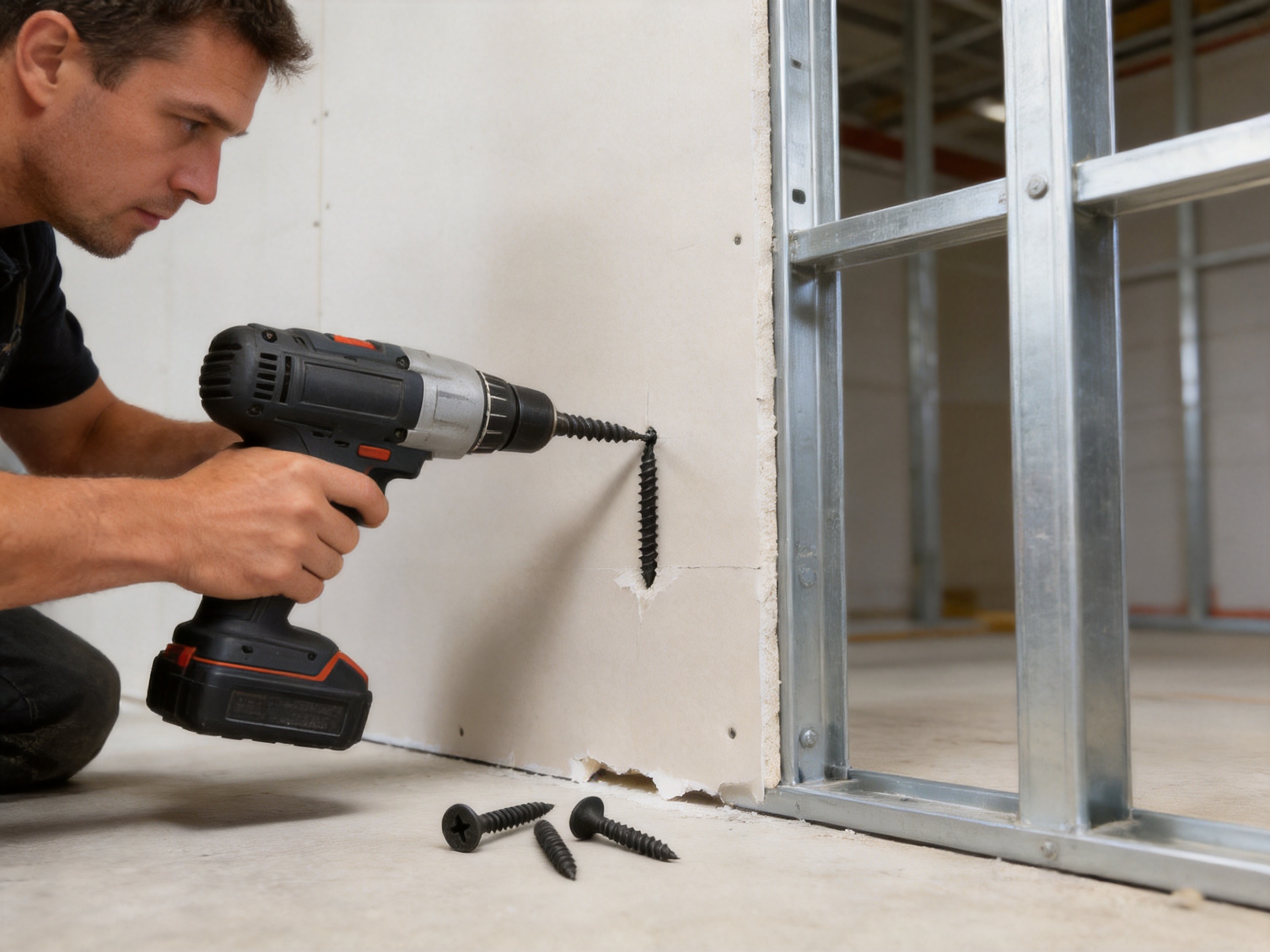
The sharp point of the drywall screw assists fast penetration. As the screw rotates, the point pierces the drywall and then meets the steel stud. The fine thread cuts or forms engagement in the metal, pulling the board tight against the frame. The installer can then seat the bugle head below the surface in one continuous motion. This efficient sequence is why drywall screws are preferred over nails or general-purpose fasteners in many interior systems.
Compared with competitor screws that use inconsistent thread rolling or weak steel, a properly produced fine thread drywall screw offers stronger performance stability. Threads must be clean, uniform, and well aligned with the shank. Burrs, incomplete threads, or eccentric rolling can create installation resistance and reduce holding capacity. High-quality thread rolling improves both mechanical engagement and driving smoothness.
Material Strength: The Role of C1022A Carbon Steel
C1022A carbon steel is commonly used in screw manufacturing because it provides a practical balance of formability and strength. During production, the material can be cold headed into the required screw shape, then heat treated to achieve the necessary hardness and mechanical properties. This makes it suitable for drywall screws that must be sharp, strong, and resistant to breakage during driving.
The quality of the raw wire is essential. If the steel contains defects, uneven chemistry, or poor surface condition, the finished screw may suffer from cracking, bending, inconsistent hardness, or thread failure. Advanced manufacturers place strong emphasis on material sourcing and inspection before production begins. Wire diameter, tensile condition, surface cleanliness, and chemical composition all influence the final result.
After forming and thread rolling, heat treatment gives the screw its working strength. Drywall screws must be hard enough to penetrate framing materials, yet not so brittle that they snap under torque. The heat treatment process must therefore be carefully controlled. Temperature, furnace atmosphere, quenching conditions, and tempering cycles all affect hardness distribution and toughness.
Compared with low-cost competitors who may reduce process control to cut costs, a manufacturer with disciplined heat treatment can deliver more consistent mechanical performance. This matters because fastener failure on site wastes labor, damages panels, and reduces customer trust. A screw that snaps during driving or strips too easily can create significant project delays. C1022A material, when properly processed, helps avoid these issues.
Black Phosphate Finish and Its Benefits
Black phosphate is a common and effective surface treatment for drywall screws. It creates a dark appearance and provides a degree of corrosion resistance suitable for many interior applications. It also improves lubricity, helping the screw drive smoothly into drywall and framing. For drywall work, this combination of appearance, driving performance, and cost efficiency makes black phosphate one of the most popular finishes.
The phosphate layer can help reduce friction during installation. Lower driving friction means less heat, less driver bit wear, and smoother penetration. When thousands of screws are installed per day, these differences become meaningful. Installers notice whether screws start easily, drive steadily, and seat without excessive pressure. A consistent black phosphate finish contributes to this experience.
Black phosphate should be distinguished from heavy-duty exterior corrosion systems. It is best suited for indoor environments or applications protected from direct moisture exposure. Where stronger corrosion resistance is required, alternatives such as zinc plating, yellow zinc plating, Dacromet, Ruspert, or Magni may be selected. The availability of multiple surface options is a competitive strength because customers can match finish performance to application conditions.
Compared with poorly finished screws, a well-phosphated screw has more uniform color, better surface coverage, and more stable driving behavior. Inconsistent phosphate treatment may cause patchy appearance, oil imbalance, rust spots, or unstable friction. Advanced finishing control ensures that the product looks professional and performs reliably when it reaches the customer.
Manufacturing Process: From Steel Wire to Finished Screw
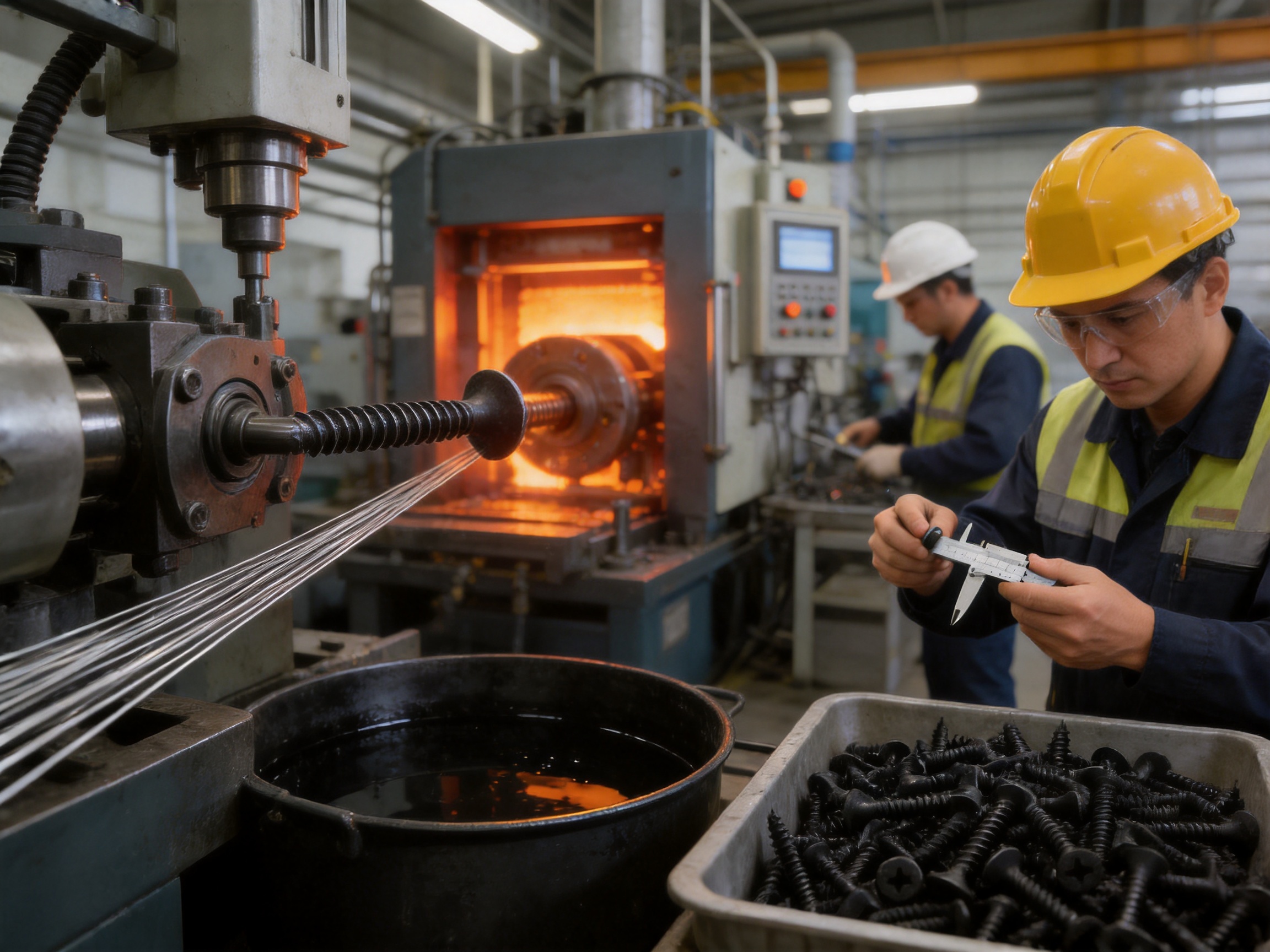
The performance of a drywall screw is created through a sequence of controlled manufacturing steps. Each step must be accurate because errors can carry forward into the final product. Lizhan Hardware Co., Ltd. emphasizes manufacturing capability as a core strength, supporting customers who need not only a screw shape but a stable, repeatable industrial product.
The process begins with wire preparation. Steel wire is selected according to grade and diameter. The wire may be drawn to precise size and cleaned to ensure it feeds smoothly into forming machines. Consistent wire diameter helps maintain accurate screw shank size, head volume, and thread profile.
Cold heading is the next major step. In this process, wire is cut into blanks and shaped under high pressure. The head, recess, and preliminary body geometry are formed without removing material. Cold heading is efficient and strengthens the metal through work hardening, but it requires accurate tooling. The Phillips recess must be sharply formed, the bugle head curvature must be controlled, and the blank length must remain consistent.
After heading, the thread is rolled rather than cut. Thread rolling forms the thread by pressing the screw blank between hardened dies. This process improves thread strength because the steel grain flow is compressed rather than interrupted. Rolled threads are generally stronger and smoother than cut threads for mass-produced screws. For drywall screws, accurate thread rolling is essential to achieve proper pitch, sharpness, and holding power.
Point formation is integrated into the forming and rolling sequence depending on the specific production setup. The point must be sharp enough to start easily through gypsum board and framing material. If the point is blunt, installers need more force and may experience skating on the surface. If it is too fragile, it may deform or break. Tooling precision ensures the point supports both penetration and durability.
Heat treatment follows forming. Screws are hardened and tempered to reach the required mechanical performance. This stage demands careful control because over-hardening can cause brittleness, while under-hardening can cause poor penetration and thread deformation. Batch monitoring, hardness testing, and process records help maintain stability.
Surface finishing is then applied. For black phosphate screws, the parts are cleaned, chemically treated, rinsed, and oiled or otherwise protected according to process requirements. Surface preparation is crucial because oil, scale, or contamination can prevent uniform phosphate formation. Good finishing improves appearance, friction behavior, and corrosion resistance.
Finally, screws are inspected, sorted, packed, and prepared for shipment. Inspection may include visual checks, dimensional measurement, recess fit, thread quality, hardness testing, torque-related evaluation, finish inspection, and packaging verification. Reliable packaging protects the screws from moisture, contamination, and damage during transport.
Advanced Manufacturing Strengths
In competitive fastener markets, price alone is not enough. Buyers need screws that match specifications shipment after shipment. Advanced manufacturing strength comes from equipment capability, tooling knowledge, material control, process discipline, and quality inspection. Lizhan Hardware Co., Ltd. supports these requirements by focusing on fastener production experience and export-oriented supply.
One major strength is the ability to produce a broad range of sizes and options. Customers may require different diameters, lengths, recess types, finishes, thread styles, and packaging formats. A flexible manufacturer can support distributors who serve multiple market segments, from building contractors to retailers and industrial users. This reduces sourcing complexity because buyers can consolidate more products with one supplier.
Tooling capability is also important. The accuracy of a drywall screw depends heavily on heading dies, punch geometry, thread rolling dies, and maintenance procedures. Worn tooling can create shallow recesses, uneven heads, inaccurate threads, and inconsistent points. A manufacturer that manages tooling carefully can maintain product consistency over long production runs.
Process automation contributes to both efficiency and quality. High-speed heading and thread rolling machines can produce large quantities, but speed must be matched with inspection. Automated feeding, controlled forming, and stable rolling reduce variation. When combined with trained technicians and scheduled maintenance, production output becomes more predictable.
Quality control is a further differentiator. Dimensional checks ensure the screw matches customer requirements. Recess checks confirm driver engagement. Hardness checks verify heat treatment. Finish checks ensure corrosion and appearance expectations are met. Packaging checks confirm label accuracy, quantity, carton strength, and customer branding instructions. These quality steps reduce risk for importers and distributors.
Logistical capability adds another layer of value. With a China factory address in Haiyan, Jiaxing City, Zhejiang, and a Thailand warehouse in Chonburi, the company has an operational structure that can support regional distribution and customer convenience. For international buyers, supply stability and shipping coordination can be as important as production quality.
Advantages Over Competitor Products
The Phillips drive bugle head drywall screw black phosphated fine thread type offers several advantages when manufactured under strict process control. These advantages can be seen in installation performance, product consistency, finish quality, application flexibility, and supply reliability.
First, the screw provides cleaner seating than many general-purpose screws. The bugle head is optimized for drywall, while flat head or pan head alternatives may not create the same smooth finish. Competitor products that use incorrect head angles can damage the gypsum board surface, leading to finishing defects and reduced holding performance.
Second, the fine thread design is better suited for metal framing than coarse wood screws. In thin steel, thread engagement is critical. A fine thread screw provides more contact points and can hold more securely when properly matched to the stud thickness. Using the wrong screw can result in spin-out, weak clamping, or poor installation speed.
Third, C1022A carbon steel with controlled heat treatment gives the screw a strong balance between hardness and toughness. Some low-cost competitors may use inconsistent raw material or weak heat treatment, leading to screws that bend, strip, or snap. Consistent metallurgy reduces jobsite frustration and warranty risk.
Fourth, the black phosphate finish supports smoother driving and a professional appearance. Inferior finishes may be patchy, dusty, oily, or prone to early rust. A controlled phosphate process helps provide uniform friction and appearance. Customers who need other finishes can select zinc plated, yellow zinc plated, Dacromet, Ruspert, or Magni options.
Fifth, the product family supports multiple drive recesses. Phillips is popular and economical, square offers strong bit engagement, and Torx supports high torque transfer with reduced cam-out. Competitors with only one drive option may not meet specialized market requirements.
Sixth, the manufacturing and supply structure supports custom packaging and export shipments. For hardware wholesalers, building material distributors, and private-label customers, packaging flexibility is a major commercial advantage. Clear cartons, strong boxes, accurate labels, and appropriate moisture protection improve customer satisfaction.
Application Areas
The main use of this screw is drywall fastening, especially gypsum board installation in interior wall and ceiling systems. Fine thread black phosphated screws are commonly used with light-gauge steel studs, while coarse thread versions are used with wood studs. Because the product range includes different diameters, lengths, finishes, and recesses, it can support many fastening scenarios.
In residential construction, drywall screws are used for partition walls, ceiling panels, renovation work, basement finishing, and home improvement projects. Contractors appreciate screws that feed smoothly, start quickly, and seat consistently. Home users value screws that work with standard tools and provide a clean finish.
In commercial construction, drywall screws are used in office partitions, retail interiors, hotel rooms, schools, hospitals, and public buildings. These projects often involve metal framing, making fine thread screws especially important. The speed of installation directly affects project schedules, so consistent fastener quality is essential.
In prefabricated and modular construction, screws may be used in factory-controlled panel assembly. Here, repeatability is even more important because production lines depend on predictable fastening behavior. Screws with stable dimensions and finish reduce equipment adjustment and downtime.
In furniture and interior fitting applications, selected drywall screw types may be used where panel fastening and concealed installation are needed. While dedicated furniture screws may be better for some wood-to-wood joints, drywall screws remain useful in certain interior assembly tasks because they are sharp, economical, and easy to install.
Choosing the Right Screw Size and Thread
Selecting the correct drywall screw depends on board thickness, framing material, application type, and local building practice. Fine thread screws should generally be chosen for metal studs, while coarse thread screws are generally selected for wood framing. Length should be sufficient to penetrate the framing material properly without creating unnecessary installation resistance.
For standard drywall panels, common screw lengths vary according to board thickness and framing requirements. Thin panels may use shorter screws, while thicker or multiple-layer assemblies require longer screws. The screw must pass through the gypsum board and engage the stud securely. If the screw is too short, holding power is reduced. If it is too long, installation may be slower and material cost may increase.
Diameter choice also matters. Smaller diameters are common for standard interior drywall applications, while larger diameters may be selected for heavier panels, special boards, or applications requiring increased strength. The available range from No. 6 equivalent through No. 14 equivalent allows buyers to match market demand and application requirements.
The recess type should be selected according to installer preference and torque needs. Phillips is economical and widely compatible. Square drive can reduce slipping and improve control. Torx drive can offer excellent torque transfer for demanding applications. A supplier that offers all three gives buyers flexibility without requiring a completely different product source.
Installation Best Practices
Even the best screw performs most effectively when installed correctly. Drywall screws should be driven straight, not at an excessive angle. The driver bit must match the recess and be in good condition. Worn bits increase cam-out and can damage the screw head. Power tools should be adjusted so that the screw seats slightly below the drywall surface without tearing the paper.
Overdriving is a common problem. When the screw head breaks through the paper facing, the holding strength is reduced. The paper layer is part of the board’s structural surface, and destroying it weakens the fastening point. The bugle head helps reduce this risk, but proper depth control is still necessary.
Underdriving is also undesirable. If the head remains above the panel surface, it interferes with finishing compound and may create visible bumps after painting. Installers should check screw depth regularly, especially when changing tools, bits, board thickness, or framing materials.
Spacing should follow project specifications and applicable building practices. Screws should be placed at appropriate intervals along studs and panel edges. Too few screws can cause loose panels, vibration, cracking, or visible seams. Too many screws can waste labor and materials without improving performance significantly.
Storage before installation is also important. Screws should be kept dry and protected from contamination. Although black phosphate provides useful interior protection, it is not intended for long-term exposure to water or harsh outdoor conditions. Proper storage preserves finish quality and driving performance.
Packaging and Distribution Advantages
Fasteners are small items, but packaging has a major impact on commercial success. A high-quality screw can lose value if it arrives in weak cartons, mixed sizes, unclear labels, or moisture-damaged boxes. Packaging must protect the product, support handling, and communicate information clearly.
For distributors, bulk cartons may be preferred because they reduce packaging cost and support repacking. For retail markets, small boxes, branded packaging, or customized labels may be required. For industrial users, packaging may need to match production line usage, including weight limits, barcode systems, or pallet standards.
Lizhan Hardware Co., Ltd. can support customers who require practical packaging solutions for export and distribution. Strong cartons, accurate labeling, and organized palletizing help reduce warehouse confusion and transportation damage. For importers, this reduces claims and improves downstream customer satisfaction.
The company’s contact options, including email and phone support, allow customers to discuss specifications, quantities, packaging requirements, and delivery planning. Direct communication is important because drywall screw standards and market preferences vary by region. A supplier that understands customization can help customers build a more competitive product program.
Quality Control and Testing Considerations
Quality control for drywall screws should cover multiple characteristics. Visual appearance is only the beginning. A screw may look acceptable but still fail if the recess is shallow, the hardness is wrong, or the thread is poorly formed. Comprehensive inspection helps ensure reliable field performance.
Dimensional inspection verifies diameter, length, head diameter, head height, thread pitch, and point geometry. These measurements ensure compatibility with tools and applications. Even small dimensional variations can affect driving behavior and holding power.
Recess inspection confirms that the Phillips, square, or Torx drive is properly formed. The driver bit should fit securely without excessive looseness. A poor recess causes slippage, bit wear, and head damage. In high-volume installation, recess quality is one of the most noticeable performance factors.
Hardness testing verifies the result of heat treatment. Drywall screws require enough hardness to penetrate and thread into framing material, especially light steel. However, excessive hardness can make screws brittle. Controlled hardness supports strength without unnecessary breakage.
Thread inspection checks thread completeness, pitch consistency, sharpness, and alignment. Poor threads increase driving torque and reduce holding. Rolled thread quality is particularly important for fine thread metal-stud screws because the thread must engage thin steel efficiently.
Finish inspection verifies phosphate coverage, color uniformity, surface cleanliness, and corrosion-related expectations. Packaging inspection confirms quantity, labeling, carton strength, and order accuracy. Together, these steps create a reliable supply chain product instead of a commodity with uncertain performance.
Sustainability, Efficiency, and Responsible Production
Modern buyers increasingly consider sustainability and responsible production when selecting fasteners. Drywall screws are mass-produced items, and even small process improvements can reduce waste significantly across large volumes. Efficient cold heading and thread rolling use material effectively, generating less scrap than machining methods. Proper tooling maintenance reduces defective parts, while controlled heat treatment improves energy efficiency and reduces rework.
Surface finishing also requires responsible management. Chemical treatment processes should be controlled to maintain product quality and reduce unnecessary waste. Alternative finishes such as Dacromet, Ruspert, and Magni may be selected for specific corrosion-performance requirements, potentially extending service life in suitable applications. Choosing the right finish prevents over-specification and under-specification, both of which can create waste.
Packaging efficiency contributes to sustainability as well. Strong but optimized cartons reduce damage while avoiding excessive material use. Pallet planning improves container loading and reduces transportation inefficiency. For international shipments, careful packaging design helps lower the risk of moisture damage and product loss.
Responsible production is also linked to consistency. Defective screws waste steel, energy, transport space, and labor. By emphasizing process control and quality inspection, a manufacturer can reduce waste while improving customer satisfaction. This practical approach benefits both business performance and resource efficiency.
Commercial Value for Importers and Distributors
For importers and distributors, the value of a drywall screw is measured not only by unit price but by total business reliability. A low-priced screw that causes customer complaints, returns, project delays, or brand damage can be more expensive in the long run. A stable product with dependable quality can strengthen customer relationships and improve repeat sales.
The Phillips drive bugle head drywall screw black phosphated fine thread type is a strong catalog item because it serves a broad and recurring market. Drywall installation is common in residential, commercial, renovation, and modular construction. Demand is steady, and users frequently repurchase fasteners. Stocking a reliable version of this product helps distributors meet ongoing needs.
Customization can further improve market fit. Some customers may need Phillips drive black phosphate screws in bulk cartons. Others may prefer Torx drive with zinc plating. Some markets require yellow zinc plated finishes or specialized corrosion coatings. A supplier with a broad surface and recess range can help distributors adapt to local preferences.
Private-label opportunities are also important. Many distributors want packaging that supports their own brand identity. A manufacturer that can provide customer-specific packaging, labeling, and carton design helps buyers differentiate themselves in competitive markets. Combined with stable product quality, this creates a stronger retail or wholesale program.
Company Strength and Customer Support
Lizhan Hardware Co., Ltd. is positioned as a screw and hardware supplier serving customers who require manufacturing capability, product variety, and export support. The company’s product categories include new products, home tools, fasteners, packages, and stamping parts, showing a broad hardware-related production and supply orientation.
The company’s China factory is located in Haiyan, Jiaxing City, Zhejiang, an area with industrial manufacturing advantages and access to logistics networks. The Thailand warehouse in Chonburi supports regional service and may benefit customers looking for Southeast Asia supply convenience. This combination can help reduce sourcing complexity for buyers who serve multiple markets.
Customer communication is supported through contact person Shawn, with email at gm@lizhan-hardware.net and phone or messaging support through plus eight six one three eight six seven one two one one two one. Buyers can discuss specification needs, packaging, surface finish, quantity, shipment planning, and product development. Direct contact helps avoid misunderstandings and supports smoother order execution.
The company also maintains social media and business communication channels, reflecting an effort to connect with modern global customers. However, the core value remains manufacturing reliability: producing screws that meet practical application requirements and delivering them in a way that supports customer business success.
Q&A Section
What is the main use of a Phillips drive bugle head drywall screw?
It is mainly used to fasten drywall or gypsum board to framing members. The fine thread version is especially suitable for light-gauge metal studs, while coarse thread versions are commonly used for wood framing.
Why is the bugle head important?
The bugle head helps the screw seat slightly below the drywall surface without cutting the paper facing excessively. This creates a cleaner finish and helps preserve the holding strength of the panel surface.
What are the benefits of black phosphate finish?
Black phosphate provides a dark appearance, supports smoother driving, and offers useful interior corrosion resistance. It is widely used for drywall screws in indoor construction environments.
Is black phosphate suitable for outdoor use?
Black phosphate is generally best for interior applications. For environments with higher moisture or corrosion exposure, finishes such as zinc plating, Dacromet, Ruspert, or Magni may be more suitable.
Why choose fine thread instead of coarse thread?
Fine thread is usually preferred for metal studs because it provides closer thread spacing and better engagement with thin steel. Coarse thread is usually preferred for wood because it bites more effectively into wood fibers.
What material is used for this screw?
The product is manufactured from C1022A carbon steel, a common screw material that can be cold formed and heat treated to provide practical strength and durability.
What drive recess options are available?
The product range includes Phillips, square, and Torx recess options. Phillips is widely compatible, square improves engagement, and Torx supports strong torque transfer.
How does this screw compare with low-cost competitor screws?
A well-manufactured version offers more consistent head shape, better recess formation, stronger thread quality, controlled heat treatment, and more uniform surface finishing. These factors reduce installation problems and improve customer satisfaction.
Can packaging be customized?
Yes. Packaging may be arranged for bulk supply, distributor cartons, retail boxes, or customer-specific labeling according to order requirements.
Who should consider buying this product?
Building material distributors, fastener importers, drywall contractors, hardware retailers, modular construction producers, and interior fitting companies can all benefit from this screw type.
Conclusion
The Phillips drive bugle head drywall screw black phosphated fine thread type is a practical, high-demand fastener for modern interior construction. Its performance comes from the combination of a drywall-friendly bugle head, widely compatible Phillips drive, fine thread engagement for metal framing, C1022A carbon steel strength, and black phosphate surface treatment. When manufactured with disciplined process control, it delivers smooth installation, clean seating, reliable holding, and strong commercial value.
Compared with competitor products that may suffer from inconsistent recesses, weak thread formation, poor heat treatment, or uneven finish, a carefully produced drywall screw offers clear advantages. It helps contractors work faster, reduces rework, supports cleaner finishes, and strengthens distributor reputation. The availability of additional recess types, thread styles, diameters, and surface coatings gives buyers flexibility across many applications and market segments.
Lizhan Hardware Co., Ltd. adds value through manufacturing capability, product variety, export support, and customer-focused communication. With production resources in China and warehouse support in Thailand, the company can serve customers seeking reliable screw supply and practical customization. For buyers who need a dependable drywall fastening solution, this product offers the right balance of engineering, usability, and supply-chain strength.
References
International Organization for Standardization. Fasteners: Mechanical Properties and General Requirements.
Industrial Fasteners Institute. Fastener Standards and Technical Guidelines.
Gypsum Association. Application and Finishing of Gypsum Panel Products.
ASTM International. Standards Related to Steel Screws, Coatings, and Building Fasteners.
Construction Specifications Institute. Interior Wall and Ceiling System Installation Practices.
Materials Engineering Handbook. Carbon Steel Processing, Heat Treatment, and Surface Finishing Principles.