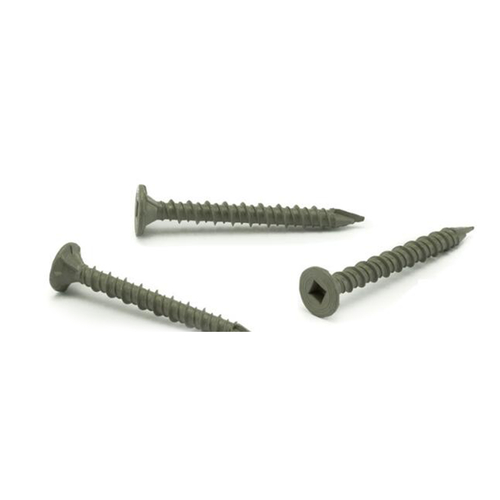
Modern construction, light-gauge steel assembly, metal framing, panel installation, and general industrial fabrication all depend on fastening systems that save time while delivering consistent holding power. Among these fastening solutions, the Phillips wafer head self-drilling screw with black Ruspert finish stands out as a practical, efficient, and visually clean option for joining metal-to-metal and selected metal-to-substrate applications. It combines a wide, low-profile wafer head, a familiar Phillips recess, a hardened self-drilling point, a controlled thread form, and a corrosion-resistant black surface treatment designed for dependable performance in demanding use environments.
This article focuses on the product’s functional advantages, its competitive strengths, and the manufacturing capabilities behind it. The screw belongs to a broader production range that includes multiple recess styles such as Phillips, square, and Torx; diameters including #6-3.5, #8-4.2, #10-4.8, #12-5.5, and #14-6.3; and head types such as bugle head, hex washer head, flat head, pan head, wafer head, and pan framing head. Available materials include C1022A carbon steel, with surface options such as black phosphate, zinc plating, yellow zinc plating, Ruspert, and Magni-type coatings. Thread options may include BSD thread and CSD thread, depending on the installation requirement.
The Phillips wafer head self-drilling screw in black Ruspert finish is particularly valued where a clean appearance, controlled seating, corrosion protection, and efficient installation are important. For contractors, distributors, OEM buyers, and industrial users, the product offers more than a simple fastening component. It offers a combination of speed, repeatability, cost control, and application flexibility.
Phillips wafer head self drilling screw black ruspert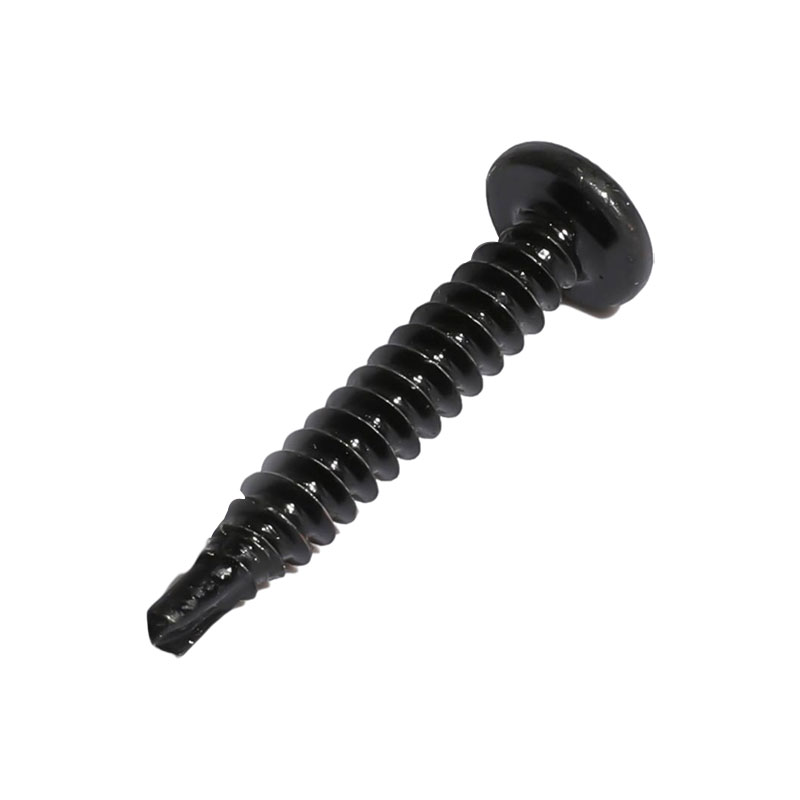
Product Overview
A self-drilling screw is engineered with a drill-shaped point that cuts its own pilot hole before the threads engage the material. This eliminates the need for separate drilling in many applications, reducing labor time and improving production efficiency. The wafer head version adds a broad, shallow head that distributes clamping force over a larger area while maintaining a relatively low profile after installation. The Phillips recess allows compatibility with widely available driver bits and installation tools, making it especially convenient for job sites and factories where standard tooling is preferred.
The black Ruspert finish gives the screw a dark, professional appearance and helps improve resistance against corrosion compared with many basic surface treatments. In visible fastening applications, the black finish can also blend better with dark panels, coated frames, black metal components, and decorative assemblies. This makes the screw suitable not only for functional fastening but also for projects where aesthetics matter.
Compared with ordinary self-tapping screws, this product offers the clear advantage of drilling and tapping in one operation. Compared with low-cost uncoated or lightly plated screws, it provides improved surface protection. Compared with conventional pan head screws, the wafer head creates a larger bearing surface, reducing the risk of pull-through in thin sheet materials. These combined benefits make it a strong fastening choice for metal framing systems, steel sheet assemblies, channel fixing, partition systems, light structural components, and general hardware installation.
Key Specification Range
| Item | Available Options or Details | Application Value |
|---|---|---|
| Product Type | Phillips wafer head self-drilling screw | Fast drilling, threading, and fastening in one operation |
| Recess Options | Phillips, square, Torx | Compatible with different installation tools and torque requirements |
| Diameter Range | #6-3.5, #8-4.2, #10-4.8, #12-5.5, #14-6.3 | Covers light, medium, and heavier fastening needs |
| Head Options | Bugle, hex washer, flat, pan, wafer, pan framing | Supports multiple installation conditions and surface requirements |
| Material Grade | C1022A carbon steel | Suitable for heat treatment and self-drilling performance |
| Standards | ASTM, DIN7504K, DIN7504P, DIN7504N | Supports international procurement and dimensional consistency |
| Surface Finishes | Black phosphate, zinc plated, yellow zinc plated, Ruspert, Magni-type coating | Allows selection according to corrosion resistance and appearance needs |
| Thread Types | BSD thread, CSD thread | Optimized engagement for different substrate and drilling requirements |
Why the Wafer Head Design Matters
The head style of a screw has a direct impact on installation quality. A wafer head is wide and low, creating a larger bearing surface than many standard pan head or flat head designs. This wider contact area helps distribute pressure across the fastened material, especially when working with thin sheet metal or panels that may deform under concentrated load. For applications where a screw must hold securely without excessively biting into the top surface, the wafer head offers a balanced solution.
A major advantage of the wafer head is its low-profile shape. In assemblies where protrusion must be minimized, a bulky head can interfere with moving parts, finishing layers, adjacent panels, or decorative covers. The wafer head sits more neatly on the surface, creating a clean, organized appearance. This is useful for partition systems, metal track installation, electrical enclosures, furniture hardware, appliance structures, garage systems, and light steel framing.
Another important benefit is installation stability. Because the head is broader, it can reduce the tendency of thin material to tear or pull over the screw head under vibration or load. In competitive comparison, lower-quality fasteners may have inconsistent head diameter, uneven bearing surfaces, or sharp burrs that damage coatings on the joined material. A well-manufactured wafer head screw provides smoother contact, better seating, and more predictable clamping behavior.
Phillips Recess Convenience
The Phillips recess remains one of the most widely used drive types in the global fastener market. Its popularity comes from broad tool availability, simple engagement, and easy operator familiarity. For large-scale installation teams, using a common recess type can reduce tool change time, simplify purchasing, and make worker training easier.
In a wafer head self-drilling screw, the recess quality is critical. A poorly formed Phillips recess can cause cam-out, bit slipping, surface damage, wasted screws, and slower installation. Precision forming helps create a clean recess geometry that accepts the driver bit correctly. When the recess is well made and the screw is properly heat-treated, users can achieve stable torque transfer during drilling and thread forming.
While square and Torx drives may provide high torque transfer for some applications, Phillips remains an excellent choice for customers who value universal compatibility. It is especially useful in maintenance, repair, and general construction environments where workers may use standard power drivers and common bits. For distributors, the Phillips version is also easier to stock and sell across diverse customer groups.
Self-Drilling Performance and Time Savings
The self-drilling point is the core feature that separates this screw from ordinary self-tapping fasteners. In many metal applications, traditional fastening requires two steps: first drilling a pilot hole, then inserting a screw. This increases labor time, tool wear, and alignment risk. A self-drilling screw combines these steps. The drill point cuts into the material, creates the correct entry, and allows the threads to engage directly.
Time savings become significant in repetitive installation work. For example, when fastening hundreds or thousands of screws in metal tracks, roofing accessories, panels, brackets, or fabricated parts, eliminating pre-drilling can reduce labor costs and improve job progress. It also reduces the number of tools needed at the worksite, improving workflow and lowering operator fatigue.
A competitive advantage comes from point consistency. Inferior screws may have irregular drill points, soft tips, poor heat treatment, or unbalanced geometry. These defects can cause slow penetration, point burning, wandering, breakage, or failure to drill through the target material. Proper manufacturing controls help ensure that the point cuts effectively, maintains hardness, and transitions smoothly from drilling to threading.
Black Ruspert Finish and Corrosion Protection
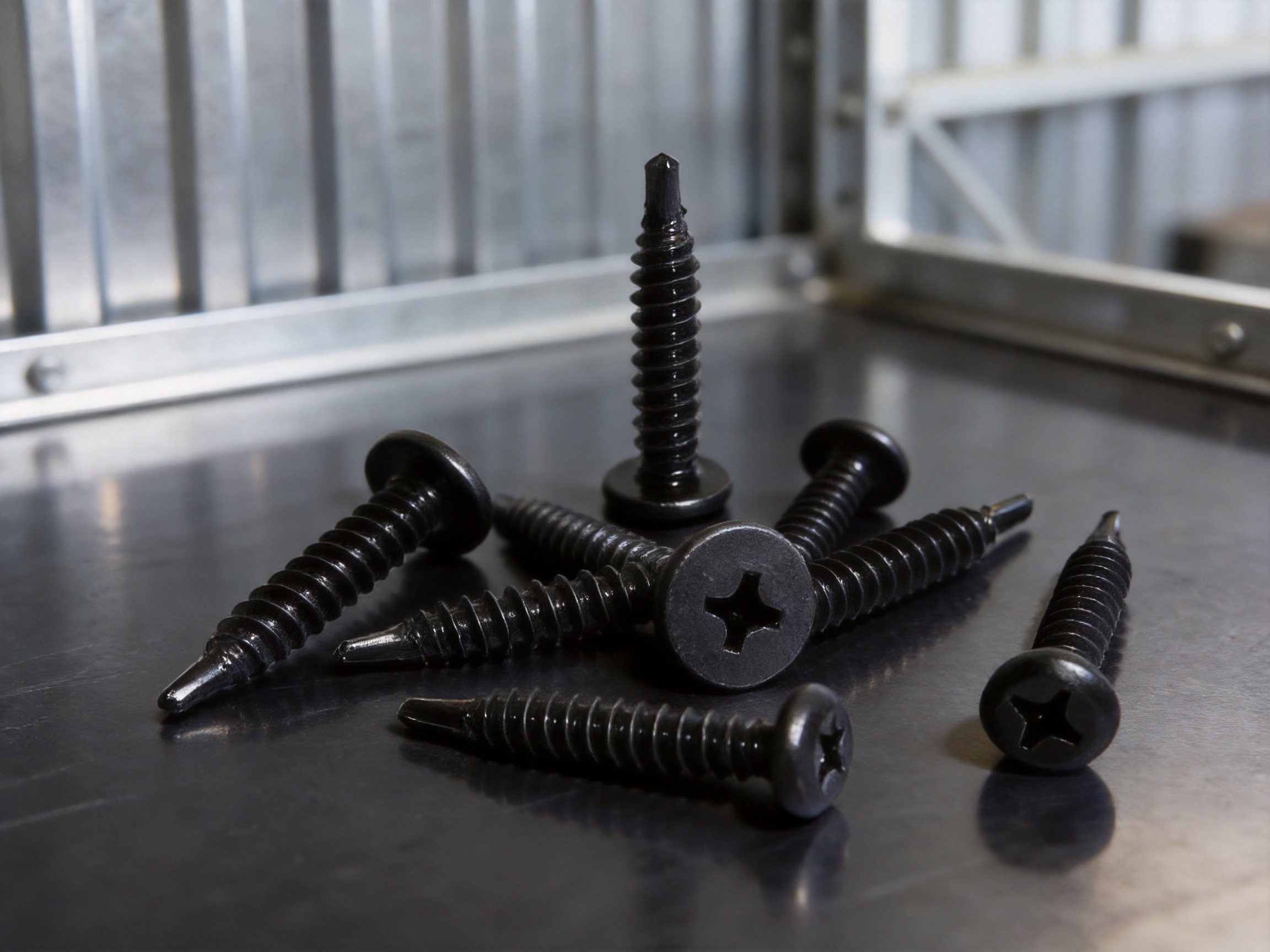
Surface treatment plays a major role in screw durability. A screw may have excellent mechanical strength, but if its coating fails quickly, corrosion can compromise appearance and performance. The black Ruspert finish is designed to provide enhanced corrosion resistance while giving the fastener a uniform dark appearance. It is suitable for applications where standard bright zinc plating may not offer the desired visual result or environmental durability.
The dark color is beneficial in exposed assemblies where the screw should blend with black, grey, or dark-coated materials. It can create a more professional finish compared with bright metallic fasteners on dark surfaces. In hardware, home improvement, metal fixtures, and interior construction, appearance can influence the perceived quality of the final product.
Compared with basic black phosphate, a Ruspert-type coating is generally selected when users want stronger corrosion protection. Compared with simple zinc plating, the black finish can offer both protective and decorative value. Compared with low-cost coatings from inconsistent suppliers, a controlled coating process helps improve thickness uniformity, adhesion, color consistency, and salt spray performance. This gives distributors and end users greater confidence in batch-to-batch reliability.
C1022A Carbon Steel and Heat Treatment
C1022A carbon steel is commonly used for self-drilling screws because it can be cold headed efficiently and then heat-treated to achieve the hardness needed for drilling. The material must provide a balance between surface hardness and core toughness. If the screw is too soft, the point may fail to drill. If it is too brittle, the screw may break under torque or load. This balance is achieved through material selection, cold forming precision, and controlled heat treatment.
For self-drilling screws, heat treatment is not optional; it is essential. The drilling point must be hard enough to cut into steel, while the shank and head must resist torsional failure. A well-controlled heat treatment process helps deliver consistent mechanical behavior across production batches. This is one of the areas where an experienced manufacturer can outperform low-cost competitors that focus only on appearance but neglect internal properties.
Advanced manufacturing control includes monitoring raw material quality, wire drawing condition, heading performance, thread rolling accuracy, carbon potential, quenching temperature, tempering process, and final inspection. Each stage influences the final screw. A beautiful coating cannot compensate for weak metallurgy, so the strength of the product begins long before surface treatment.
Manufacturing Process Strengths
High-quality self-drilling screws require a series of precise manufacturing steps. The process generally begins with wire selection and wire drawing. The wire must have the correct diameter, chemical composition, and surface condition. It is then cold headed to form the head and recess. For a wafer head screw, head shape must be carefully controlled to achieve proper width, height, and bearing surface. The Phillips recess must be accurately punched so that it supports stable driver engagement.
After heading, thread rolling forms the screw threads and helps shape the drilling section. Thread rolling is a cold-forming process that strengthens the surface fibers of the material while producing consistent thread geometry. Accurate thread pitch, thread height, and thread angle are essential for holding performance. Poorly rolled threads may strip, cross-thread, or fail to clamp properly.
The drill point must be formed with special attention. The point geometry determines penetration speed, cutting stability, and chip removal. An uneven point can wander, create oversized holes, or fail before the thread engages. Reliable production equipment and skilled tool maintenance help keep the drill point sharp, centered, and repeatable.
Heat treatment follows, giving the screw its required hardness and toughness. The process must be carefully controlled to avoid under-hardening, over-hardening, decarburization, distortion, and brittleness. After heat treatment, surface finishing is applied. For black Ruspert screws, coating uniformity and curing control are important for corrosion protection and appearance.
Final inspection may include dimensional checks, recess quality inspection, drilling performance tests, torsion tests, hardness tests, coating thickness checks, salt spray testing, and visual sorting. Packaging then protects the screws from moisture, abrasion, and contamination during transportation and storage.
Competitive Advantages Over Ordinary Screws
The Phillips wafer head self-drilling screw with black Ruspert finish offers multiple advantages over ordinary fasteners. The first advantage is installation speed. Because the screw drills its own hole, it reduces pre-drilling work and makes repetitive assembly more efficient. This can lower labor cost and increase productivity for contractors and manufacturers.
The second advantage is improved seating. The wafer head provides a wide bearing area and a low-profile finish. This improves contact with thin metal and panel materials while reducing the risk of surface damage or pull-through. Ordinary small-head screws may not provide enough bearing area for some thin materials.
The third advantage is corrosion resistance. The black Ruspert finish provides a protective coating selected for stronger performance than many basic treatments. This helps extend service life and preserve appearance. In projects where rust staining or visible corrosion is unacceptable, coating quality is an important purchasing factor.
The fourth advantage is consistent drilling performance. When manufactured with controlled point geometry and proper heat treatment, the screw penetrates faster and more reliably. Low-quality competitors often suffer from point wear, inconsistent hardness, recess failure, or thread defects. Such problems lead to wasted fasteners, damaged materials, and slower work.
The fifth advantage is procurement flexibility. The broader production range includes multiple diameters, head types, recesses, thread types, and finishes. This allows buyers to source related fastening products from one supplier rather than managing many separate sources. Consolidated sourcing can improve communication, reduce lead time complexity, and support customized packaging.
Application Areas
This screw is useful in many industries where metal fastening is frequent. In light steel framing, it can be used to connect tracks, studs, channels, clips, and accessories. The self-drilling point reduces preparation work, while the wafer head provides stable bearing on thin steel sections.
In sheet metal assembly, the screw helps join panels, brackets, covers, and enclosures. The black finish is especially useful for dark-coated metal components, where a bright screw would stand out visually. In appliance and equipment manufacturing, the low-profile head can reduce interference and improve appearance.
In furniture hardware and home tool applications, the screw may be used where metal brackets, rails, hinges, and supports require efficient fastening. The broad head offers good contact, while the self-drilling function can simplify assembly operations. In packaging-related hardware and stamped parts, consistent fastening performance supports repeatable production.
The screw may also be used in maintenance and repair operations. Technicians often need a fastener that can be installed quickly without carrying multiple drilling tools. A Phillips self-drilling screw is convenient because it matches common driver bits and performs reliably in many light metal situations.
Importance of Standards and Dimensional Consistency
References to standards such as ASTM and DIN7504 series are important for international buyers because standards help define dimensions, performance expectations, and product compatibility. DIN7504K, DIN7504P, and DIN7504N relate to common self-drilling screw forms, and a manufacturer familiar with these norms can better support customers who require consistent specification control.
Dimensional consistency affects every aspect of installation. Head diameter influences bearing area. Head height affects profile and clearance. Recess depth affects driver engagement. Thread pitch affects holding power. Drill point length affects penetration capacity. If these dimensions vary too much, installers experience inconsistent performance, even when the screws appear similar at first glance.
For distributors, dimensional consistency also reduces complaints and returns. A batch of screws that performs well in one shipment but poorly in another can damage customer trust. Reliable manufacturing and inspection systems help provide stable quality across repeated orders.
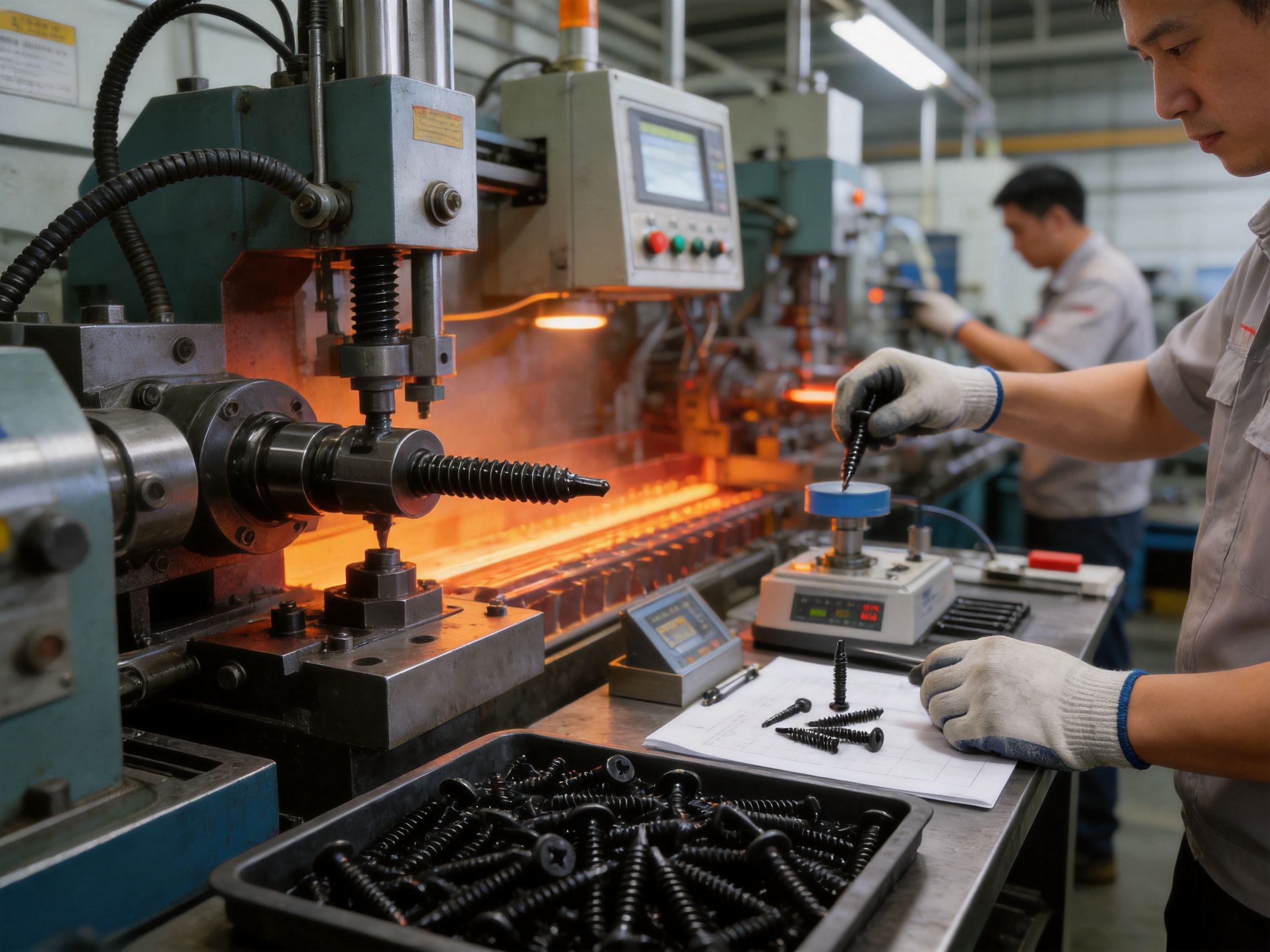
Quality Control from Raw Material to Packaging
Strong quality control begins with raw material verification. The steel wire must meet chemical and mechanical requirements suitable for self-drilling screw production. If raw material is inconsistent, later processes cannot fully correct the problem. Incoming inspection helps confirm wire diameter, surface condition, and material traceability.
During heading, operators and inspectors check head formation, recess depth, concentricity, and visible defects. A clean Phillips recess is essential for proper torque transfer. During thread rolling, thread form and point geometry are monitored. Thread defects can cause installation failure, while point defects can cause poor drilling.
Heat treatment control is one of the most critical quality stages. Hardness testing helps verify that the drill point can penetrate target materials while the screw remains tough enough to resist breaking. Torsion testing can be used to evaluate resistance to twisting failure. Drilling tests simulate real installation behavior and reveal problems that dimensional inspection alone may not detect.
After coating, visual checks help confirm color, coverage, and surface uniformity. Coating thickness and corrosion-resistance tests may be performed according to customer requirements. Packaging inspection ensures that carton weight, quantity, labels, and protective packing meet order specifications. Good packaging prevents mixing, moisture exposure, and transportation damage.
Advanced Production Capability and Supply Strength
A manufacturer with a wide screw production range can serve customers more effectively than a supplier with limited capabilities. The ability to produce self-drilling screws, drywall screws, roofing screws, furniture screws, machine screws, and other fastener types creates a stronger technical base. Experience across multiple product families improves tooling knowledge, material control, coating selection, and packaging customization.
The available diameter range from #6 through #14 supports many application levels, from light fastening to heavier metal connections. Multiple head styles make it possible to match fasteners to different surfaces and load conditions. Multiple recess types allow customers to choose between standard compatibility, anti-cam-out performance, and higher torque transfer.
Production flexibility is also important for distributors who serve different markets. A buyer may need black Ruspert wafer head screws for visible metal framing, zinc plated hex washer head screws for roofing accessories, yellow zinc plated screws for hardware packaging, or black phosphate screws for interior applications. A capable manufacturer can coordinate these variations under consistent quality expectations.
In addition, warehousing and export experience help support international buyers. A company with manufacturing capacity in China and warehouse support in Thailand can improve regional service flexibility, stock planning, and shipment coordination. For customers in Southeast Asia or global markets, this can reduce supply uncertainty and improve response time.
Packaging and Distribution Value
Packaging is often overlooked, but it plays an important role in the fastener supply chain. Screws are small, heavy, and vulnerable to moisture and handling damage if poorly packed. Good packaging protects coating integrity, prevents carton failure, supports easy counting, and improves shelf presentation.
For wholesalers and retailers, customized packaging can increase product competitiveness. Screws may be packed in bulk cartons, small boxes, plastic containers, or customer-branded retail packages, depending on market needs. Clear labeling helps identify size, finish, head style, recess type, quantity, and batch information. For industrial users, strong cartons and organized packing reduce warehouse confusion and speed up production line replenishment.
The black Ruspert surface also benefits from careful packaging because dark coatings can show scratches if handled roughly. Protective packing methods help preserve the professional appearance of the screw until installation. This is especially important when the fastener is used in visible or decorative applications.
How the Product Helps Reduce Total Cost
Fastener purchasing should not be judged only by unit price. A cheaper screw may become expensive if it drills slowly, strips easily, breaks during installation, corrodes early, or causes rework. The total cost of fastening includes labor, tool wear, scrap, downtime, warranty risk, and customer satisfaction.
The Phillips wafer head self-drilling screw helps reduce total cost in several ways. First, it eliminates separate drilling in many applications, saving labor and time. Second, its stable recess and point geometry reduce installation failure. Third, the wafer head improves clamping on thin materials, reducing pull-through risk. Fourth, the corrosion-resistant black finish can extend usable life and improve project appearance. Fifth, consistent quality reduces complaints and improves production planning.
For contractors, time saved per screw becomes meaningful across an entire project. For factories, fewer defective fasteners mean smoother assembly lines. For distributors, reliable quality means fewer returns and stronger customer loyalty. Therefore, a well-made screw with a slightly higher unit cost can often provide better economic value than a low-grade alternative.
Comparison with Common Alternatives
Compared with ordinary self-tapping screws, the self-drilling version provides faster installation in metal because it forms its own drilling path. Self-tapping screws generally need a pre-drilled hole in metal applications, which increases labor and alignment steps. The self-drilling screw is the better choice when productivity is important.
Compared with pan head self-drilling screws, the wafer head offers a wider and lower profile. Pan heads can be useful in many situations, but they may protrude more and may provide a smaller bearing area depending on design. Wafer heads are preferred when a broad, low-profile contact surface is desired.
Compared with flat head screws, wafer head screws do not require countersinking. Flat head screws are useful when a flush finish is needed, but countersinking thin metal can be impractical or may weaken the material. Wafer head screws sit neatly on the surface without requiring extra preparation.
Compared with basic zinc plated screws, the black Ruspert finish offers a different balance of appearance and corrosion resistance. Bright zinc may be suitable for general use, but black Ruspert is attractive for dark assemblies and applications requiring improved protection. Compared with low-cost black coatings, a controlled coating system can provide better adhesion, consistency, and durability.
Selection Guidance for Buyers
When selecting this screw, buyers should consider the material thickness, fastening load, installation tool, required appearance, environmental exposure, and packaging method. Diameter selection should match the strength requirement and substrate thickness. Smaller sizes such as #6 or #8 may suit light sheet metal and hardware work, while larger sizes such as #12 or #14 may be chosen for heavier fastening needs.
Length selection depends on the combined thickness of the materials and the required thread engagement. A screw must be long enough for the drill point to penetrate, the threads to engage correctly, and the head to clamp the top material securely. If the screw is too short, holding power may be poor. If it is too long, it may protrude unnecessarily or interfere with other parts.
The surface finish should match the environment. Black Ruspert is suitable where corrosion resistance and dark appearance are desired. Zinc plated and yellow zinc plated screws may suit general hardware and indoor applications. Black phosphate may be selected for certain interior uses, while Magni-type finishes may be specified for enhanced corrosion performance.
Drive type should match installation needs. Phillips is widely compatible and convenient. Square and Torx may be selected where higher torque transfer or reduced cam-out is preferred. However, for general construction and distribution, Phillips remains a practical and market-friendly choice.
Installation Best Practices
Proper installation improves performance and service life. Operators should use the correct driver bit size and ensure that the bit is not worn. A worn bit can damage the recess, increase cam-out, and reduce torque control. The screw should be aligned perpendicular to the work surface so that the drill point penetrates cleanly and the head seats evenly.
Driver speed and pressure should be adjusted according to material thickness and screw size. Excessive speed can overheat the point or damage the coating, while insufficient pressure can cause the point to spin without cutting effectively. Too much pressure may deform thin material or strip threads after seating. Operators should stop driving once the wafer head is seated firmly against the surface.
For critical applications, test installation should be performed before full production. This confirms that screw size, point type, thread form, and coating are suitable for the actual material. Testing is especially important when joining harder steel, coated panels, layered materials, or substrates with variable thickness.
Appearance Value in Finished Assemblies
The black finish gives this screw an important visual advantage. In many modern designs, dark hardware is preferred because it creates a cleaner and more coordinated appearance. Bright fasteners can draw attention and make an assembly look unfinished when used on black frames or dark panels. A black wafer head screw blends more naturally and supports a professional result.
The low-profile head also contributes to visual quality. A tall or bulky head may look rough, especially on visible surfaces. The wafer head provides a broad but shallow form that looks controlled and intentional. For retail products, furniture components, exhibition structures, decorative metalwork, and interior systems, this detail can improve customer perception.
Appearance is not merely cosmetic. A uniform coating also indicates controlled finishing, proper handling, and quality awareness. When customers open a box and see consistent color, clean heads, sharp points, and smooth threads, they gain confidence in the product before installation begins.
Sustainability and Efficiency Considerations
Efficient fastening contributes to sustainability by reducing wasted labor, damaged materials, and rejected components. A screw that drills correctly the first time helps avoid scrap and rework. Consistent manufacturing also reduces defective products and improves resource utilization.
Surface treatments that improve corrosion resistance can extend the life of assemblies, reducing the need for premature repair or replacement. Longer service life means fewer materials consumed over time. In addition, consolidated sourcing from a capable manufacturer can reduce supply chain complexity and improve logistics planning.
While fasteners are small components, they are used in large quantities. Small improvements in quality, installation speed, and durability can produce meaningful benefits across large projects and production runs.
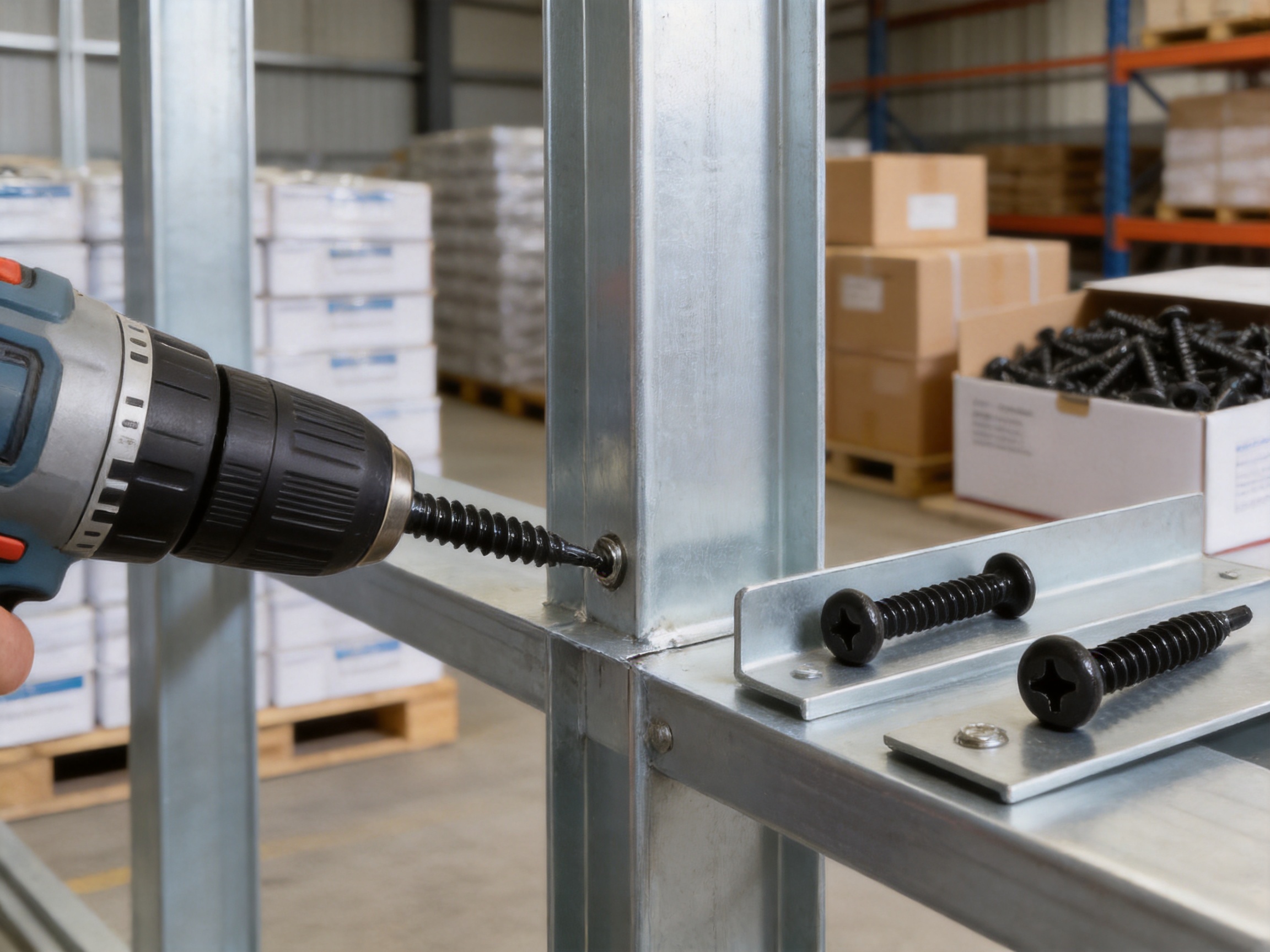
Company Manufacturing Strength and Customer Support
Lizhan Hardware Co., Ltd. supports the production and supply of screws for construction, furniture, roofing, drywall, machinery, home tools, fasteners, packaging, and stamping-related applications. Its product scope covers self-drilling screws and many related screw families, allowing customers to source multiple fastening solutions from one experienced supplier.
The company’s manufacturing strength lies in process control, product variety, and export-oriented service. From raw material selection to cold heading, thread rolling, heat treatment, coating, inspection, and packaging, each step affects final performance. A supplier that understands the full production chain can better control product consistency and respond to technical requirements.
Its production range includes multiple recesses, diameters, head styles, surfaces, and thread types, enabling flexible customization for distributors, OEM buyers, and project contractors. Whether customers need standard black Ruspert wafer head screws, zinc plated hex washer head screws, bugle head drywall screws, roofing screws, or furniture screws, a broad manufacturing base supports efficient procurement.
The company’s China factory and Thailand warehouse support regional service and international supply coordination. For buyers who require communication, sampling, repeat orders, packaging discussion, and shipment planning, this structure provides practical support. Contact channels such as email, phone, WhatsApp, and WeChat make communication convenient for global buyers.
Why Buyers Choose a Professional Screw Manufacturer
Professional fastener buyers know that screw quality cannot be fully judged by a photograph. Two screws may look similar but perform very differently in drilling speed, torsion strength, coating durability, and recess stability. Choosing an experienced manufacturer reduces risk because the supplier understands the technical details behind the product.
A professional manufacturer can advise on size selection, finish choice, packaging format, and application suitability. It can also provide more consistent batch production, which is important for distributors who sell under long-term programs. Reliable supply reduces emergency purchasing and helps customers maintain inventory confidence.
Professional production also supports quality documentation when required. Buyers may request specifications, test reports, coating information, or packaging details. This is especially important for customers serving construction, industrial, or export markets where product traceability and compliance matter.
Frequently Asked Questions
What is a Phillips wafer head self-drilling screw?
It is a screw with a Phillips drive recess, a wide low-profile wafer head, and a drill-shaped point that can create its own hole in suitable metal materials before the threads engage. It is designed to reduce installation steps and provide stable clamping.
What is the advantage of the wafer head?
The wafer head provides a broad bearing surface and a low-profile finish. This helps distribute clamping force, reduces pull-through risk in thin material, and creates a cleaner appearance than many taller head styles.
Why choose a black Ruspert finish?
The black Ruspert finish offers a dark appearance and improved corrosion resistance compared with many basic coatings. It is suitable for visible fastening, dark metal assemblies, and applications where both appearance and protection are important.
What material is commonly used for this screw?
C1022A carbon steel is commonly used because it can be cold formed and heat-treated to achieve the hardness and toughness required for self-drilling performance.
Which diameters are available?
The production range includes common sizes such as #6-3.5, #8-4.2, #10-4.8, #12-5.5, and #14-6.3. The best diameter depends on the substrate, load requirement, and installation conditions.
Can the screw be supplied with other recess types?
Yes. In addition to Phillips, square and Torx recess options may be available. Phillips is widely compatible, while square and Torx may be selected for specific torque transfer requirements.
Does a self-drilling screw always eliminate pre-drilling?
In many suitable metal applications, yes. However, the need for pre-drilling depends on material hardness, thickness, screw size, drill point type, and installation tool. Testing is recommended for critical or unusual substrates.
What industries commonly use this screw?
Common uses include light steel framing, sheet metal assembly, hardware manufacturing, furniture hardware, metal brackets, interior partitions, equipment enclosures, home tools, and general repair work.
How does this product compare with low-cost alternatives?
A high-quality version offers more consistent drill points, better recess formation, controlled heat treatment, stronger coating performance, and reliable dimensions. Low-cost alternatives may save money initially but can increase total cost through breakage, stripping, corrosion, and rework.
What should buyers check before placing an order?
Buyers should confirm diameter, length, head style, recess type, surface finish, thread type, packaging method, performance requirements, and target application. If possible, sample testing should be completed before large-volume purchasing.
Conclusion
The Phillips wafer head self-drilling screw with black Ruspert finish is a practical and high-value fastening solution for metal assembly and related applications. It combines drilling, threading, and fastening in one efficient operation, reducing installation time and improving workflow. Its wafer head provides a wide, low-profile bearing surface, while the Phillips recess offers broad tool compatibility. The black Ruspert coating adds corrosion protection and a clean dark appearance suitable for visible or decorative fastening.
The product’s strength comes not only from its design but also from the manufacturing process behind it. Reliable raw material selection, precision cold heading, accurate thread rolling, controlled drill point formation, proper heat treatment, uniform coating, and strict inspection all contribute to final performance. Compared with ordinary or low-grade competitors, a professionally manufactured screw delivers better installation efficiency, more stable holding power, improved appearance, and lower total cost.
For distributors, contractors, OEM buyers, and industrial users, this screw offers flexibility across sizes, finishes, head styles, recess options, and packaging formats. Supported by broad fastener manufacturing capability and international supply experience, it is a dependable choice for customers who require consistent quality, efficient installation, and professional presentation.
References
1. Industrial Fasteners Institute. Fastener Standards and Technical Guidance for Mechanical Fastening Applications.
2. ASTM International. Standard Specifications and Test Methods Related to Carbon Steel Fasteners and Coating Performance.
3. Deutsches Institut für Normung. DIN 7504 Series: Self-Drilling Screws, Dimensional and Performance References.
4. Bickford, J. H. Introduction to the Design and Behavior of Bolted Joints.
5. Smith, W. F., and Hashemi, J. Foundations of Materials Science and Engineering.
6. Surface Engineering Association. Practical Guidance on Protective Coatings for Steel Fasteners.