Triangle stamping parts are small components with a large influence on product strength, assembly accuracy, and long-term reliability. In automotive systems, electronic equipment, furniture structures, machinery frames, tool assemblies, packaging hardware, and home improvement applications, a precisely formed triangular metal part can provide reinforcement, alignment, locking support, load distribution, and dimensional stability. The product discussed in this article is a reinforced triangle stamping part manufactured for applications that require dependable geometry, corrosion resistance, repeatable assembly performance, and a clean industrial finish.
Unlike ordinary flat metal brackets or loosely formed sheet metal parts, a reinforced triangle stamping component is engineered around the mechanical advantages of triangular geometry. The triangle is one of the most stable shapes in structural design. It resists deformation better than many rectangular or open shapes because force is distributed along fixed angles and rigid edges. When combined with metal stamping, controlled forming, and carefully selected materials such as stainless steel or high-strength alloy steel, the result is a compact component that can improve structural integrity without adding excessive weight or assembly complexity.
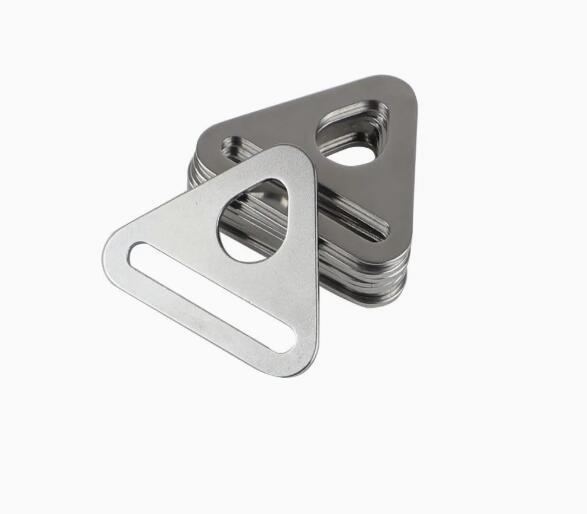
This article explains the product’s design value, its advantages over many competing parts, and the manufacturing strengths behind high-quality triangle stamping parts. It also describes material options, surface treatments, tooling considerations, quality inspection, application scenarios, and practical purchasing factors. The goal is to provide a complete technical and commercial overview for engineers, buyers, product designers, distributors, and procurement teams evaluating triangle stamping parts for industrial or commercial use.
Understanding the Product: What Is a Reinforced Triangle Stamping Part?
A triangle stamping part is a metal component produced by pressing sheet or strip metal into a designed shape using stamping dies and high-tonnage presses. The reinforced triangular form may include bends, ribs, flanges, holes, buckles, notches, or locking features depending on the application. The product title refers to triangle stamping parts, metal stamping parts, reinforced triangle buckle parts, stainless steel pole triangles, and related cast-style or formed metal supports. In practical use, these terms describe a family of metal parts designed to provide triangular reinforcement and reliable mechanical connection.
The defining feature is the triangular body or triangular reinforcement structure. A reinforced triangle buckle, for example, may be used to stabilize a pole, connect a bracket, lock two parts together, or strengthen an assembly corner. In furniture, it can help support frames and joints. In automotive or machinery equipment, it can act as a positioning or support part. In packaging or home tool applications, it can provide compact metal strength in a repeatable, economical format.
Metal stamping is especially suitable for this type of product because it supports high-volume production with excellent repeatability. Once the tooling is designed and validated, each part can be produced with consistent geometry, controlled thickness, and stable feature placement. Compared with slow machining or manual fabrication, stamping can deliver better production efficiency, lower unit cost at scale, and more consistent shape control.
The reinforced triangle design can also be adapted to different requirements. Some customers need thin, lightweight parts for compact devices. Others require thicker parts for stronger load-bearing support. Some require stainless steel for corrosion resistance, while others may choose carbon steel, alloy steel, galvanized steel, or special surface-treated materials depending on environment, cost target, and service life requirements.
Why Triangular Geometry Matters in Metal Components
The triangle has long been used in bridges, towers, trusses, brackets, and reinforcement plates because it is naturally stable. A rectangle can distort into a parallelogram when force is applied unless it is braced. A triangle, however, cannot easily change shape without changing the length of one of its sides. This makes triangular metal parts extremely valuable where rigidity, alignment, and load distribution are needed.
In a stamped metal triangle part, the shape can be enhanced through reinforcing ribs, bends, flanges, coined areas, or raised edges. These features increase stiffness without requiring a much thicker material. This is one of the major advantages over heavier conventional parts. By using geometry intelligently, the component can provide high strength while reducing material use and assembly weight.
For buyers comparing similar products, this difference is important. A competitor may offer a simple flat cut plate with a triangular outline, but a properly engineered stamping part can include controlled deformation zones, strengthened corners, accurate holes, and repeatable locking features. These details improve performance during installation and throughout the product’s service life.
Triangular parts are also efficient in limited spaces. Many modern assemblies require compact components because equipment is becoming smaller, lighter, and more modular. A triangle bracket or buckle can fit into corners, support angled connections, and reinforce joints without occupying unnecessary space. This makes the product useful in home tools, fastener systems, packaging structures, machinery, and custom hardware applications.
Core Advantages Over Competing Products
The reinforced triangle stamping part offers several competitive advantages when compared with ordinary stamped brackets, simple cut plates, low-grade cast components, and manually formed metal parts. These advantages come from a combination of design, material selection, tooling precision, forming technology, quality inspection, and supply chain management.
Higher Structural Stability
The triangular shape naturally improves mechanical stability. When the part is properly stamped and reinforced, it can resist bending, twisting, and installation stress more effectively than many basic shapes. Reinforcing ribs or folded edges can further increase stiffness, allowing the component to maintain its shape under repeated use.
This is especially useful in systems exposed to vibration, assembly pressure, or intermittent load. In automotive and machinery applications, even a small dimensional shift can cause noise, looseness, misalignment, or premature wear. A strong triangle stamping part helps maintain the intended connection geometry.
Improved Precision and Repeatability
A major weakness of low-cost metal parts is poor repeatability. If hole positions vary, edges are inconsistent, or angles are not stable, the part may slow down assembly or cause rejection during quality inspection. Precision stamping addresses this issue by using engineered dies, controlled press parameters, and inspection systems.
The product is designed for accurate angular alignment, clean edge control, and stable dimensions. Laser-calibrated or precision-checked edges can help ensure that each part matches the intended assembly requirement. For high-volume customers, this repeatability reduces installation problems and improves production efficiency.
Corrosion Resistance and Surface Durability
Depending on the material and finish, triangle stamping parts can offer strong corrosion resistance. Stainless steel versions are well suited to environments where moisture, cleaning agents, outdoor exposure, or long-term appearance matters. Carbon steel or alloy steel versions can be protected through zinc plating, nickel plating, passivation, electrophoretic coating, powder coating, black oxide, or other treatments.
Competitor products may appear similar at first glance but fail earlier when exposed to humidity, salt spray, or industrial chemicals. A properly treated stamping part can protect the base metal, extend service life, and reduce maintenance or replacement costs.
Lower Weight Without Sacrificing Strength
Modern manufacturing increasingly values lightweight design. A reinforced stamped part can deliver strength through geometry rather than relying only on material thickness. This means the component can be lighter than a bulky machined or cast part while still providing the required support.
For customers producing large assemblies, small weight reductions across many parts can improve handling, shipping efficiency, and energy consumption during production. In some cases, the triangle stamping design can reduce material use while maintaining performance, supporting more eco-conscious manufacturing goals.
Better Cost Efficiency at Scale
Stamping has strong cost advantages when production volume increases. Although tooling requires initial investment, the unit cost can become very competitive once the part is in regular production. Compared with CNC machining, manual welding, or small-batch fabrication, stamping can produce high quantities quickly with stable quality.
Buyers often compare only the unit price of a part, but the real cost includes rejected parts, assembly delays, inconsistent quality, excessive weight, corrosion failure, and supplier instability. A well-engineered triangle stamping part can reduce these hidden costs.
Flexible Customization
The product can be adapted to different sizes, hole patterns, materials, thicknesses, finishes, and packaging requirements. Custom geometry is important because many triangle parts are not universal items; they must fit a specific assembly. Advanced manufacturers can support drawing review, sample production, tooling adjustment, and project-specific adaptation.
This flexibility gives the product a competitive advantage over standard catalog components that may require customers to redesign their assemblies. Instead, the stamping part can be engineered to fit the customer’s actual application.
Manufacturing Strength Behind High-Quality Triangle Stamping Parts
A high-performance stamping part is not created by press force alone. It depends on a complete manufacturing process that includes engineering analysis, raw material control, die design, forming simulation or trial adjustment, press operation, secondary processing, surface treatment, inspection, and packaging. Lizhan Hardware Co., Ltd. focuses on these manufacturing fundamentals to deliver metal components that are reliable, repeatable, and suitable for industrial supply chains.
The company operates with manufacturing experience in hardware, fasteners, home tools, packaging-related components, and stamping parts. Its production strengths include custom metal forming capability, attention to dimensional accuracy, flexible order support, and the ability to serve customers from a China factory with warehousing support in Thailand. This combination helps international buyers reduce communication barriers, shorten supply response time in regional markets, and maintain more stable procurement planning.
Engineering Review and Design for Manufacturability
The manufacturing process begins before the first part is stamped. Drawings, samples, 3D models, or customer specifications are reviewed to evaluate manufacturability. Engineers consider material thickness, bend radius, hole-to-edge distance, tolerance expectations, burr direction, grain direction, surface finish, tooling complexity, and production volume.
Design for manufacturability is critical for triangle stamping parts because sharp angles, small holes, narrow bridges, and reinforced features may create forming challenges if not planned correctly. A skilled engineering team can recommend adjustments that improve part strength, reduce tooling wear, and prevent cracking or distortion.
For example, if a customer requires a very sharp triangular corner, the manufacturer may propose a controlled radius to prevent stress concentration. If a reinforced rib is needed, the team may evaluate whether it should be formed in one step or multiple steps. If the part requires holes near a bend line, the sequence of punching and forming must be planned carefully to avoid hole deformation.
Material Selection and Raw Material Control
Material selection determines strength, corrosion resistance, formability, and cost. Triangle stamping parts may be produced from stainless steel, carbon steel, alloy steel, galvanized sheet, or other metals depending on customer requirements. Stainless steel is commonly selected for corrosion resistance and clean appearance. Alloy steel may be chosen for higher strength. Carbon steel with plating can be a cost-effective choice for indoor applications.
Raw material control includes verifying thickness, mechanical properties, surface condition, and supplier consistency. Even a well-designed die cannot produce stable parts from unstable material. Variation in hardness or thickness can affect bending angles, springback, surface quality, and hole accuracy. Advanced manufacturers therefore manage material sourcing carefully and use incoming inspection to reduce production risk.
For reinforced triangle stamping parts, material formability is especially important. If the steel is too brittle, ribs or bends may crack. If it is too soft, the part may deform during use. The correct material balance ensures that the part can be stamped efficiently and perform reliably after installation.
Precision Tooling and Die Development
The die is the heart of the stamping process. It determines the shape, accuracy, and repeatability of the finished component. Tooling for triangle stamping parts may include blanking dies, punching dies, bending dies, forming dies, coining dies, or progressive dies. For high-volume parts, progressive tooling can perform multiple operations in sequence as the metal strip moves through the press.
Precision die development involves careful calculation of clearances, bend allowances, forming pressure, material flow, and springback compensation. If the die clearance is too large, burrs may become excessive. If it is too small, tool wear and cracking may increase. If springback is not controlled, the final angle may be inaccurate.
A strong tooling capability gives the manufacturer an advantage over competitors that rely on generic or poorly maintained dies. High-quality tooling produces cleaner edges, more consistent dimensions, and fewer defects. It also supports faster production and longer tool life.
Stamping, Forming, and Reinforcement Operations
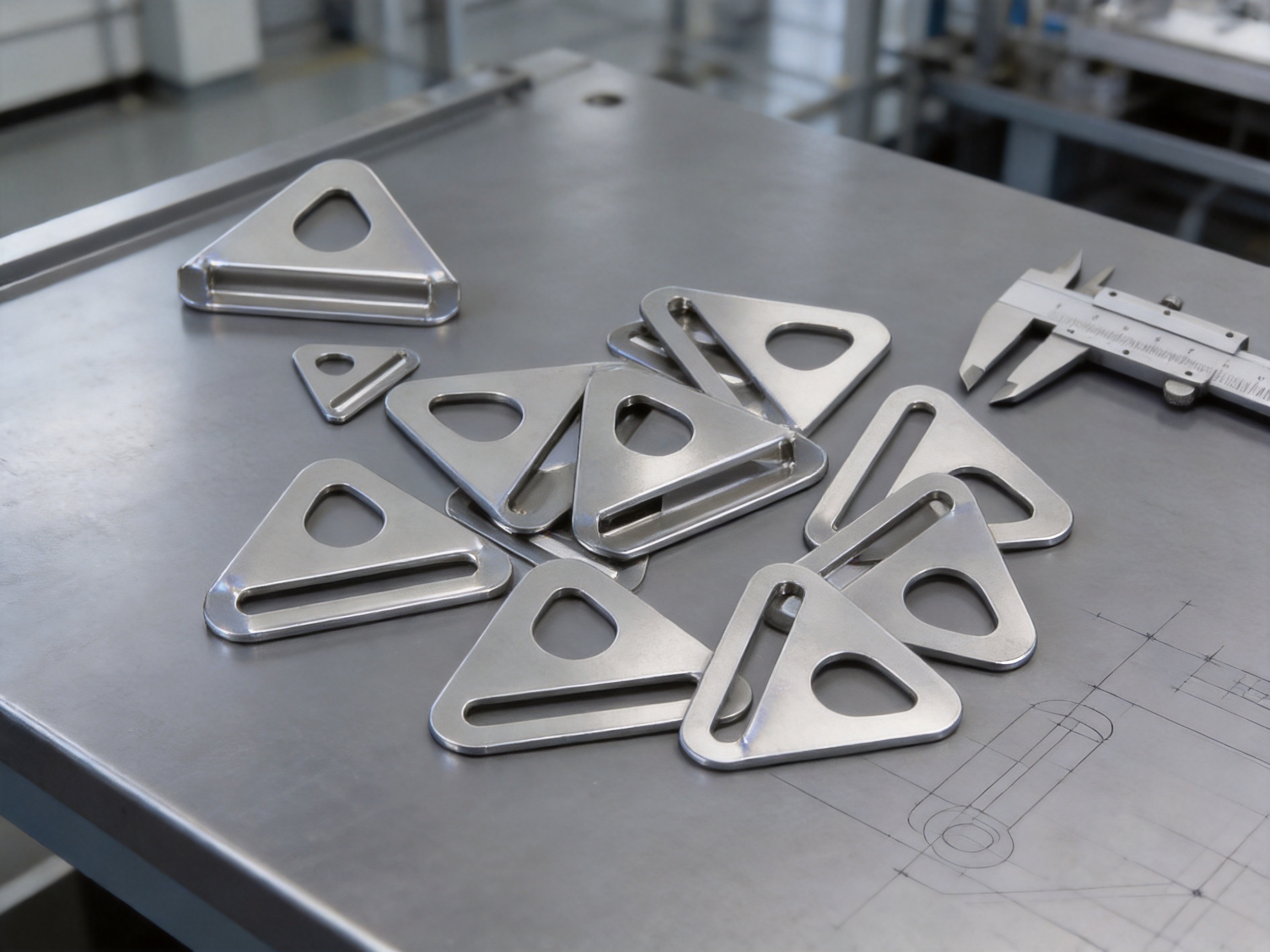
During stamping, metal sheet or strip is placed into a press and shaped by upper and lower dies. Depending on the design, the process may include blanking the triangular outline, punching holes, forming ribs, bending flanges, coining reinforcement areas, or creating buckle features. The exact sequence is chosen to maintain dimensional accuracy and prevent unwanted deformation.
Reinforcement features are important for this product. A rib or formed edge can greatly increase stiffness while using the same material thickness. This allows the part to outperform a flat plate of similar weight. In some designs, the triangular part may include a raised center, folded side, or angular bracket form to improve load transfer.
Press parameters must be controlled carefully. Excessive force can damage tooling or mark the part surface. Insufficient force can result in incomplete forming. Feed accuracy, lubrication, alignment, and press speed also affect final quality. Advanced process control helps ensure that each batch remains consistent.
Deburring and Edge Conditioning
Stamped metal parts often have burrs after blanking or punching. Burr control is essential for safety, assembly performance, and appearance. Deburring may be performed through tumbling, brushing, grinding, vibration finishing, or other methods depending on part size and requirements.
For triangle stamping parts, edge quality is particularly important because corners and holes may contact other parts or be handled by workers during assembly. Clean edges reduce the risk of scratches, cutting injuries, paint damage, and poor fit. Competitor parts with rough burrs may appear less expensive but can create hidden costs in assembly and quality control.
Surface Treatment and Finishing
Surface treatment improves corrosion resistance, wear resistance, appearance, and compatibility with the final assembly. Stainless steel parts may be passivated or polished. Carbon steel or alloy steel parts may receive zinc plating, nickel plating, electrophoresis, powder coating, blackening, or oil protection. The right finish depends on the service environment.
A diamond-cut or clean industrial finish can also help reduce micro-defects on critical edges. Surface quality is not only cosmetic; cracks, scratches, and rough edges can become starting points for corrosion or fatigue failure. A controlled finishing process improves both appearance and long-term reliability.
Customers should specify environmental requirements such as indoor use, outdoor use, humidity exposure, salt spray expectations, chemical exposure, or decorative appearance. The manufacturer can then recommend a suitable surface treatment.
Technical Characteristics and Capability Overview
The following table summarizes common technical considerations for reinforced triangle stamping parts. Exact specifications depend on the customer’s drawing, application, material choice, and production volume.
| Item | Typical Options or Considerations | Customer Benefit |
|---|---|---|
| Product Type | Triangle stamping part, reinforced triangle buckle, bracket, pole triangle, support plate | Fits multiple industrial and hardware applications |
| Material Options | Stainless steel, carbon steel, alloy steel, galvanized steel, custom metal grades | Balances strength, corrosion resistance, and cost |
| Manufacturing Process | Blanking, punching, bending, forming, coining, progressive stamping, secondary finishing | Ensures repeatable geometry and efficient production |
| Reinforcement Features | Ribs, folded edges, flanges, raised sections, buckle structures | Improves stiffness without excessive weight |
| Surface Treatments | Passivation, zinc plating, nickel plating, black oxide, powder coating, polishing, oil protection | Enhances corrosion resistance and appearance |
| Quality Control | Dimensional inspection, angle checks, visual inspection, thickness verification, surface testing | Reduces assembly risk and batch variation |
| Customization | Custom size, hole pattern, thickness, finish, packaging, drawing-based production | Supports project-specific requirements |
| Application Fields | Automotive, electronics, machinery, home tools, furniture, packaging, fastener assemblies | Provides broad purchasing flexibility |
Applications in Automotive, Electronics, Machinery, and Hardware
Triangle stamping parts are used across many industries because they are compact, strong, and adaptable. Their value is especially clear in applications where space is limited but structural support is required.
Automotive Applications
Automotive manufacturers and suppliers use stamped metal parts throughout vehicles. Triangle reinforcement parts may be used in brackets, support structures, fastening systems, interior assemblies, underbody components, or accessory hardware. Automotive applications require consistency because assembly lines depend on parts that fit quickly and reliably.
Compared with manually fabricated brackets, stamped triangle components provide better dimensional repeatability. This supports automated or semi-automated assembly. Corrosion-resistant finishes can also help meet durability expectations for vehicle environments where moisture, road salt, and temperature variation are common.
Electronics and Electrical Equipment
In electronics, small metal parts may provide support, grounding, positioning, or structural protection. A triangular stamped component can stabilize internal frames or support covers and panels. Stainless steel or plated steel options provide clean appearance and controlled conductivity depending on design needs.
Electronics applications often demand tight tolerances and clean edges. Burrs, contamination, or distorted holes can cause assembly problems. Precision stamping and finishing are therefore important advantages.
Machinery and Industrial Equipment
Machinery applications benefit from reinforced metal parts that resist vibration and repeated loading. Triangle stamping parts can support guards, housings, rails, poles, brackets, or internal assemblies. Because industrial equipment may operate in harsh conditions, material strength and surface treatment must be selected carefully.
A competitor’s low-grade part may function during initial installation but fail after months of vibration or corrosion. A properly designed and treated triangle stamping part helps maintain reliability during long-term operation.
Furniture and Home Tool Applications
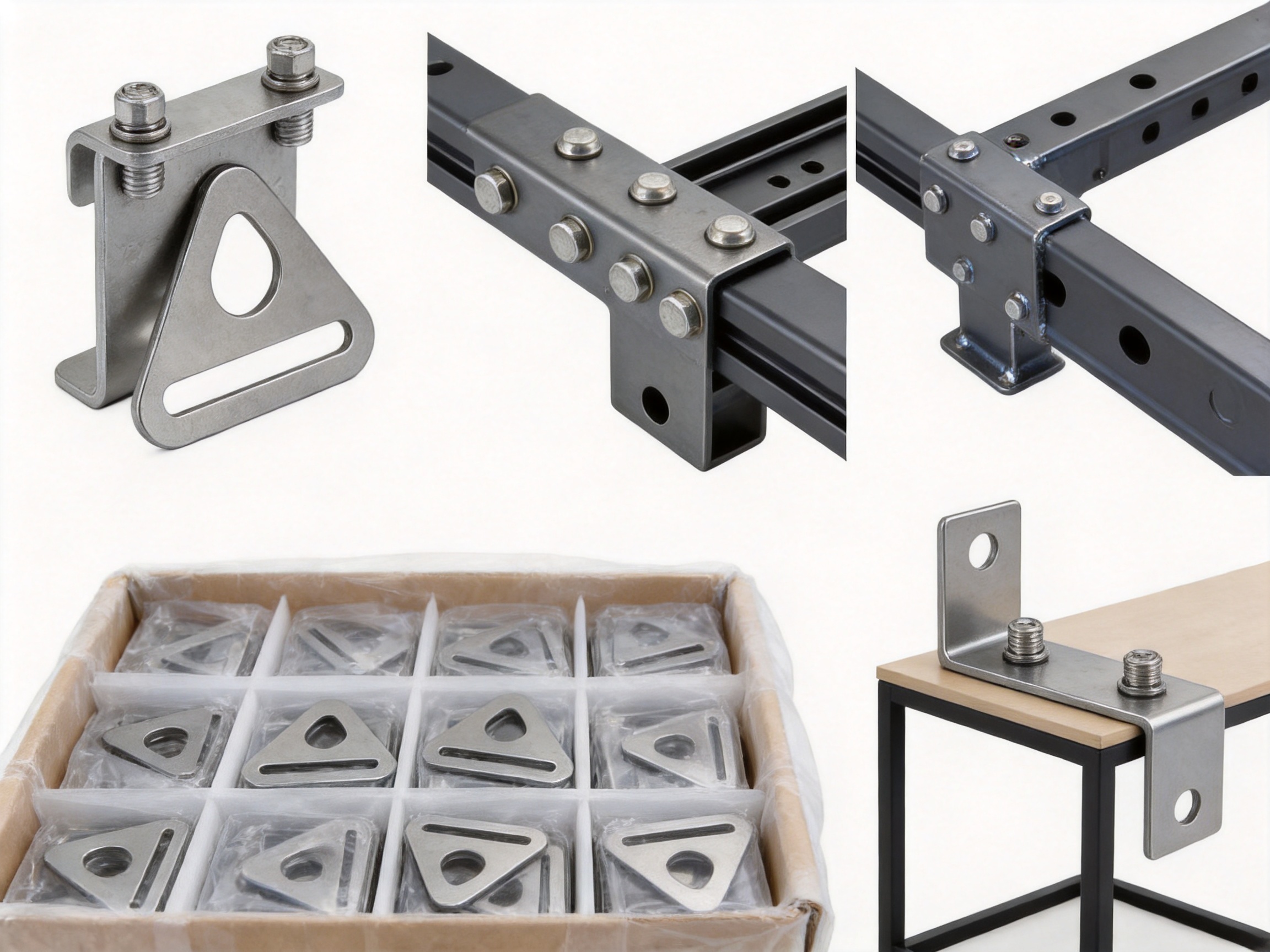
In furniture, triangular reinforcement brackets are commonly used to stabilize corners, connect frames, and improve load capacity. In home tools, compact metal supports and buckles may be used in handles, storage systems, folding structures, or fastening accessories.
The product’s clean finish and controlled geometry are valuable in consumer-facing applications. Sharp burrs, inconsistent angles, or visible corrosion can damage brand reputation. High-quality stamping parts help manufacturers deliver better finished products.
Packaging and Fastener-Related Uses
Packaging hardware and fastening systems often require strong, compact metal parts that can be produced economically. Reinforced triangle buckles may help lock, support, or secure packaging structures. When combined with screws, rivets, or other fasteners, the triangle part can distribute load and reduce local stress.
Because the product belongs to a broader hardware and fastener supply ecosystem, buyers can benefit from supplier experience in screws, machine screws, furniture screws, and related metal components. Understanding how stamped parts interact with fasteners helps improve assembly design.
Quality Control: Ensuring Consistency from Batch to Batch
Quality control is essential for stamping parts because small dimensional variations can affect assembly speed and product performance. A reliable manufacturer uses inspection at multiple stages rather than waiting until the final shipment.
Incoming material inspection verifies that the metal meets thickness, surface, and specification requirements. In-process inspection checks critical dimensions during production, allowing operators to adjust before large quantities are affected. Final inspection confirms that the parts meet drawing requirements, surface expectations, packaging standards, and customer-specific criteria.
For triangle stamping parts, important inspection items include side length, angle accuracy, hole diameter, hole position, bend angle, rib height, material thickness, burr height, surface finish, and overall flatness or form. If the part functions as a buckle, locking dimensions and engagement features must also be checked.
Visual inspection is also important. Scratches, cracks, plating defects, oil stains, deformation, or sharp burrs may affect product usability. When surface treatment is required, corrosion resistance testing such as salt spray testing may be used depending on customer specifications.
Advanced inspection capability gives the product an advantage over cheaper alternatives. Buyers may initially save money with lower-cost parts, but inconsistent quality can lead to assembly downtime, rework, customer complaints, and warranty costs. Stable quality reduces the total cost of ownership.
Customization for Project-Specific Requirements
Many customers require triangle stamping parts that are not available as standard items. Customization may include changing the triangle size, adding holes, modifying angles, adjusting material thickness, adding reinforcement ribs, changing surface finish, or designing a special buckle structure. A capable manufacturer can work from customer drawings, samples, or functional requirements.
Customization begins with understanding the application. The manufacturer may ask where the part will be used, what load it must support, what fasteners will be used, what environment it will face, and what tolerances are critical. These details help determine the best material and process.
For example, a part used in outdoor equipment may require stainless steel or a strong anti-corrosion coating. A part used inside furniture may prioritize cost efficiency and clean appearance. A part used in machinery may require thicker steel and stronger reinforcement. A part used in electronics may require tighter dimensional control and smoother edges.
Tooling can be developed for the specific design. For small prototype quantities, sample tooling or simplified processes may be used. For mass production, progressive dies may be recommended to improve efficiency. After sample approval, production parameters can be stabilized for repeat orders.
The ability to adapt the product to project-specific needs is a major advantage. Instead of forcing customers to accept a standard bracket that may not fit well, the part can be engineered to match the customer’s design intent.
Comparing Stamping with Casting, Machining, and Manual Fabrication
When choosing a metal component, buyers often compare different manufacturing methods. Stamping is not always the only option, but it has clear advantages for triangle parts that require repeatability and volume efficiency.
Casting can produce complex shapes, but it may involve higher weight, surface porosity, dimensional variation, and additional machining. For thin triangular reinforcement components, casting may be unnecessary or inefficient. Stamping can produce thinner, lighter parts with faster cycle times.
CNC machining provides high precision but can be costly for simple sheet-metal geometries, especially at high volume. Machining removes material, creating waste and longer cycle times. Stamping forms and cuts material efficiently, making it more economical for repeat production.
Manual fabrication may be suitable for prototypes or very small quantities, but it is difficult to maintain consistent angles, hole positions, and edge quality across large batches. Labor cost and quality variation can become significant issues.
Stamping offers an effective balance of speed, repeatability, material efficiency, and cost. For reinforced triangle parts, the ability to form ribs, bends, and holes in a controlled process makes stamping especially attractive.
Material and Finish Selection Guide
Selecting the right material and finish is one of the most important decisions in purchasing triangle stamping parts. The best choice depends on environment, strength requirement, budget, appearance, and assembly method.
Stainless Steel
Stainless steel is an excellent option for corrosion resistance and clean appearance. It is suitable for outdoor use, humid environments, food-related equipment, decorative hardware, and applications requiring long-term surface stability. Stainless steel may cost more than carbon steel, but it can reduce maintenance and replacement costs.
Carbon Steel
Carbon steel is cost-effective and widely used. It offers good strength and formability. When combined with zinc plating, powder coating, or other finishes, it can serve many indoor or moderate-environment applications. It is often chosen when cost efficiency and mechanical performance are both important.
Alloy Steel
Alloy steel can provide higher strength and durability. It may be used for demanding machinery, automotive, or structural applications. Depending on the alloy and hardness, forming requirements must be carefully evaluated to prevent cracking.
Galvanized Steel
Galvanized steel provides built-in zinc coating for corrosion resistance. It can be suitable for hardware, furniture, construction accessories, and general industrial use. However, forming may affect the coating at bend areas, so process design and post-treatment may be considered.
Surface Finish Options
Surface finishes should be selected according to both function and appearance. Passivation is useful for stainless steel. Zinc plating is common for carbon steel. Nickel plating can improve appearance and corrosion resistance. Powder coating offers color options and durable surface protection. Black oxide provides a dark finish for certain industrial applications. Polishing can improve decorative quality.
Buyers should avoid selecting a finish based only on appearance. The finish must match the service environment. For example, an indoor decorative finish may not survive outdoor salt exposure. A strong supplier can recommend suitable options based on application conditions.

Packaging, Logistics, and Supply Chain Reliability
Packaging is an often-overlooked part of metal component supply. Triangle stamping parts may have sharp corners, finished surfaces, or precise features that require protection during transportation. Poor packaging can cause scratches, deformation, corrosion, or mixed batches.
Packaging solutions may include bulk packing, layered packing, bags, cartons, pallets, anti-rust paper, plastic separators, or custom labels. The correct method depends on part size, finish, quantity, and destination. Export shipments require packaging that can withstand handling, humidity, vibration, and stacking pressure.
Supply chain reliability is another major purchasing factor. Customers need on-time delivery, clear communication, stable quality, and responsive after-sales support. With a China factory and Thailand warehouse support, the supplier can better serve customers in different regions and support more flexible logistics planning.
For international buyers, communication matters as much as production capability. A supplier familiar with export requirements, drawing communication, packaging standards, and customer-specific inspection documents can reduce procurement risk. This is especially important for custom stamping parts where misunderstandings may lead to tooling errors or production delays.
How Advanced Manufacturing Improves Sustainability
Sustainability in metal parts manufacturing is not limited to using recyclable materials. It also involves reducing waste, improving material efficiency, extending product life, reducing rework, and optimizing logistics. Triangle stamping parts support these goals in several ways.
First, stamping can make efficient use of sheet metal through optimized nesting and progressive die layouts. Less scrap means lower material waste. Second, reinforced geometry can reduce the need for thicker or heavier components. A lighter part uses less material and can reduce shipping weight. Third, durable surface treatment extends service life, reducing replacement frequency.
Quality consistency also supports sustainability. Defective parts waste material, energy, labor, packaging, and transportation. By improving tooling, process control, and inspection, the manufacturer reduces scrap and rework. Long-lasting parts are environmentally preferable because they reduce the need for repeated production and disposal.
For customers with sustainability goals, choosing a well-engineered stamped part can contribute to better material efficiency and more responsible production. The product’s potential to be lighter than conventional alternatives is a meaningful advantage in large-scale manufacturing.
Common Purchasing Considerations
When sourcing triangle stamping parts, buyers should prepare clear requirements to help the manufacturer quote accurately and produce correctly. Important information includes drawings, material grade, thickness, tolerance, quantity, surface finish, packaging method, application environment, and inspection requirements.
If a drawing is not available, a physical sample can be provided. The manufacturer can measure the sample and develop a drawing for confirmation. However, for best accuracy, technical drawings with critical dimensions are recommended.
Buyers should also clarify whether the part is safety-critical, decorative, load-bearing, or used in an environment with corrosion risk. These factors affect material choice, finish, and inspection level. For example, a hidden internal bracket may not require a decorative polish, while a visible consumer product part may need a cleaner surface.
Tooling cost and lead time should be considered. Custom stamping parts usually require tooling, and tooling quality strongly affects long-term production performance. A low tooling price may be attractive, but poor tooling can create quality problems and higher unit costs later.
Finally, buyers should evaluate supplier responsiveness. A good supplier can review drawings, suggest improvements, provide samples, explain production options, and support repeat orders. Technical communication is especially important for custom stamped metal parts.
Why This Triangle Stamping Part Is a Strong Choice
The reinforced triangle stamping part stands out because it combines the strength of triangular geometry with the efficiency of metal stamping. It is not merely a cut piece of metal; it is a functional component designed for stability, alignment, and durability. Reinforcement features improve stiffness, while precise tooling supports repeatable assembly performance.
Compared with competitors that offer basic brackets or low-grade stamped parts, this product emphasizes controlled geometry, durable materials, corrosion-resistant finishing, and customization. These advantages help customers reduce assembly problems, improve product reliability, and manage long-term costs.
The manufacturer’s capabilities in hardware production, fastener-related components, stamping processes, and international supply support further increase the product’s value. By combining engineering review, controlled raw materials, precision tooling, forming technology, finishing, inspection, and proper packaging, the product can meet a wide range of industrial needs.
For buyers seeking dependable metal stamping parts, the reinforced triangle design offers a practical solution. It can serve automotive, electronics, machinery, furniture, home tool, packaging, and fastener-related applications. Whether the requirement is strength, corrosion resistance, lightweight design, clean appearance, or custom geometry, this product provides a strong foundation for reliable assembly.
Q&A Section
Q1: What is the main function of a triangle stamping part?
A triangle stamping part is mainly used to provide reinforcement, support, alignment, or connection in an assembly. Its triangular geometry improves stability and helps distribute force more effectively than many simple flat shapes.
Q2: Why is the triangle shape useful for reinforcement?
The triangle is naturally rigid because its shape resists deformation. When used in a metal part, it helps maintain angles and supports load transfer. Reinforcing ribs, bends, or flanges can further improve strength without greatly increasing weight.
Q3: What materials can be used for reinforced triangle stamping parts?
Common materials include stainless steel, carbon steel, alloy steel, and galvanized steel. The best material depends on strength requirements, corrosion exposure, budget, appearance, and application environment.
Q4: Are stainless steel triangle stamping parts better than carbon steel parts?
Stainless steel offers better natural corrosion resistance and a clean appearance, making it suitable for humid, outdoor, or decorative applications. Carbon steel is often more cost-effective and can perform well when protected with plating or coating. The better choice depends on the specific project.
Q5: Can the part be customized according to drawings?
Yes. Customization can include size, thickness, hole pattern, bend angle, reinforcement ribs, buckle features, material, surface finish, and packaging. Drawings or samples help the manufacturer produce parts that match the customer’s assembly requirements.
Q6: What makes precision stamping better than manual fabrication?
Precision stamping offers better repeatability, faster production, cleaner feature control, and lower unit cost at scale. Manual fabrication may be acceptable for very small quantities, but it is harder to maintain consistent dimensions across large batches.
Q7: How does surface treatment affect product life?
Surface treatment protects the metal from corrosion, improves appearance, and may increase wear resistance. Zinc plating, passivation, nickel plating, powder coating, and other finishes can extend service life when selected correctly for the environment.
Q8: What quality checks are important for this product?
Important checks include material thickness, angle accuracy, hole diameter, hole position, burr height, surface condition, rib height, bend consistency, and overall dimensions. For corrosion-resistant finishes, coating thickness or salt spray testing may also be required.
Q9: Is stamping suitable for high-volume production?
Yes. Stamping is especially suitable for medium- and high-volume production. Once tooling is completed and approved, large quantities can be produced efficiently with consistent quality.
Q10: What information should a buyer provide for quotation?
A buyer should provide drawings or samples, material requirements, thickness, finish, quantity, tolerance requirements, application environment, packaging preferences, and any inspection standards. Clear information helps ensure accurate pricing and production planning.
Practical Design Recommendations
When designing a triangle stamping part, engineers should consider both product function and manufacturing feasibility. The strongest design is not always the thickest design. Often, the best result comes from using the correct material thickness together with ribs, bends, or flanges that increase stiffness efficiently.
Hole placement should be carefully reviewed. Holes located too close to edges or bends may deform during stamping. If the part will be fastened with screws or rivets, the hole size and tolerance should match the fastener system. If the part functions as a buckle, engagement dimensions should be treated as critical.
Bend radii should be suitable for the material. Extremely sharp bends may cause cracking, especially in harder materials. Stainless steel and alloy steel may require different bend allowances from mild carbon steel. Proper bend design improves tool life and product reliability.
Surface finish should be specified clearly. If the part is visible, cosmetic requirements should be defined. If the part is hidden but exposed to corrosion, protective performance may be more important than appearance. If the part contacts plastic, rubber, painted surfaces, or wires, edge smoothness should be emphasized.
Packaging should also be considered during design and purchasing. Parts with sharp points or decorative surfaces may need separators or protective packing. Heavy bulk packing may save cost but can damage finishes or deform thin parts. The right packaging protects both quality and customer satisfaction.
Long-Term Value for Industrial Buyers
Industrial buyers often focus on price, but the best purchasing decision considers total value. A triangle stamping part affects assembly speed, product reliability, warranty risk, inventory stability, and brand reputation. A low-cost part that creates assembly problems is not truly economical.
High-quality triangle stamping parts reduce hidden costs. Accurate holes reduce rework. Stable angles improve assembly speed. Smooth edges reduce handling problems. Corrosion-resistant finishes extend service life. Reliable packaging prevents transportation damage. Consistent supply supports production planning.
For repeat-order customers, tooling stability is especially valuable. Once a die is proven and maintained properly, future batches can remain consistent. This makes long-term cooperation with a capable manufacturer more efficient than frequently switching suppliers based only on small price differences.
In industries such as automotive, machinery, electronics, and hardware, reliability is a competitive advantage. A small component can influence the performance of a complete product. Choosing a better triangle stamping part helps improve the quality of the final assembly.
Conclusion
The reinforced triangle stamping part is a practical, high-value metal component for modern manufacturing. It uses the mechanical strength of triangular geometry, the efficiency of stamping production, and the reliability of controlled materials and finishes. Compared with ordinary brackets, flat plates, cast components, or manually fabricated alternatives, it can offer better stability, lighter weight, cleaner geometry, stronger repeatability, and more cost-effective production at scale.
Its advantages are especially meaningful in automotive, electronics, machinery, furniture, home tool, packaging, and fastener-related applications. With options for stainless steel, alloy steel, carbon steel, galvanized steel, and multiple surface treatments, the product can be adapted to many environments and performance requirements.
Behind the product, advanced manufacturing processes make the difference. Engineering review, material control, precision tooling, stamping, forming, deburring, finishing, inspection, and packaging all contribute to final quality. A manufacturer with strong technical capability and international supply support can help customers reduce risk, improve assembly efficiency, and develop parts tailored to real project needs.
For buyers looking for durable and customizable metal stamping parts, the reinforced triangle design is a strong choice. It provides compact strength, reliable geometry, and long-term value in a form that is simple, efficient, and widely applicable.
References
Boljanovic, Vukota. Sheet Metal Forming Processes and Die Design. Industrial Press.
Kalpakjian, Serope, and Steven R. Schmid. Manufacturing Engineering and Technology. Pearson.
ASM International. ASM Handbook, Volume 14B: Metalworking: Sheet Forming. ASM International.
Groover, Mikell P. Fundamentals of Modern Manufacturing: Materials, Processes, and Systems. Wiley.
Schuler GmbH. Metal Forming Handbook. Springer.
American Iron and Steel Institute. Design Guidelines for the Selection and Use of Stainless Steels.
Society of Manufacturing Engineers. Tool and Manufacturing Engineers Handbook: Forming. SME.