
A dependable screwdriver is one of the most useful tools in a home, workshop, maintenance kit, furniture assembly station, or professional service bag. Although a traditional single-bit screwdriver can complete one type of fastening task, modern users often need greater flexibility. Furniture hardware, household appliances, electrical covers, cabinets, toys, bicycles, fixtures, and general maintenance projects may use different screw head sizes and patterns. Carrying a separate tool for every requirement can make a toolbox heavy, expensive, and difficult to organize.
The six-in-one manual screwdriver cross screwdriver is designed to solve this problem with a compact and convenient format. It combines multiple screwdriver functions in one practical hand tool, allowing users to change between commonly required configurations without carrying a large collection of individual screwdrivers. The result is a versatile solution for homeowners, installers, maintenance personnel, furniture assemblers, hardware retailers, and professional users who value portability and working efficiency.
This article examines the product’s design advantages, practical applications, user benefits, manufacturing considerations, quality-control requirements, and supply strengths. It also explains why a well-designed multi-function screwdriver can provide better value than several basic single-purpose tools while remaining easy to use, store, package, and distribute.
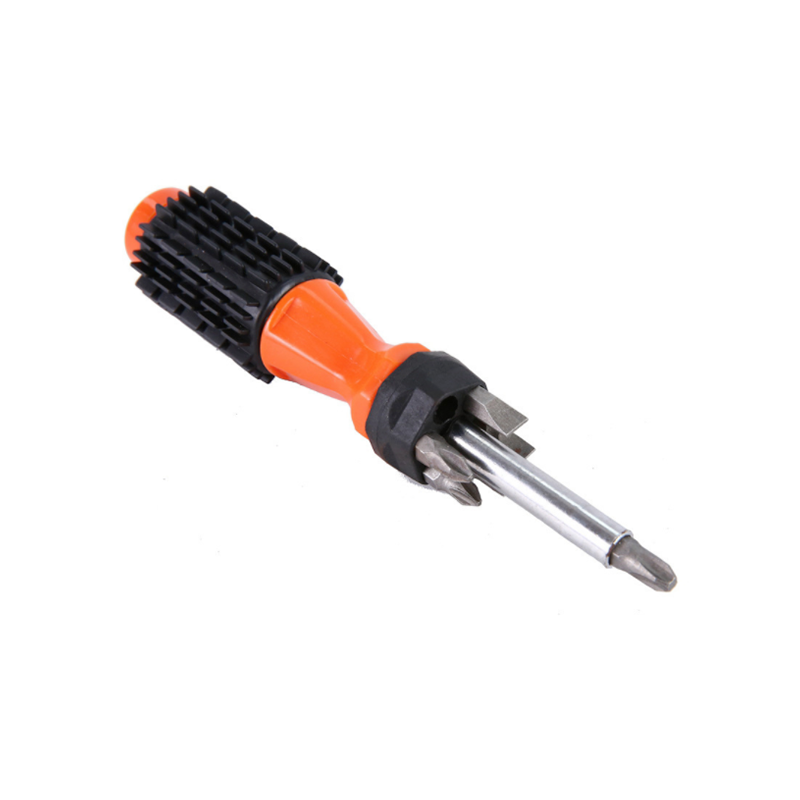
Six in one manual screwdriver cross screwdriver
1. Understanding the Six-in-One Screwdriver Concept
The term “six-in-one” refers to the tool’s ability to support six screwdriver functions within one manual screwdriver format. In most designs, the functions are provided through interchangeable or reversible driver components, with each working end intended for a specific screw type or size. A cross screwdriver generally refers to a Phillips-style driver, although a multi-function model may also include other commonly used profiles depending on the configuration.
The main idea is simple: one handle and a compact set of working ends can replace several separate tools. This design is especially useful when the user must move between different fasteners during one project. Instead of returning to a toolbox several times, the operator can select the appropriate driver end, fit it into the handle, and continue working.
A multi-function screwdriver is not merely a smaller version of a conventional screwdriver set. Its value comes from the integration of storage, handling, interchangeability, and working performance. The handle must provide a secure grip, the driver components must fit accurately, and the complete tool must be easy to use without unnecessary adjustment. When these elements are correctly coordinated, the product offers both convenience and practical reliability.
Compact organization
Traditional screwdriver sets often contain numerous individual handles, each occupying space in a toolbox or retail package. A six-in-one model reduces this storage burden by combining several functions into a single product. It can be placed in a drawer, tool pouch, vehicle compartment, repair cabinet, or household emergency kit.
Compact organization is particularly important for installers and maintenance workers who travel between locations. A lightweight, organized tool can help reduce preparation time and make it easier to keep essential equipment available. For home users, the advantage is equally clear: the screwdriver is easy to store and less likely to become separated from its accessories.
Fast function changes
Many fastening jobs involve more than one screw. A cabinet may use different screw sizes for hinges, handles, panels, and internal brackets. A household repair may involve a cover screw and a mounting screw with different heads. A multi-function tool allows the user to change working ends instead of searching for another complete screwdriver.
This convenience can improve the rhythm of work. The user can keep the handle in hand, select the required driver component, and continue the task. While the exact changing method depends on the product configuration, a well-made design should make the process intuitive and secure.
Reduced carrying cost
For distributors, retailers, and end users, a combined tool may provide better value than purchasing several separate screwdrivers. One product can cover several routine fastening requirements, making it attractive for consumers who want practical functionality without a large investment in a professional tool collection.
For wholesale customers, the six-in-one format can also be suitable for hardware stores, home improvement retailers, furniture suppliers, promotional tool packages, maintenance kits, and general merchandise programs. Its broad application range gives it the potential to appeal to multiple customer groups.
2. Product Advantages Over Conventional Single Screwdrivers
The most important competitive advantage of a six-in-one manual screwdriver is functional coverage. A conventional screwdriver is limited to one working profile and, in many cases, one size. If the screw does not match that profile, the user must obtain another tool. The six-in-one format offers a more flexible response to common fastening situations.
| Feature | Single-Purpose Screwdriver | Six-in-One Manual Screwdriver |
|---|---|---|
| Number of functions | Usually one function per handle | Multiple functions integrated into one tool |
| Storage requirement | Several handles may be required | More compact and easier to organize |
| Portability | Less convenient when several tools are needed | Suitable for toolboxes, drawers, pouches, and travel kits |
| Task flexibility | Limited to matching fasteners | Supports a broader range of routine fastening work |
| Purchase value | Separate tools may increase total cost | One product can cover several common requirements |
| Retail appeal | Basic and specialized positioning | Convenience-focused and easy to understand |
Better use of limited space
A toolbox is often filled with items that are useful but not frequently used. The six-in-one screwdriver helps users make better use of available space. It may replace multiple basic tools while still offering several useful configurations. This is valuable in apartments, workshops, service vehicles, dormitories, offices, and small retail maintenance rooms where storage space is limited.
Convenience for occasional users
Professional tradespeople may own complete tool systems, but occasional users often want one practical product for common household tasks. They may not know the exact screwdriver type needed before beginning a project. A multi-function product gives them a wider range of options without requiring specialized knowledge or a large initial purchase.
This makes the product suitable for assembling furniture, tightening loose hardware, installing handles, repairing cabinets, opening small equipment covers, adjusting household fixtures, and performing routine maintenance. It is a useful addition to a general-purpose tool kit rather than a product limited to one industry.
Improved purchasing clarity
Product selection can be confusing when a customer must choose between numerous screwdriver sizes and profiles. A clearly presented six-in-one product is easier to understand: one tool provides multiple commonly used functions. The value proposition can be communicated quickly on packaging, product displays, e-commerce listings, and wholesale catalogs.
For retailers, easy communication is a commercial advantage. Products that are simple to explain often require less sales support and can attract customers who are looking for an immediate solution. The product’s compact format also supports hanging display, boxed packaging, blister packaging, or inclusion in a larger hardware assortment.
3. Practical Design Features
The performance of a manual screwdriver depends on more than the number of included functions. The handle, driver components, connection area, surface finish, dimensions, and packaging all influence the user experience. A successful six-in-one product should balance versatility with straightforward operation.
Ergonomic handle design
The handle is the primary contact point between the user and the tool. It should be comfortable enough for repeated turning while providing sufficient control for tightening and loosening. A suitable shape can reduce hand fatigue, support better alignment with the screw, and make it easier to apply controlled force.
Common ergonomic considerations include rounded edges, a stable central grip, a profile that fits the palm, and surfaces that help reduce slipping. The handle should also be easy to clean and resistant to ordinary workshop contact. If the tool is intended for general household and hardware use, its design should be approachable for users with different levels of experience.
Secure component retention
Interchangeable driver components must remain securely connected to the handle during use. A loose connection can reduce control, damage the fastener, or create an uncomfortable working experience. The connection system should therefore be designed for stable engagement while still allowing the user to change functions without excessive effort.
Accurate dimensions are essential in this area. The handle opening, driver shaft, retention feature, and contact surfaces must work together consistently. Manufacturing tolerances should be controlled so that the components fit correctly across the production batch.
Useful driver profiles
The product’s six functions should be selected to reflect common customer requirements. Cross-head screwdrivers are widely used in furniture, appliances, electronics housings, household hardware, and general assembly. Additional driver ends may be selected according to the intended market, product version, or customer specification.
The most important consideration is not simply the number six. The functions must be useful, recognizable, and suitable for the applications promoted by the product. A well-planned configuration improves customer satisfaction because users can immediately understand how the tool supports their daily tasks.
Balanced size and portability
A compact tool should remain large enough to provide comfortable handling. If the handle is too small, users may struggle to apply turning force. If it is too large, the product may lose its portability advantage. A balanced design allows the product to fit conveniently into a toolbox while still providing a practical grip.
Product dimensions can also influence packaging efficiency. A well-organized six-in-one tool can reduce packaging volume, improve carton utilization, and simplify warehouse handling. These benefits may be important for distributors managing transportation costs and retail shelf space.
4. Applications in Homes, Furniture, and Maintenance
The six-in-one manual screwdriver is suited to a broad range of non-powered fastening tasks. It can be used wherever a compatible screw requires manual turning and where the user benefits from having several driver options in one product.
Furniture assembly
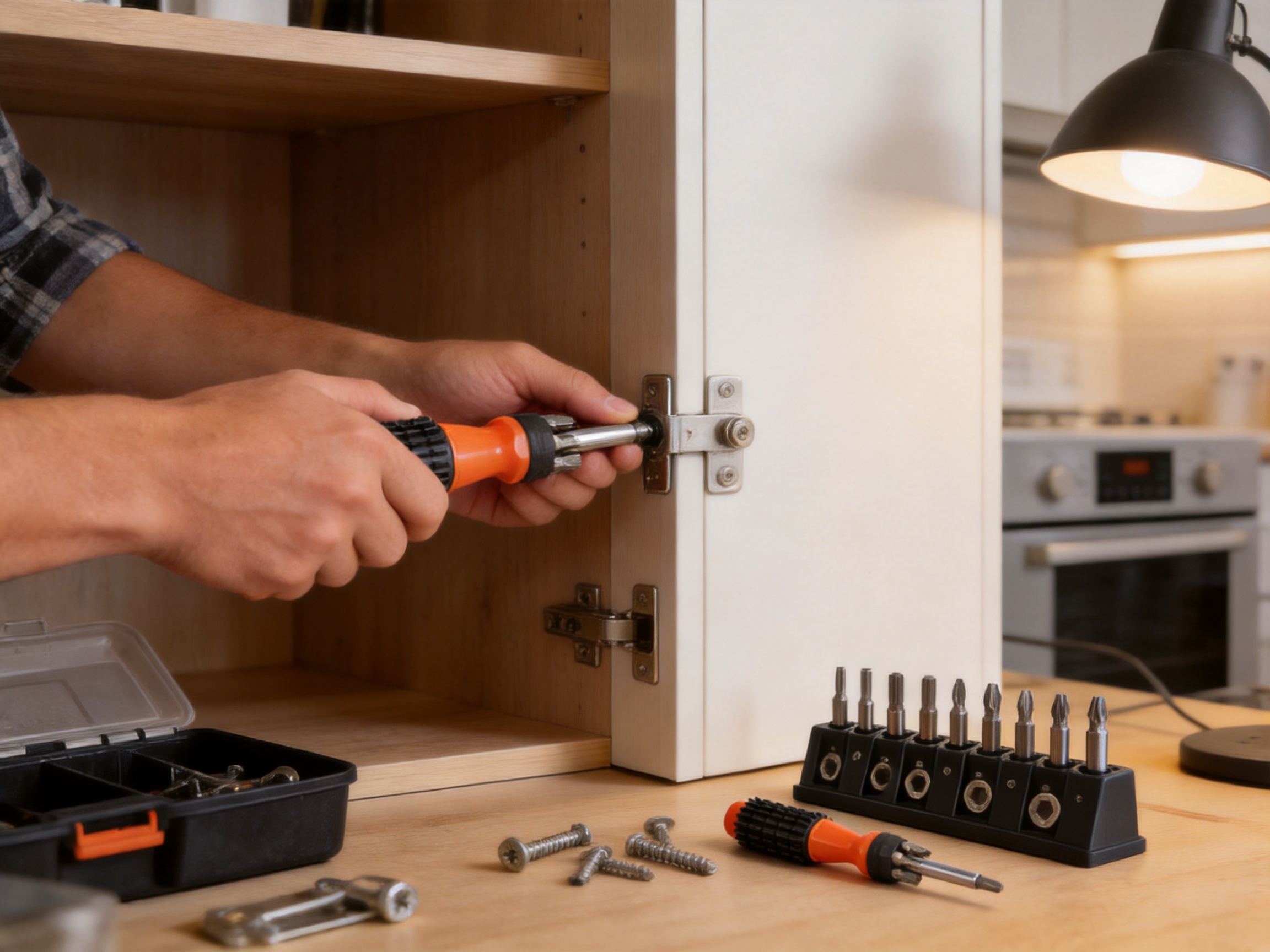
Furniture assembly is one of the most natural applications. Flat-pack furniture frequently includes screws, brackets, hinges, handles, connector plates, and adjustment hardware. Different components may use different screw heads or sizes, and assembly instructions may require the installer to change tools several times.
A six-in-one screwdriver simplifies the process by keeping the necessary options together. It is suitable for assembling cabinets, shelves, tables, chairs, storage units, desks, beds, and other household furniture. It can also be useful after assembly when a user needs to tighten a loose handle or adjust a hinge.
Household repairs
Homes contain many fastened components, including switch covers, cabinet hardware, door plates, drawer runners, appliance panels, toys, lamps, and decorative fixtures. A compact multi-function screwdriver is convenient for routine maintenance because it can be stored where it is easy to access.
For occasional repairs, the product may prevent the need to purchase a new specialized tool for every task. It is a practical choice for homeowners, renters, property managers, and building maintenance teams who need a general-purpose manual solution.
Workshop and craft projects
Small workshops and hobby areas often require frequent adjustments and assembly work. Model building, woodworking accessories, craft fixtures, repair projects, and DIY upgrades may use a variety of small screws. A multi-function screwdriver allows users to keep the work area organized and reduce interruptions.
Because the product is manually operated, it can also offer greater control for delicate tasks than a powered tool. The user can feel the resistance of the screw and stop when the fastener is properly seated. This is useful when working with softer materials or smaller components that could be damaged by excessive torque.
Retail and service kits
The product can be included in maintenance kits, starter tool sets, furniture delivery packages, hardware assortments, and promotional bundles. Its broad application range makes it suitable for both consumer-facing and business-to-business programs.
For service providers, the screwdriver can serve as a compact backup tool. For retailers, it can be positioned as a practical everyday item. For furniture suppliers, it can be supplied with installation materials or offered as an accessory. These multiple sales channels can help reduce dependence on a single market segment.
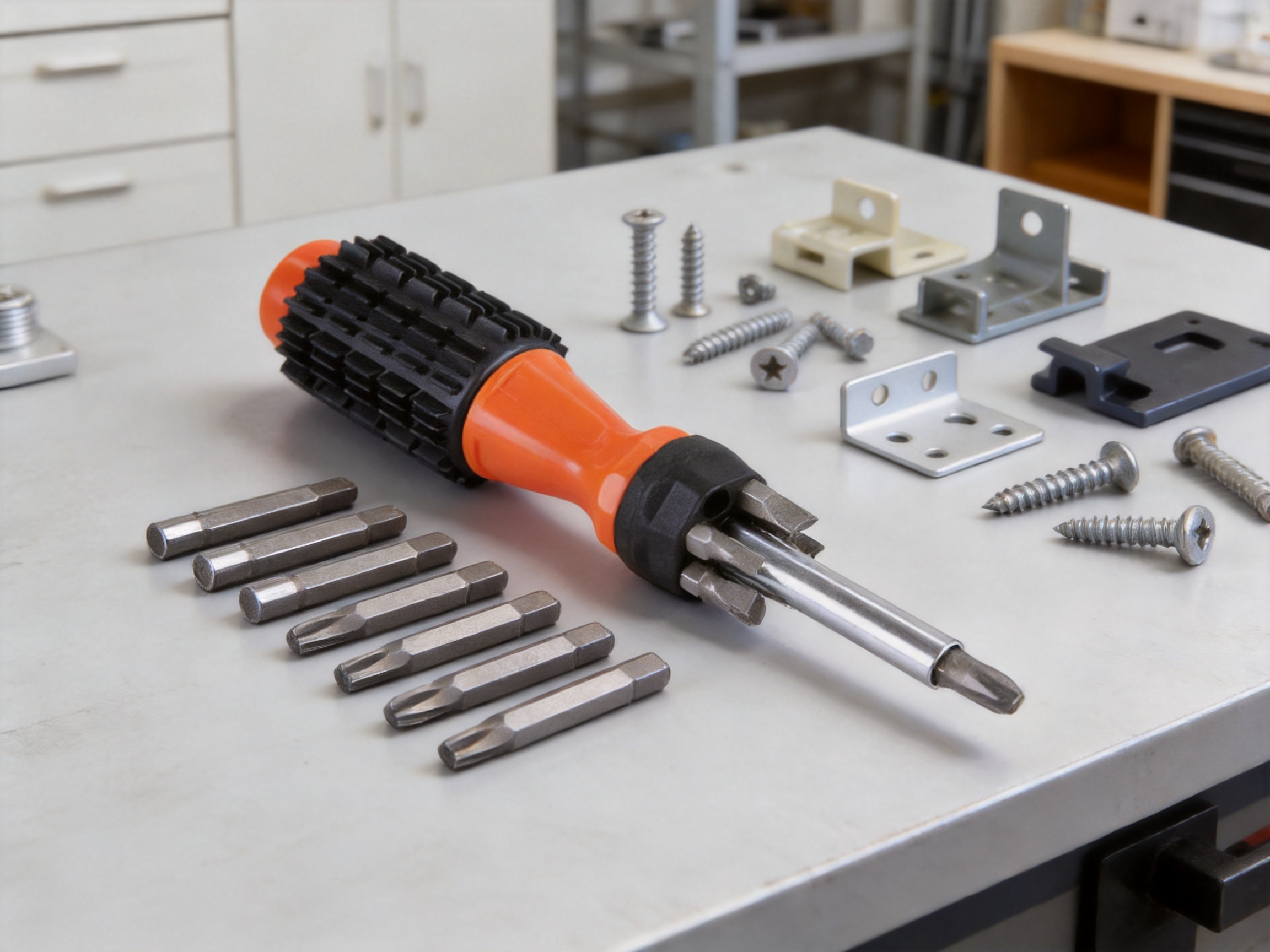
5. Materials, Manufacturing, and Engineering Considerations
A reliable multi-function screwdriver begins with appropriate material selection and controlled manufacturing. The product includes several parts that must work together: the handle, driver shafts or bits, connection features, surface treatments, and packaging components. Each part contributes to the tool’s function, appearance, durability, and commercial value.
Driver component production
Driver components require accurate forming, machining, or shaping so that the working end matches the intended screw profile. The tip must engage the fastener correctly. Poorly formed tips may slip, damage the screw head, or make the tool uncomfortable to use. Consistent geometry is therefore a key quality requirement.
Depending on the product specification, driver components may involve cutting, forming, grinding, heat treatment, surface finishing, and dimensional inspection. The manufacturing route should be selected according to the required performance, production volume, material characteristics, and customer expectations.
Handle production
The handle may be produced through molding, assembly, or a combination of processes. Tooling must be designed to achieve consistent shape, stable dimensions, and a clean surface finish. The grip area should be comfortable and free from sharp edges, flash, sink marks, or other defects that could affect user acceptance.
Color, texture, marking, and packaging presentation can be adapted for different customer programs. Retail customers may request a highly visible color scheme, while industrial buyers may prioritize simple identification and durable labeling. Flexible manufacturing and product-development support allow the same basic concept to serve different markets.
Stamping and precision hardware capabilities
Stamping is an important manufacturing process for many hardware products and related components. It can be used to produce consistent metal parts at efficient production rates when the tooling and process parameters are properly controlled. Stamping capabilities can support the wider product range associated with fasteners, furniture hardware, package components, and other metal parts.
For a multi-function screwdriver, stamping and precision metalworking knowledge may contribute to the production of internal clips, retention components, brackets, sleeves, or packaging-related parts, depending on the final design. The ability to coordinate metal forming, machining, assembly, and finishing is valuable because it reduces dependence on disconnected supply channels.
Process engineering
Advanced manufacturing is not limited to the use of modern machines. It also includes process planning, tooling control, work instructions, inspection standards, production scheduling, and continuous improvement. A strong manufacturing partner evaluates each stage from raw material receipt to final packing.
Process engineering can identify possible causes of variation before mass production begins. These may include dimensional changes during forming, inconsistent insertion force, surface damage, component mismatch, or packaging movement during transportation. Preventive planning improves production stability and reduces avoidable rework.
6. Quality Control for a Six-in-One Manual Screwdriver
Quality control should cover both the individual parts and the complete assembled product. Because the product contains several interchangeable functions, inspection must confirm that every component is usable and that the set is complete.
Incoming material inspection
Materials and purchased components should be checked before entering production. Inspection may include appearance, dimensions, material identification, surface condition, and quantity verification. Incoming control helps prevent unsuitable parts from moving into assembly and reduces the risk of large-scale defects.
Dimensional inspection
Critical dimensions affect fit, function, and interchangeability. Driver length, shaft diameter, connection dimensions, tip geometry, handle opening, and component seating should be checked against approved specifications. Inspection frequency may be adjusted according to production volume, process stability, and customer requirements.
Assembly inspection
During assembly, operators should confirm that the correct parts are installed in the correct configuration. A six-in-one product must contain the required number of working functions, and each component should be retained appropriately. Visual inspection can identify missing parts, incorrect orientation, surface defects, and assembly damage.
Functional testing
Functional testing is particularly important because appearance alone cannot confirm performance. Sample tools can be tested for component insertion, removal, retention, turning action, alignment, and engagement with representative fasteners. The objective is to ensure that the tool works as intended under normal manual use.
Testing should reflect the product’s actual application. It should not claim performance beyond the intended use. A manual screwdriver is designed for suitable hand-operated fastening tasks, not for unlimited force, impact use, or powered-tool operation unless specifically engineered and labeled for those purposes.
Packaging and final inspection
Final inspection should confirm product quantity, packaging accuracy, labeling, appearance, and carton condition. Packaging must protect the tool from scratches, loss of components, moisture exposure, and movement during transportation. Correct packaging also helps retailers present the product professionally.
| Quality-Control Stage | Primary Purpose | Typical Inspection Focus |
|---|---|---|
| Incoming inspection | Confirm suitable materials and components | Material condition, dimensions, quantity, appearance |
| In-process inspection | Control manufacturing consistency | Forming accuracy, surface quality, assembly fit |
| Functional inspection | Verify practical operation | Insertion, retention, alignment, turning performance |
| Set completeness inspection | Ensure all six functions are included | Component count, correct configuration, identification |
| Final inspection | Approve finished goods for shipment | Packaging, labeling, appearance, carton condition |
7. Manufacturing Strengths and Supply Support
A product such as the six-in-one manual screwdriver benefits from a manufacturer that understands both finished tools and the wider hardware industry. Experience with fasteners, stamping parts, home tools, packaging, and related metal products can support more efficient product development and production coordination.
Integrated product understanding
When a manufacturer works across several hardware categories, it can better understand how tools are used alongside screws, furniture fittings, brackets, and other components. This broader perspective is useful when developing a product for a particular market or application. The manufacturer can consider not only the tool itself but also the fasteners it is expected to operate.
This knowledge may help customers choose appropriate driver configurations, packaging formats, labeling approaches, and product positioning. It can also make communication easier during sampling and specification review.
China production and Thailand warehouse support
A manufacturing structure that includes a China factory and a Thailand warehouse can provide supply-chain flexibility. Production in China can support manufacturing efficiency, engineering coordination, tooling management, and access to established hardware resources. A regional warehouse in Thailand can support local stock handling, distribution planning, and service for customers operating in Thailand or nearby markets.
Warehouse support does not replace the importance of production quality, but it can improve order coordination and shorten certain logistical steps. Customers may benefit from clearer shipment planning, better regional inventory management, and more flexible distribution options depending on order size and destination.
Customization potential
Hardware buyers often require product adjustments for different customer groups. These adjustments may include handle color, surface marking, logo placement, packaging type, barcode information, set configuration, carton quantity, and instruction materials. A capable manufacturer should be able to review such requirements before production and identify which changes affect tooling, cost, lead time, or minimum order quantity.
Customization should be managed carefully. Clear drawings, approved samples, written specifications, and pre-production confirmation help ensure that the final product matches the customer’s expectations. Strong communication is especially important for multi-component products because a small change in one part can influence the fit of the complete set.
Production planning and order reliability
For wholesale customers, consistent delivery is as important as product quality. Production planning should account for raw materials, tooling availability, assembly capacity, inspection schedules, packaging supply, and shipping requirements. A structured production system helps reduce unexpected delays and supports repeat orders.
Repeatability is a major advantage for distributors. Once a product specification has been approved, future orders should maintain the same basic performance, appearance, component count, and packaging arrangement unless a formal change is requested. This consistency supports customer confidence and reduces the need for repeated product evaluation.
8. Advantages for Wholesale Buyers and Retailers
The six-in-one manual screwdriver has several characteristics that can make it attractive to business buyers. Its practical purpose is easy to understand, its target market is broad, and its compact size can simplify storage and display.
Broad customer appeal
The product can be marketed to homeowners, renters, students, office workers, furniture assemblers, maintenance teams, DIY users, workshops, and general hardware consumers. This broad audience gives retailers flexibility in product placement. It may be displayed in hand-tool sections, home improvement aisles, furniture accessory areas, repair kits, or seasonal promotional displays.
Efficient shelf usage
Retail space is limited, particularly for small hardware stores and convenience-oriented home improvement outlets. A compact multi-function tool can provide several customer benefits while occupying less shelf space than a larger group of separate tools. Its packaging can communicate the number of functions, application range, and convenience advantage at a glance.
Suitable for private-label programs
The product format may be appropriate for private-label and custom-brand programs. Buyers can discuss their desired handle appearance, package design, labeling, and sales channel requirements with the manufacturer. A private-label approach can help distributors develop a consistent tool range under their own market identity.
Successful private-label programs require careful control of approved artwork, product samples, packaging materials, and inspection standards. The manufacturer’s ability to manage these details contributes directly to the buyer’s brand reputation.
Potential for bundled sales
The screwdriver can be bundled with furniture hardware, screw assortments, wall-mounting kits, household repair packs, or DIY project materials. Bundling increases convenience for the customer and may raise the practical value of the overall package. It also creates opportunities for distributors to design application-specific solutions rather than selling an isolated tool.
9. Safe and Effective Use
Although a manual screwdriver is simple to operate, correct use is important for user safety and product life. The user should select the driver end that matches the screw head as closely as possible. The tool should be aligned with the screw axis before turning. Applying force while the tool is at an angle can cause slipping, damage to the fastener, or unnecessary wear on the driver tip.
The user should apply steady manual pressure and avoid using the screwdriver as a pry bar, chisel, punch, or lever. The tool should not be struck with a hammer unless the specific model is expressly designed for impact use. It should also not be attached to a powered driver unless the manufacturer has clearly approved that application.
Before use, the operator should check that the selected component is properly seated in the handle. If the connection feels loose, the tool should not be used until the issue has been corrected. Damaged, bent, cracked, or heavily worn components should be replaced rather than forced into service.
Proper storage also helps preserve performance. The tool should be kept clean and dry, away from corrosive chemicals and excessive heat. If the product is used in a workshop or outdoor environment, dirt and moisture should be removed after use. These basic practices help maintain the appearance and function of the screwdriver.
10. Packaging, Presentation, and Distribution
Packaging plays an important role in protecting a multi-component product. The driver ends must remain together with the handle so that the customer receives a complete six-in-one set. Internal movement should be minimized, and the package should be strong enough for normal handling during warehouse operations and transportation.
Clear product communication
Packaging should communicate the product’s primary advantages without creating confusion. Important information may include the six-in-one configuration, suitable general applications, basic usage guidance, material information where applicable, and care instructions. A clear layout helps customers recognize the product quickly.
Retail packaging should also show how the components are stored or connected. If the changing process is not immediately obvious, a simple visual guide or short instruction can improve the user experience. For wholesale and industrial packaging, the emphasis may be placed on quantity, labeling, carton identification, and efficient handling.
Protection during shipment
Multi-function products can be damaged if components move freely inside a carton. Packaging design should reduce impact between metal parts and protect visible surfaces from scratching. Carton dimensions should be selected to balance protection with transportation efficiency.
For international shipments, customers should review packing requirements, moisture protection, carton markings, pallet arrangements, and destination regulations. Proper preparation at the factory can reduce receiving problems and improve warehouse efficiency.
Inventory management
A compact product is generally easy to store, but inventory control remains important. Each product version should have a clear item code, configuration record, packaging specification, and approved sample. If several handle colors or packaging versions are offered, separate identification helps prevent mixed shipments.
Regional warehouse support may allow customers to keep stock closer to their sales market. This can be useful for retailers who need smaller replenishment quantities or faster access to regular products. Inventory strategies should be developed according to demand patterns, lead times, seasonal sales, and customer commitments.
11. How This Product Creates Long-Term Value
The value of a six-in-one screwdriver is not limited to the first fastening task. Its long-term usefulness comes from repeated availability. A homeowner may use it for furniture assembly today, a cabinet adjustment next month, and a household repair later in the year. Because the product remains compact and easy to store, it is likely to be retained as part of a general tool collection.
For professional users, the product can serve as a convenient secondary tool or a compact option for tasks that do not justify carrying a complete tool case. For retailers, its broad appeal can support steady demand across different customer categories. For distributors, the product may complement a wider range of screws, fasteners, stamping parts, and home tools.
Long-term value also depends on consistent manufacturing. A product that looks attractive but has inconsistent fit or poor component retention may create returns and damage customer confidence. By contrast, controlled production, accurate inspection, suitable packaging, and responsive supply support can help transform a basic tool concept into a dependable commercial product.
12. Recommended Evaluation Checklist for Buyers
Before placing a wholesale or customized order, buyers should review the product specification carefully. The following points can help confirm whether the product is appropriate for the intended market.
Function configuration
Confirm the exact six functions included in the set. Check the driver profiles, sizes, component lengths, and intended applications. The selected configuration should match the fasteners commonly used by the target customers.
Handle and connection quality
Evaluate the handle shape, grip comfort, surface finish, component retention, and ease of changing driver ends. Samples should be tested by more than one user when possible, because comfort and handling preferences can vary.
Appearance and customization
Review available colors, markings, logos, packaging formats, labels, barcodes, and instruction materials. Confirm which elements are standard and which require customized tooling or minimum order quantities.
Inspection and documentation
Ask for the applicable quality standards, inspection procedures, approved drawings, sample requirements, and shipment documentation. Clear records are especially important when the product will be sold under a private label or supplied to multiple retail locations.
Supply and logistics
Discuss production capacity, lead time, order quantity, carton packing, warehouse options, shipping arrangements, and repeat-order procedures. A product can only create commercial value when it is available in the right quantity and at the right time.
13. Questions and Answers
What is a six-in-one manual screwdriver?
It is a compact hand tool that combines six screwdriver functions in one product. The functions are normally provided through interchangeable or reversible driver components, allowing the user to work with several compatible screw types or sizes.
Is the product suitable for furniture assembly?
Yes. The tool is suitable for many routine furniture assembly tasks, including installing handles, tightening brackets, fitting hinges, and securing panels, provided that the driver profile matches the supplied fasteners.
How is it different from carrying six separate screwdrivers?
The six-in-one model combines several functions into one organized product. It generally requires less storage space, is easier to carry, and can reduce the number of separate handles that a user must purchase and manage.
Is a manual screwdriver better than a powered driver?
Neither tool is universally better. A powered driver can provide speed for repetitive work, while a manual screwdriver offers direct control, portability, and convenience for smaller or more delicate tasks. The six-in-one manual model is especially useful when the user needs a compact tool for occasional or controlled fastening.
Can the screwdriver be used as a pry bar or chisel?
No. It should be used only for suitable manual fastening tasks unless the manufacturer specifically states otherwise. Using it as a lever, chisel, punch, or impact tool can damage the product and create a safety risk.
What should the user do if a driver component feels loose?
The user should stop working and check whether the component is correctly inserted and retained. If it remains loose or appears damaged, it should not be used until the issue has been resolved.
Can the product be customized for a private-label program?
Customization may be possible for elements such as handle color, surface marking, packaging, labeling, set presentation, and carton quantity. The exact options, minimum order requirements, tooling needs, and production schedule should be confirmed before order approval.
What quality checks are important for this product?
Important checks include driver-tip geometry, component dimensions, handle quality, connection security, set completeness, functional operation, surface condition, packaging accuracy, and final appearance.
Why is manufacturing experience in related hardware categories useful?
Experience with fasteners, stamping parts, home tools, packaging, and other hardware products can help a manufacturer understand material selection, metal forming, assembly, inspection, and supply-chain coordination. This broader knowledge can support more effective product development and production management.
Is the product suitable for professional tradespeople?
It can be useful as a compact general-purpose tool, service backup, or accessory for routine work. Professional users should select the product according to the required screw types, working conditions, torque expectations, and safety requirements.
14. Final Assessment
The six-in-one manual screwdriver cross screwdriver is a practical response to a common problem: users need several fastening options but do not always want to carry or purchase several separate tools. Its compact format, interchangeable functions, broad application range, and simple operation make it suitable for homes, furniture assembly, workshops, maintenance kits, retail programs, and wholesale hardware distribution.
Its advantages over conventional single-purpose screwdrivers include better portability, improved organization, broader task coverage, easier retail communication, and potentially better overall purchase value. However, these benefits depend on accurate component fit, comfortable handling, reliable retention, suitable driver geometry, and consistent manufacturing quality.
For buyers, the product becomes more attractive when supported by a manufacturer with experience in hardware production, stamping, fasteners, tools, packaging, and supply coordination. Controlled tooling, process engineering, inspection, assembly management, packaging protection, and regional logistics support can all contribute to a more reliable customer experience.
When correctly designed and responsibly manufactured, the six-in-one screwdriver is more than a basic hand tool. It is a compact maintenance solution that helps users work efficiently, keep their equipment organized, and respond to a wider range of everyday fastening needs with one convenient product.
References
1. General principles of manual hand-tool design, including grip comfort, force control, and user handling.
2. Standard practices for screwdriver tip geometry, fastener engagement, and dimensional inspection.
3. Industrial guidance on metal stamping, forming accuracy, tooling maintenance, and process control.
4. Quality-management principles for incoming inspection, in-process inspection, final inspection, and product traceability.
5. Packaging engineering practices for protecting small hardware products during warehouse handling and transportation.
6. General workplace guidance for the safe use, storage, and maintenance of non-powered hand tools.
7. Retail merchandising principles for compact home-improvement tools and multi-function hardware products.
8. Supply-chain planning practices for factory production, regional warehousing, inventory control, and wholesale distribution.