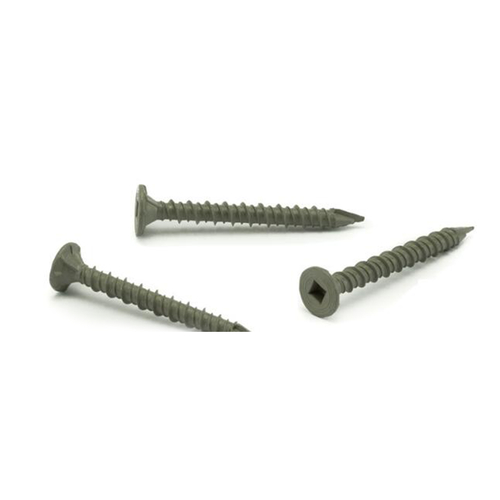
An order for 50,000 fasteners can stall on the shape of a screw tip. A buyer writes "self-tapping screw, 4.8 x 25 mm, zinc plated" on a specification sheet for a metal roofing project. The factory ships exactly that: a sharp-point screw with cutting threads. On site, the crew finds it will not bite into a 3.0 mm purlin without a pilot hole, and the installers spend a morning drilling holes by hand.
That is the practical difference. A self-drilling screw — often called a Tek screw — carries a small drill point with cutting edges that bores its own hole in metal before the threads engage. A self-tapping screw has a sharp, tapered point and cutting threads that form their own mating threads, but it needs a pilot hole or a punched hole to start in.
Everything downstream follows from that geometry: installation steps, labor hours per panel, maximum material thickness, driver torque settings, and the price per thousand pieces a distributor should expect to pay for each.
Quick rule of thumb: if the crew drills or punches first, you are buying a tapping screw. If the screw drills its own hole as it goes in, it is self-drilling.
Removing Material vs. Forming Threads
Both families belong to the same broad group of thread-forming fasteners, which is why the language gets muddy. In North America, "self-tapping" usually means a screw that needs a pilot hole. In parts of Europe and the UK, "self-tapping screw" is the generic term for any screw that cuts its own thread in metal — including self-drilling types. A specification that says only "self-tapping" leaves the point style open, and that is where orders go wrong.
A self-drilling screw does two jobs in sequence. The point, with its cutting edges and flutes, removes material and creates a hole. Then the threads engage the wall of that hole and cut their own path. A self-tapping screw does only the second job: its threads cut into the wall of a hole that already exists.
That missing step explains why a self-drilling screw usually costs more per piece. There are more features to form, tighter tolerances on the point, and a case-hardening process that must leave a hard skin on a tip that also has to survive bending. The extra cents are normally repaid in the first hour of installation.
Point Geometry, Pilot Holes, and Thickness Limits
Looking at the two screws side by side makes the trade-off clear. The table below compares the variables that matter when you write a purchase order.
| Feature | Self-tapping screw | Self-drilling screw |
|---|---|---|
| Point | Sharp and tapered, with cutting threads or flutes | Drill-shaped point (Tek #1 to #5) with cutting edges |
| Pilot hole | Required in metal; roughly 80 percent of major diameter as a starting point | None; the screw drills its own hole |
| Best substrates | Thin sheet metal, plastics, wood, pre-drilled plate | Steel sheet and studs, roofing panels, ductwork, wood-to-steel |
| Thickness rule | Aim for at least three full threads of engagement | Combined material thickness must not exceed drill point length |
| Installation | Two steps: drill, then drive | One step: drive |
| Typical failure | Stripped threads in an oversized hole | Spun point in thick material, or snapped shank |
These are starting points for a specification, not a substitute for test data on the actual substrate and torque setting.
Where Each Type Earns Its Keep
Self-drilling: roofing, steel framing, and ductwork
When a cladding panel is fastened to a steel purlin, or a duct section to a hanger bracket, the drill point passes through both layers in one motion. A hex washer head with an EPDM washer seals the penetration so water does not track along the thread. Buyers ordering for these jobs should list the point number, head style, washer, and coating as separate line items, because changing any one of them changes how the crew installs it.
Self-tapping: thin sheet, plastics, and pre-drilled assemblies
Inside an enclosure, a junction box, or an appliance panel, the material is often 0.5 to 1.2 mm steel with a punched hole. A self-tapping screw with a wafer or pan head cuts its own threads in that hole and sits low against the surface. The same logic applies to plastic bosses and to wood, where a pilot hole prevents splitting. When hole size drifts — a worn punch, an oversized drill — the thread has less material to bite and the joint strips at lower torque. Our guide on choosing between self-tapping and drilling screws for sheet metal work walks through the hole-size calculations in more detail.
 Zinc-Plated Phillips Wafer Head Self-Tapping ScrewsZinc-plated Phillips wafer head self-tapping screws in C1022A fine thread, #8-4.2 x 10.3-10.7 mm; low-profile head suits thin sheet and punched-hole fastening.View Product →
The Thickness Rule That Prevents Most Field Failures
The most common specification error on self-drilling screws is ignoring the drill point length. The rule is straightforward: the total combined thickness of everything the screw passes through must not exceed the length of the drill point. If a 1.5 mm cladding panel sits on a 3.0 mm purlin, the screw must drill 4.5 mm before the threads start working. A #3 point, commonly rated to about 4.8 mm, will handle it. A #2 point rated to roughly 3.2 mm will spin in place, overheat the tip, and damage the drive recess.
Going the other way is just as risky. When joined material is thinner than about 0.7 mm, there is little wall for the thread to bite, and the joint strips before it reaches full clamp load. In that case, consider a larger diameter, a finer thread pitch, a screw with a longer thread length, or a different fastening method entirely.
For tapping screws, the equivalent variable is the pilot hole. As a starting point, a hole around 80 percent of the major diameter gives the threads enough material to cut without splitting or stripping. The correct figure depends on the substrate — steel, aluminum, ABS, and glass-filled nylon all behave differently — and a short test run on the real material is the only reliable confirmation.
Wood-to-steel connections need their own solution. When a screw must pass through 30 mm of timber before reaching a steel bracket, a standard self-drilling screw jacks the timber away from the steel as the threads bite. A winged screw solves this: the wings ream the timber so the head pulls both parts together, then snap off when the point reaches steel.
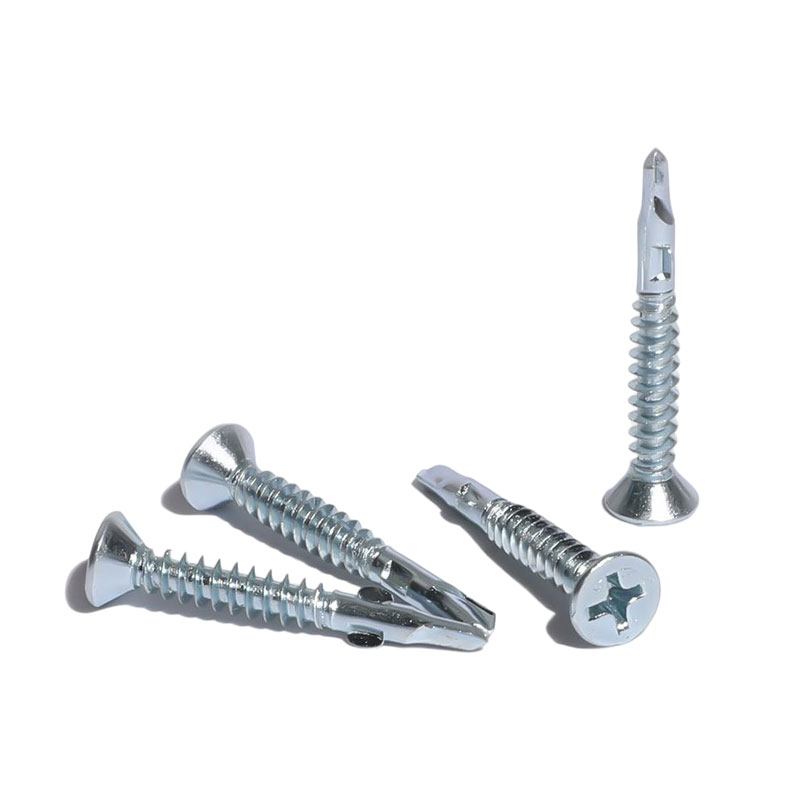 Zinc-Plated Phillips Countersunk Self-Drilling Screws with WingsWinged countersunk self-drilling screws in zinc plating, C1022A grade; production range covers #6-3.5 to #14-6.3, ASTM/DIN standards, and multiple head, recess, and thread options.View Product →
Failure Modes to Write Into the Specification
- Spun drill point. The point cannot cut the total thickness, so it heats up, dulls, and stops advancing.
- Snapped shank. Usually a heat-treatment issue: a case that is too deep and brittle, or a screw driven into an undersized hole.
- Stripped drive recess. Cam-out from a worn bit, an undersized recess, or excessive torque from an impact driver.
- Compressed washer. An EPDM washer crushed past its limit will leak long before the coating fails.
- Stripped thread in thin sheet. Too few engaged threads, or a hole that has grown beyond the tolerance window.
- Joint corrosion. Coating damaged during installation, or dissimilar metals in direct contact.
Each of these becomes a callback, a replacement shipment, or a charge-back. Naming them in the specification is cheaper than discovering them on a roof in November.
Coatings and Corrosion: A Small Line Item With a Long Tail
Zinc electroplating is the default for interior and general exterior work, typically in the 5 to 12 micron range. It is inexpensive and uniform, but it will not survive years of salt exposure. Black and grey phosphate finishes are common on drywall screws, where driver grip and indoor appearance matter more than corrosion resistance.
For exterior cladding, roofing, and coastal projects, the specification moves to zinc-flake or ceramic-type coatings, which can deliver several hundred to over a thousand hours of salt-spray resistance depending on coating weight. Concrete screws and anchors in wet or treated timber environments usually call for a high-build zinc-flake coating. Stainless steel — A2 for general exterior, A4 for chloride-heavy sites — is the fallback when coatings are not enough. It brings one rule of its own: do not place stainless screws against aluminum or copper without an isolating washer, or the joint becomes a galvanic cell.
What to Put on the Purchase Order
A supplier can only quote accurately against a complete description. These are the fields that should appear on any fastener line item:
- Point number or point style (Tek #2, #3, or sharp point)
- Head type and drive recess
- Thread form, pitch, and thread length
- Diameter and length, with tolerance
- Material, core hardness, and case depth
- Coating type, thickness, or salt-spray target
- Standard reference, such as DIN 7504, DIN 7981, DIN 7982, or ASME B18.6.4
- Packaging, labeling, and pallet configuration
- Sampling and inspection requirements before shipment
Where the standard and the drawing disagree, the drawing wins — and that should be written into the order, not assumed.
Frequently Asked Questions
Q1: Can I use a self-drilling screw where a self-tapping screw was specified?
Usually yes, if the material is metal and the combined thickness falls within the drill point capacity. The reverse is not true: a sharp-point tapping screw will not create its own hole in steel.
Q2: Do self-tapping screws always need pilot holes?
In metal, yes. In plastics and wood, it depends. Hardwoods and brittle plastics split or craze without a pilot hole, while soft materials often accept the screw directly.
Q3: What does "Tek screw" mean?
Tek is a widely used trade term for a self-drilling screw with a drill point. It describes the point style rather than a separate product standard.
Q4: How do I select a point number?
Start with total thickness. Common ratings run from about 1.6 mm for a #1 point, 3.2 mm for #2, 4.8 mm for #3, 6.4 mm for #4, and up to roughly 12.7 mm for #5. Always confirm the supplier's rating for the specific diameter you are buying.
Q5: Are self-drilling screws stronger than self-tapping screws?
Not inherently. Load capacity comes from diameter, material, and heat treatment. A self-drilling screw is case-hardened at the point so it can drill; the body strength of the two types is comparable when they share the same grade and diameter.
The choice rarely comes down to price per thousand pieces. It comes down to whether the crew drills first, and how many holes they have to make. Match the point to the substrate, check the total thickness against the point length, set the driver torque, and confirm the coating for the environment — in that order.
Our factory has been producing fasteners since 2007 for importers, wholesalers, and distributors, with export experience across markets that use different standards. If you are comparing options for a specific project, our self-drilling screw range covers point numbers, head styles, washers, and coating systems for metal-to-metal and wood-to-steel work, with packaging and documentation prepared for bulk export.